Within Sound Reports
Why Can the Same UFO Sound Get Different Descriptions?
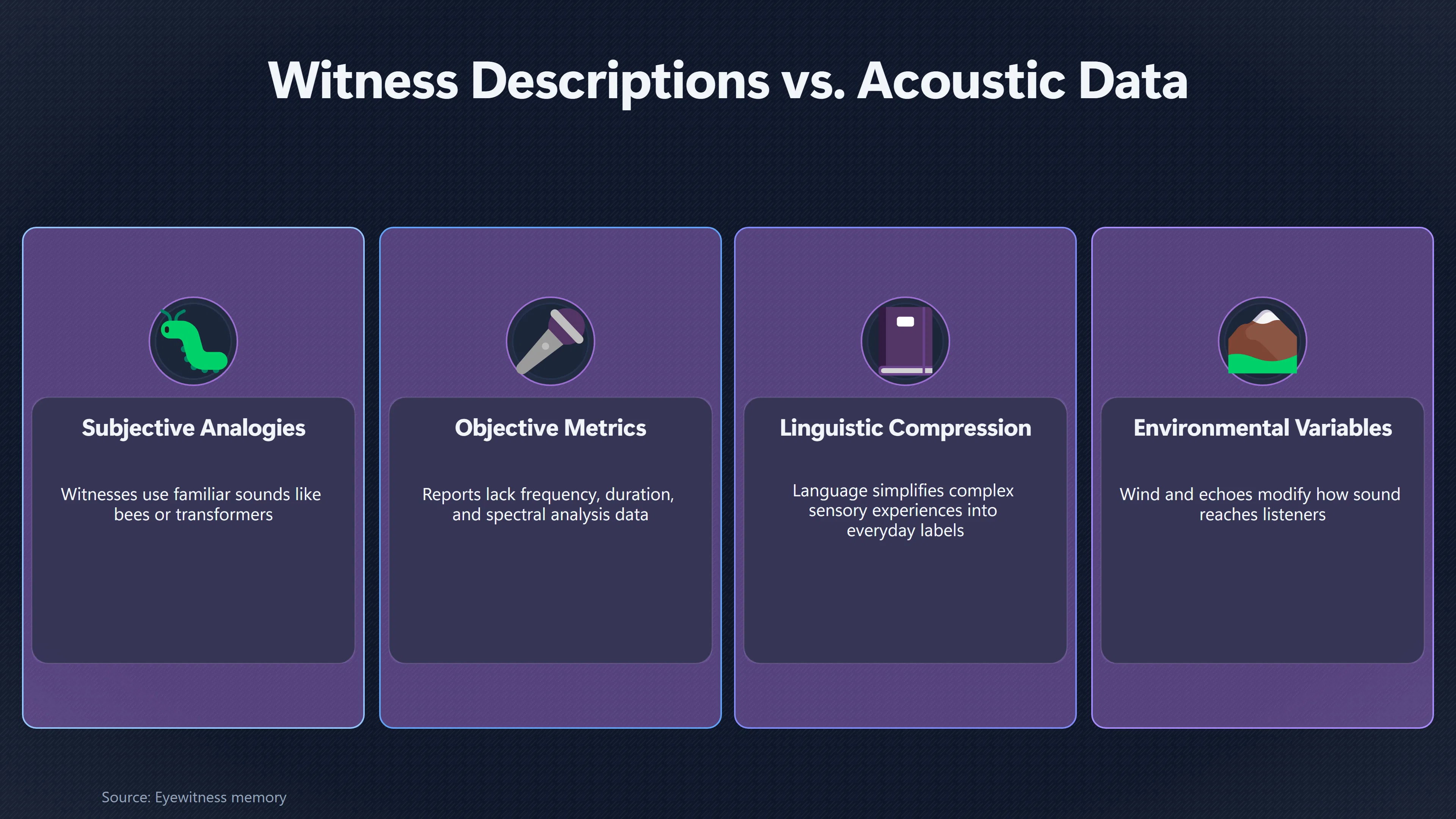
People translate unfamiliar sounds into familiar comparisons such as bees, transformers, turbines or electricity, creating wide variation in reports.
On this page
- Everyday comparisons used by witnesses
- How memory and expectation shape wording
- Limits of reports without acoustic measurements
Page outline Jump by section
Introduction
People who report unusual UFO sounds often seem to disagree about what they heard, even when describing what may have been the same kind of event. One witness might recall a sound “like bees”, another “like a transformer”, and another “like an electric motor”. This variation does not necessarily mean they heard completely different noises. Instead, it reflects how people describe unfamiliar sounds using familiar experiences, how memory reconstructs unusual events, and the fact that almost no reports include objective acoustic measurements.
Within historical UFO case collections, investigators have long noted that witnesses rely on analogies rather than technical descriptions. That makes sound reports valuable as personal observations, but less reliable as precise evidence for identifying a distinctive “UFO noise”. The wording often reveals as much about human perception and language as it does about the sound itself.[BUFORA]bufora.org.ukBUFORAINVESTIGATIONS | BUFORABUFORAINVESTIGATIONS | BUFORA
Why unfamiliar sounds become familiar comparisons
Humans rarely describe a sound by its exact frequency, pitch or acoustic spectrum. Instead, they compare it with something they already know. This is a normal feature of perception rather than something unique to UFO reports.
When witnesses encounter an unfamiliar noise, they often reach for comparisons such as:
- Bees or insects, to convey a steady buzzing.
- An electrical transformer, to suggest a low continuous hum.
- A turbine or jet engine, to indicate a rising mechanical whine.
- High-voltage electricity, to describe crackling or sizzling.
- A distant generator or industrial machinery, to communicate a persistent low-frequency vibration.
These comparisons are not technical measurements. They are metaphors intended to help another person imagine an unfamiliar sound. Two listeners could hear broadly similar acoustic characteristics yet choose different comparisons because their personal experiences differ. Someone familiar with industrial equipment may think of electrical substations, while another person with little exposure to heavy machinery may think instead of insects or household appliances.
Investigators from organisations such as BUFORA have repeatedly noted that witnesses often explain unusual experiences by translating them into familiar language rather than reporting measurable acoustic properties.[BUFORA]bufora.org.ukBUFORAINVESTIGATIONS | BUFORABUFORAINVESTIGATIONS | BUFORA
Vocabulary shapes what gets reported
A person’s background strongly influences the labels they choose.
For example:
- An engineer may describe a “50 Hz transformer hum”.
- A pilot may compare the same impression to an aircraft auxiliary power unit.
- Someone living in the countryside may think of bees or power lines.
- Another witness may simply report “a strange vibration” because no familiar comparison seems adequate.
This does not automatically imply different underlying sounds. It illustrates how language compresses complex sensory experiences into everyday references that other people are likely to understand.

How memory and expectation influence wording
Descriptions are also affected by how memory reconstructs unusual events.
Psychological research shows that memory is not a perfect recording. People actively reconstruct experiences using prior knowledge, expectations and existing mental categories. For unfamiliar sounds, listeners naturally fit what they heard into the closest pattern already stored in memory. Research on auditory expectation demonstrates that predictability and prior experience influence both how sounds are perceived and how well they are remembered.[PubMed]pubmed.ncbi.nlm.nih.govInformation-Theoretic Properties of Auditory Sequences Dynamically Influence Expectation and Memory - PubMedJanuary 25, 2017…
In eyewitness research, another relevant finding is the role of verbalisation. Translating an unusual sensory experience into words can subtly reshape later recall, because language often captures only selected features while omitting others. Studies of “verbal overshadowing” show that describing complex sensory experiences may alter subsequent memory rather than preserving it exactly. Although most research concerns faces and voices rather than unexplained aerial events, the underlying principle highlights why later descriptions should not be treated as exact acoustic records.[Wikipedia]WikipediaEyewitness memoryEyewitness memory
Expectation can also influence which aspects of a sound become most memorable. A witness who believes an object resembles advanced technology may focus on electrical qualities, while someone expecting conventional aircraft may remember engine-like characteristics. These influences affect wording without necessarily implying deliberate exaggeration or fabrication.
Why reports rarely agree in precise acoustic terms
Unlike scientific acoustic investigations, almost all UFO reports are based entirely on human hearing.
Witnesses seldom record:
- Frequency or frequency range.
- Sound pressure level (volume).[silicon-steels.com]silicon-steels.comMarch 27, 2026 — A COMPREHENSIVE GUIDE TO IDENTIFYING AND TROUBLESHOOTING TRANSFORMER FAULTS USING SOUND 27 Mar 2026 Reading Volume: In…
- Duration measured by a clock.
- Directional measurements.
- Spectral analysis.
- Changes over time.[pmc.ncbi.nlm.nih.gov]pmc.ncbi.nlm.nih.govSource details in endnotes.
Without these measurements, investigators cannot determine whether two reported humming sounds were objectively similar or only appeared similar after witnesses chose comparable words.
Environmental conditions further complicate interpretation. Wind, echoes from buildings or hillsides, background traffic, vegetation and atmospheric conditions all modify how sound reaches different listeners. Even people standing only a short distance apart may notice different elements of the same acoustic event.
For that reason, investigators generally treat reported sounds as supporting observations rather than diagnostic evidence. The absence of instrumental acoustic data means comparisons between cases remain largely qualitative rather than quantitative.[BUFORA]bufora.org.ukBUFORAINVESTIGATIONS | BUFORABUFORAINVESTIGATIONS | BUFORA
What this means for comparing UFO sound reports
The wide variety of sound descriptions does not necessarily indicate that witnesses experienced completely different phenomena. Nor does it demonstrate that a unique acoustic signature exists.
Instead, the historical record suggests three consistent patterns:
- Witnesses usually describe unfamiliar sounds by comparing them with familiar objects or technologies.
- Individual memory, vocabulary and expectations influence which comparison they choose.
- Without objective acoustic measurements, different verbal descriptions cannot reliably be interpreted as evidence of different underlying sounds.
This helps explain why one historical catalogue may contain references to humming, buzzing, turbines, electricity and bees without implying several distinct categories of UFO noise. Many descriptions may simply represent different linguistic attempts to communicate broadly similar auditory impressions.
Consequently, researchers examining reported UFO sounds generally place greater weight on patterns across many independent reports than on the exact wording used by any individual witness. The comparisons themselves remain informative, but they are best understood as human descriptions of unusual listening experiences rather than precise acoustic measurements.
Amazon book picks
Further Reading
Books and field guides related to Why Can the Same UFO Sound Get Different Descriptions?. Use these as the next step if you want deeper reading beyond the article.
The UFO Handbook: A Guide to Investigating, Evaluating, and R...
An explanation of the usual reasons for confusing IFOs (identified flying objects) with UFOs and a survey of the tools used to investigat...
The Invisible Gorilla: How Our Intuitions Deceive Us
NEW YORK TIMES BESTSELLER • Our minds don’t work the way we think they do. Two renowned psychologists explain how and why our intuitions...
The Seven Sins of Memory: How the Mind Forgets and Remembers
Rating: 3.5/5 from 5 Google Books ratings
A New York Times Notable Book: A psychologist's "gripping and thought-provoking" look at how and why our brains sometimes fail us (Steven...
Why You Hear What You Hear: An Experiential Approach to Sound...
First published 2012.
eBay marketplace picks
Marketplace Samples
Live-tested eBay searches with available results related to this page.
Selected fromUFO art print oneBay.co.uk.




Endnotes
1.
Source: bufora.org.uk
Link:https://bufora.org.uk/documents/BUFORAjournalVolume1No.1Summer1964.pdf
Source snippet
Vol. lNo. ISUMMER 1964...
2.
Source: Wikipedia
Title: Eyewitness memory
Link:https://en.wikipedia.org/wiki/Eyewitness_memory
3.
Source: Wikipedia
Title: Verbal overshadowing
Link:https://en.wikipedia.org/wiki/Verbal_overshadowing
4.
Source: bufora.org.uk
Title: BUFORAINVESTIGATIONS | BUFORA
Link:https://www.bufora.org.uk/investigations
5.
Source: bufora.org.uk
Title: BUFORARESEARCH | BUFORA
Link:https://www.bufora.org.uk/research
6.
Source: pubmed.ncbi.nlm.nih.gov
Link:https://pubmed.ncbi.nlm.nih.gov/28121017/
Source snippet
Information-Theoretic Properties of Auditory Sequences Dynamically Influence Expectation and Memory - PubMedJanuary 25, 2017...
Published: January 25, 2017
7.
Source: pubmed.ncbi.nlm.nih.gov
Link:https://pubmed.ncbi.nlm.nih.gov/11762864/
Source snippet
Earwitness testimony: effects of exposure and attention on the face overshadowing effect - PubMed...
8.
Source: pmc.ncbi.nlm.nih.gov
Link:https://pmc.ncbi.nlm.nih.gov/articles/PMC12006449/
9.
Source: pmc.ncbi.nlm.nih.gov
Link:https://pmc.ncbi.nlm.nih.gov/articles/PMC11588100/
10.
Source: bufora.org.uk
Title: investigating ufology 2018
Link:https://www.bufora.org.uk/post/investigating-ufology-2018
11.
Source: pmc.ncbi.nlm.nih.gov
Link:https://pmc.ncbi.nlm.nih.gov/articles/PMC5125666/
12.
Source: pmc.ncbi.nlm.nih.gov
Link:https://pmc.ncbi.nlm.nih.gov/articles/PMC2667065/
13.
Source: bufora.org.uk
Link:https://www.bufora.org.uk/about
14.
Source: bufora.org.uk
Link:https://www.bufora.org.uk/bufora-publications/bufora-research-bulletins-reports
15.
Source: bufora.org.uk
Title: HOM E | BUFORA
Link:https://www.bufora.org.uk/
16.
Source: bufora.org.uk
Link:https://www.bufora.org.uk/blog
17.
Source: bufora.org.uk
Link:https://www.bufora.org.uk/bufora-publications
18.
Source: bufora.org.uk
Title: ARTICLE S | BUFORABUFORA ARTICLES Calvine Revisited
Link:https://www.bufora.org.uk/articles
19.
Source: pubmed.ncbi.nlm.nih.gov
Link:https://pubmed.ncbi.nlm.nih.gov/9042739/
20.
Source: criminal-justice.iresearchnet.com
Title: verbal overshadowing
Link:https://criminal-justice.iresearchnet.com/forensic-psychology/eyewitness-memory/verbal-overshadowing/
Additional References
21.
Source: transformergrid.com
Link:https://transformergrid.com/technical-library/transformer-sound-vibration-engineering-guide/
Source snippet
Transformer Sound and Vibration Engineering Guide | TransformerGridJuly 22, 2026 — Technical reference prepared by TransformerGrid’s engi...
Published: July 22, 2026
22.
Source: silicon-steels.com
Link:https://www.silicon-steels.com/blog/industry-knowledge/transformer-noise-diagnosis-guide.html
Source snippet
March 27, 2026 — A COMPREHENSIVE GUIDE TO IDENTIFYING AND TROUBLESHOOTING TRANSFORMER FAULTS USING SOUND 27 Mar 2026 Reading Volume: In...
Published: March 27, 2026
23.
Source: nature.com
Link:https://www.nature.com/articles/s44159-024-00287-z
24.
Source: ora.ox.ac.uk
Link:https://ora.ox.ac.uk/objects/uuid%3Ad0bc067a-af78-4537-b4e0-66f50f501074
Source snippet
influence of expectation and experience on auditory perception - ORA - Oxford University Research ArchiveFebruary 25, 2026 — Image: Thesi...
Published: February 25, 2026
25.
Source: youtube.com
Title: These Illusions Fool Almost Everyone
Link:https://www.youtube.com/watch?v=Sn07AMCfaAI
Source snippet
Audio-Visual Illusion in Speech Perception: McGurk Effect | Psychology 101...
26.
Source: sciencedirect.com
Link:https://www.sciencedirect.com/science/article/abs/pii/S1388245709002004
27.
Source: frontiersin.org
Link:https://www.frontiersin.org/journals/psychology/articles/10.3389/fpsyg.2013.00789/full
28.
Source: cambridge.org
Link:https://www.cambridge.org/core/journals/organised-sound/article/abs/memory-expectation-and-the-temporal-flux-of-acousmatic-music/D885FF321A27EB78C8775EAE7D06E3D8
29.
Source: vlex.co.uk
Link:https://vlex.co.uk/vid/the-impact-of-irrelevant-846731191
30.
Source: nicap.org
Link:https://www.nicap.org/ufology/ufochap4.htm