Within Aircraft Noise
How Weather Makes Aircraft Sound Close and Misplaced
Wind and temperature layers can redirect aircraft noise, making distant flights sound closer or come from the wrong direction.
On this page
- How wind shifts apparent sound direction
- Why temperature inversions carry noise farther
- Terrain and cloud reflections that confuse listeners
Page outline Jump by section
Introduction
Many reports of mysterious whining, roaring or humming overhead that are later linked to aircraft share one important feature: the atmosphere between the aircraft and the listener was not acoustically neutral. Wind, temperature layers and local terrain can bend, redirect and reinforce sound waves, making an ordinary aircraft seem much closer than it is or making the noise appear to come from the wrong part of the sky. These effects are especially noticeable at night, during calm weather following sunset, or beneath low cloud, when visual cues are weak and atmospheric conditions often favour long-distance sound propagation. Rather than indicating an unusual flying object, these acoustic distortions are well understood in aviation noise research and atmospheric acoustics.[PubMed]pubmed.ncbi.nlm.nih.govToward inclusion of atmospheric effects in the aircraft community noise predictions - PubMed…
How wind shifts apparent sound direction
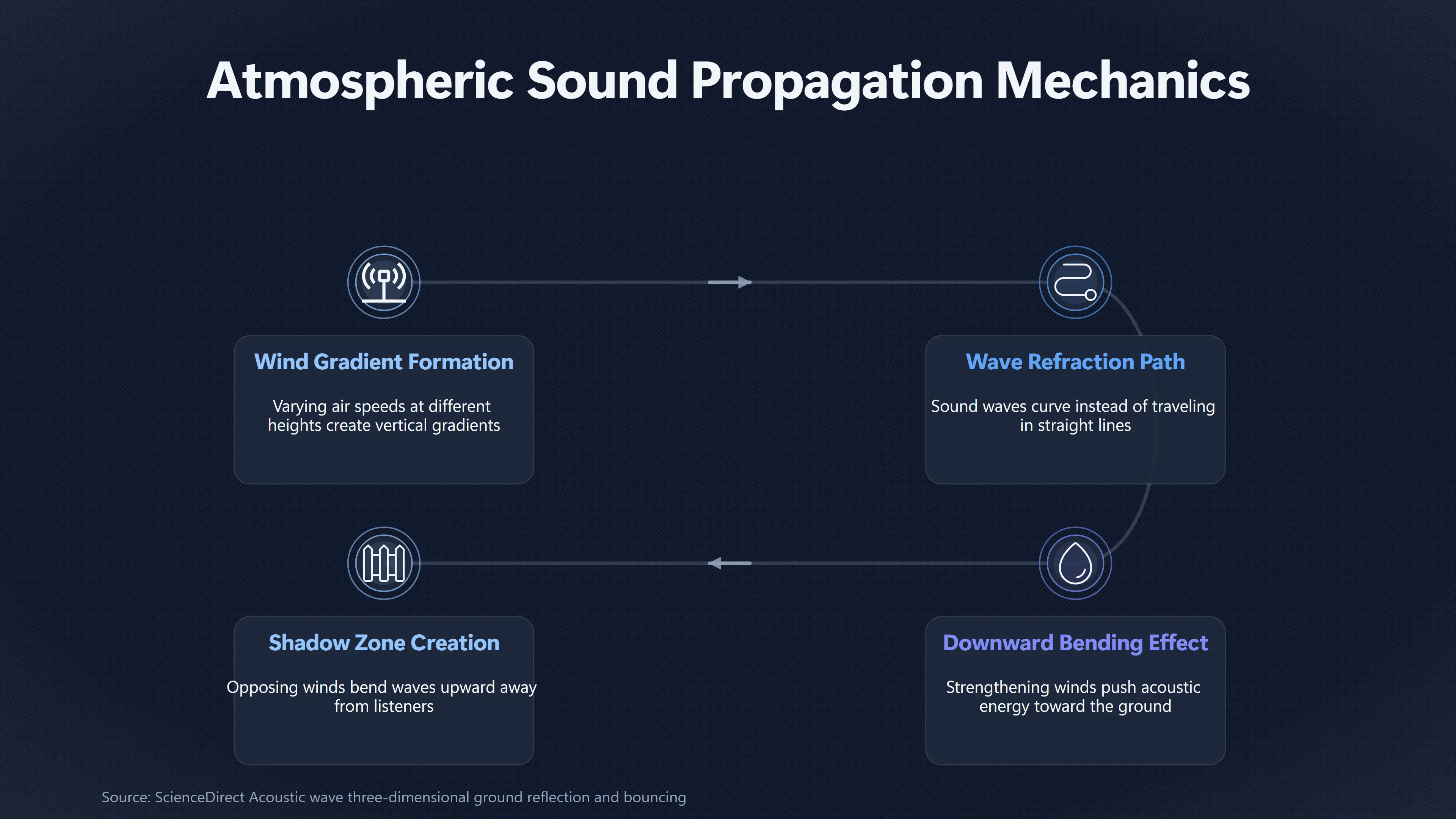
Sound does not travel through still air in the real atmosphere. Winds usually change speed and direction with height, creating a vertical wind gradient that alters the path of sound waves. Instead of travelling in straight lines, sound can be refracted, meaning it curves as it moves through layers of moving air.
When the wind strengthens with altitude in the direction from the aircraft towards the listener, sound waves tend to bend downward. This keeps more acoustic energy close to the ground, allowing aircraft to be heard at greater distances than expected. Conversely, when sound travels against increasing winds, the waves bend upward, creating “shadow zones” where an aircraft may seem surprisingly quiet despite being nearby. Modern aircraft noise prediction models explicitly include these atmospheric effects because they can alter ground-level noise patterns by several decibels.[PubMed]pubmed.ncbi.nlm.nih.govToward inclusion of atmospheric effects in the aircraft community noise predictions - PubMed…
For someone trying to identify an unfamiliar overhead sound, this bending creates several perceptual traps:
- the aircraft may already have moved well beyond the point where the sound appears to originate;
- the loudest sound may arrive from one side rather than directly beneath the aircraft;
- changes in loudness can resemble a manoeuvring object rather than a steadily flying aircraft.
These effects become more confusing because observers naturally expect sound to travel in straight lines, even though the atmosphere often prevents that.
Why temperature inversions carry noise farther
One of the most important weather conditions affecting aircraft sound is a temperature inversion. Under normal daytime conditions, air becomes cooler with increasing height. During an inversion, typically after clear, calm nights, the opposite occurs for a layer of the atmosphere: warmer air sits above cooler surface air.
Because the speed of sound varies with temperature, this structure bends sound waves back towards the ground instead of allowing them to spread upward. The result is that aircraft noise can remain concentrated over much longer distances, making flights many kilometres away seem unexpectedly loud. This is one reason communities around airports often report that aircraft sound travels farther during the early morning or overnight hours.[sciencedirect.com]sciencedirect.comMeteorological and ground effects on the propagation of aircraft noise close to the Earth's surface - ScienceDirectSeptember…
Importantly, a temperature inversion does not make aircraft louder at the source. Instead, it changes how efficiently the atmosphere transports their sound to the listener. Someone unfamiliar with the effect may conclude that an unusually low aircraft has passed overhead when the aircraft is actually following a routine flight path at normal altitude.
Historical research into airport acoustics has shown that unusually low sound attenuation at long distances is often explained by a combination of atmospheric refraction and interactions with the ground rather than by any increase in aircraft engine output.[ScienceDirect]sciencedirect.comMeteorological and ground effects on the propagation of aircraft noise close to the Earth's surface - ScienceDirectSeptember…
Terrain and cloud reflections that confuse listeners
Weather is only part of the story. The landscape itself can further distort where aircraft seem to be.
Hillsides, cliffs, large buildings and even extensive urban environments can reflect or diffract sound, creating delayed echoes or multiple arrival paths. A listener may therefore hear one aircraft as though several independent sound sources exist overhead. Modern aviation noise models devote significant attention to predicting these terrain effects because they materially change perceived noise around airports.[DOI.org]doi.orgOpen source on doi.org.
Low cloud often receives credit for “reflecting” aircraft noise back to the ground. In practice, the situation is more subtle. Clouds themselves are generally much less effective reflectors than popular belief suggests. Instead, the stable atmospheric conditions commonly associated with low cloud or overcast weather often reduce atmospheric mixing and coincide with wind and temperature profiles that favour downward refraction. Listeners therefore correctly notice louder aircraft under these conditions, but the primary cause is usually the atmosphere as a whole rather than the cloud layer acting as a giant acoustic mirror.[PubMed]pubmed.ncbi.nlm.nih.govToward inclusion of atmospheric effects in the aircraft community noise predictions - PubMed…
Why these conditions produce convincing “UFO noises”
Within the broader context of reports of unexplained aerial sounds, weather-driven sound propagation explains several recurring witness descriptions without requiring an unusual airborne source.
Common observations include:
- A distant aircraft sounding directly overhead. Downward refraction concentrates sound near the surface, making remote traffic appear surprisingly close.
- Noise arriving from the wrong direction. Curved sound paths and reflections disconnect the apparent sound source from the aircraft’s true position.
- Aircraft heard before they are seen—or after they appear to have passed. Because aircraft move much faster than sound, atmospheric bending can exaggerate the normal delay between visual and acoustic cues.
- Exceptionally loud nights followed by ordinary mornings. Small changes in wind profile or the breakdown of an overnight temperature inversion can dramatically change how aircraft are heard without any change in flight operations.[nih.gov]pubmed.ncbi.nlm.nih.govToward inclusion of atmospheric effects in the aircraft community noise predictions - PubMed…
These effects are strongest when visual information is poor. Darkness, haze or broken cloud removes the visual reference points that would normally allow observers to associate the sound with an identifiable aircraft, increasing the likelihood that an ordinary flight is perceived as an unidentified aerial phenomenon.
What weather can—and cannot—explain
Atmospheric acoustics provides a robust explanation for many reports of misplaced, unusually loud or oddly directed aircraft sounds. Wind gradients, temperature inversions and interactions with terrain are established physical mechanisms that are routinely incorporated into aviation noise modelling because they measurably alter where and how strongly aircraft are heard on the ground.[nih.gov]pubmed.ncbi.nlm.nih.govToward inclusion of atmospheric effects in the aircraft community noise predictions - PubMed…
However, these mechanisms do not create new sounds or transform an aircraft into something fundamentally different. They alter the path, timing and apparent location of existing aircraft noise. In investigations of alleged “UFO noises”, recognising these weather-dependent acoustic effects helps distinguish genuine atmospheric illusions from claims that require other explanations, reducing the risk of mistaking ordinary aviation under unusual propagation conditions for evidence of an unidentified object.
Amazon book picks
Further Reading
Books and field guides related to How Weather Makes Aircraft Sound Close and Misplaced. Use these as the next step if you want deeper reading beyond the article.
The Sound Book
A professor of acoustic engineering provides a tour of the world's most amazing sound phenomena, including creaking glaciers, whispering...
Master Handbook of Acoustics
The goal of this book is to apply the principles of acoustics to the audio arts. This involves serving as an interpreter of major trends...
Atmospheric Science
Atmospheric Science, Second Edition, is the long-awaited update of the classic atmospheric science text, which helped define the field ne...
Meteorology Today
METEOROLOGY TODAY has for many years been one of the most widely used and authoritative texts for the introductory meteorology course. Ea...
eBay marketplace picks
Marketplace Samples
Live-tested eBay searches with available results related to this page.
Selected fromaircraft model oneBay.co.uk.

Endnotes
1.
Source: sciencedirect.com
Link:https://www.sciencedirect.com/science/article/pii/S0022460X78800339
Source snippet
Meteorological and ground effects on the propagation of aircraft noise close to the Earth's surface - ScienceDirectSeptember...
2.
Source: doi.org
Link:https://doi.org/10.17226/26897
3.
Source: sciencedirect.com
Title: ScienceDirect Acoustic wave three-dimensional ground reflection and bouncing
Link:https://www.sciencedirect.com/science/article/pii/S0003682X21002036
Source snippet
Acoustic wave three-dimensional ground reflection and bouncing - ScienceDirect...
4.
Source: sciencedirect.com
Link:https://www.sciencedirect.com/science/article/pii/S0003682X25006590
Source snippet
March 1, 2026 — APPLIED ACOUSTICS Date: 1 March 2026 Article: 111187 Volume: Volume 245 PART OF SPECIAL ISSUE AIRCRAFT NOISE...
Published: March 1, 2026
5.
Source: sciencedirect.com
Link:https://www.sciencedirect.com/science/article/abs/pii/S0022460X78800339
6.
Source: sciencedirect.com
Title: Impact of buildings, forests and cliffs on aircraft noise mapping: Case study
Link:https://www.sciencedirect.com/science/article/pii/S1361920924002360
7.
Source: forecast.weather.gov
Link:https://forecast.weather.gov/glossary.php?word=s
8.
Source: forecast.weather.gov
Link:https://forecast.weather.gov/glossary.php?word=T
9.
Source: weather.gov
Title: NW S Jet Stream
Link:https://www.weather.gov/source/zhu/ZHU_Training_Page/lightning_stuff/lightning2/thunder.html
10.
Source: forecast.weather.gov
Link:https://forecast.weather.gov/glossary.php?word=INVERSION
11.
Source: forecast.weather.gov
Link:https://forecast.weather.gov/glossary.php?letter=t
12.
Source: pubmed.ncbi.nlm.nih.gov
Link:https://pubmed.ncbi.nlm.nih.gov/34470331/
Source snippet
Toward inclusion of atmospheric effects in the aircraft community noise predictions - PubMed...
13.
Source: faa.gov
Title: Federal Aviation Administration Aircraft Noise | Federal Aviation Administration
Link:https://www.faa.gov/noise/aircraft_noise
Source snippet
Aircraft Noise | Federal Aviation AdministrationJanuary 31, 2025 — AIRCRAFT NOISE Who to contact about noise complaints TOPICS ON THIS PA...
Published: January 31, 2025
Additional References
14.
Source: youtube.com
Title: Why Crowded Shows Sound Dull
Link:https://www.youtube.com/watch?v=_lB8e9OY0-U
Source snippet
This selection of videos explains atmospheric refraction, temperature inversions, and wind gradients to show how environmental conditions...
15.
Source: faa.gov
Link:https://www.faa.gov/noise/aviation_noise/community_response
Source snippet
Community Response to Noise | Federal Aviation AdministrationJuly 22, 2022 — COMMUNITY RESPONSE TO NOISE * Introduction * Using the day-n...
Published: July 22, 2022
16.
Source: youtube.com
Title: Noise Pollution L-7: Outdoor Sound Propagation | Environmental Science
Link:https://www.youtube.com/watch?v=PV8dF4ceNyc
Source snippet
Why Crowded Shows Sound Dull - Impact of Heat on Live Sound Coverage...
17.
Source: ready.noaa.gov
Link:https://www.ready.noaa.gov/READYthetahelp.php
Source snippet
Tools - Potential temperature versus height chartsMay 12, 2025 — STABILITY PLOT ABBREVIATIONS Image: READY logo HOW TO INTERPRET POTENTIA...
Published: May 12, 2025
18.
Source: faa.gov
Link:https://www.faa.gov/faq/what-dnl-and-why-does-faa-use-it
19.
Source: youtube.com
Title: Refraction of Sound: How Sound Waves Bend Through Different Media
Link:https://www.youtube.com/watch?v=4_B_pTxlQvE
Source snippet
ACOUSTICS: Refraction and Temperature Inversion...
20.
Source: researchgate.net
Link:https://www.researchgate.net/publication/359030468_On_the_effects_of_rough_ground_and_atmospheric_absorption_on_aircraft_noise
21.
Source: sxjs.ac.cn
Link:https://www.sxjs.ac.cn/en/article/doi/10.16300/j.%20cnki.1000-3630.2023.03.012
22.
Source: research.tudelft.nl
Link:https://research.tudelft.nl/en/publications/toward-inclusion-of-atmospheric-effects-in-the-aircraft-community/
23.
Source: faa.gov
Title: Fundamentals of Noise and Sound | Federal Aviation Administration
Link:https://www.faa.gov/noise/aviation_noise/fundamentals_of_noise