Within Myths
Why Clear UFO Audio Can Still Mislead
Even clear audio may not reveal a source's distance, direction or connection to a visible object without synchronized supporting data.
On this page
- What recordings capture and what they omit
- Distance, direction and source ambiguity
- How synchronization changes evidential value
Page outline Jump by section
Introduction
A clear audio recording of an alleged UFO event is often more valuable than a witness’s memory because it preserves the sound for repeated analysis. Even so, the recording rarely identifies what produced the sound on its own. A microphone captures changes in air pressure at one location, not a complete three-dimensional picture of the event. Without accurate timing, location data, multiple recording points or synchronised visual evidence, investigators usually cannot determine whether the sound came from the visible object, from something outside the camera’s view, or from an entirely unrelated source. Modern UAP research therefore treats audio as one piece of a broader evidence set rather than as a standalone identifier.[PubMed Central (PMC)]pmc.ncbi.nlm.nih.govPub Med Central (PMC)Auditory localization: a comprehensive practical reviewPubMed Central (PMC)Auditory localization: a comprehensive practical review - PMCJuly 10, 2024…
What a recording captures – and what it leaves out
An audio recording faithfully stores the signal that reached a microphone, but it does not automatically preserve the context needed to interpret that signal.
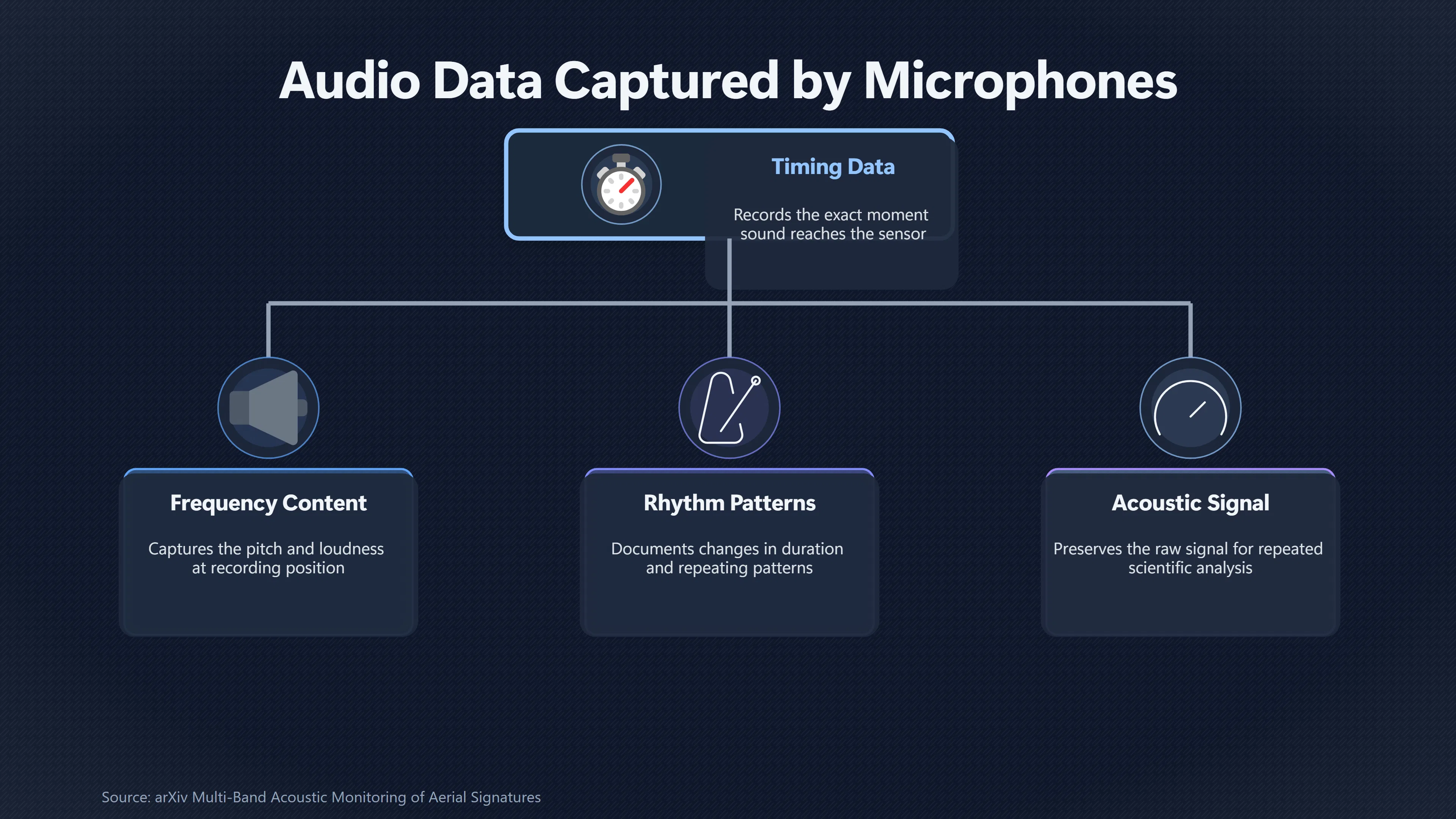
A single recording typically documents:
- The timing of the sound reaching the microphone.
- Its frequency content and loudness at the recording position.
- Changes in pitch, rhythm or duration that may later be analysed.
However, it usually does not reveal:
- The exact location of the source.
- The true loudness at the source.
- Whether the sound originated from the visible object or another nearby source.
- Whether reflections from buildings, terrain or clouds altered the sound before it reached the microphone.
This distinction is important because the microphone records only what arrives at one point in space after the sound has travelled through the environment. The recording is therefore evidence of an acoustic event, not automatically evidence of the object’s identity.[PubMed Central (PMC)]pmc.ncbi.nlm.nih.govPub Med Central (PMC)Auditory localization: a comprehensive practical reviewPubMed Central (PMC)Auditory localization: a comprehensive practical review - PMCJuly 10, 2024…
Distance, direction and source ambiguity
People often assume that an unusual sound in a recording must have come from the object visible in the video. In reality, determining a sound’s origin from a single recording is surprisingly difficult.
Human listeners estimate direction using tiny timing and loudness differences between both ears. A single microphone lacks those binaural cues, making localisation much less reliable than ordinary hearing. Even people using both ears regularly make front-versus-back mistakes or misjudge distance when echoes, background noise or unfamiliar sounds are involved.[PubMed Central (PMC)]pmc.ncbi.nlm.nih.govPubMed Central (PMC)An Overview of the Major Phenomena of the Localization of Sound Sources by Normal-Hearing, Hearing-Impaired, and Aide…
Distance is even more uncertain. A quiet nearby source and a loud distant source may produce nearly identical recordings because the microphone cannot know how powerful the original sound was. Wind, humidity, terrain and atmospheric conditions can further alter how sound travels before it is recorded.[PubMed]pubmed.ncbi.nlm.nih.govAuditory distance perception in humans: a review of cues, development, neuronal bases, and effects of sensory loss - PubMed…
As a result, an apparently dramatic hum, buzz or roar may have originated from:
- an aircraft outside the camera’s field of view;
- industrial equipment;
- road traffic reflected by surrounding terrain;
- a drone;
- an unrelated environmental source.
The recording alone often cannot distinguish between these possibilities.
Why matching sound to a visible object is difficult
Even when a video appears to show an unidentified object while unusual audio is heard, coincidence remains a genuine possibility.
A camera’s field of view is narrow compared with the surrounding environment. A microphone, by contrast, records sound arriving from many directions simultaneously. An aircraft behind the camera, a helicopter several kilometres away or machinery outside the frame may all contribute to the recorded soundtrack.
Another complication is timing. Light reaches the camera almost instantly over ordinary viewing distances, whereas sound travels through air at roughly 343 metres per second under typical conditions. If an object is distant, the sound associated with it should arrive noticeably later than the image. Without careful synchronisation and accurate distance estimates, investigators cannot simply assume that the recorded sound belongs to the object shown on screen.[PubMed Central (PMC)]pmc.ncbi.nlm.nih.govPub Med Central (PMC)Auditory localization: a comprehensive practical reviewPubMed Central (PMC)Auditory localization: a comprehensive practical review - PMCJuly 10, 2024…
How synchronisation changes evidential value
The value of an audio recording increases dramatically when it is synchronised with independent measurements.
Modern proposals for scientific UAP observation therefore combine microphones with multiple other sensors rather than relying on audio alone. These systems are designed so that every measurement shares accurate timing, allowing investigators to compare whether different instruments detected the same event simultaneously.[arXiv]arxiv.orgOpen source on arxiv.org.
A much stronger case can be built when investigators have:
- precisely timestamped audio;
- calibrated video from more than one viewpoint;
- known microphone locations;
- environmental measurements such as wind and weather;
- radar or radio-frequency observations;
- aircraft tracking information.
When these independent records agree, competing explanations can be tested rather than assumed. Conversely, if the sound fails to match the timing or location implied by other sensors, it may indicate that the audio originated elsewhere rather than from the observed object.[arXiv]arxiv.orgOpen source on arxiv.org.
What investigators can still learn from audio
Although audio rarely identifies an unknown object by itself, it remains scientifically useful.
Spectral analysis can reveal whether a recording resembles known sources such as propellers, jet engines or electrical equipment. Investigators may also examine background characteristics, repeated frequency bands and transient sounds to determine whether the recording is internally consistent or has likely been edited.
However, these analyses usually answer narrower questions than many people expect. They may show that a recording is authentic, that it contains identifiable environmental sounds or that it resembles a particular class of machinery. They generally cannot demonstrate that an unidentified aerial object was extraordinary simply because the sound is unusual.[arXiv]arxiv.orgarXiv Multi-Band Acoustic Monitoring of Aerial SignaturesarXiv Multi-Band Acoustic Monitoring of Aerial Signatures
The key limitation
A recording preserves sound more accurately than human memory, but preservation is not the same as identification. Without reliable information about where the microphone was, where the sound originated, how the environment affected transmission and whether other sensors observed the same event, even a remarkably clear recording may prove very little about the source itself.
For that reason, the strongest investigations treat audio as corroborating evidence rather than decisive proof. A mysterious recording may document that an unusual sound occurred, yet still leave unanswered the central question: what actually produced it?[arXiv]arxiv.orgOpen source on arxiv.org.

Amazon book picks
Further Reading
Books and field guides related to Why Clear UFO Audio Can Still Mislead. Use these as the next step if you want deeper reading beyond the article.
The Demon-Haunted World
Rating: 4.5/5 from 43 Google Books ratings
NEW YORK TIMES BESTSELLER • From the renowned astronomer and author of Cosmos comes a “powerful [and] stirring defense of informed ration...
Modern Recording Techniques
Expanded to include the latest digital audio technology, the 7th edition now includes sections on podcasting, new surround sound formats...
The Sound Effects Bible
Introduction - What is a sound effect? - The science of sound - The microphone - Mocrophone models and applications - Microphone accessor...
The Audio Expert
The Audio Expert is a comprehensive reference book covering all aspects of audio, with both practical and theoretical explanations. It is...
eBay marketplace picks
Marketplace Samples
Live-tested eBay searches with available results related to this page.
Selected fromRoswell UFO poster oneBay.co.uk.



Endnotes
1.
Source: arxiv.org
Link:https://arxiv.org/abs/2305.18566
2.
Source: arxiv.org
Title: arXiv Multi-Band Acoustic Monitoring of Aerial Signatures
Link:https://arxiv.org/abs/2305.18551
3.
Source: pmc.ncbi.nlm.nih.gov
Title: Pub Med Central (PMC)Auditory localization: a comprehensive practical review
Link:https://pmc.ncbi.nlm.nih.gov/articles/PMC11267622/
Source snippet
PubMed Central (PMC)Auditory localization: a comprehensive practical review - PMCJuly 10, 2024...
Published: July 10, 2024
4.
Source: pubmed.ncbi.nlm.nih.gov
Link:https://pubmed.ncbi.nlm.nih.gov/26590050/
Source snippet
Auditory distance [perception]({{ 'perception/' | relative_url }}) in humans: a review of cues, development, neuronal bases, and effects of sensory loss - PubMed...
5.
Source: pmc.ncbi.nlm.nih.gov
Link:https://pmc.ncbi.nlm.nih.gov/articles/PMC4271773/
Source snippet
PubMed Central (PMC)An Overview of the Major Phenomena of the Localization of Sound Sources by Normal-Hearing, Hearing-Impaired, and Aide...
6.
Source: pubmed.ncbi.nlm.nih.gov
Link:https://pubmed.ncbi.nlm.nih.gov/39049946/
7.
Source: pubmed.ncbi.nlm.nih.gov
Link:https://pubmed.ncbi.nlm.nih.gov/37430559/
8.
Source: pmc.ncbi.nlm.nih.gov
Link:https://pmc.ncbi.nlm.nih.gov/articles/PMC7381569/
9.
Source: pubmed.ncbi.nlm.nih.gov
Link:https://pubmed.ncbi.nlm.nih.gov/25492094/
10.
Source: pubmed.ncbi.nlm.nih.gov
Link:https://pubmed.ncbi.nlm.nih.gov/2018391/
Additional References
11.
Source: researchgate.net
Link:https://www.researchgate.net/publication/392981073_A_Wireless_Self-Calibrating_Ultrasound_Microphone_Array_with_Sub-Microsecond_Synchronization
Source snippet
June 24, 2025 — Preprint PDF Available A WIRELESS SELF-CALIBRATING ULTRASOUND MICROPHONE ARRAY WITH SUB-MICROSECOND SYNCHRONIZATION * Jun...
Published: June 24, 2025
12.
Source: sciencedirect.com
Link:https://www.sciencedirect.com/science/article/abs/pii/S1051200426002253
Source snippet
LOW RANK PROPERTIES FOR SYNCHRONIZING MICROPHONES AND SOURCES IN AD-HOC WIRELESS ACOUSTIC SE...
13.
Source: ojp.gov
Link:https://ojp.gov/library/publications/forensic-interpretation-and-processing-user-generated-audio-recordings
14.
Source: youtube.com
Title: Listening for UFOs
Link:https://www.youtube.com/watch?v=87POecVP-s4
Source snippet
Why UFO video evidence is not proof analysis Mick West DHS "Rubber Duck" UFO - Initial Analysis Mick West...
15.
Source: youtube.com
Title: Neil de Grasse Tyson: Unfiltered on UFOs & Whistleblower Grusch
Link:https://www.youtube.com/watch?v=HhWWlJFwTqs
Source snippet
Analyzing UFO Misinformation - An Intelligence Approach...
16.
Source: youtube.com
Title: Breakdown of the Pentagon UFO videos with Mick West
Link:https://www.youtube.com/watch?v=Le7Fqbsrrm8
Source snippet
Neil deGrasse Tyson: Unfiltered on UFOs & Whistleblower Grusch...
17.
Source: ojp.gov
Link:https://www.ojp.gov/library/publications/forensic-handling-user-generated-audio-recordings
18.
Source: sciencedirect.com
Link:https://www.sciencedirect.com/science/article/pii/S1051200426002253
Source snippet
"[https://doi.o..."](https://doi.o...")...
19.
Source: doi.org
Link:https://doi.org/10.1142/S2251171723400056
20.
Source: mdpi.com
Link:https://www.mdpi.com/1424-8220/23/10/4645