Within Sound Travel
Do Low Clouds Really Amplify Sky Sounds?
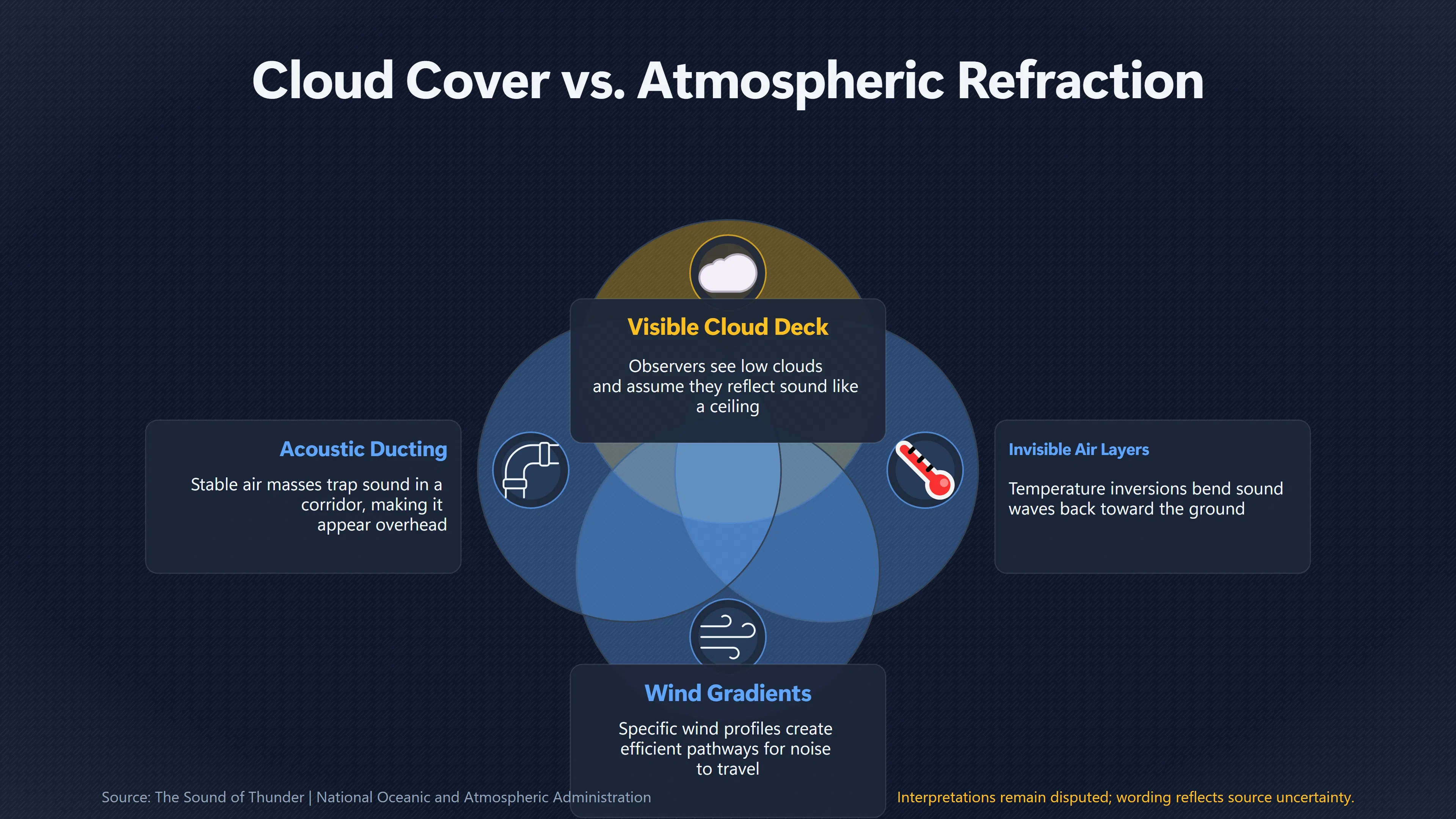
Low cloud may alter some higher frequencies, but temperature and wind structure usually explain long-range sky sounds far better.
On this page
- What clouds can and cannot do to audible sound
- Why inversions often occur beneath low cloud
- How to avoid mistaking correlation for the main cause
Page outline Jump by section
Introduction
Reports of mysterious “UFO noises” are often linked with low, grey cloud decks because witnesses notice unusual humming, roaring or droning on overcast nights. It is therefore tempting to assume that the clouds themselves are reflecting or amplifying sound. The evidence, however, points to a more subtle explanation. Low clouds can make a modest difference to how some sound frequencies behave, but the dominant factor is usually the structure of the atmosphere beneath the cloud base—particularly temperature inversions and wind gradients that bend sound back towards the ground. In many situations, the cloud layer is simply a visible sign that these favourable acoustic conditions already exist, leading observers to credit the cloud when the invisible air layers are doing most of the work.[metoffice.gov.uk]weather.metoffice.gov.ukMet Office What is a temperature inversion?Met OfficeWhat is a temperature inversion? - Met Office…
Do Low Clouds Really Amplify Sky Sounds?
The popular idea that a blanket of low cloud acts like the ceiling of a concert hall is only partly correct. Water droplets in clouds interact with sound, but for the audible frequencies associated with aircraft, traffic, industrial machinery and many reported “sky hums”, the effect is generally much weaker than commonly imagined.
Clouds are not solid surfaces. They consist of tiny droplets or ice crystals suspended in air, so they do not produce the strong mirror-like reflections that many people picture. Instead, they may scatter or slightly attenuate some higher-frequency sound while having comparatively little direct influence on lower frequencies that travel long distances most effectively.[Institute of Acoustics]ioa.org.ukInstitute of Acoustics Proceedings of the Institute of AcousticsInstitute of Acoustics Proceedings of the Institute of Acoustics
This distinction matters because many sounds described in UFO reports—deep rumbles, humming and distant engine-like drones—contain substantial low-frequency energy. Those frequencies are far more strongly affected by the temperature and wind profile of the atmosphere than by the presence of cloud droplets.
What Clouds Can and Cannot Do to Audible Sound
Low cloud is not acoustically irrelevant, but its role is limited.
Clouds can:
- slightly scatter or absorb some higher-frequency components;
- contribute to a generally damped acoustic environment under certain conditions;
- coincide with weather patterns that favour long-range sound transmission.
Clouds usually cannot:
- dramatically amplify sound by themselves;
- redirect sound over many kilometres without favourable atmospheric layering;
- explain why distant aircraft or industrial noise suddenly appears overhead.
Outdoor acoustics studies consistently show that atmospheric refraction caused by temperature and wind gradients dominates long-range sound propagation. Even where cloud cover is present, researchers typically model the air’s temperature profile and wind shear as the primary controls on how sound bends.[Institute of Acoustics]ioa.org.ukInstitute of Acoustics Proceedings of the Institute of AcousticsInstitute of Acoustics Proceedings of the Institute of Acoustics
This explains why two overcast days can sound completely different. One cloudy day may seem unusually quiet, while another carries motorway or airport noise for many kilometres, depending on the invisible structure of the air below the clouds.
Why Inversions Often Occur Beneath Low Cloud
The reason low cloud receives so much blame is that it frequently appears alongside temperature inversions.
A temperature inversion occurs when warmer air overlies cooler air near the surface. Instead of allowing sound to disperse upward, this structure bends sound waves back towards the ground. The result can be surprisingly loud and distant noises that appear to come from above rather than from their true source.[Met Office]weather.metoffice.gov.ukMet Office What is a temperature inversion?Met OfficeWhat is a temperature inversion? - Met Office…
Low stratus or fog often forms because moisture becomes trapped beneath the same stable layer. In other words, the cloud is frequently a visible symptom of the inversion rather than its acoustic cause. The inversion acts as an atmospheric lid, limiting vertical mixing while also creating conditions that favour downward refraction of sound.[Met Office]weather.metoffice.gov.ukMet Office What is a temperature inversion?Met OfficeWhat is a temperature inversion? - Met Office…
This relationship explains why many witnesses sincerely associate unusual sounds with cloudy nights. Their observation is often accurate—the sounds do coincide with cloud—but the underlying physical mechanism is usually the stable atmospheric layering that produced both the cloud and the altered acoustics.

Historical and Scientific Examples
Meteorologists have documented the effects of inversions for decades, particularly in relation to thunder, aircraft noise and industrial sound.
The US National Weather Service and NOAA both explain that thunder can seem louder and carry farther during inversions because sound waves are refracted back towards the Earth’s surface. In these situations, the inversion—not the cloud itself—effectively concentrates more of the sound where listeners are standing.[National Weather Service]weather.govNational Weather Service NWS Jet StreamNational Weather ServiceNWS JetStream - The Sound of Thunder…
Studies of aircraft noise have reached similar conclusions. Classical investigations found that unexpectedly strong aircraft sound often results from a combination of atmospheric refraction and interactions with the ground rather than simple “reflection” from weather layers.[ScienceDirect]sciencedirect.comMeteorological and ground effects on the propagation of aircraft noise close to the Earth's surface - ScienceDirect…
An interesting comparison comes from research on low-frequency infrasound. A reinterpretation of historic pigeon navigation experiments found that temperature inversions associated with low stratus clouds could trap infrasonic waves beneath the cloud layer. Birds released above the inversion apparently lacked access to those signals, illustrating that it was the atmospheric duct beneath the clouds—not the clouds themselves—that controlled long-range propagation. Although this concerns frequencies below human hearing, it demonstrates how strongly atmospheric layers can dominate sound transmission.[USGS]usgs.govA reinterpretation of “Homing pigeons’ flight over and under low stratus” based on atmospheric propagation modeling of infrasonic nav…
How to Avoid Mistaking Correlation for the Main Cause
When assessing reports of unexplained sky sounds, it helps to separate visible weather from the invisible atmospheric structure.
Questions that are often more informative than simply asking whether it was cloudy include:
- Was the weather calm, with little surface wind?
- Did the event occur after sunset or before sunrise, when inversions commonly strengthen?
- Was there fog, mist or low stratus suggesting stable air?
- Were there airports, motorways, railways or industrial sites tens of kilometres away?
- Did the apparent direction of the sound change over time?
If several of these conditions are present, atmospheric refraction provides a well-established explanation for why ordinary sounds may seem detached from their true source.
Conversely, overcast skies alone are poor evidence that clouds amplified the sound. Without the accompanying temperature and wind structure, a low cloud deck may have little noticeable influence on what reaches the listener.

The Practical Takeaway
Within the broader question of atmospheric conditions that distort sky sounds, low clouds are best understood as indicators rather than principal actors. They often accompany the stable air masses that allow distant sounds to travel unusually well, making them easy to blame for mysterious noises. Yet decades of atmospheric acoustics research consistently show that temperature inversions and wind structure are the primary mechanisms responsible for long-range, seemingly overhead sounds.
For reports of unusual humming, roaring or droning associated with alleged UFO activity, the most reliable interpretation is therefore not that low clouds are acting as giant acoustic mirrors, but that the weather layers beneath them have created an efficient pathway by which ordinary sounds can travel farther, arrive from unexpected directions and appear far more mysterious than their true origin.[metoffice.gov.uk]weather.metoffice.gov.ukMet Office What is a temperature inversion?Met OfficeWhat is a temperature inversion? - Met Office…
Amazon book picks
Further Reading
Books and field guides related to Do Low Clouds Really Amplify Sky Sounds?. Use these as the next step if you want deeper reading beyond the article.
Meteorology Today
METEOROLOGY TODAY has for many years been one of the most widely used and authoritative texts for the introductory meteorology course. Ea...
The Sound Book
A professor of acoustic engineering provides a tour of the world's most amazing sound phenomena, including creaking glaciers, whispering...
Atmospheric Science
Atmospheric Science, Second Edition, is the long-awaited update of the classic atmospheric science text, which helped define the field ne...
Why You Hear What You Hear
Why You Hear What You Hear is the first book on the physics of sound for the nonspecialist to empower readers with a hands-on, ears-open...
eBay marketplace picks
Marketplace Samples
Live-tested eBay searches with available results related to this page.
Selected fromweather poster oneBay.co.uk.

Endnotes
1.
Source: prod-01-alb-www-noaa.woc.noaa.gov
Title: The Sound of Thunder | National Oceanic and Atmospheric Administration
Link:https://prod-01-alb-www-noaa.woc.noaa.gov/jetstream/lightning/sound-of-thunder
Source snippet
The Sound of Thunder | National Oceanic and Atmospheric Administration...
2.
Source: sciencedirect.com
Link:https://www.sciencedirect.com/science/article/pii/S0022460X78800339
Source snippet
Meteorological and ground effects on the propagation of aircraft noise close to the Earth's surface - ScienceDirect...
3.
Source: gml.noaa.gov
Title: Global Monitoring Laboratory Global Radiation and Aerosols
Link:https://gml.noaa.gov/grad/about/redsky/
Source snippet
NOAA Global Monitoring LaboratoryGlobal Radiation and Aerosols - NOAA Global Monitoring Laboratory...
4.
Source: weather.gov
Title: National Weather Service NWS Jet Stream
Link:https://www.weather.gov/source/zhu/ZHU_Training_Page/lightning_stuff/lightning2/thunder.html
Source snippet
National Weather ServiceNWS JetStream - The Sound of Thunder...
5.
Source: usgs.gov
Link:https://www.usgs.gov/publications/a-reinterpretation-homing-pigeons-flight-over-and-under-low-stratus-based-atmospheric
Source snippet
A reinterpretation of “Homing pigeons’ flight over and under low stratus” based on atmospheric propagation modeling of infrasonic nav...
6.
Source: csl.noaa.gov
Link:https://csl.noaa.gov/news/2025/426_0324.html
Source snippet
2025 News & Events: Injecting light-reflecting particles into the stratosphere could also make marine clouds brighterMarch 24, 2025...
Published: March 24, 2025
7.
Source: oceanservice.noaa.gov
Link:https://oceanservice.noaa.gov/facts/sound.html?platform=hootsuite
Source snippet
THE DISTANCE THAT [SOUND TRAVELS]({{ 'sound-travel/' | relative_url }}) IN THE OCEAN VARIES GREATLY, DEPENDING PRIMARILY UPON WATER TEMPERATURE AND PRESSURE. Image: short captio...
8.
Source: pubs.usgs.gov
Link:https://pubs.usgs.gov/publication/70215783
9.
Source: ncei.noaa.gov
Title: sounds solar storm
Link:https://www.ncei.noaa.gov/news/sounds-solar-storm
10.
Source: sciencedirect.com
Link:https://www.sciencedirect.com/science/article/abs/pii/S0022460X78800339
11.
Source: repository.library.noaa.gov
Link:https://repository.library.noaa.gov/view/noaa/32558
12.
Source: nesdis.noaa.gov
Title: wave clouds
Link:https://www.nesdis.noaa.gov/our-environment/clouds/wave-clouds
13.
Source: gfdl.noaa.gov
Title: clouds and convection
Link:https://www.gfdl.noaa.gov/clouds-and-convection/
14.
Source: repository.library.noaa.gov
Link:https://repository.library.noaa.gov/view/noaa/66980
15.
Source: sciencedirect.com
Link:https://www.sciencedirect.com/science/article/abs/pii/S0003682X02001044
16.
Source: sciencedirect.com
Link:https://www.sciencedirect.com/science/article/pii/0003682X9190068P
17.
Source: sciencedirect.com
Link:https://www.sciencedirect.com/science/article/abs/pii/0003682X9190068P
18.
Source: forecast.weather.gov
Link:https://forecast.weather.gov/glossary.php?word=r
19.
Source: youtube.com
Title: Refraction of Sound Waves
Link:https://www.youtube.com/watch?v=09aT3Ywf-tY
Source snippet
Temperature Inversions...
20.
Source: youtube.com
Title: Temperature Inversions
Link:https://www.youtube.com/watch?v=Dk9VHHFUbqo
Source snippet
What Are Inversions?...
21.
Source: weather.metoffice.gov.uk
Title: Met Office What is a temperature inversion?
Link:https://weather.metoffice.gov.uk/learn-about/weather/types-of-weather/temperature/temperature-inversion
Source snippet
Met OfficeWhat is a temperature inversion? - Met Office...
22.
Source: ioa.org.uk
Title: Institute of Acoustics Proceedings of the Institute of Acoustics
Link:https://www.ioa.org.uk/system/files/proceedings/m_turner_m_dowie_d_manvell_mitigating_the_effect_of_weather_on_environmental_noise_measurements.pdf
Additional References
23.
Source: pubmed.ncbi.nlm.nih.gov
Link:https://pubmed.ncbi.nlm.nih.gov/30430252/
Source snippet
A reinterpretation of "Homing pigeons' flight over and under low stratus" based on atmospheric propagation modeling of infrasonic n...
24.
Source: ndlsearch.ndl.go.jp
Link:https://ndlsearch.ndl.go.jp/en/books/R000000004-I025300336
25.
Source: rmets.org
Title: Under a cloud or walking on sunshine? | Royal Meteorological Society
Link:https://www.rmets.org/metmatters/under-cloud-or-walking-sunshine
26.
Source: youtube.com
Title: Refraction of Sound: How Sound Waves Bend Through Different Media
Link:https://www.youtube.com/watch?v=4_B_pTxlQvE
Source snippet
Refraction of Sound Waves...
27.
Source: degruyterbrill.com
Title: Basics of meteorology for outdoor sound propagation and r
Link:https://www.degruyterbrill.com/document/doi/10.1515/noise-2024-0006/html?lang=en
28.
Source: pubmed.ncbi.nlm.nih.gov
Link:https://pubmed.ncbi.nlm.nih.gov/21895057/
29.
Source: youtube.com
Title: What Are Inversions?
Link:https://www.youtube.com/watch?v=c14rwAIA5U0
Source snippet
Reflection and Refraction of Sound...
30.
Source: youtube.com
Title: Reflection and Refraction of Sound
Link:https://www.youtube.com/watch?v=cDxFsEVb16U
31.
Source: ntrs.nasa.gov
Link:https://ntrs.nasa.gov/citations/20120003626
32.
Source: agupubs.onlinelibrary.wiley.com
Link:https://agupubs.onlinelibrary.wiley.com/doi/full/10.1029/2022GL098137