Within Earth Booms
Why an Earthquake Boom Can Sound Airborne
Low-frequency sound, weak shaking and atmospheric conditions can make a geological boom seem as though it came from an aircraft overhead.
On this page
- Why listeners misjudge low frequency direction
- How sound can arrive before noticeable shaking
- How weather and terrain distort perceived origin
Page outline Jump by section
Introduction
When people hear a sudden, powerful boom with little or no visible cause, many instinctively look upwards for an aircraft, meteor or even something more unusual. That reaction is understandable, but it is not always correct. Some booms that appear to come from the sky are actually produced by very shallow geological events, including small earthquakes. The apparent contradiction arises because human hearing is surprisingly poor at locating deep, low-frequency sounds, while atmospheric conditions and local terrain can further distort where a sound seems to originate. In the context of UFO noise reports and discussions of earthquake booms or Seneca Guns, this perceptual illusion is one of the most important reasons why an Earth-generated event can initially be mistaken for an airborne one.[U.S. Geological Survey]usgs.govOpen source on usgs.gov.
Why listeners misjudge the direction of low-frequency booms
A loud crack from a nearby object is usually easy to locate because it contains abundant high-frequency sound. Those higher frequencies are filtered differently by each ear and by the folds of the outer ear, allowing the brain to estimate direction with reasonable accuracy.
Deep booming sounds behave differently. Their long wavelengths wrap around the head rather than being strongly blocked by it, reducing the differences between what each ear receives. With fewer directional clues available, the brain must rely more heavily on context and expectation. If there is no obvious source on the ground, people often assume the sound came from above because aircraft, thunder and explosions are familiar overhead causes of sudden booms. This is a limitation of normal human hearing rather than evidence that the source was actually airborne.[U.S. Geological Survey]usgs.govOpen source on usgs.gov.
This effect is especially relevant for shallow earthquake booms. The audible sound may consist largely of low-frequency energy combined with a brief impulse, giving listeners an impression of an explosion without providing reliable information about its true location. The result is that witnesses frequently report the boom as “overhead” even when the source lies beneath their feet.[U.S. Geological Survey]usgs.govOpen source on usgs.gov.
Why the boom may be heard before noticeable shaking
One reason earthquake booms are so confusing is that people often remember hearing the sound before they consciously noticed any ground movement.
This does not necessarily mean the sound travelled faster than the seismic waves. Instead, several factors affect perception:
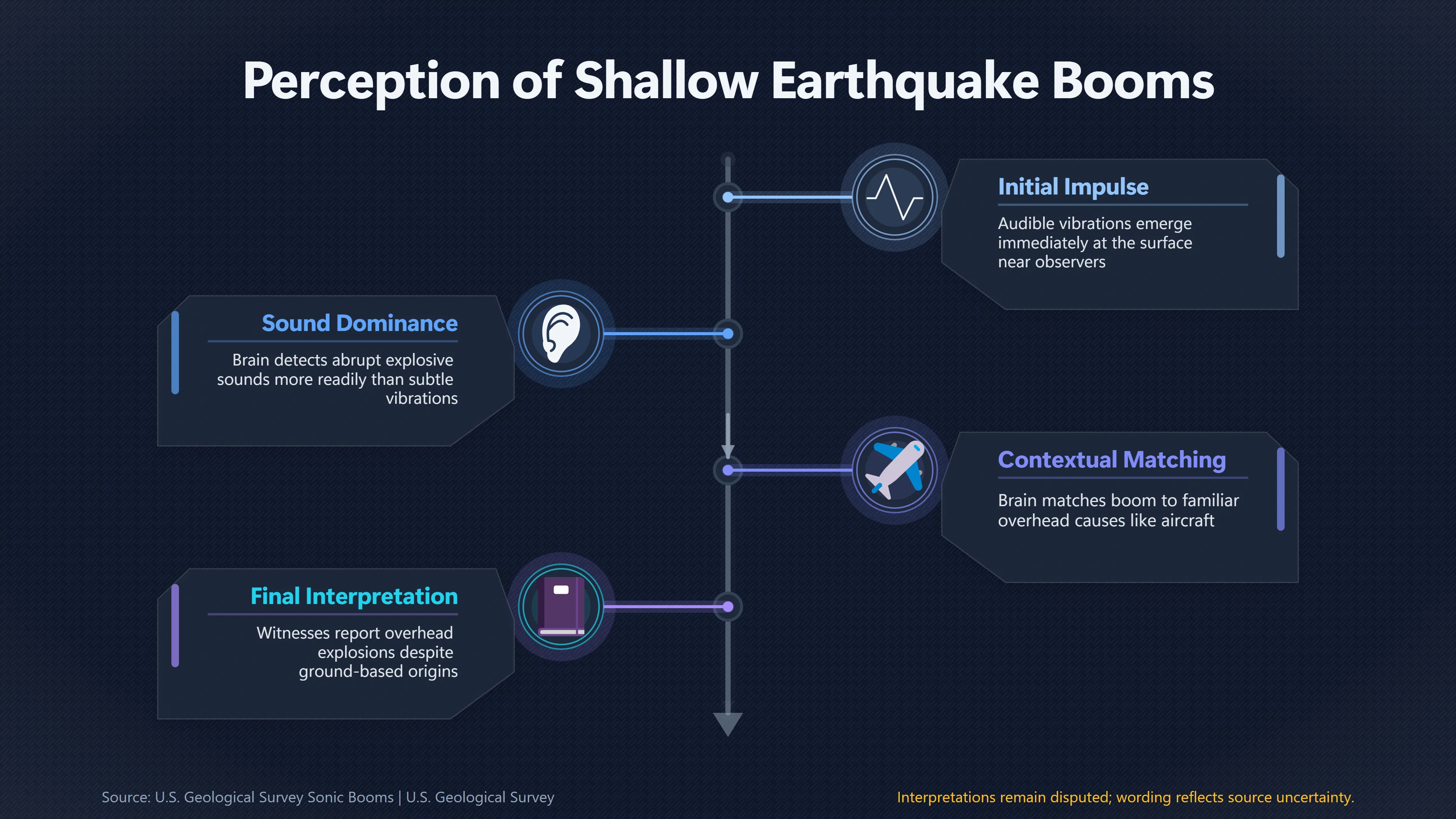
- Very shallow earthquakes can generate audible vibrations that emerge almost immediately at the surface near the observer.
- Weak shaking may fall below conscious awareness until loose objects rattle or a second, stronger pulse arrives.
- The brain detects an abrupt explosive sound more readily than subtle vibration, causing the sound to dominate the memory of the event.
The USGS notes that some shallow earthquakes produce booming sounds even when nearby people report little or no obvious shaking. Because the expected sequence—earth moving first, sound second—is absent, witnesses naturally search for an atmospheric explanation instead.[U.S. Geological Survey]usgs.govOpen source on usgs.gov.
This perceptual sequence helps explain why many reports begin with statements such as “something exploded overhead” rather than “I felt an earthquake.”
How weather and terrain distort perceived origin
The atmosphere is not acoustically uniform. Temperature, humidity and wind alter how sound travels, while hills, valleys, forests and bodies of water can reflect or refract sound waves.
Several effects can reinforce the illusion of an aerial source:
- Temperature inversions can bend sound back towards the ground, allowing distant booms to remain surprisingly loud.
- Wind layers may carry sound farther in one direction than another, making the source seem displaced.
- Valleys, cliffs and water surfaces can reflect sound, producing echoes that obscure the original direction.
- Urban environments create multiple reflections from buildings, reducing the brain’s ability to identify the first arriving sound.
The same atmospheric processes are well known to influence genuine sonic booms, which is why investigators cannot rely solely on witness descriptions when distinguishing between aircraft, meteors and geological sources.[U.S. Geological Survey]usgs.govU.S. Geological Survey Sonic Booms | U.S. Geological SurveyU.S. Geological Survey Sonic Booms | U.S. Geological Survey
Why witnesses instinctively scan the sky
Human expectations strongly influence perception. Most people have little experience with audible earthquakes but are familiar with aircraft, thunder and explosions occurring above them.
When an unexpected boom is heard without an immediately obvious cause, the brain quickly matches it to familiar experiences. Looking upwards is therefore a natural response, particularly if:
- no significant shaking is felt;
- the boom is singular rather than a prolonged rumble;
- windows or walls vibrate without visible ground movement; or
- there is clear weather that rules out nearby thunder.
This expectation bias does not imply that witnesses are unreliable. Instead, it demonstrates that perception combines physical sound with prior experience. Two people hearing the same boom may sincerely report different apparent directions depending on where they were standing, surrounding structures and what they expected to hear.
Why this matters when evaluating UFO noise reports
The tendency for ground-generated booms to sound airborne provides an important caution when interpreting unexplained noises associated with UFO reports. A loud bang with no visible aircraft does not automatically imply an unidentified object overhead.
Investigators instead compare multiple lines of evidence, including:
- whether seismic instruments detected a shallow earthquake;
- whether the sound was reported over a broad region or only locally;
- whether atmospheric conditions favoured unusual sound propagation;
- whether any shaking, however slight, accompanied the boom; and
- whether aviation, meteor or industrial sources can be independently confirmed.
The USGS emphasises that mysterious booms have multiple causes. Some are attributable to shallow earthquakes, some to atmospheric phenomena such as sonic booms, and others remain unexplained because available evidence is insufficient. The important point is that the perceived direction of the sound, by itself, is not a reliable indicator of where the event actually originated.[U.S. Geological Survey]usgs.govOpen source on usgs.gov.
Amazon book picks
Further Reading
Books and field guides related to Why an Earthquake Boom Can Sound Airborne. Use these as the next step if you want deeper reading beyond the article.
Earthquakes
The ultimate introduction to seismology, written by distinguished scholar and Professor Bruce Bolt, of the University of California, Berk...
The Sound Book
A professor of acoustic engineering provides a tour of the world's most amazing sound phenomena, including creaking glaciers, whispering...
The Universal Sense
A surprising, entertaining book about how what we hear with our ears affects what's between them.
Why You Hear What You Hear
Why You Hear What You Hear is the first book on the physics of sound for the nonspecialist to empower readers with a hands-on, ears-open...
eBay marketplace picks
Marketplace Samples
Live-tested eBay searches with available results related to this page.
Selected fromUFO poster oneBay.co.uk.

Current eBay listing
VINTAGE UFO FLYING SAUCERS COMIC ADVERTISING A2 POSTER PRINT



Current eBay listing
I Want To Believe UFO Poster Giclée Fine Art Heavyweight Print
Endnotes
1.
Source: usgs.gov
Link:https://www.usgs.gov/programs/earthquake-hazards/earthquake-booms-seneca-guns-and-other-sounds
2.
Source: usgs.gov
Link:https://www.usgs.gov/faqs/what-are-those-booms-i-sometimes-hear-or-during-earthquake
Source snippet
U.S. Geological SurveyFebruary 16, 2022 — WHAT ARE THOSE BOOMS I SOMETIMES HEAR BEFORE OR DURING AN EARTHQUAKE? "Booms" have been repor...
Published: February 16, 2022
3.
Source: usgs.gov
Link:https://www.usgs.gov/faqs/what-does-earthquake-feel
Source snippet
U.S. Geological SurveyAugust 6, 2025 — WHAT DOES AN EARTHQUAKE FEEL LIKE? The way an earthquake feels depends on where you are, where t...
Published: August 6, 2025
4.
Source: usgs.gov
Title: U.S. Geological Survey Sonic Booms | U.S. Geological Survey
Link:https://www.usgs.gov/programs/earthquake-hazards/sonic-booms
5.
Source: usgs.gov
Link:https://www.usgs.gov/faqs/how-does-usgs-tell-difference-between-earthquake-and-a-sonic-boom
Source snippet
U.S. Geological SurveySeptember 5, 2024 — HOW DOES THE USGS TELL THE DIFFERENCE BETWEEN AN EARTHQUAKE AND A SONIC BOOM? Steps to identi...
Published: September 5, 2024
6.
Source: pubs.usgs.gov
Link:https://pubs.usgs.gov/gip/earthq3/whatearth.html
7.
Source: pubs.usgs.gov
Link:https://pubs.usgs.gov/pinatubo/ramos/
8.
Source: earthquake.usgs.gov
Link:https://earthquake.usgs.gov/education/listen/distance.php
9.
Source: earthquake.usgs.gov
Link:https://earthquake.usgs.gov/education/listen/
10.
Source: earthquake.usgs.gov
Link:https://earthquake.usgs.gov/earthquakes/events/1906calif/18april/earthwaves.php
11.
Source: usgs.gov
Title: Earthquake Hazards
Link:https://www.usgs.gov/programs/earthquake-hazards/science/faqs?page=5
12.
Source: earthquake.usgs.gov
Link:https://earthquake.usgs.gov/education/listen/combination.php
Additional References
13.
Source: arxiv.org
Link:https://arxiv.org/abs/1710.01904
Source snippet
Head shadow enhancement with low-frequency beamforming improves sound localization and speech perception for simulated bimodal liste...
14.
Source: youtube.com
Link:https://www.youtube.com/watch?v=P6_a314KiZo
Source snippet
Mysterious Sky Sounds Explained - The Science Behind the Global Phenomenon...
15.
Source: youtube.com
Title: Scientists Finally Know What Caused the Sonic Booms on the US East Coast
Link:https://www.youtube.com/watch?v=FkQfLqm240E
Source snippet
The Unsolved Mystery of 'Skyquakes' | Unexplained Loud Sounds Baffle Scientists...
16.
Source: youtube.com
Title: The Unsolved Mystery of ‘Skyquakes’ | Unexplained Loud Sounds Baffle Scientists
Link:https://www.youtube.com/watch?v=BCaHFn5n7Wc
Source snippet
The Sky Just BOOMED… But No One Knows Why...
17.
Source: youtube.com
Title: The Sky Just BOOMED… But No One Knows Why
Link:https://www.youtube.com/watch?v=j7QOQ1IKYes
Source snippet
What Are the Mystery Booms, Hums and "Trumpets" in the Sky? | Make This Make Sense...
18.
Source: doi.org
Title: Influence of atmospheric structure and topography on infrasonic wave propagation
Link:https://doi.org/10.1002/2013JB010827
19.
Source: sciencedirect.com
Title: The localisation of spectrally restricted sounds by human listeners
Link:https://www.sciencedirect.com/science/article/abs/pii/S0378595598002056
20.
Source: sciencedirect.com
Title: Human sound localization at near-threshold levels
Link:https://www.sciencedirect.com/science/article/pii/S0378595504002485
21.
Source: pubmed.ncbi.nlm.nih.gov
Link:https://pubmed.ncbi.nlm.nih.gov/15574307/
22.
Source: pubmed.ncbi.nlm.nih.gov
Link:https://pubmed.ncbi.nlm.nih.gov/2018391/