Within Meteor Booms
Can a Meteor Be Heard Instantly?
Rare reports of hissing or crackling during a visible meteor may involve local vibrations triggered by electromagnetic waves, but the mechanism remains
On this page
- Why ordinary sound cannot arrive with the flash
- The electromagnetic vibration hypothesis
- Why the evidence remains unsettled
Page outline Jump by section
Introduction
Most meteor sounds are heard minutes after a brilliant fireball, when the shock wave finally reaches the ground. Yet a much rarer class of reports describes something very different: a faint hiss, crackle, sizzle or pop heard at exactly the same moment as the meteor flashes across the sky. These so-called electrophonic meteor sounds have intrigued astronomers for centuries because ordinary sound cannot travel from a meteor tens of kilometres overhead quickly enough to explain them. Rather than overturning physics, the reports have prompted researchers to investigate whether a meteor might generate electromagnetic energy that causes nearby objects—or even hair, glasses or foliage—to vibrate locally. Although the phenomenon has not been conclusively verified under controlled conditions, it remains one of the most unusual unresolved questions associated with bright meteors and is occasionally mistaken for a mysterious “UFO noise”.[amsmeteors.org]amsmeteors.orgAmerican Meteor Society Fireball FAQsAmerican Meteor SocietyFireball FAQs - American Meteor Society…
Why ordinary sound cannot arrive with the flash
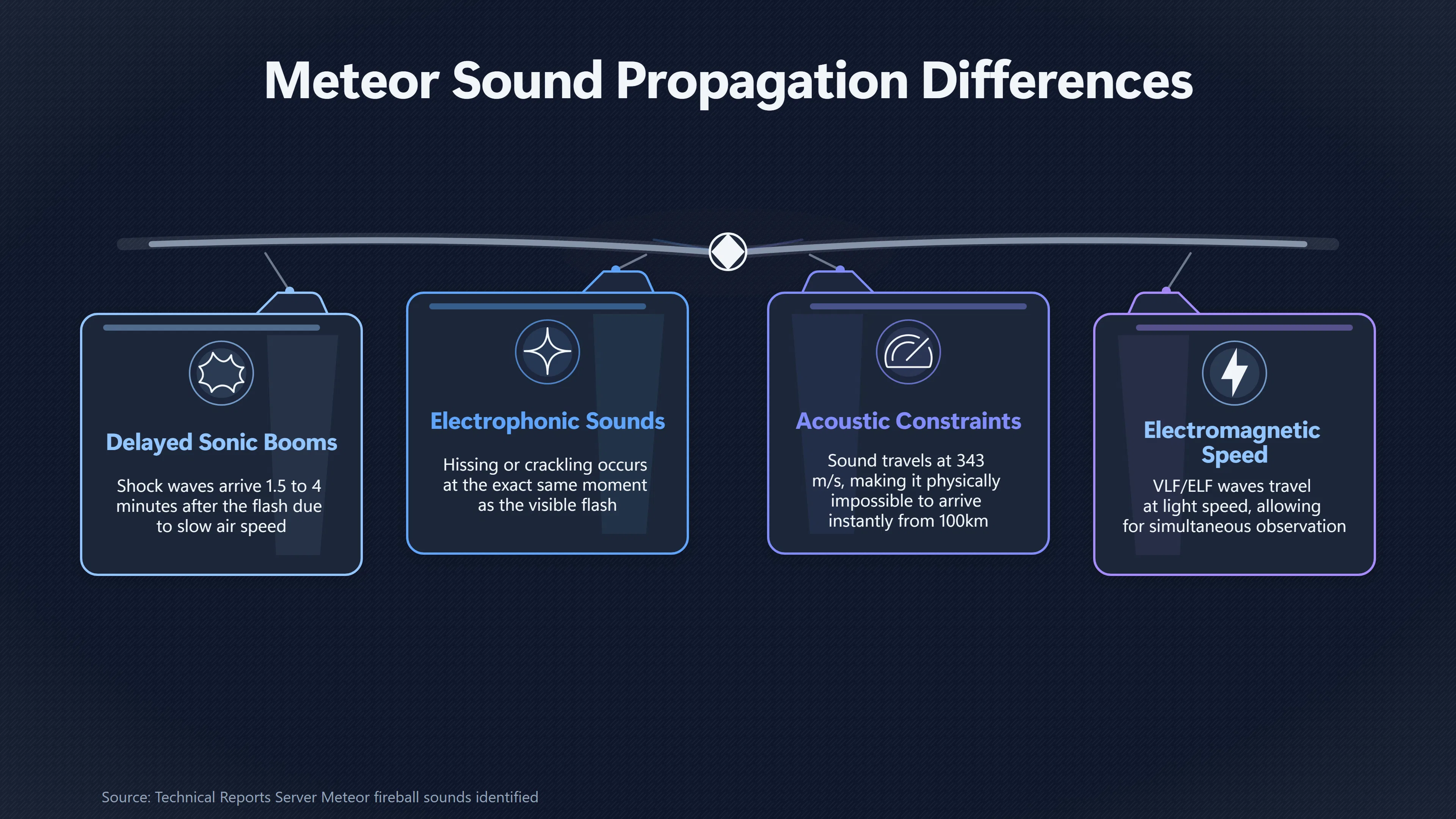
The central mystery begins with a simple physical constraint. Light from a meteor reaches an observer almost instantly, while sound in air travels at roughly 343 metres per second. A meteor burning 80–100 km above Earth cannot produce an audible hiss or crackle that arrives simultaneously through normal acoustic propagation.
This distinction is important because it separates two very different phenomena:
- Delayed sonic booms are well understood. They result from shock waves produced by large fireballs and typically arrive between about 1.5 and 4 minutes after the meteor is seen.
- Instantaneous reports describe sounds perceived during the visible flight itself, with no noticeable delay. These are the observations referred to as electrophonic sounds.[American Meteor Society]amsmeteors.orgAmerican Meteor Society Fireball FAQsAmerican Meteor SocietyFireball FAQs - American Meteor Society…
Because the timing appears impossible for ordinary sound, early investigators often dismissed such reports as mistakes or coincidence. However, the remarkable consistency of many independent descriptions—often involving words such as “hissing”, “sizzling”, “swishing” or “crackling”—kept the question alive.[NASA Technical Reports Server]ntrs.nasa.govTechnical Reports Server Meteor fireball sounds identifiedNASA Technical Reports ServerMeteor fireball sounds identified - NASA Technical Reports Server (NTRS)…
The electromagnetic vibration hypothesis
The leading explanation does not suggest that the meteor’s sound itself travels instantaneously. Instead, it proposes that the meteor emits very low frequency (VLF) or extremely low frequency (ELF) electromagnetic waves.
Unlike sound, electromagnetic waves travel at essentially the speed of light. If sufficiently strong, they could reach an observer almost simultaneously with the visible meteor. The audible sound would then be created locally, not in the sky.
Researchers have proposed that the electromagnetic pulse could induce tiny vibrations in nearby objects acting as natural transducers, including:
- thin metal objects such as wire fences or spectacles;
- dry leaves, pine needles or grass;
- aluminium foil or lightweight conductors;
- even strands of human hair under favourable conditions.
The listener would therefore hear a nearby object vibrating, even though the trigger originated with the distant meteor. This neatly resolves the apparent conflict with the speed of sound.[nasa.gov]ntrs.nasa.govTechnical Reports Server Meteor fireball sounds identifiedNASA Technical Reports ServerMeteor fireball sounds identified - NASA Technical Reports Server (NTRS)…
One influential series of studies by physicist Colin Keay argued that turbulent plasma surrounding exceptionally bright meteors could distort Earth’s magnetic field and generate VLF radiation. Laboratory experiments also demonstrated that ordinary objects can convert electrical excitation into audible vibrations, making the basic transduction mechanism physically plausible even if the atmospheric source remains debated.[NASA Technical Reports Server]ntrs.nasa.govTechnical Reports Server Meteor fireball sounds identifiedNASA Technical Reports ServerMeteor fireball sounds identified - NASA Technical Reports Server (NTRS)…
Why witnesses often describe hissing rather than explosions
Reported electrophonic sounds differ noticeably from delayed meteor booms.[nature.com]nature.comPhotoacoustic Sounds from Meteors | Scientific ReportsPhotoacoustic Sounds from Meteors | Scientific Reports
Instead of loud explosive noises, witnesses commonly describe:
- gentle hissing;
- frying or sizzling sounds;[livescience.com]livescience.comCan You Hear a Meteor? | Electrophonics | Live ScienceCan You Hear a Meteor? | Electrophonics | Live Science
- static-like crackling;
- soft swishing;
- brief popping noises.
These descriptions resemble the sort of noises expected from small nearby objects vibrating rather than a powerful explosion many kilometres away.
Some surveys have also noted recurring circumstances in witness accounts. Reports sometimes mention the presence of metal objects nearby, exceptionally dry vegetation, or unusually bright fireballs. A few observers even reported their hair appearing to respond at the same moment as the sound. While such anecdotes are intriguing, they remain observational rather than definitive evidence.[amsmeteors.org]amsmeteors.orgAmerican Meteor Society Fireball FAQsAmerican Meteor SocietyFireball FAQs - American Meteor Society…

Why the evidence remains unsettled
Although electrophonic sounds are taken more seriously today than they once were, they are not considered a solved phenomenon.
Several problems continue to challenge researchers.
First, the events are extremely rare. Even among brilliant fireballs, only a small proportion generate simultaneous sound reports, making planned instrumental observations difficult.[NASA Technical Reports Server]ntrs.nasa.govTechnical Reports Server Meteor fireball sounds identifiedNASA Technical Reports ServerMeteor fireball sounds identified - NASA Technical Reports Server (NTRS)…
Second, no single physical model explains every reported case. Different researchers have suggested several mechanisms, including:
- VLF electromagnetic radiation produced by plasma turbulence;
- electric fields generated during catastrophic fragmentation;
- local corona discharge around nearby objects;
- other forms of atmospheric electrical coupling.
Each model accounts for some observations while struggling with others.[wiley.com]agupubs.onlinelibrary.wiley.comAGU PublicationsOn the electrophonic generation of audio frequency sound by meteors - Kelley - 2017 - Geophysical Research Letters - Wile…
Third, direct instrumental confirmation remains limited. The American Meteor Society notes that electrophonic sounds have never been conclusively validated scientifically, and although the VLF hypothesis is the most widely discussed explanation, it has not been definitively demonstrated.[American Meteor Society]amsmeteors.orgAmerican Meteor Society Fireball FAQsAmerican Meteor SocietyFireball FAQs - American Meteor Society…
For this reason, the phenomenon occupies an unusual position: it is no longer routinely dismissed as impossible, yet neither is it regarded as fully explained.
Why instant meteor sounds can resemble UFO reports
Within reports of unexplained aerial noises, electrophonic meteors occupy a unique niche.
Unlike delayed sonic booms—which can usually be matched with the meteor’s trajectory and timing—an instantaneous hiss may leave witnesses convinced that the sound came directly from an object flying overhead. Since the sound coincides perfectly with the visible streak, it can create the impression that the object itself was “making noise” despite its immense altitude.
This timing has occasionally contributed to UFO interpretations, particularly when observers were unfamiliar with electrophonic reports or expected all meteor sounds to be delayed. In reality, if electrophonic sounds occur, the audible source is thought to be the observer’s immediate surroundings rather than the meteor itself.[amsmeteors.org]amsmeteors.orgAmerican Meteor Society Fireball FAQsAmerican Meteor SocietyFireball FAQs - American Meteor Society…
What can be said with confidence
Several conclusions are supported by the available evidence.
- Ordinary acoustic sound from a meteor cannot reach an observer simultaneously with the visible flash because the speed of sound is far too slow.[American Meteor Society]amsmeteors.orgAmerican Meteor Society Fireball FAQsAmerican Meteor SocietyFireball FAQs - American Meteor Society…
- Reports of simultaneous hissing, crackling and popping have been documented for centuries and have been catalogued by researchers rather than dismissed outright.[NASA Technical Reports Server]ntrs.nasa.govTechnical Reports Server Meteor fireball sounds identifiedNASA Technical Reports ServerMeteor fireball sounds identified - NASA Technical Reports Server (NTRS)…
- The leading scientific explanation is that electromagnetic energy generated by a bright meteor causes nearby objects to produce sound locally.[wiley.com]agupubs.onlinelibrary.wiley.comAGU PublicationsOn the electrophonic generation of audio frequency sound by meteors - Kelley - 2017 - Geophysical Research Letters - Wile…
- The exact mechanism remains unresolved because convincing, repeatable instrumental confirmation is still lacking, despite decades of investigation.[amsmeteors.org]amsmeteors.orgAmerican Meteor Society Fireball FAQsAmerican Meteor SocietyFireball FAQs - American Meteor Society…
Amazon book picks
Further Reading
Books and field guides related to Can a Meteor Be Heard Instantly?. Use these as the next step if you want deeper reading beyond the article.
Rocks from Space
Appendices A-C: Meteorite verification laboratories, Commercial meteorite dealers, Selected list of suspected impact craters worldwide.
The Cambridge Encyclopedia of Meteorites
Beautifully illustrated with over 140 full colour images, The Cambridge Encyclopedia of Meteorites provides a thorough guide to these fas...
Meteorites: The Story of Our Solar System
Meteorite tells the fascinating story of the stones from outer space scattered across our planet. From the impact that finished off the d...
Falling Stars: A Guide to Meteors and Meteorites
Month-by-month information on meteor showers and how to make the most of watching them Advice on starting and building a meteorite collec...
eBay marketplace picks
Marketplace Samples
Live-tested eBay searches with available results related to this page.
Selected fromUFO disclosure print oneBay.co.uk.



Endnotes
1.
Source: ntrs.nasa.gov
Title: Technical Reports Server Meteor fireball sounds identified
Link:https://ntrs.nasa.gov/citations/19930009995
Source snippet
NASA Technical Reports ServerMeteor fireball sounds identified - NASA Technical Reports Server (NTRS)...
2.
Source: ethw.org
Title: Electrophonic Meteors
Link:https://ethw.org/Electrophonic_Meteors
Source snippet
Electrophonic Meteors - Engineering and Technology History Wiki...
3.
Source: academic.oup.com
Link:https://academic.oup.com/mnras/article/305/2/253/1020150
Source snippet
OUP AcademicLarge meteoroids in the Lyrid stream | Monthly Notices of the Royal Astronomical Society | Oxford Academic...
4.
Source: arxiv.org
Title: arXiv Global Electrophonic Fireball Survey: a review of witness reports
Link:https://arxiv.org/abs/astro-ph/0211203
Source snippet
Global Electrophonic Fireball Survey: a review of witness reports - I...
5.
Source: arxiv.org
Title: arXiv A space charge model for electrophonic bursters
Link:https://arxiv.org/abs/astro-ph/0112376
6.
Source: arxiv.org
Title: arXiv Electrophonic sounds from meteors and auroral audibility
Link:https://arxiv.org/abs/2104.14660
7.
Source: svs.gsfc.nasa.gov
Link:https://svs.gsfc.nasa.gov/14983/
Source snippet
“Cosmic Echoes” Audio ActivationMay 8, 2026 — “COSMIC ECHOES” AUDIO ACTIVATION * Released Friday, May 8, 2026 * ID: 14983 * * * * *...
Published: May 8, 2026
8.
Source: nasa.gov
Title: It’s Fireball Season!
Link:https://www.nasa.gov/blogs/watch-the-skies/2026/03/26/its-fireball-season-answering-your-meteor-questions/
Source snippet
Answering Your Meteor Questions - NASAMarch 26, 2026 — WATCH THE SKIES Image Janet Sudnik March 26, 2026 5:18PM CATEGORIES Marshall Space...
Published: March 26, 2026
9.
Source: ciencia.nasa.gov
Link:https://ciencia.nasa.gov/sistema-solar/el-rover-de-la-nasa-detecta-chispas-electricas-en-las-tormentas-y-torbellinos-de-polvo-de-marte/
10.
Source: nasa.gov
Title: NAS A Rover Detects Electric Sparks in Mars Dust Devils, Storms
Link:https://www.nasa.gov/missions/mars-2020-perseverance/perseverance-rover/nasa-rover-detects-electric-sparks-in-mars-dust-devils-storms/
11.
Source: nasa.gov
Title: interesting fact of the month 2021
Link:https://www.nasa.gov/space-science-and-astrobiology-at-ames/interesting-fact-of-the-month-current/interesting-fact-of-the-month-2021/
12.
Source: apod.nasa.gov
Link:https://apod.nasa.gov/rjn/apod/ap210315.html
13.
Source: science.nasa.gov
Title: eavesdropping in space how nasa records eerie sounds around earth
Link:https://science.nasa.gov/blogs/the-sun-spot/2018/12/11/eavesdropping-in-space-how-nasa-records-eerie-sounds-around-earth/
14.
Source: science.nasa.gov
Title: sound of saturn radio emissions of the planet and enceladus
Link:https://science.nasa.gov/resource/sound-of-saturn-radio-emissions-of-the-planet-and-enceladus/
15.
Source: nasa.gov
Title: NAS A Listens in as Electrons Whistle While They Work
Link:https://www.nasa.gov/missions/mms/nasa-listens-in-as-electrons-whistle-while-they-work/
16.
Source: apod.nasa.gov
Link:https://apod.nasa.gov/apod/ap011130.html
17.
Source: amsmeteors.org
Title: American Meteor Society Fireball FAQs
Link:https://www.amsmeteors.org/fireballs/faqf/
Source snippet
American Meteor SocietyFireball FAQs - American Meteor Society...
18.
Source: agupubs.onlinelibrary.wiley.com
Link:https://agupubs.onlinelibrary.wiley.com/doi/full/10.1002/2017GL072911
Source snippet
AGU PublicationsOn the electrophonic generation of audio frequency sound by meteors - Kelley - 2017 - Geophysical Research Letters - Wile...
19.
Source: agupubs.onlinelibrary.wiley.com
Link:https://agupubs.onlinelibrary.wiley.com/doi/full/10.1029/2001JA000310
20.
Source: agupubs.onlinelibrary.wiley.com
Link:https://agupubs.onlinelibrary.wiley.com/doi/abs/10.1029/94JE01092
21.
Source: onlinelibrary.wiley.com
Title: j.1945 5100.1949.tb00105.x
Link:https://onlinelibrary.wiley.com/doi/abs/10.1111/j.1945-5100.1949.tb00105.x
Additional References
22.
Source: youtube.com
Title: ‘Spooky Meteor Noises’ Reproduced and Explained by Scientists
Link:https://www.youtube.com/watch?v=JqXZbrDZrVU
Source snippet
Starship seen and (HEARD in real time!) over Puerto Rico...
23.
Source: cambridge.org
Link:https://www.cambridge.org/core/journals/publications-of-the-astronomical-society-of-australia/article/abs/audible-fireballs-and-geophysical-electrophonics/7ACB0E5FE9D8B29742EAA45371B9EDF8
24.
Source: doaj.org
Link:https://doaj.org/article/8ed48a7b35a34fa3896fc6a5694d0451
25.
Source: sciencedirect.com
Link:https://www.sciencedirect.com/science/article/pii/S0275106203900671
26.
Source: youtube.com
Title: What Would You Hear If A Meteor Flew By?
Link:https://www.youtube.com/watch?v=qG7qHtm5cM8
Source snippet
'Spooky Meteor Noises' Reproduced and Explained by Scientists...
27.
Source: nature.com
Title: Photoacoustic Sounds from Meteors | Scientific Reports
Link:https://www.nature.com/articles/srep41251
28.
Source: cris.tau.ac.il
Title: tau.ac.il On the electrophonic generation of audio frequency sound by meteors
Link:https://cris.tau.ac.il/en/publications/on-the-electrophonic-generation-of-audio-frequency-sound-by-meteo/
29.
Source: researchgate.net
Title: (PDF) Global Electrophonic Fireball Survey: a review of witness reports
Link:https://www.researchgate.net/publication/1928350Global_Electrophonic_Fireball_Survey_a_review_of_witness_reports-_I
30.
Source: livescience.com
Title: Can You Hear a Meteor? | Electrophonics | Live Science
Link:https://www.livescience.com/38651-meteor-sound-electrophonics-perseids.html
31.
Source: researchgate.net
Title: (PDF) A space charge model for electrophonic bursters
Link:https://www.researchgate.net/publication/2234976_A_space_charge_model_for_electrophonic_bursters