Within Earth Booms
Why Some Earthquakes Sound Like Cannon Fire
Earthquakes near the surface can release high-frequency vibrations that reach listeners as a bang, roar or cannon-like boom.
On this page
- How shallow depth preserves audible vibrations
- Why weak shaking can accompany a loud boom
- What field reports and earthquake swarms reveal
Page outline Jump by section
Introduction
One of the most surprising explanations for an apparent “explosion” in the absence of aircraft, storms or visible impacts is an earthquake occurring extremely close to the Earth’s surface. Although earthquakes are normally associated with shaking, very shallow events can generate sharp bangs, cannon-like reports or rolling booms that are heard more clearly than they are felt. This makes them especially relevant when assessing reports of mysterious “UFO noises” or unexplained booms. The key factor is not simply the earthquake’s magnitude, but its depth: when the rupture occurs only a few kilometres below ground, or even shallower, high-frequency vibrations can reach the surface before they are absorbed, producing audible sound.[U.S. Geological Survey]usgs.govOpen source on usgs.gov.
Unlike broader discussions of earthquake booms or the historical mystery of Seneca Guns, this mechanism focuses on why shallow earthquakes can sound remarkably like explosions despite producing only modest ground motion.
How shallow depth preserves audible vibrations
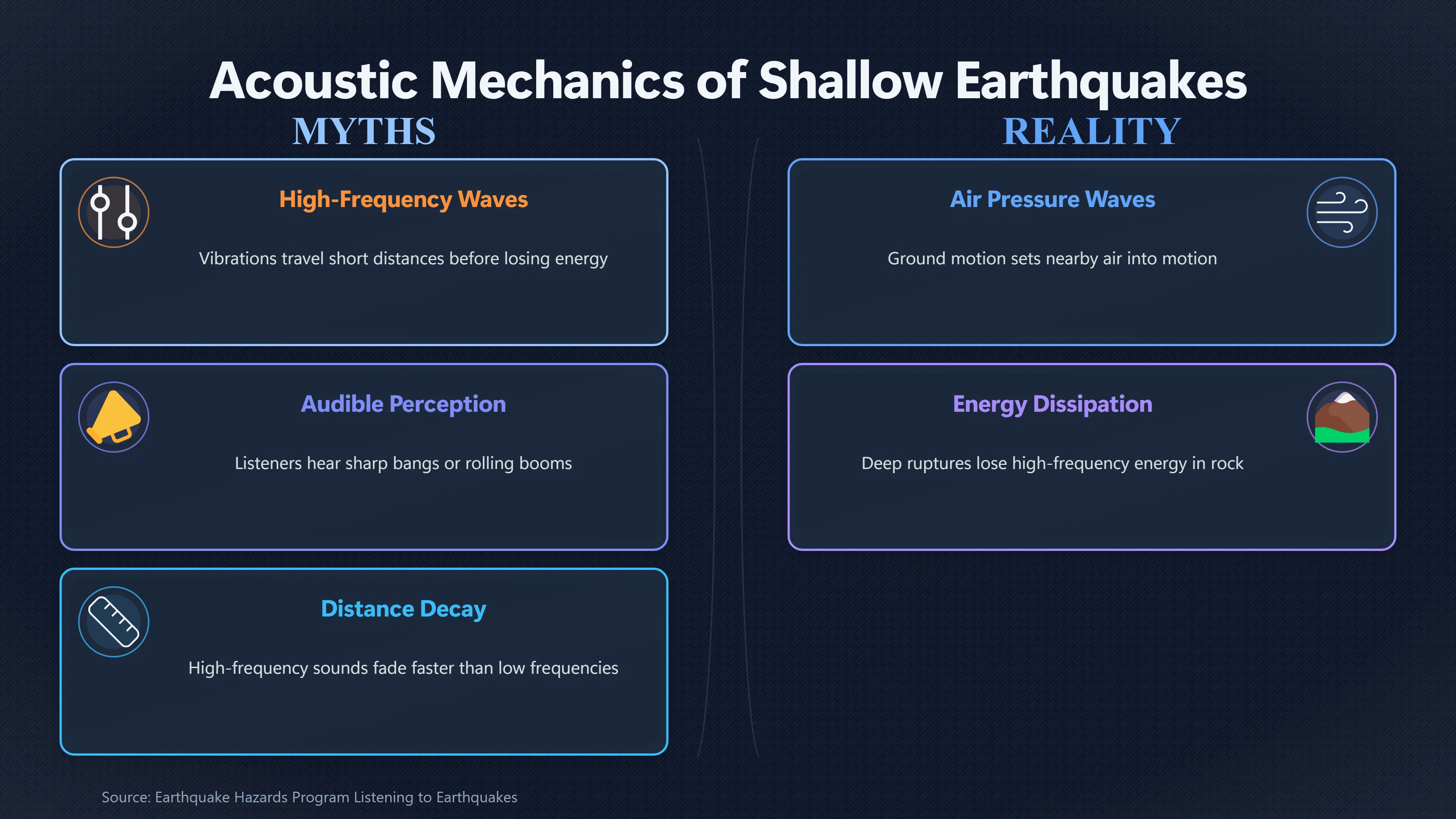
Earthquakes release energy across a broad range of frequencies. Most of the energy from large or deep earthquakes reaches people as ground motion rather than audible sound because higher-frequency vibrations are rapidly weakened as they travel through rock. By the time seismic waves from a deep earthquake reach the surface, much of the energy capable of creating audible vibrations has already dissipated.[USGS Earthquake Hazards Program]earthquake.usgs.govEarthquake Hazards Program Listening to EarthquakesUSGS Earthquake Hazards ProgramListening to Earthquakes…
Very shallow earthquakes behave differently. Because the rupture occurs close to the surface:
- High-frequency seismic waves have much less rock through which to lose energy.
- Those vibrations can reach the ground with enough strength to set nearby air into motion.
- The resulting pressure waves are perceived as a sharp bang, crack, boom or short roar rather than a prolonged rumble.[U.S. Geological Survey]usgs.govOpen source on usgs.gov.
This explains why two earthquakes of similar magnitude can produce very different experiences. A deeper event may cause obvious shaking but little or no sound, whereas a much smaller earthquake only a kilometre or two below the surface may generate a startling explosive noise.
Why weak shaking can accompany a loud boom
Many eyewitnesses assume that a loud explosion should correspond to a powerful earthquake. In reality, sound and felt shaking do not always scale together.
A small, shallow rupture concentrates high-frequency energy close to the epicentre. These frequencies are efficient at producing short, impulsive sounds but do not necessarily produce prolonged or widespread ground motion. Someone standing very near the rupture may hear what resembles a heavy detonation while experiencing only a brief jolt or almost imperceptible vibration. The USGS notes that some shallow earthquakes create booming sounds even when people report no noticeable shaking at all.[U.S. Geological Survey]usgs.govOpen source on usgs.gov.
Distance also changes perception. High-frequency waves fade much faster than low-frequency waves. Close to the source, people may hear a sharp crack or bang. Further away, those higher frequencies disappear, leaving only lower-frequency shaking or nothing noticeable at all.[USGS Earthquake Hazards Program]earthquake.usgs.govEarthquake Hazards Program Earthquake Distance EffectsUSGS Earthquake Hazards ProgramEarthquake Distance Effects…
This combination explains why emergency services sometimes receive reports of an “explosion” without obvious earthquake damage, particularly when the seismic event is too small to attract immediate public attention.
Why the sound resembles cannon fire
The comparison with artillery or cannon fire appears repeatedly in historical earthquake accounts because the acoustic signal is usually brief, impulsive and rich in higher frequencies.
Witnesses commonly describe:
- a single cannon shot;
- an explosion beneath the ground;
- a heavy door slamming;
- a quarry blast;
- a deep rolling boom similar to distant thunder.[U.S. Geological Survey]usgs.govOpen source on usgs.gov.
These descriptions arise because the audible component is generated by an abrupt release of energy rather than a continuous vibration. The sound often lasts only a fraction of a second before any noticeable shaking arrives or while it is occurring.
People are also relatively poor at locating the direction of low-frequency sounds. As a result, a geological source beneath the surface may be perceived as originating somewhere overhead, contributing to reports that initially seem consistent with aircraft, meteors or unidentified aerial phenomena.[U.S. Geological Survey]usgs.govOpen source on usgs.gov.
What field reports and earthquake swarms reveal
Several well-documented earthquake sequences illustrate the importance of shallow depth rather than large magnitude.
Spokane earthquake swarm
During a 2001 earthquake swarm near Spokane, Washington, numerous residents reported repeated booming sounds. According to the USGS, the earthquakes occurred at unusually shallow depths—sometimes only 1–2 miles (roughly 1.6–3.2 km)—which probably explains why the noises were so widely reported despite the modest size of the events.[U.S. Geological Survey]usgs.govOpen source on usgs.gov.
Mammoth Mountain and Imperial Valley
USGS scientists working near Mammoth Mountain, California, reported hearing muffled booms without feeling noticeable shaking. Seismographs later showed that several very small, shallow earthquakes, each below magnitude 2, had occurred simultaneously. Similar observations were made during an earthquake swarm in California’s Imperial Valley, where researchers both heard low rumbling sounds and experienced local shaking. These field observations demonstrate that audible earthquake sounds are not merely folklore but have been directly observed alongside instrumental recordings.[U.S. Geological Survey]usgs.govOpen source on usgs.gov.

Historical examples
Historical earthquakes provide comparable descriptions over much longer timescales. Reports from the 1886 Charleston earthquake describe roaring sounds accompanying both the main shock and numerous aftershocks. Earlier accounts from the New Madrid earthquake sequence of 1811–1812 also mention artillery-like detonations. While those were much larger earthquakes than the shallow swarms discussed above, they show that explosive sounds have been recognised features of some earthquakes for centuries.[U.S. Geological Survey]usgs.govOpen source on usgs.gov.
Why this matters when investigating mysterious booms
For reports collected under labels such as “earthquake booms” or “Seneca Guns”, the presence of an explosion-like sound does not automatically indicate an atmospheric source. A shallow earthquake should be considered whenever a boom is:
- localised rather than heard across hundreds of kilometres;
- accompanied by a brief jolt or slight vibration;
- reported near an area with known seismic activity or earthquake swarms;
- unsupported by evidence of aircraft, industrial explosions or meteor activity.[U.S. Geological Survey]usgs.govOpen source on usgs.gov.
At the same time, scientists emphasise that most unexplained booms are not earthquakes. Sonic booms, industrial blasts, quarry explosions and other atmospheric or human-made sources account for many reports. The significance of very shallow earthquakes is that they provide a well-established geological mechanism capable of producing sounds that listeners naturally interpret as explosions, even when the accompanying earthquake is too small or too shallow to fit everyday expectations.[U.S. Geological Survey]usgs.govU.S. Geological Survey Sonic Booms | U.S. Geological SurveyU.S. Geological Survey Sonic Booms | U.S. Geological Survey
Amazon book picks
Further Reading
Books and field guides related to Why Some Earthquakes Sound Like Cannon Fire. Use these as the next step if you want deeper reading beyond the article.
Earthquakes
The ultimate introduction to seismology, written by distinguished scholar and Professor Bruce Bolt, of the University of California, Berk...
A Crack in the Edge of the World
History: Specific Events & Topics;Earth Sciences; Geography; Environment; Planning;History Of The Americas
Earthquakes in Human History
On November 1, 1755—All Saints' Day—a massive earthquake struck Europe's Iberian Peninsula and destroyed the city of Lisbon. Churches col...
The Great Earthquake and Firestorms of 1906
"In this well-researched book, Fradkin contends that it was the people of San Francisco, not the forces of nature, who were responsible f...
eBay marketplace picks
Marketplace Samples
Live-tested eBay searches with available results related to this page.
Selected fromUFO poster oneBay.co.uk.

Current eBay listing
VINTAGE UFO FLYING SAUCERS COMIC ADVERTISING A2 POSTER PRINT



Current eBay listing
I Want To Believe UFO Poster Giclée Fine Art Heavyweight Print
Endnotes
1.
Source: usgs.gov
Link:https://www.usgs.gov/programs/earthquake-hazards/earthquake-booms-seneca-guns-and-other-sounds
2.
Source: usgs.gov
Link:https://www.usgs.gov/faqs/what-are-those-booms-i-sometimes-hear-or-during-earthquake
3.
Source: earthquake.usgs.gov
Title: Earthquake Hazards Program Listening to Earthquakes
Link:https://earthquake.usgs.gov/education/listen/
Source snippet
USGS Earthquake Hazards ProgramListening to Earthquakes...
4.
Source: earthquake.usgs.gov
Title: Earthquake Hazards Program Earthquake Distance Effects
Link:https://earthquake.usgs.gov/education/listen/distance.php
Source snippet
USGS Earthquake Hazards ProgramEarthquake Distance Effects...
5.
Source: pubs.usgs.gov
Title: U.S. Geological Survey Publications Earthquakes
Link:https://pubs.usgs.gov/gip/earthq1/how.html
Source snippet
U.S. Geological Survey PublicationsEarthquakes - General Interest Publication...
6.
Source: usgs.gov
Title: U.S. Geological Survey Sonic Booms | U.S. Geological Survey
Link:https://www.usgs.gov/programs/earthquake-hazards/sonic-booms
7.
Source: usgs.gov
Link:https://www.usgs.gov/faqs/how-does-usgs-tell-difference-between-earthquake-and-a-sonic-boom
Source snippet
U.S. Geological SurveySeptember 5, 2024 — HOW DOES THE USGS TELL THE DIFFERENCE BETWEEN AN EARTHQUAKE AND A SONIC BOOM? Steps to identi...
Published: September 5, 2024
8.
Source: usgs.gov
Title: What does an earthquake feel like?
Link:https://www.usgs.gov/faqs/what-does-earthquake-feel
Source snippet
U.S. Geological SurveyAugust 6, 2025 — WHAT DOES AN EARTHQUAKE FEEL LIKE? The way an earthquake feels depends on where you are, where t...
Published: August 6, 2025
9.
Source: usgs.gov
Link:https://www.usgs.gov/publications/characteristics-relationships-and-precision-direct-acoustic-seismic-coupling
10.
Source: pubs.usgs.gov
Link:https://pubs.usgs.gov/gip/earthq3/whatearth.html
11.
Source: pubs.usgs.gov
Link:https://pubs.usgs.gov/gip/earthq1/earthqkgip.html
12.
Source: usgs.gov
Link:https://www.usgs.gov/programs/earthquake-hazards/what-are-effects-earthquakes
13.
Source: usgs.gov
Title: Earthquake Hazards
Link:https://www.usgs.gov/programs/earthquake-hazards/science/faqs?page=5
14.
Source: earthquake.usgs.gov
Link:https://earthquake.usgs.gov/monitoring/seismograms/about.php
15.
Source: usgs.gov
Link:https://www.usgs.gov/programs/earthquake-hazards/determining-depth-earthquake
Additional References
16.
Source: sciencedirect.com
Link:https://www.sciencedirect.com/science/article/pii/S0267726126001235
Source snippet
rams - ScienceDirectJune 1, 2026 — SOIL DYNAMICS AND EARTHQUAKE ENGINEERING Volume 205, June 2026, 110211 THE ORIGIN AND CHARACTERISTICS...
Published: June 1, 2026
17.
Source: youtube.com
Title: Loud boom sound across our area caused by small earthquake, USGS says
Link:https://www.youtube.com/watch?v=P_dEQ2RhHVQ
Source snippet
Why can i hear the rumble of an earthquake, what makes the noise?...
18.
Source: nature.com
Link:https://www.nature.com/articles/s41598-021-98701-6
19.
Source: youtube.com
Title: Why can i hear the rumble of an earthquake, what makes the noise?
Link:https://www.youtube.com/watch?v=JFaaiWzBKrY
Source snippet
Why Do Shallow Earthquakes Cause More Destruction Than Deep Ones?...
20.
Source: eartharxiv.org
Title: Audible acoustics from low-magnitude fluid-induced earthquakes in Finland
Link:https://eartharxiv.org/repository/view/2048/
21.
Source: youtube.com
Title: Loud Booms Reported During Earthquake
Link:https://www.youtube.com/watch?v=xCDwqzhhSjA
Source snippet
Loud boom sound across our area caused by small earthquake, USGS says...
22.
Source: pearl.plymouth.ac.uk
Link:https://pearl.plymouth.ac.uk/gees-research/886/
23.
Source: nature.com
Title: Curious Aerial or Subterranean Sounds | Nature
Link:https://www.nature.com/articles/053004d0
24.
Source: youtube.com
Title: The Sky Just BOOMED… But No One Knows Why
Link:https://www.youtube.com/watch?v=j7QOQ1IKYes
Source snippet
Loud Booms Reported During Earthquake...
25.
Source: pubmed.ncbi.nlm.nih.gov
Link:https://pubmed.ncbi.nlm.nih.gov/17757998/