Within Earth Booms
Was That Boom an Earthquake or Something Else
Seismic timing, weather, aviation records and witness details help distinguish shallow earthquakes from sonic booms, meteors and explosions.
On this page
- What seismic instruments can confirm
- Clues that point to aircraft, meteors or blasting
- Why some boom reports remain unresolved
Page outline Jump by section
Introduction
A loud unexplained boom is not, by itself, evidence of an earthquake, a meteor, a military aircraft or anything more exotic. Investigators rarely identify the source from witness descriptions alone. Instead, they compare several independent datasets—including seismic recordings, the timing and distribution of reports, weather conditions, aviation activity and, where available, astronomical observations. This multi-source approach is especially important when investigating reports that later become associated with UFO folklore or longstanding mysteries such as Seneca Guns, because many different natural and human-made events can produce remarkably similar sounds.[U.S. Geological Survey]usgs.govOpen source on usgs.gov.
In practice, most cases are resolved by asking a simple question: does the evidence point to energy travelling through the ground, through the atmosphere, or from a local explosion? The answer comes from comparing physical measurements rather than relying on how dramatic the boom sounded.
What seismic instruments can confirm
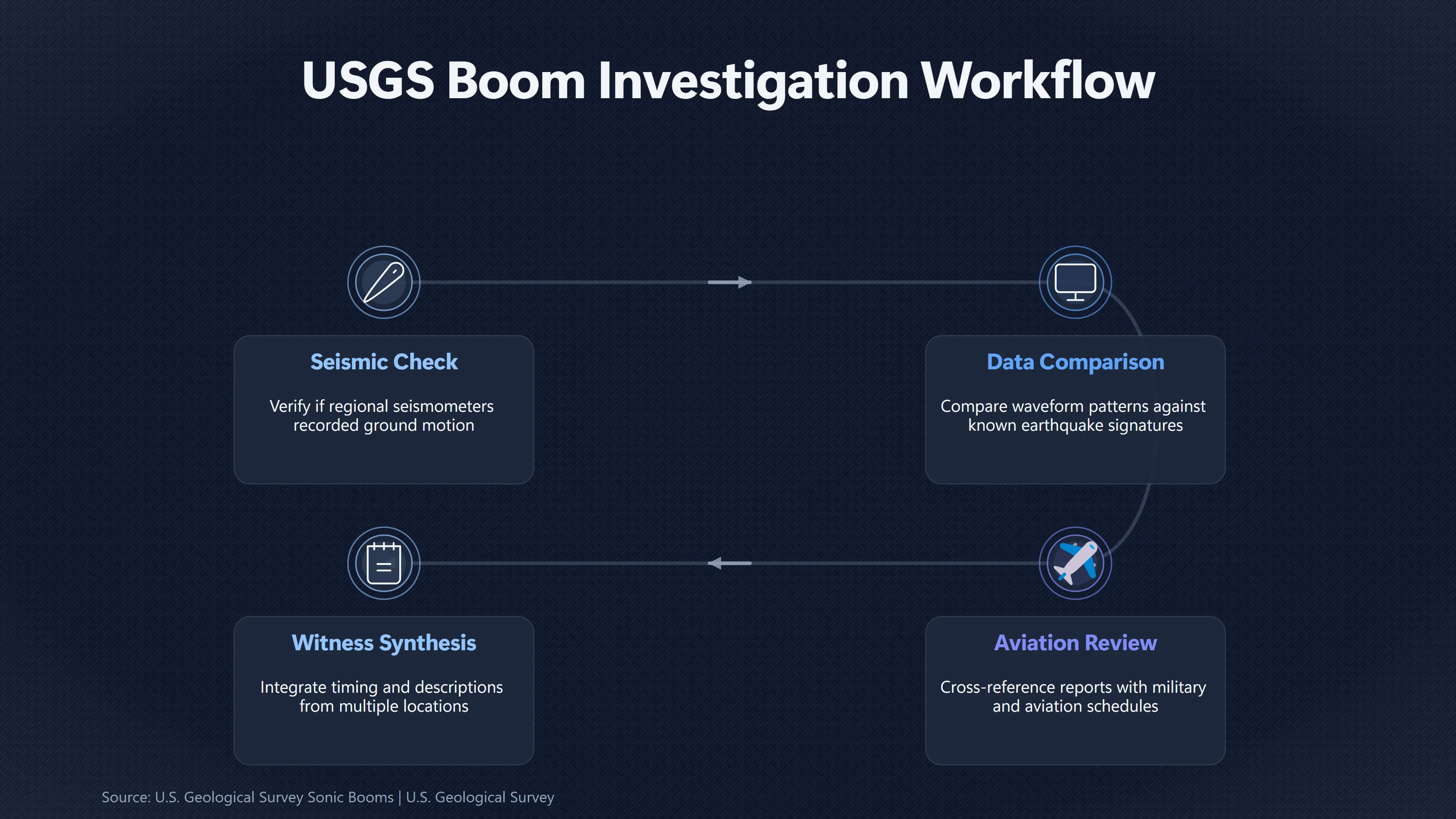
The first step is checking whether regional seismometers recorded an event. Modern seismic networks continuously monitor ground motion, allowing investigators to determine whether the boom coincided with an earthquake or another disturbance.
A genuine earthquake usually produces a recognisable sequence of seismic waves. Even very small, shallow earthquakes often generate characteristic waveforms that can be detected at several stations. By comparing arrival times, seismologists estimate the source location and depth. When an earthquake is extremely shallow—sometimes only one or two miles (roughly 1.5 to 3 kilometres) below the surface—it may generate an audible boom even if the shaking is weak.[U.S. Geological Survey]usgs.govOpen source on usgs.gov.
Sonic booms look different. If they appear on seismometers at all, they generally create short, high-frequency signals rather than the familiar earthquake pattern. The timing between stations also reflects the speed of sound travelling through the atmosphere, which is much slower than seismic waves moving through rock. This distinction is one of the strongest diagnostic tools available to investigators.[U.S. Geological Survey]usgs.govU.S. Geological Survey Sonic Booms | U.S. Geological SurveyU.S. Geological Survey Sonic Booms | U.S. Geological Survey
Investigators also compare the geographic pattern:
- Earthquakes typically produce a coherent seismic source that can be located underground.
- Atmospheric events may be heard across a broad corridor while producing little or no conventional earthquake signal.
- Local explosions or quarry blasts usually affect a relatively limited area and have different waveform characteristics from natural earthquakes.[U.S. Geological Survey]usgs.govU.S. Geological Survey Sonic Booms | U.S. Geological SurveyU.S. Geological Survey Sonic Booms | U.S. Geological Survey
Clues that point to aircraft, meteors or blasting
Once the seismic evidence has been reviewed, investigators compare it with other independent records.
Aircraft and sonic booms
A widespread boom with no corresponding earthquake is often investigated as a possible sonic boom. Analysts examine aviation activity, military training schedules where available, radar information and the pattern of public reports.
One important clue is the distribution of witnesses. A supersonic aircraft can produce a boom heard over a long, narrow corridor rather than around a single point. If seismic stations record only weak atmospheric coupling while reports extend across many kilometres, an atmospheric source becomes more likely than a local explosion. Official confirmation may later come from military or aviation authorities, although this is not always available.[U.S. Geological Survey]usgs.govU.S. Geological Survey Sonic Booms | U.S. Geological SurveyU.S. Geological Survey Sonic Booms | U.S. Geological Survey
Meteors and bolides
Large meteors can also produce explosive sounds, but they often leave additional evidence.
Investigators look for:
- reports of bright fireballs or daylight flashes;
- observations from meteor camera networks;[arxiv.org]arxiv.orgReview of synergic meteor observations: linking the results from cameras, ionosondes, infrasound and seismic detectorsJuly 2, 2021…
- satellite detections where available;
- infrasound recordings of atmospheric shock waves;
- consistent eyewitness descriptions of an object crossing the sky.
Many significant bolides produce both optical observations and low-frequency atmospheric waves, allowing scientists to match visual records with acoustic measurements. When neither visual nor astronomical evidence exists, a meteor explanation becomes less persuasive.[arXiv]arxiv.orgReview of synergic meteor observations: linking the results from cameras, ionosondes, infrasound and seismic detectorsJuly 2, 2021…
Quarry blasting and industrial explosions
Industrial blasting usually follows predictable patterns.
Investigators compare:
- local quarry operating schedules;
- mining records;
- known demolition work;
- the reported direction of the sound;
- the limited geographic extent of reports.
Because blasting occurs at fixed locations, repeated reports from the same area often become easier to identify than isolated mysterious booms.
Why witness accounts still matter
Although eyewitness testimony cannot identify the cause by itself, it provides valuable context when combined with instrument records.
Investigators pay attention to details such as:
- the exact time of the boom;
- whether windows rattled or the ground shook;
- whether one bang or multiple reports were heard;
- whether the sound rolled like thunder or arrived as a sharp crack;
- whether any flash, smoke or aircraft was observed.
Time is especially important. Even a difference of a minute or two can determine whether a report matches a recorded earthquake, an aircraft track or a known blast.
Investigators also compare reports from many locations. Consistent timing across a wide area can reveal the direction of travel of an atmospheric disturbance, while tightly clustered reports may indicate a local source.
Why some boom reports remain unresolved
Not every mysterious boom receives a definitive explanation.
Several factors can prevent a firm identification:
- the event may be too small to produce a clear seismic record;
- weather conditions can refract sound unusually far from its source;
- aviation information may be unavailable or incomplete;
- there may be too few reliable witness reports to reconstruct what happened;
- no meteor observations or industrial records match the reported time.
The USGS notes that many reported booms are ultimately linked to ordinary human activity such as explosions, heavy vehicles, construction or sonic booms, while others are associated with shallow earthquakes. However, some reports remain unexplained simply because there is insufficient evidence—not because they necessarily represent an unknown physical phenomenon.[U.S. Geological Survey]usgs.govOpen source on usgs.gov.
For investigations of alleged UFO noises or historic reports of Seneca Guns, this distinction is crucial. An unexplained boom is a starting point for evidence gathering rather than a conclusion. Only by comparing seismic data, atmospheric observations, aviation records, weather information and carefully documented witness accounts can investigators distinguish an earthquake boom from a sonic boom, meteor airburst or local explosion with confidence.[U.S. Geological Survey]usgs.govOpen source on usgs.gov.
Amazon book picks
Further Reading
Books and field guides related to Was That Boom an Earthquake or Something Else. Use these as the next step if you want deeper reading beyond the article.
The Sound Book
A professor of acoustic engineering provides a tour of the world's most amazing sound phenomena, including creaking glaciers, whispering...
Earthquakes
The ultimate introduction to seismology, written by distinguished scholar and Professor Bruce Bolt, of the University of California, Berk...
The Rocks Don't Lie
How the mystery of the Bible's greatest story shaped geology: a MacArthur Fellow presents a surprising perspective on Noah's Flood. In Ti...
A Crack in the Edge of the World
History: Specific Events & Topics;Earth Sciences; Geography; Environment; Planning;History Of The Americas
eBay marketplace picks
Marketplace Samples
Live-tested eBay searches with available results related to this page.
Selected fromUFO poster oneBay.co.uk.

Current eBay listing
VINTAGE UFO FLYING SAUCERS COMIC ADVERTISING A2 POSTER PRINT


Current eBay listing
I Want To Believe UFO Poster Giclée Fine Art Heavyweight Print

Endnotes
1.
Source: usgs.gov
Link:https://www.usgs.gov/programs/earthquake-hazards/earthquake-booms-seneca-guns-and-other-sounds
2.
Source: usgs.gov
Link:https://www.usgs.gov/faqs/how-does-usgs-tell-difference-between-earthquake-and-a-sonic-boom
Source snippet
U.S. Geological SurveySeptember 5, 2024 — HOW DOES THE USGS TELL THE DIFFERENCE BETWEEN AN EARTHQUAKE AND A SONIC BOOM? Steps to identi...
Published: September 5, 2024
3.
Source: usgs.gov
Link:https://www.usgs.gov/faqs/what-are-those-booms-i-sometimes-hear-or-during-earthquake
Source snippet
U.S. Geological SurveyFebruary 16, 2022 — WHAT ARE THOSE BOOMS I SOMETIMES HEAR BEFORE OR DURING AN EARTHQUAKE? "Booms" have been repor...
Published: February 16, 2022
4.
Source: usgs.gov
Title: U.S. Geological Survey Sonic Booms | U.S. Geological Survey
Link:https://www.usgs.gov/programs/earthquake-hazards/sonic-booms
5.
Source: arxiv.org
Link:https://arxiv.org/abs/2107.01122
Source snippet
Review of synergic meteor observations: linking the results from cameras, ionosondes, infrasound and seismic detectorsJuly 2, 2021...
Published: July 2, 2021
6.
Source: arxiv.org
Title: arXiv Optical Observations of Meteors Generating Infrasound
Link:https://arxiv.org/abs/1407.6331
Source snippet
Optical Observations of Meteors Generating Infrasound - I: Acoustic Signal Identification and Phenomenology...
7.
Source: pubs.usgs.gov
Link:https://pubs.usgs.gov/gip/earthq1/measure.html
8.
Source: pubs.usgs.gov
Link:https://pubs.usgs.gov/publication/70048204
9.
Source: usgs.gov
Title: Earthquake Hazards
Link:https://www.usgs.gov/programs/earthquake-hazards/science/faqs?page=5
10.
Source: earthquake.usgs.gov
Link:https://earthquake.usgs.gov/education/topics.php?topicID=63
11.
Source: earthquake.usgs.gov
Link:https://earthquake.usgs.gov/education/usgs.php
12.
Source: usgs.gov
Link:https://www.usgs.gov/science/faqs/natural-hazards?page=2&sort_bef_combine=position+ASC&sort_by=position&sort_order=ASC&topics=0
13.
Source: earthquake.usgs.gov
Link:https://earthquake.usgs.gov/education/topics.php?topicID=50
14.
Source: earthquake.usgs.gov
Link:https://earthquake.usgs.gov/monitoring/seismograms/about.php
15.
Source: youtube.com
Link:https://www.youtube.com/watch?v=P6_a314KiZo
Source snippet
Seismic Waves - GCSE Physics...
16.
Source: youtube.com
Title: Seismic Waves
Link:https://www.youtube.com/watch?v=CYMWpvY38z8
Source snippet
Sonic boom felt in Los Angeles area This video is directly relevant because seismologist Dr. Lucy Jones explains how seismic network data...
Additional References
17.
Source: nesdis.noaa.gov
Title: earth orbit catching bolides
Link:https://www.nesdis.noaa.gov/news/earth-orbit-catching-bolides
Source snippet
1, 2022, just before 11:30 am local time, there were numerous citizen and media reports (as well as m...
18.
Source: youtube.com
Title: Scientists Finally Know What Caused the Sonic Booms on the US East Coast
Link:https://www.youtube.com/watch?v=FkQfLqm240E
Source snippet
The Sky Just BOOMED… But No One Knows Why...
19.
Source: youtube.com
Title: The Sky Just BOOMED… But No One Knows Why
Link:https://www.youtube.com/watch?v=j7QOQ1IKYes
Source snippet
What Are the Mystery Booms, Hums and "Trumpets" in the Sky? | Make This Make Sense...
20.
Source: youtube.com
Title: Sonic boom felt in Los Angeles area
Link:https://www.youtube.com/watch?v=dPamurwx87o
Source snippet
Scientists Finally Know What Caused the Sonic Booms on the US East Coast...
21.
Source: af.mil
Link:https://www.af.mil/About-Us/Fact-Sheets/Display/article/104540/sonic-boom/
22.
Source: prod-01-alb-www-noaa.woc.noaa.gov
Title: learning lesson determining distance to thunderstorm
Link:https://prod-01-alb-www-noaa.woc.noaa.gov/jetstream/lightning/sound-of-thunder/learning-lesson-determining-distance-to-thunderstorm
23.
Source: doi.org
Title: on meteor‐generated infrasound
Link:https://doi.org/10.1029/JA081i007p01217
24.
Source: law.cornell.edu
Title: edu50 CFR § 217.65
Link:https://www.law.cornell.edu/cfr/text/50/217.65
25.
Source: ntrs.nasa.gov
Link:https://ntrs.nasa.gov/citations/20110013392
26.
Source: repository.library.noaa.gov
Link:https://repository.library.noaa.gov/view/noaa/32526