Within Low Frequency
Why Your Ears Struggle to Place Deep Bass
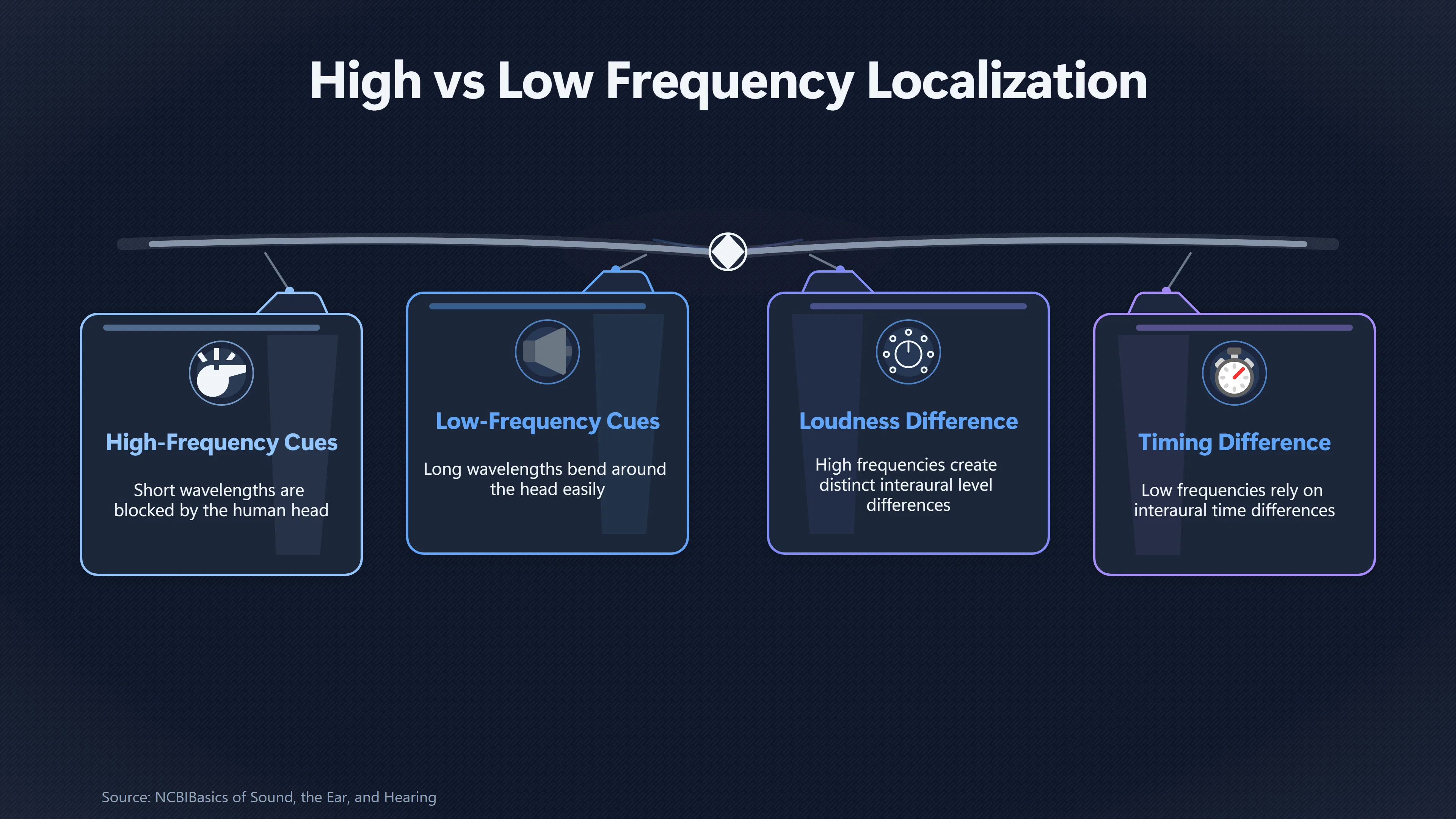
Long bass wavelengths bend around the head, so both ears receive similar sound levels and the source becomes harder to place.
On this page
- How the head creates a sound shadow
- Why long wavelengths reach both ears evenly
- What missing loudness differences mean for UFO hum reports
Page outline Jump by section
Introduction
One reason deep, low-frequency sounds are so difficult to locate is that they largely defeat one of the brain’s most important directional tools: comparing how loud a sound is at each ear. For many everyday sounds, the head creates an acoustic “shadow”, making the sound slightly quieter at the ear furthest from the source. The brain interprets this loudness difference—known as the interaural level difference (ILD)—to determine where the sound is coming from. With deep bass, however, this cue almost disappears because the sound’s long wavelengths bend around the head instead of being blocked by it.[PubMed Central (PMC)]pmc.ncbi.nlm.nih.govPub Med Central (PMC)Auditory localization: a comprehensive practical reviewPubMed Central (PMC)Auditory localization: a comprehensive practical review - PMCJuly 10, 2024…
This mechanism helps explain why low-frequency rumbles often seem to come from “everywhere” rather than a single location. In reports of mysterious UFO hums or sky noises, the absence of strong loudness differences can make an ordinary distant source feel detached from the ground, even though nothing unusual is happening acoustically.
How the Head Creates a Sound Shadow
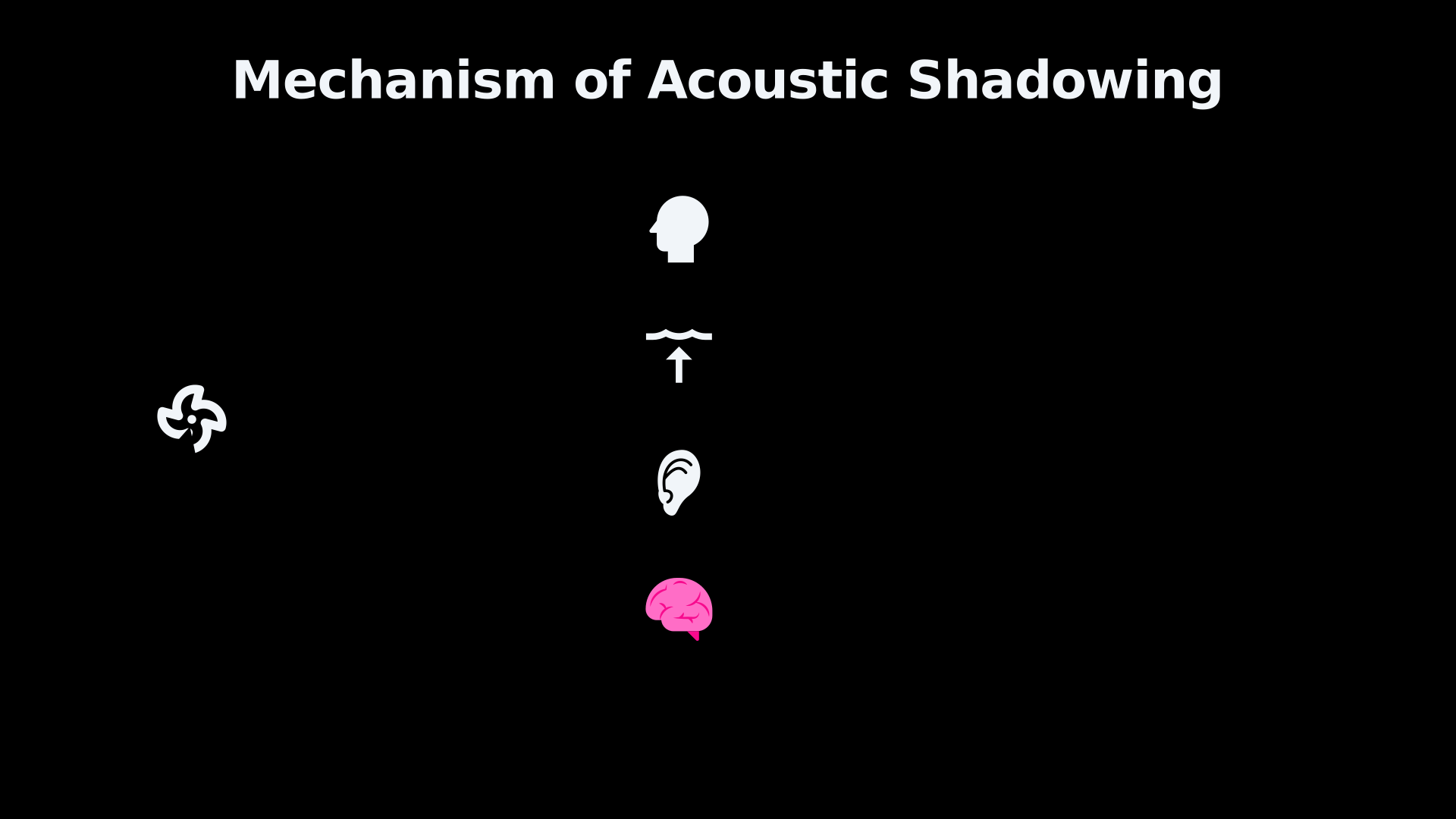
The human head is an obstacle to sound waves, but not equally for every frequency.
High-frequency sounds have short wavelengths that are similar in size to, or smaller than, the width of the head. When these sounds arrive from one side, the head blocks and reflects part of the energy before it reaches the far ear. As a result:
- the nearer ear receives a stronger signal,
- the farther ear receives a weaker signal,
- the brain measures this difference in level and estimates the sound’s direction.
This acoustic shadow grows larger as frequency increases and as the sound source moves further from directly in front of the listener. It is one of the principal reasons why the direction of a whistle, bird call or snapping twig can often be identified almost instantly.[nih.gov]pmc.ncbi.nlm.nih.govPub Med Central (PMC)Auditory localization: a comprehensive practical reviewPubMed Central (PMC)Auditory localization: a comprehensive practical review - PMCJuly 10, 2024…
Why Long Wavelengths Reach Both Ears Almost Equally
Deep bass behaves differently because its wavelengths are enormous compared with the size of the human head.
For example:
- a 100 Hz tone has a wavelength of roughly 3.4 metres,
- a 50 Hz tone stretches to about 6.9 metres,
- both are vastly larger than a head measuring only around 17–20 centimetres across.
When an obstacle is much smaller than a wave’s wavelength, the wave diffracts—it bends around the obstacle instead of being strongly blocked. The head therefore casts very little acoustic shadow for these frequencies. Nearly the same sound level reaches both ears, leaving almost no useful ILD for the auditory system to measure.[PubMed Central (PMC)]pmc.ncbi.nlm.nih.govPub Med Central (PMC)Auditory localization: a comprehensive practical reviewPubMed Central (PMC)Auditory localization: a comprehensive practical review - PMCJuly 10, 2024…
Rather than producing two noticeably different signals, deep bass delivers two remarkably similar ones.
What Missing Loudness Differences Mean
The absence of a strong loudness difference does not make bass impossible to localise, but it removes one of the brain’s most reliable directional cues.
Instead of comparing sound levels, the auditory system must depend much more heavily on tiny differences in arrival time between the ears, known as interaural time differences (ITDs). These timing cues work well under ideal listening conditions, especially for low-frequency sounds, but they are easier to disrupt when a sound is:
- continuous rather than sharply starting,
- masked by environmental noise,
- reflected from buildings or terrain,
- dominated by a narrow band of low frequencies.
Without the supporting evidence provided by ILDs, directional judgements become less certain, and perceived source locations become broader or more ambiguous.[nih.gov]ncbi.nlm.nih.govNCBIBasics of Sound, the Ear, and HearingHearing Loss - NCBI Bookshelf…
Importantly, modern auditory research shows that localisation is not governed by a rigid split between timing cues for bass and loudness cues for treble. Instead, the brain combines multiple cues whenever they are available. The difficulty with deep bass is that one of those cues—the loudness difference—is physically much weaker to begin with.[PubMed Central (PMC)]pmc.ncbi.nlm.nih.govPub Med Central (PMC)Auditory localization: a comprehensive practical reviewPubMed Central (PMC)Auditory localization: a comprehensive practical review - PMCJuly 10, 2024…
Why This Matters for Reports of UFO Hums
Many reports of mysterious aerial hums describe a low, steady vibration that seems impossible to point towards. The missing ILD cue contributes directly to that impression.
Imagine a distant industrial fan, large diesel engine or ventilation system producing mostly low-frequency energy. By the time the sound reaches a listener:
- higher-frequency components may have been absorbed more strongly by the atmosphere,
- reflections from buildings or the landscape may blur timing information,
- the remaining bass reaches both ears at almost identical levels.
Because neither ear receives a clearly louder signal, listeners often cannot confidently identify a horizontal direction. The sound may instead seem to surround them, drift overhead or appear to fill the entire environment rather than originate from a specific point. This perceptual ambiguity can make an ordinary terrestrial source feel unusually mysterious, especially at night when visual reference points are limited.[NCBI]ncbi.nlm.nih.govNCBIBasics of Sound, the Ear, and HearingHearing Loss - NCBI Bookshelf…

Bass Direction Is Reduced, Not Eliminated
A common misconception is that humans cannot localise bass at all. That is not correct.
Low-frequency sounds can still be located using timing differences, head movements and, when available, higher-frequency harmonics that accompany the bass. Problems arise when the sound contains little besides deep low frequencies or when echoes and background noise degrade the remaining cues.
This is why a full-range sound containing both bass and higher frequencies is generally much easier to place than an isolated low-frequency rumble. The high-frequency content restores the head-shadow effect, giving the brain the loudness differences it needs for more confident localisation.[NCBI]ncbi.nlm.nih.govNCBIBasics of Sound, the Ear, and HearingHearing Loss - NCBI Bookshelf…
Amazon book picks
Further Reading
Books and field guides related to Why Your Ears Struggle to Place Deep Bass. Use these as the next step if you want deeper reading beyond the article.
An Introduction to the Psychology of Hearing
Now available in a Fourth Edition, Introduction to the Psychology of Hearing is the leading textbook in the field of auditory perception-...

Spatial Hearing: The Psychophysics of Human Sound Localization
The field of spatial hearing has exploded in the decade or so since Jens Blauert's classic work on acoustics was first published in Engli...
Auditory Perception: An Analysis and Synthesis
This revised and updated third edition describes the nature of sound, how sound is analyzed by the auditory system, and the rules and pri...
Why You Hear What You Hear: An Experiential Approach to Sound...
First published 2012.
eBay marketplace picks
Marketplace Samples
Live-tested eBay searches with available results related to this page.
Selected fromUFO patch oneBay.co.uk.



Endnotes
1.
Source: ncbi.nlm.nih.gov
Title: NCBIBasics of Sound, the Ear, and Hearing
Link:https://www.ncbi.nlm.nih.gov/books/NBK207834/?report=reader
Source snippet
Hearing Loss - NCBI Bookshelf...
2.
Source: ncbi.nlm.nih.gov
Title: NCBIIntegrating Information from the Two Ears
Link:https://ncbi.nlm.nih.gov/books/NBK10820/
Source snippet
Neuroscience - NCBI Bookshelf...
3.
Source: pmc.ncbi.nlm.nih.gov
Title: Pub Med Central (PMC)Auditory localization: a comprehensive practical review
Link:https://pmc.ncbi.nlm.nih.gov/articles/PMC11267622/
Source snippet
PubMed Central (PMC)Auditory localization: a comprehensive practical review - PMCJuly 10, 2024...
Published: July 10, 2024
4.
Source: pubmed.ncbi.nlm.nih.gov
Link:https://pubmed.ncbi.nlm.nih.gov/1564201/
Source snippet
The dominant role of low-frequency interaural time differences in sound localization - PubMed...
5.
Source: pubmed.ncbi.nlm.nih.gov
Link:https://pubmed.ncbi.nlm.nih.gov/25972580/
Source snippet
Sound frequency-invariant neural coding of a frequency-dependent cue to sound source location - PubMed...
6.
Source: pmc.ncbi.nlm.nih.gov
Title: ^{2} These differences
Link:https://pmc.ncbi.nlm.nih.gov/articles/PMC8463127/
Source snippet
Signal Processing in Hearing Aids - PMCSeptember 24, 2021 — The brain integrates information received from each ear and then translates t...
Published: September 24, 2021
7.
Source: pubmed.ncbi.nlm.nih.gov
Title: Auditory spatial acuity is robust across a broad range of sound fre
Link:https://pubmed.ncbi.nlm.nih.gov/30326382/
Source snippet
variation in signal and sensory precision both constrain auditory acuity at high frequencies - PubMedOctober 4, 2018 — ABSTRACT Sensory p...
Published: October 4, 2018
8.
Source: pmc.ncbi.nlm.nih.gov
Link:https://pmc.ncbi.nlm.nih.gov/articles/PMC4871213/
9.
Source: pmc.ncbi.nlm.nih.gov
Link:https://pmc.ncbi.nlm.nih.gov/articles/PMC4769260/
10.
Source: pmc.ncbi.nlm.nih.gov
Link:https://pmc.ncbi.nlm.nih.gov/articles/PMC4271773/
11.
Source: pmc.ncbi.nlm.nih.gov
Link:https://pmc.ncbi.nlm.nih.gov/articles/PMC3791412/
12.
Source: pmc.ncbi.nlm.nih.gov
Link:https://pmc.ncbi.nlm.nih.gov/articles/PMC2856510/
13.
Source: pmc.ncbi.nlm.nih.gov
Link:https://pmc.ncbi.nlm.nih.gov/articles/PMC6729291/
14.
Source: pubmed.ncbi.nlm.nih.gov
Link:https://pubmed.ncbi.nlm.nih.gov/3372866/
15.
Source: pubmed.ncbi.nlm.nih.gov
Link:https://pubmed.ncbi.nlm.nih.gov/2754111/
Additional References
16.
Source: headphonesty.com
Title: A Deep Dive Into Harman Curves
Link:https://www.headphonesty.com/2020/04/harman-target-curves-part-1/
Source snippet
The Long Way Round (Part 1) | HeadphonestySeptember 2, 2021 — EVERY EAR HAS IT OWN HRTF Every single ear has its own head-related transfe...
Published: September 2, 2021
17.
Source: youtube.com
Title: Is YOUR SUBWOOFER facing the WRONG way? How we locate sounds explained!
Link:https://www.youtube.com/watch?v=Ug6wJj6-7XA
Source snippet
How Sound Localization Works: Timing + Intensity Differences...
18.
Source: auditoryneuroscience.org
Link:https://www.auditoryneuroscience.org/htmlEd1/Chapter5.html
19.
Source: youtube.com
Title: How Sound Localization Works: Timing + Intensity Differences
Link:https://www.youtube.com/watch?v=Kzgom_RaxoI
Source snippet
Interaural time difference and how to find your phone instantly...
20.
Source: sciencedirect.com
Title: ScienceDirect Sound source localization
Link:https://www.sciencedirect.com/science/article/pii/S187972961830067X
Source snippet
Sound source localization - ScienceDirect...
21.
Source: sciencedirect.com
Link:https://www.sciencedirect.com/science/article/abs/pii/S0378595518300169
22.
Source: sciencedirect.com
Link:https://www.sciencedirect.com/science/article/pii/S0378595518300169
23.
Source: sciencedirect.com
Link:https://www.sciencedirect.com/science/article/abs/pii/S0378595509001580
24.
Source: researchgate.net
Link:https://www.researchgate.net/publication/241248443_Interaural_level_differences_Diffraction_and_localization_by_human_listeners
25.
Source: waf-www-bohrium-com-hngfcxduded0fmhr.a03.azurefd.net
Link:https://waf-www-bohrium-com-hngfcxduded0fmhr.a03.azurefd.net/en/sciencepedia/feynman/keyword/interaural_level_difference