Within Meteor Booms
Why the Meteor Boom Comes Minutes Later
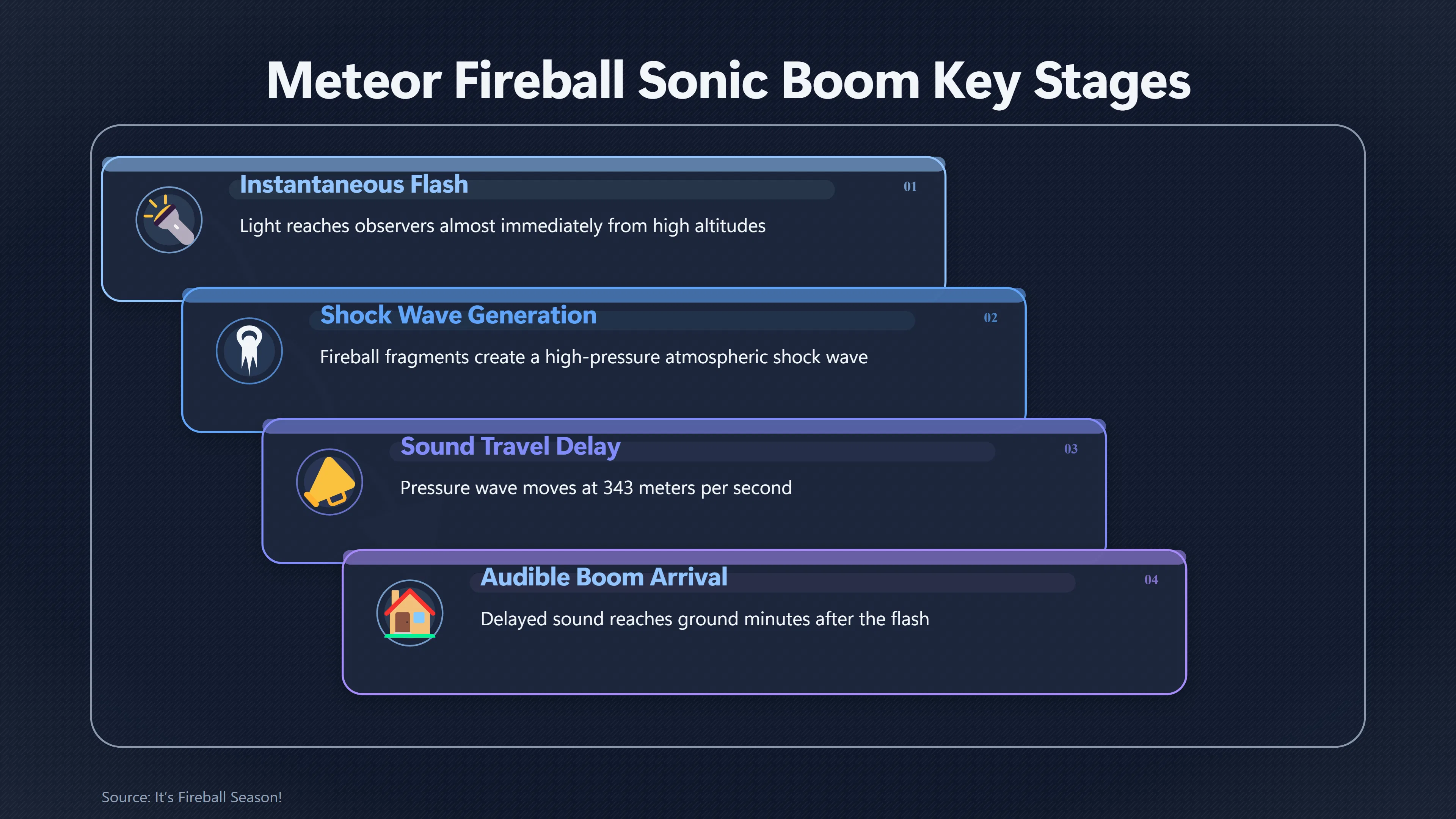
A meteor's flash is seen almost instantly, while its shock wave may take several minutes to reach people on the ground.
On this page
- How light and sound travel at different speeds
- How altitude and distance shape the delay
- Why witnesses may miss the connection
Page outline Jump by section
Introduction
A bright fireball can vanish in seconds, yet the loud boom associated with it may not arrive until several minutes later. That delay is one of the main reasons meteor-generated sonic booms are sometimes mistaken for unexplained aerial sounds or even UFO-related events. The apparent separation between the flash and the explosion is not mysterious: it is a direct consequence of light travelling vastly faster than sound, combined with the great height at which most fireballs fragment.[American Meteor Society]amsmeteors.orgAmerican Meteor Society Fireball FAQsAmerican Meteor SocietyFireball FAQs - American Meteor Society…
For many witnesses, the visual event has already faded from memory by the time windows rattle or a deep explosion is heard. Others never see the meteor at all because they are indoors, looking the wrong way, or because daylight or cloud obscures the fireball. The delayed boom therefore appears to have no obvious source, encouraging speculation about aircraft, explosions or unidentified aerial phenomena when the explanation is simply the travel time of the atmospheric shock wave.[American Meteor Society]amsmeteors.orgAmerican Meteor Society Fireball FAQsAmerican Meteor SocietyFireball FAQs - American Meteor Society…
How light and sound travel at different speeds
The key mechanism is the enormous difference between the speed of light and the speed of sound.
The light from a meteor reaches an observer essentially instantaneously over atmospheric distances. Even if a fireball fragments 50 kilometres above the ground, the light takes only a tiny fraction of a second to arrive. Human perception therefore treats the flash as immediate.
The pressure wave generated by the same event behaves very differently. Once created, the shock eventually weakens into an audible sonic boom that travels through the atmosphere at roughly the speed of sound—about 343 metres per second near sea level under typical conditions, although temperature, pressure and wind alter the exact value.[American Meteor Society]amsmeteors.orgAmerican Meteor Society Fireball FAQsAmerican Meteor SocietyFireball FAQs - American Meteor Society…
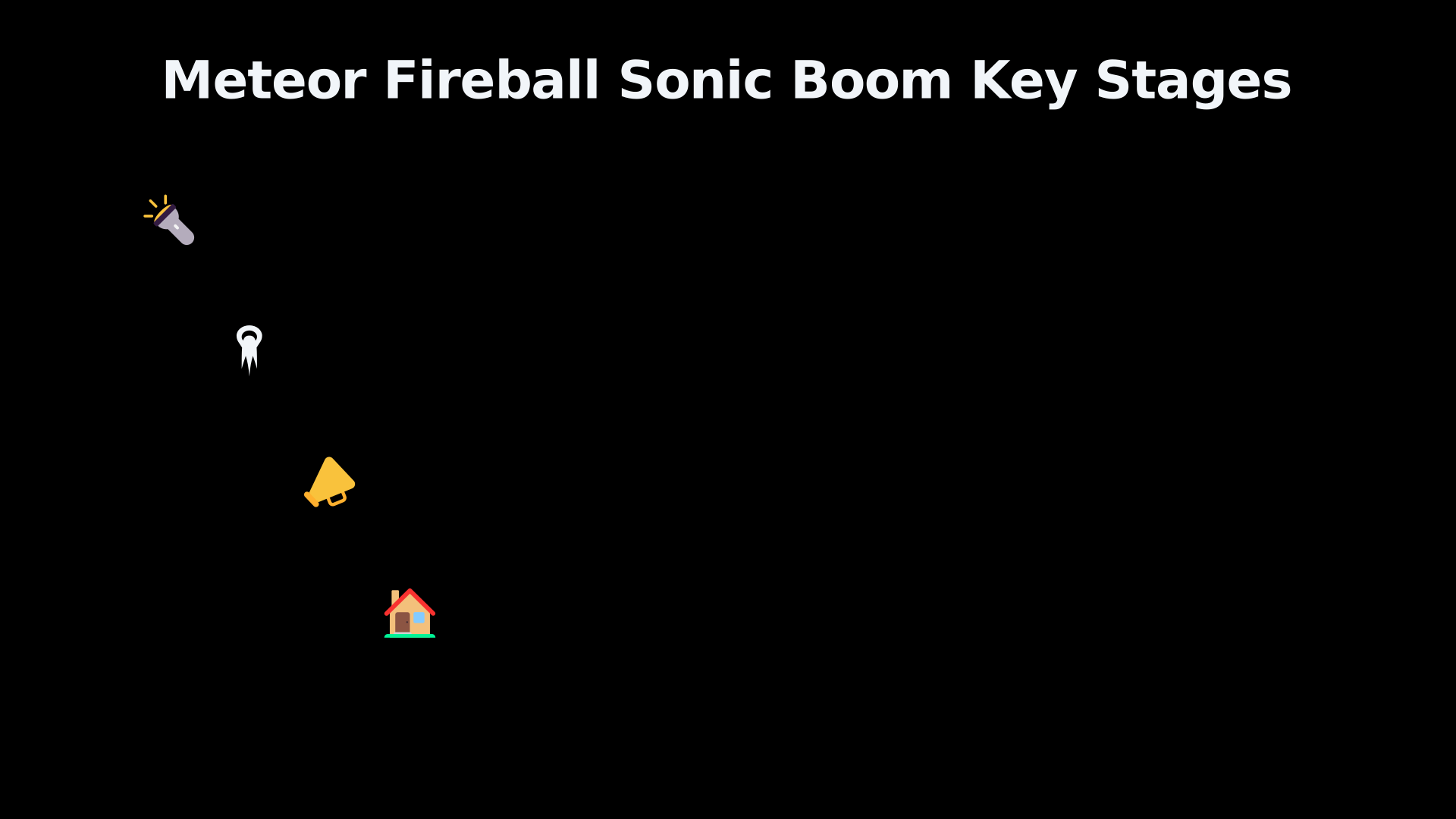
Because sound is comparatively slow, even a simple estimate shows why delays are expected:
- A boom from around 30 km away can take roughly 90 seconds to arrive.
- A source about 50 km away can produce a delay approaching two and a half minutes.
- More distant or higher-altitude airbursts can produce waits of three, four or more minutes before the sound reaches observers.
The delay is therefore a normal feature of the physics rather than evidence that two separate events occurred.[American Meteor Society]amsmeteors.orgAmerican Meteor Society Fireball FAQsAmerican Meteor SocietyFireball FAQs - American Meteor Society…
How altitude and distance shape the delay
The waiting time depends on more than the meteor’s altitude alone. What matters is the distance the sound must travel through the atmosphere from the point where the strongest shock wave is generated to the listener.
A large fireball may fragment between roughly 20 and 50 kilometres above Earth’s surface. Someone directly beneath the event experiences a shorter sound path than someone observing it near the horizon, where the boom must travel both downward and sideways through the atmosphere.[American Meteor Society]amsmeteors.orgAmerican Meteor Society Fireball FAQsAmerican Meteor SocietyFireball FAQs - American Meteor Society…
Several additional factors influence when—and even whether—the boom is heard:
- Fragmentation height: A lower-altitude breakup generally produces a shorter delay and a stronger boom.
- Observer location: People tens of kilometres apart can hear the same event at noticeably different times.
- Atmospheric conditions: Wind patterns and temperature layers can bend, weaken or focus sound waves, making booms audible much farther away than expected in some situations.[U.S. Geological Survey]usgs.govU.S. Geological Survey Sonic Booms | U.S. Geological SurveyU.S. Geological Survey Sonic Booms | U.S. Geological Survey
These effects explain why reports from different communities often describe the same meteor but disagree about exactly when the explosion was heard.
Why witnesses often miss the connection
The delayed arrival of sound creates a psychological disconnect between what people see and what they later hear.
If someone watches a brilliant meteor streak overhead, they may naturally assume the event is over once the light disappears. By the time an explosive bang arrives several minutes later, many have resumed whatever they were doing and no longer associate the sound with the earlier flash.
Others never make the connection because they experience only one part of the event:
- People indoors may hear the boom but never see the meteor.
- Drivers may notice the explosion after the fireball has passed out of view.
- Daytime observers may hear windows shake without ever noticing the brief flash against a bright sky.
- Residents facing away from the meteor’s path may hear only the delayed pressure wave.[American Meteor Society]amsmeteors.orgAmerican Meteor Society Fireball FAQsAmerican Meteor SocietyFireball FAQs - American Meteor Society…
This separation in perception makes the boom seem spontaneous, encouraging reports of unexplained explosions, military activity or unidentified flying objects until meteor observations and camera footage reconstruct the event.
A real-world pattern seen repeatedly
Documented meteor events repeatedly follow this sequence: a brilliant fireball appears, several minutes pass, and only then do widespread reports of booming sounds and shaking buildings emerge.
For example, a large meteor over the north-eastern United States in 2026 produced a daylight fireball followed by delayed sonic booms that were initially mistaken by many residents for an earthquake or explosion. NASA and the American Meteor Society identified the event as a bolide after combining eyewitness reports and observational data, while the U.S. Geological Survey confirmed the disturbance was atmospheric rather than seismic.[apnews.com]apnews.comThe American Meteor Society and NASA confirmed that a meteor, about three feet wide, entered the atmosphere around 2:06 p.m. near the New…
This pattern is characteristic of large fireballs. The visual event and the audible boom originate from the same phenomenon, but because light arrives almost instantly while sound takes minutes to cross the atmosphere, the two experiences become separated in time. That delay is one of the simplest—and most important—reasons meteor booms are so often reported as mysterious or UFO-related noises before their true cause is established.
Amazon book picks
Further Reading
Books and field guides related to Why the Meteor Boom Comes Minutes Later. Use these as the next step if you want deeper reading beyond the article.
Meteorites: The Story of Our Solar System
Meteorite tells the fascinating story of the stones from outer space scattered across our planet. From the impact that finished off the d...
Rocks from Space
Appendices A-C: Meteorite verification laboratories, Commercial meteorite dealers, Selected list of suspected impact craters worldwide.
Falling Stars: A Guide to Meteors and Meteorites
Month-by-month information on meteor showers and how to make the most of watching them Advice on starting and building a meteorite collec...
The Cambridge Encyclopedia of Meteorites
Beautifully illustrated with over 140 full colour images, The Cambridge Encyclopedia of Meteorites provides a thorough guide to these fas...
eBay marketplace picks
Marketplace Samples
Live-tested eBay searches with available results related to this page.
Selected fromUFO poster oneBay.co.uk.

Current eBay listing
FS02 VINTAGE UFO FLYING SAUCERS COMIC ADVERTISING A4 POSTER PRINT

Current eBay listing
UFO ABDUCTION OVER THE OCEAN -FRAMED WALL ART PAPER PRINT POSTER
Endnotes
1.
Source: nasa.gov
Title: It’s Fireball Season!
Link:https://www.nasa.gov/blogs/watch-the-skies/2026/03/26/its-fireball-season-answering-your-meteor-questions/
Source snippet
Answering Your Meteor Questions - NASAMarch 26, 2026 — WATCH THE SKIES Image Janet Sudnik March 26, 2026 5:18PM CATEGORIES Marshall Space...
Published: March 26, 2026
2.
Source: science.nasa.gov
Title: meteors meteorites
Link:https://science.nasa.gov/solar-system/meteors-meteorites/
Source snippet
Image: Starry night with meteors streaking above the trees. The constellation Orion is visible Image: A mete...
3.
Source: science.nasa.gov
Link:https://science.nasa.gov/solar-system/meteors-meteorites/facts/
4.
Source: nasa.gov
Title: interesting fact of the month 2021
Link:https://www.nasa.gov/space-science-and-astrobiology-at-ames/interesting-fact-of-the-month-current/interesting-fact-of-the-month-2021/
5.
Source: science.nasa.gov
Title: looking for lightning finding fireballs 149381
Link:https://science.nasa.gov/earth/earth-observatory/looking-for-lightning-finding-fireballs-149381/
6.
Source: science.nasa.gov
Title: instruments image fireball over bering sea
Link:https://science.nasa.gov/solar-system/nasa-instruments-image-fireball-over-bering-sea/
7.
Source: jpl.nasa.gov
Title: instruments image fireball over bering sea
Link:https://www.jpl.nasa.gov/news/nasa-instruments-image-fireball-over-bering-sea/
8.
Source: nasa.gov
Title: NAS A Instruments Image Fireball over Bering Sea
Link:https://www.nasa.gov/centers-and-facilities/goddard/nasa-instruments-image-fireball-over-bering-sea/
9.
Source: nasa.gov
Title: Five Years after the Chelyabinsk Meteor: NASA Leads Efforts in Planetary Defense
Link:https://www.nasa.gov/solar-system/five-years-after-the-chelyabinsk-meteor-nasa-leads-efforts-in-planetary-defense/
10.
Source: science.nasa.gov
Title: meteor fragments blaze over the ural mountains
Link:https://science.nasa.gov/blogs/earth-matters/2013/02/15/meteor-fragments-blaze-over-the-ural-mountains/
11.
Source: jpl.nasa.gov
Title: additional details on the large feb 15 fireball over russia
Link:https://www.jpl.nasa.gov/news/additional-details-on-the-large-feb-15-fireball-over-russia/
12.
Source: jpl.nasa.gov
Title: fireball over californianevada how big was it
Link:https://www.jpl.nasa.gov/news/fireball-over-californianevada-how-big-was-it/
13.
Source: amsmeteors.org
Title: American Meteor Society Fireball FAQs
Link:https://www.amsmeteors.org/fireballs/faqf/
Source snippet
American Meteor SocietyFireball FAQs - American Meteor Society...
14.
Source: usgs.gov
Title: U.S. Geological Survey Sonic Booms | U.S. Geological Survey
Link:https://www.usgs.gov/programs/earthquake-hazards/sonic-booms
15.
Source: usgs.gov
Link:https://www.usgs.gov/faqs/how-does-usgs-tell-difference-between-earthquake-and-a-sonic-boom
16.
Source: apnews.com
Link:https://apnews.com/article/2b79039c94af28e4b63aaeabf06c6844
Source snippet
The American Meteor Society and NASA confirmed that a meteor, about three feet wide, entered the atmosphere around 2:06 p.m. near the New...
17.
Source: theverge.com
Title: meteor exploded [new england]({{ ‘new-england/’ | relative_url }})
Link:https://www.theverge.com/science/940467/meteor-exploded-new-england
Source snippet
The event produced a sonic boom that shook houses across the region, prompting initial speculation of an earthquake. However, the US Geol...
18.
Source: earthquake.usgs.gov
Link:https://earthquake.usgs.gov/earthquakes/eventpage/us7000sp6m
Source snippet
Sonic Boom - 6 km NNE of Saint Andrews, South CarolinaMay 28, 2026 — M? SONIC BOOM - 6 KM NNE OF SAINT ANDREWS, SOUTH CAROLINA * 2026-05...
Published: May 28, 2026
19.
Source: usgs.gov
Link:https://www.usgs.gov/faqs/what-are-those-booms-i-sometimes-hear-or-during-earthquake
20.
Source: pubs.usgs.gov
Link:https://pubs.usgs.gov/gip/msh/lateral.html
21.
Source: usgs.gov
Link:https://www.usgs.gov/programs/earthquake-hazards/earthquake-booms-seneca-guns-and-other-sounds
22.
Source: usgs.gov
Title: Earthquake Hazards
Link:https://www.usgs.gov/programs/earthquake-hazards/science/faqs?page=5
23.
Source: amsmeteors.org
Link:https://www.amsmeteors.org/fireballs/
25.
Source: amsmeteors.org
Link:https://www.amsmeteors.org/fireballs/page/2/
26.
Source: amsmeteors.org
Title: Fireball Logs
Link:https://www.amsmeteors.org/fireballs/fireball-report/
28.
Source: amsmeteors.org
Link:https://amsmeteors.org/fireballs/page/7/
29.
Source: amsmeteors.org
Link:https://www.amsmeteors.org/fireballs/page/7/?referer=www.cuteslator.com
30.
Source: imo.net
Link:https://www.imo.net/observations/fireballs/fireballs/
31.
Source: sciencedirect.com
Title: Sonic Boom
Link:https://www.sciencedirect.com/topics/physics-and-astronomy/sonic-boom
32.
Source: usgs.gov
Title: Stishovite: Synthesis by shock wave | U.S. Geological Survey
Link:https://www.usgs.gov/publications/stishovite-synthesis-shock-wave
Additional References
33.
Source: arxiv.org
Title: arXiv Physics of Meteor Generated Shock Waves in the Earth’s Atmosphere
Link:https://arxiv.org/abs/1805.07842
Source snippet
Physics of Meteor Generated Shock Waves in the Earth's Atmosphere - A Review...
34.
Source: af.mil
Link:https://www.af.mil/About-Us/Fact-Sheets/Display/article/104540/sonic-boom/
35.
Source: youtube.com
Title: Meteorite Explodes Over Russia
Link:https://www.youtube.com/watch?v=DR49rHKycpE
Source snippet
Bolide meteor falls from the sky over Southeast: Brad Panovich analysis...
36.
Source: youtube.com
Title: 10 Facts about the Chelyabinsk Meteor
Link:https://www.youtube.com/watch?v=3QzeF6uMq8E
Source snippet
Bright, loud meteor passes by Metro Vancouver...
37.
Source: madsci.org
Title: Re: Why can’t we hear meteors when they penetrate the atmosphere?
Link:https://www.madsci.org/posts/archives/2007-01/1167662574.As.r.html
38.
Source: nationalgeographic.com
Title: What is a sonic boom—and is it dangerous? | National Geographic
Link:https://www.nationalgeographic.com/science/article/sonic-boom-cause-shock-wave-physics
39.
Source: youtube.com
Title: Bolide meteor falls from the sky over Southeast: Brad Panovich analysis
Link:https://www.youtube.com/watch?v=YHKPtb9H3JE
40.
Source: youtube.com
Title: Bright, loud meteor passes by Metro Vancouver
Link:https://www.youtube.com/watch?v=6WbhGMSUJ8Q
Source snippet
Meteorite Explodes Over Russia...
41.
Source: youtube.com
Title: The Day the Sky Exploded Over a City
Link:https://www.youtube.com/watch?v=qi4vYZXwGgM
Source snippet
10 Facts about the Chelyabinsk Meteor...
42.
Source: popastro.com
Title: Detailed Fireball Reporting Guide
Link:https://www.popastro.com/meteor/detailed-fireball-reporting-guide/