Within Silent Sightings
Can Aircraft Noise Arrive After the UFO Passes?
A fast or high aircraft can be visible well before its sound arrives, creating a brief but convincing impression of complete silence.
On this page
- How sound travel time creates a delay
- When altitude and speed make the gap noticeable
- Why witnesses may fail to link the later noise
Page outline Jump by section
Introduction
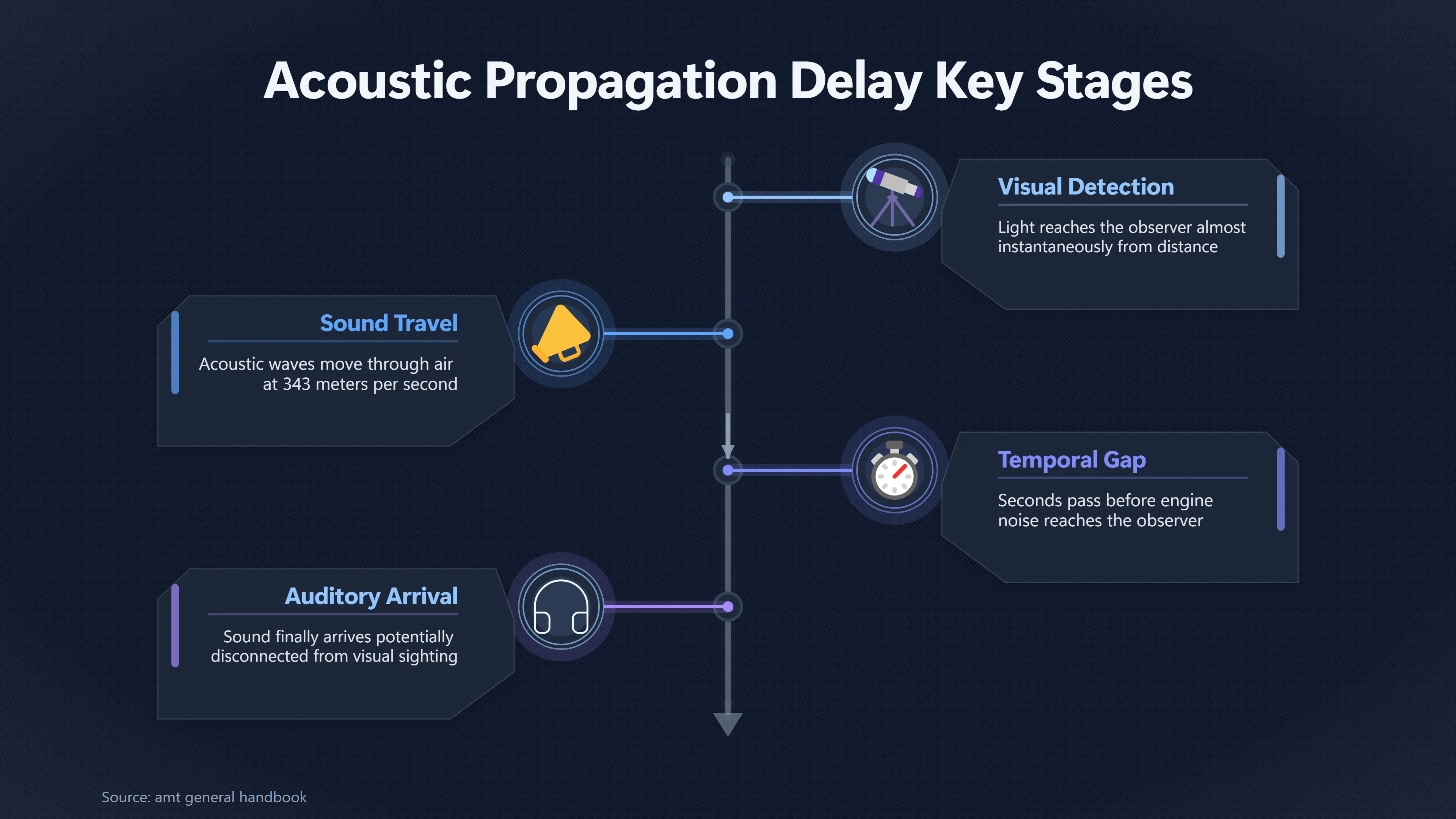
A witness who sees an aircraft but hears nothing at first may understandably conclude that the object is unusually quiet or even silent. In many cases, however, the apparent silence is a consequence of timing rather than an absence of sound. Light reaches the observer almost instantaneously, while sound travels through air at only about 343 metres per second under typical conditions. As a result, an aircraft can be seen well before its engine noise arrives, especially if it is distant, flying at altitude or moving quickly. This delay can briefly create the impression of a silent unidentified object, and when the sound finally arrives it may no longer seem connected to what was seen. This mechanism is a well-understood aspect of acoustics and is an important conventional explanation when evaluating reports of apparently silent UFOs.[Federal Aviation Administration]faa.govFederal Aviation AdministrationFundamentals of Noise and Sound | Federal Aviation AdministrationMarch 29, 2022…
Can Aircraft Noise Arrive After the UFO Passes?
Yes. The delay between seeing an aircraft and hearing it is a normal consequence of the different speeds of light and sound.
For nearby, low-flying aircraft the gap is often so short that people perceive the sight and sound as occurring together. As the distance increases, however, the delay becomes increasingly noticeable. An aircraft several kilometres away may be visible for many seconds before its engine noise reaches the observer. During that interval, the object can appear to move silently across the sky.
This effect becomes especially persuasive when there are few visual references. If an observer believes an aircraft is only a few hundred metres away when it is actually several kilometres distant, the lack of immediate engine noise can seem extraordinary rather than expected.
How Sound Travel Time Creates a Delay
The mechanism is straightforward. Electromagnetic radiation, including visible light, effectively reaches human observers instantly over atmospheric distances. Sound must physically travel through the air, making its arrival much slower.
Approximate delays illustrate the effect:
- At 1 kilometre, sound takes roughly 3 seconds to arrive.
- At 3 kilometres, the delay is close to 9 seconds.
- At 5 kilometres, the delay approaches 15 seconds.
- At 10 kilometres, the delay can exceed 29 seconds.
These values vary slightly with air temperature because the speed of sound changes with atmospheric conditions, but the principle remains the same. A witness may therefore watch an aircraft cross a substantial portion of the sky before hearing the engines.[Federal Aviation Administration]faa.govFederal Aviation AdministrationFundamentals of Noise and Sound | Federal Aviation AdministrationMarch 29, 2022…
When Altitude and Speed Make the Gap Noticeable
Several factors can lengthen the perceived separation between sight and sound.
High Altitude
Aircraft cruising at several thousand metres altitude are physically much farther away than many observers realise. Even if they appear directly overhead, the sound must travel the full slant distance through the atmosphere before reaching the ground.
Because engine noise also weakens with distance, the arriving sound may be much quieter than expected, making it easier to overlook or dismiss. Modern commercial aircraft are also significantly quieter than earlier generations, further reducing the chance that observers immediately associate a delayed sound with the aircraft they saw.[Federal Aviation Administration]faa.govFederal Aviation Administration Aircraft Noise | Federal Aviation AdministrationFederal Aviation AdministrationAircraft Noise | Federal Aviation AdministrationJanuary 31, 2025…
Fast Motion
A fast-moving aircraft changes position while its earlier-produced sound is still travelling towards the observer.
Imagine an aircraft travelling several hundred kilometres per hour. By the time engine noise produced at one point reaches the ground, the aircraft itself may already have travelled a considerable distance. The observer therefore sees the aircraft in one location while hearing sound generated when it occupied another.
This separation can make the noise seem to come from the wrong direction or appear unrelated to the visible object.
Wind and Atmospheric Conditions
Wind does not simply make sounds louder or quieter; it can also influence how efficiently sound reaches different locations.
A tailwind carrying sound towards an observer may reduce the apparent delay, while wind blowing the opposite way can increase it or weaken the sound enough that it becomes difficult to notice. Temperature gradients and atmospheric layering can also refract sound, bending acoustic waves upward or downward and changing where engine noise is most easily heard. These effects can reinforce the impression that an otherwise ordinary aircraft is unexpectedly silent.[Federal Aviation Administration]faa.govFederal Aviation AdministrationFundamentals of Noise and Sound | Federal Aviation AdministrationMarch 29, 2022…
Why Witnesses May Fail to Link the Later Noise
The human brain naturally assumes that sounds occurring together have a common source. When several seconds separate a visual event from its accompanying noise, that connection becomes much less obvious.
Several psychological factors contribute:
- Attention shifts. Once the object has moved on or disappeared, the observer may already be looking elsewhere.
- Direction mismatch. The delayed sound may appear to originate behind the aircraft’s current position because it reflects where the aircraft was when that sound was generated.
- Expectation bias. People generally expect large, nearby aircraft to produce immediate engine noise. When that expectation is violated, they may interpret the silence as evidence that the object was unconventional.
- Background masking. Traffic, wind, insects or urban noise can obscure the first faint arrival of engine sound, making the eventual noise seem detached from the original sighting.
These factors make delayed sound particularly easy to misinterpret during brief or unexpected observations.
Why This Matters in Silent UFO Reports
The delayed arrival of aircraft noise does not explain every report of a silent unidentified object, but it provides a simple and well-established mechanism that investigators routinely consider before invoking more unusual explanations.
A report describing an apparently silent object that is followed several seconds later by distant engine noise is consistent with ordinary acoustic propagation, especially if the object’s distance or altitude was uncertain. The later sound should not automatically be dismissed as unrelated simply because it arrived after the visual observation.
For this reason, careful investigation benefits from reconstructing the geometry of the sighting, estimated altitude, likely aircraft routes and the expected sound travel time. A delay that initially appears mysterious may be entirely consistent with the known physics of sound propagation through the atmosphere.[Federal Aviation Administration]faa.govFederal Aviation AdministrationFundamentals of Noise and Sound | Federal Aviation AdministrationMarch 29, 2022…
Amazon book picks
Further Reading
Books and field guides related to Can Aircraft Noise Arrive After the UFO Passes?. Use these as the next step if you want deeper reading beyond the article.
Fundamentals of Acoustics
Dargestellt werden die physikalischen und mathematischen Konzepte zur Beschreibung der Erzeugung, Weiterleitung und Wahrnehmung von Schal...
The Science of Sound
Written for students without a background in mathematics or physics, this textbook provides an introduction to the study of acoustics. It...
Stick and Rudder: An Explanation of the Art of Flying
In the early 1940's, Wolfgang Langewiesche wrote a series of articles in Air Facts analyzing the various aspects of piloting techniques....
Why You Hear What You Hear: An Experiential Approach to Sound...
First published 2012.
eBay marketplace picks
Marketplace Samples
Live-tested eBay searches with available results related to this page.
Selected fromUFO poster oneBay.co.uk.


Current eBay listing
I Want To Believe UFO Poster Giclée Fine Art Heavyweight Print


Current eBay listing
VINTAGE UFO FLYING SAUCERS COMIC ADVERTISING A2 POSTER PRINT
Endnotes
1.
Source: faa.gov
Link:https://www.faa.gov/regulations_policies/policy_guidance/noise/basics
Source snippet
Federal Aviation AdministrationFundamentals of Noise and Sound | Federal Aviation AdministrationMarch 29, 2022...
Published: March 29, 2022
2.
Source: faa.gov
Title: amt general handbook
Link:https://www.faa.gov/sites/faa.gov/files/regulations_policies/handbooks_manuals/aviation/amt_general_handbook.pdf
Source snippet
Federal Aviation AdministrationFAA-H-8083-30A...
3.
Source: faa.gov
Title: Federal Aviation Administration Aircraft Noise | Federal Aviation Administration
Link:https://www.faa.gov/noise/aircraft_noise
Source snippet
Federal Aviation AdministrationAircraft Noise | Federal Aviation AdministrationJanuary 31, 2025...
Published: January 31, 2025
4.
Source: faa.gov
Link:https://www.faa.gov/noise/aviation_noise/fundamentals_of_noise
5.
Source: faa.gov
Title: Supersonic Flight | Federal Aviation Administration
Link:https://www.faa.gov/supersonic
Source snippet
July 9, 2026 — SUPERSONIC FLIGHT The Future of Supersonic Transportation > "This order begins a historic national effort to reestablish t...
Published: July 9, 2026
6.
Source: faa.gov
Title: Trump’s Transportation Secretary Sean P
Link:https://www.faa.gov/newsroom/trumps-transportation-secretary-sean-p-duffy-announces-supersonic-flight-coming-us
Source snippet
Duffy Announces Supersonic Flight Is Coming to the U.S. | Federal Aviation AdministrationJune 30, 2026 — TRUMP’S TRANSPORTATION SECRETARY...
Published: June 30, 2026
7.
Source: faa.gov
Title: Noise | Federal Aviation Administration
Link:https://www.faa.gov/noise
Source snippet
While there are many benefits to air travel, aviation noise can be a concern for communities. The FAA is limited b...
8.
Source: faa.gov
Title: Community Response to Noise | Federal Aviation Administration
Link:https://www.faa.gov/noise/aviation_noise/community_response
9.
Source: faa.gov
Link:https://www.faa.gov/faq/what-dnl-and-why-does-faa-use-it
10.
Source: sciencedirect.com
Title: Aircraft Noise
Link:https://www.sciencedirect.com/topics/earth-and-planetary-sciences/aircraft-noise
Additional References
11.
Source: nasa.gov
Title: NAS A’s X-59 Flies Supersonic for First Time
Link:https://www.nasa.gov/blogs/quesst/2026/06/08/x-59-blog-060826/
Source snippet
NASA’s X-59 Flies Supersonic for First Time - NASAJune 8, 2026 — NASA QUESST NASA's Quesst mission, which features the one-of-a-kind X-59...
Published: June 8, 2026
12.
Source: youtube.com
Title: Measuring the Speed of Sound
Link:https://www.youtube.com/watch?v=xVzHT5BP-Sw
Source snippet
Speed of sound vs speed of light sound delay Speed Of Light Vs Speed Of Sound #shorts Zypherium...
13.
Source: youtube.com
Title: The sound barrier, shockwaves, sonic booms and the shock wave cone
Link:https://www.youtube.com/watch?v=Uw8zIOjzJbo
Source snippet
Breaking The Sound Barrier: Can Pilots Hear Sonic Booms?...
14.
Source: usgs.gov
Link:https://www.usgs.gov/programs/earthquake-hazards/sonic-booms
15.
Source: congress.gov
Link:https://www.congress.gov/crs-product/IF11420
16.
Source: ufouap.net
Title: This g
Link:https://www.ufouap.net/en/explainers/common-ufo-misidentifications
Source snippet
Common UFO misidentifications: [drones]({{ 'drones/' | relative_url }}), satellites, [balloons]({{ 'balloons/' | relative_url }}), aircraft, planets, and camera artifacts | Global UFO ArchiveJuly 1...
Published: July 15, 2026
17.
Source: youtube.com
Title: Breaking The Sound Barrier: Can Pilots Hear Sonic Booms?
Link:https://www.youtube.com/watch?v=pD77DIO034A
Source snippet
Measuring the Speed of Sound - GCSE Physics...
18.
Source: youtube.com
Title: Neil de Grasse Tyson Explains Sonic Booms
Link:https://www.youtube.com/watch?v=GQSeTNctYig
Source snippet
The sound barrier, shockwaves, sonic booms and the shock wave cone...
19.
Source: doi.org
Link:https://doi.org/10.1142/S2251171723400056
20.
Source: ufotransparency.com
Link:https://ufotransparency.com/files/intl-uk-project-condign-volume-1-uap-vol1-annex-dtof