Within Low Frequency
How Distant Noise Loses Its Sense of Direction
Atmospheric travel removes much of a distant sound's sharper content, leaving a bass-heavy rumble with few clues to its source.
On this page
- Why high frequencies fade faster over distance
- How bass survives from remote ground sources
- Why filtered rumbles can be mistaken for sky sounds
Page outline Jump by section
Introduction
One reason distant noises are often reported as mysterious “UFO sounds” is that long-distance travel changes what reaches the listener. Over several kilometres, the atmosphere removes much of a sound’s higher-frequency content while allowing lower-frequency energy to travel much farther. The result is a deep, bass-heavy rumble that has lost many of the directional clues the human auditory system normally relies on. A train, industrial fan, cargo ship or distant aircraft may therefore sound detached from its true location, appearing to come from the sky, the horizon or even from “everywhere at once” rather than from a single identifiable source. This effect is well understood in acoustics and hearing science and helps explain why remote, ordinary sound sources can be perceived as unfamiliar or difficult to locate.[NCBI]ncbi.nlm.nih.govNCBIBasics of Sound, the Ear, and HearingHearing Loss - NCBI Bookshelf…
Why High Frequencies Fade Faster Over Distance
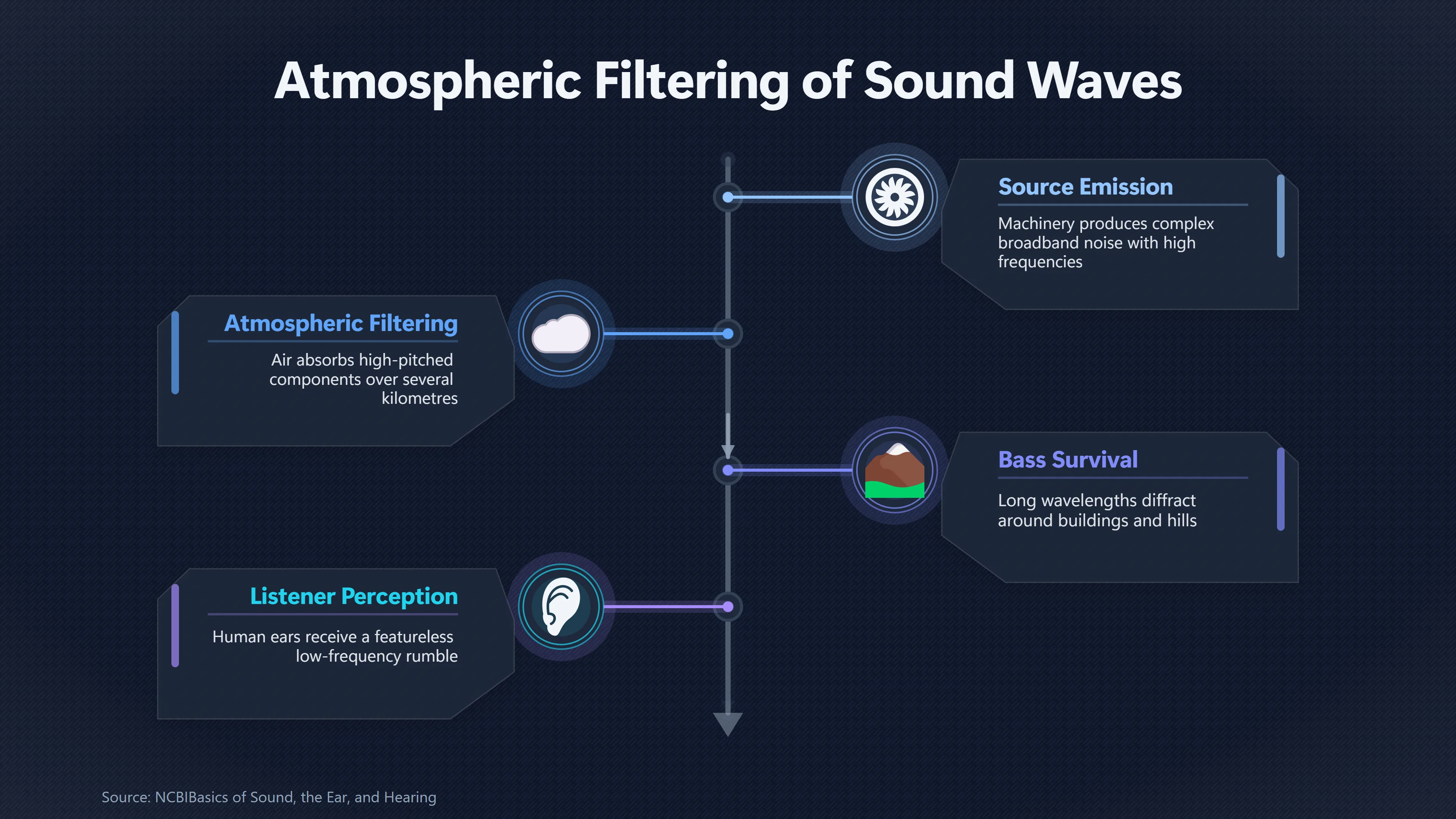
Air does not transmit every frequency equally well. As sound propagates, higher frequencies are absorbed more strongly by the atmosphere than lower frequencies. The amount depends on humidity, temperature and atmospheric pressure, but the overall trend is consistent: sharp, high-pitched components weaken much faster than deep bass.
This selective filtering matters because many everyday sound sources contain a broad range of frequencies.
For example:
- A diesel locomotive produces deep engine pulses alongside metallic wheel noise and higher-frequency mechanical sounds.
- A large industrial compressor emits both a low-frequency hum and higher-pitched motor components.
- An aircraft engine generates broadband noise extending from bass into high frequencies.
Close to the source, these combined frequencies help listeners recognise both the type of sound and its direction. After travelling long distances, however, much of the higher-frequency information has disappeared, leaving mainly the lower-frequency rumble. The sound becomes less distinctive and much harder to place accurately.[NCBI]ncbi.nlm.nih.govNCBIBasics of Sound, the Ear, and HearingHearing Loss - NCBI Bookshelf…
How Bass Survives From Remote Ground Sources
Low-frequency sound has wavelengths measured in metres. These long wavelengths interact differently with obstacles and the atmosphere than shorter wavelengths.
Because of their size, bass waves:
- diffract, or bend, around buildings, hills and vegetation more effectively;
- lose less energy to atmospheric absorption over long distances;
- can continue propagating after higher-frequency components have largely disappeared.
This does not mean low frequencies travel without loss. Their level still decreases with distance through geometric spreading and ground interaction. However, compared with higher-frequency sound, they often remain the dominant part of the signal over several kilometres.
Large ground-based sources therefore become acoustically “simplified” with distance. What began as a complex industrial or transport sound may eventually resemble a smooth, continuous low-frequency drone with few identifying features.[NCBI]ncbi.nlm.nih.govNCBIBasics of Sound, the Ear, and HearingHearing Loss - NCBI Bookshelf…
Why Filtered Rumbles Can Be Mistaken for Sky Sounds
Human directional hearing depends heavily on comparing what reaches each ear.
When higher frequencies are present, the head creates an acoustic shadow, making the nearer ear receive a noticeably louder signal. This interaural level difference is one of the strongest directional cues available.
After atmospheric filtering removes much of that high-frequency content, several problems arise:
- the sound reaching both ears becomes much more similar;
- remaining directional information relies mainly on tiny timing differences;
- continuous low-frequency rumbles provide fewer distinct features for the brain to analyse.
The result is increased uncertainty rather than complete inability to localise. Instead of confidently pointing to a factory, railway or distant aircraft, listeners may simply perceive the sound as surrounding them or hovering somewhere above. Hearing research shows that localisation becomes progressively less precise when these spectral cues are reduced, especially for sustained low-frequency sounds in real outdoor environments.[nih.gov]pmc.ncbi.nlm.nih.govPub Med Central (PMC)Auditory localization: a comprehensive practical reviewPubMed Central (PMC)Auditory localization: a comprehensive practical review - PMC…
Why “Overhead” Is a Common Impression
Reports of unexplained aerial noises often describe a sound that seems suspended in the sky despite having no visible source.
Several factors contribute to this perception:
- No obvious horizontal direction. With weakened localisation cues, the listener cannot confidently assign the sound to a point on the ground.
- Broad environmental coverage. Low-frequency waves can arrive along multiple paths after bending around terrain and structures, making the sound feel widespread rather than point-like.
- Lack of visual confirmation. When no obvious train, ship or industrial site is visible, the brain searches for alternative explanations.
The perception of an overhead source therefore does not necessarily indicate that the source is actually airborne. Instead, it reflects uncertainty created by the loss of directional information during long-distance propagation.[PubMed Central (PMC)]pmc.ncbi.nlm.nih.govPub Med Central (PMC)Auditory localization: a comprehensive practical reviewPubMed Central (PMC)Auditory localization: a comprehensive practical review - PMC…
Everyday Sources That Change Character With Distance
Several common sources illustrate this transformation particularly well.
Freight trains may lose the distinctive clatter of wheels and retain mainly the deep engine or rolling rumble, making them sound like a distant continuous vibration.
Ships operating many kilometres offshore often produce persistent low-frequency engine noise that travels inland after much of the sharper machinery noise has been absorbed.
Industrial facilities such as refineries, mines or large ventilation systems frequently emit broadband noise. At long range, listeners may hear only a featureless hum that bears little resemblance to the original machinery.
Aircraft can also change dramatically with distance. Rather than the familiar close-range engine sound, a remote aircraft may produce a diffuse low-frequency rumble that is difficult to connect with the visible object—or may be heard before the aircraft is noticed at all.[NCBI]ncbi.nlm.nih.govNCBIBasics of Sound, the Ear, and HearingHearing Loss - NCBI Bookshelf…
Why This Matters When Interpreting Unusual Noise Reports
Distance acts as a natural acoustic filter. It removes many of the spectral details that identify a sound source while leaving behind the frequencies that humans find hardest to localise precisely. This combination can make entirely ordinary machinery, transport or industrial activity sound unfamiliar and directionless.
For reports of unexplained “UFO noises”, this mechanism offers a well-supported physical explanation for why witnesses sometimes describe deep rumbles as coming from nowhere in particular or from directly overhead. The effect does not require an unusual sound source. Instead, it arises because atmospheric propagation strips away much of the information the auditory system normally uses to determine where a sound originates.[nih.gov]ncbi.nlm.nih.govNCBIBasics of Sound, the Ear, and HearingHearing Loss - NCBI Bookshelf…
Amazon book picks
Further Reading
Books and field guides related to How Distant Noise Loses Its Sense of Direction. Use these as the next step if you want deeper reading beyond the article.
The Sound Book
A professor of acoustic engineering provides a tour of the world's most amazing sound phenomena, including creaking glaciers, whispering...
Master Handbook of Acoustics
Practical Instruction on the Art and Science of Acoustic Design and Architecture Build your own acoustic environments such as recording s...
The Universal Sense
A surprising, entertaining book about how what we hear with our ears affects what's between them.
Why You Hear What You Hear
Why You Hear What You Hear is the first book on the physics of sound for the nonspecialist to empower readers with a hands-on, ears-open...
eBay marketplace picks
Marketplace Samples
Live-tested eBay searches with available results related to this page.
Selected fromUFO poster oneBay.co.uk.

Current eBay listing
VINTAGE UFO FLYING SAUCERS COMIC ADVERTISING A2 POSTER PRINT


Current eBay listing
I Want To Believe UFO Poster Giclée Fine Art Heavyweight Print

Endnotes
1.
Source: ncbi.nlm.nih.gov
Title: NCBIBasics of Sound, the Ear, and Hearing
Link:https://www.ncbi.nlm.nih.gov/books/NBK207834/?report=reader
Source snippet
Hearing Loss - NCBI Bookshelf...
2.
Source: ncbi.nlm.nih.gov
Title: NCBIIntegrating Information from the Two Ears
Link:https://www.ncbi.nlm.nih.gov/books/NBK10820/
Source snippet
Neuroscience - NCBI Bookshelf...
3.
Source: pmc.ncbi.nlm.nih.gov
Title: Pub Med Central (PMC)Auditory localization: a comprehensive practical review
Link:https://pmc.ncbi.nlm.nih.gov/articles/PMC11267622/
Source snippet
PubMed Central (PMC)Auditory localization: a comprehensive practical review - PMC...
4.
Source: oceanservice.noaa.gov
Link:https://oceanservice.noaa.gov/facts/sound.html
Source snippet
THE DISTANCE THAT [SOUND TRAVELS]({{ 'sound-travel/' | relative_url }}) IN THE OCEAN VARIES GREATLY, DEPENDING PRIMARILY UPON WATER TEMPERATURE AND PRESSURE. Image: short captio...
5.
Source: pmc.ncbi.nlm.nih.gov
Link:https://pmc.ncbi.nlm.nih.gov/articles/PMC8837388/
Source snippet
2022 Feb 10;151(2):924–938. doi: 10.1121/10.0009398 THE EFFECT OF TARGET AND INTERFERER FREQUENCY ON ACROSS-FREQUENCY BINAURAL INTERFEREN...
6.
Source: pmc.ncbi.nlm.nih.gov
Link:https://pmc.ncbi.nlm.nih.gov/articles/PMC8249038/
7.
Source: pubmed.ncbi.nlm.nih.gov
Link:https://pubmed.ncbi.nlm.nih.gov/30326382/
8.
Source: pmc.ncbi.nlm.nih.gov
Link:https://pmc.ncbi.nlm.nih.gov/articles/PMC5798994/
9.
Source: pmc.ncbi.nlm.nih.gov
Link:https://pmc.ncbi.nlm.nih.gov/articles/PMC5479918/
10.
Source: pmc.ncbi.nlm.nih.gov
Link:https://pmc.ncbi.nlm.nih.gov/articles/PMC4769260/
11.
Source: pubmed.ncbi.nlm.nih.gov
Link:https://pubmed.ncbi.nlm.nih.gov/25972580/
12.
Source: pmc.ncbi.nlm.nih.gov
Link:https://pmc.ncbi.nlm.nih.gov/articles/mid/NIHMS8602/
13.
Source: pubmed.ncbi.nlm.nih.gov
Link:https://pubmed.ncbi.nlm.nih.gov/25698049/
14.
Source: pmc.ncbi.nlm.nih.gov
Link:https://pmc.ncbi.nlm.nih.gov/articles/PMC3155591/
15.
Source: pubmed.ncbi.nlm.nih.gov
Link:https://pubmed.ncbi.nlm.nih.gov/21895092/
16.
Source: pubmed.ncbi.nlm.nih.gov
Link:https://pubmed.ncbi.nlm.nih.gov/19045635/
Additional References
17.
Source: mdpi.com
Title: In general, loudness is regarded as a relative distance cue unless the li
Link:https://www.mdpi.com/2076-3417/11/23/11242
Source snippet
Psychoacoustic Principle, Methods, and Problems with Perceived Distance Control in Spatial AudioNovember 26, 2021 — Prior knowledge of so...
Published: November 26, 2021
18.
Source: repository.library.noaa.gov
Title: [Button: Download] Citation [Select]
Link:https://repository.library.noaa.gov/view/noaa/67828
Source snippet
simplified semi-empirical model for long-range low-frequency noise propagation in the turbulent atmosphereJanuary 1, 2023 — A SIMPLIFIED...
Published: January 1, 2023
19.
Source: catalog.data.gov
Title: sanctsound sound propagation models
Link:https://catalog.data.gov/dataset/sanctsound-sound-propagation-models
Source snippet
Oceanic and Atmospheric Administration, Department of Commerce - SanctSound Sound Propagation ModelsMarch 15, 2022 — RESOURCES 7 resource...
Published: March 15, 2022
20.
Source: youtube.com
Title: Is YOUR SUBWOOFER facing the WRONG way? How we locate sounds explained!
Link:https://www.youtube.com/watch?v=Ug6wJj6-7XA
Source snippet
Atmospheric absorption of sound frequency distance propagation Lecture 29: Topography and Sound Propagation NPTEL IIT Kharagpur...
21.
Source: youtube.com
Title: Refraction of Sound: How Sound Waves Bend Through Different Media
Link:https://www.youtube.com/watch?v=4_B_pTxlQvE
Source snippet
Where is Sound Coming From? | How Humans Use Sound LOCALIZATION...
22.
Source: oceanservice.noaa.gov
Link:https://oceanservice.noaa.gov/facts/sofar.html?m=1
Source snippet
IS AN OCEAN “CHANNEL” THAT ALLOWS SOUND TO CARRY GREAT DISTANCES. Image: SOFAR, or Sound Fixing and Ranging Channel, is a naturally-occur...
23.
Source: youtube.com
Title: Interaural Time Difference and Interaural Level Difference
Link:https://www.youtube.com/watch?v=7-tJoSS5fmg
Source snippet
Is YOUR SUBWOOFER facing the WRONG way? How we locate sounds explained...
24.
Source: youtube.com
Title: Where is Sound Coming From? | How Humans Use Sound LOCALIZATION
Link:https://www.youtube.com/watch?v=dnDrAG8FZok
Source snippet
Interaural Time Difference and Interaural Level Difference...
25.
Source: spaceweather.gov
Link:https://www.spaceweather.gov/content/global-d-region-absorption-prediction-documentation
26.
Source: spaceweather.gov
Link:https://www.spaceweather.gov/phenomena/ionosphere