Within Low Hums
Which Machines Can Mimic a UFO Hum?
Generators, compressors, fans and pumping stations can produce persistent mechanical tones that resemble reported UFO humming.
On this page
- Common industrial sound sources
- How distance changes the sound
- Environmental checks near a sighting
Page outline Jump by section
Introduction
Many reports of unidentified flying objects describe a persistent, low mechanical hum rather than a dramatic roar. One of the most plausible conventional explanations is that the sound originated not from an unusual object in the sky but from industrial equipment operating nearby or several kilometres away. Large compressors, ventilation systems, pumping stations, transformers and other heavy machinery commonly generate stable low-frequency tones that can be difficult for people to locate accurately. Under favourable weather and terrain conditions, these sounds may appear detached from their true source, creating the impression that a hovering or distant object is emitting the hum. Understanding how industrial machinery produces these sounds helps explain why some UFO reports include remarkably similar acoustic descriptions without requiring an extraordinary cause.

Which Machines Can Mimic a UFO Hum?
Industrial installations are among the most common producers of continuous low-frequency sound. Unlike sharp mechanical noises, these systems often emit steady tones that remain audible long after higher-frequency components have faded with distance.
Common examples include:
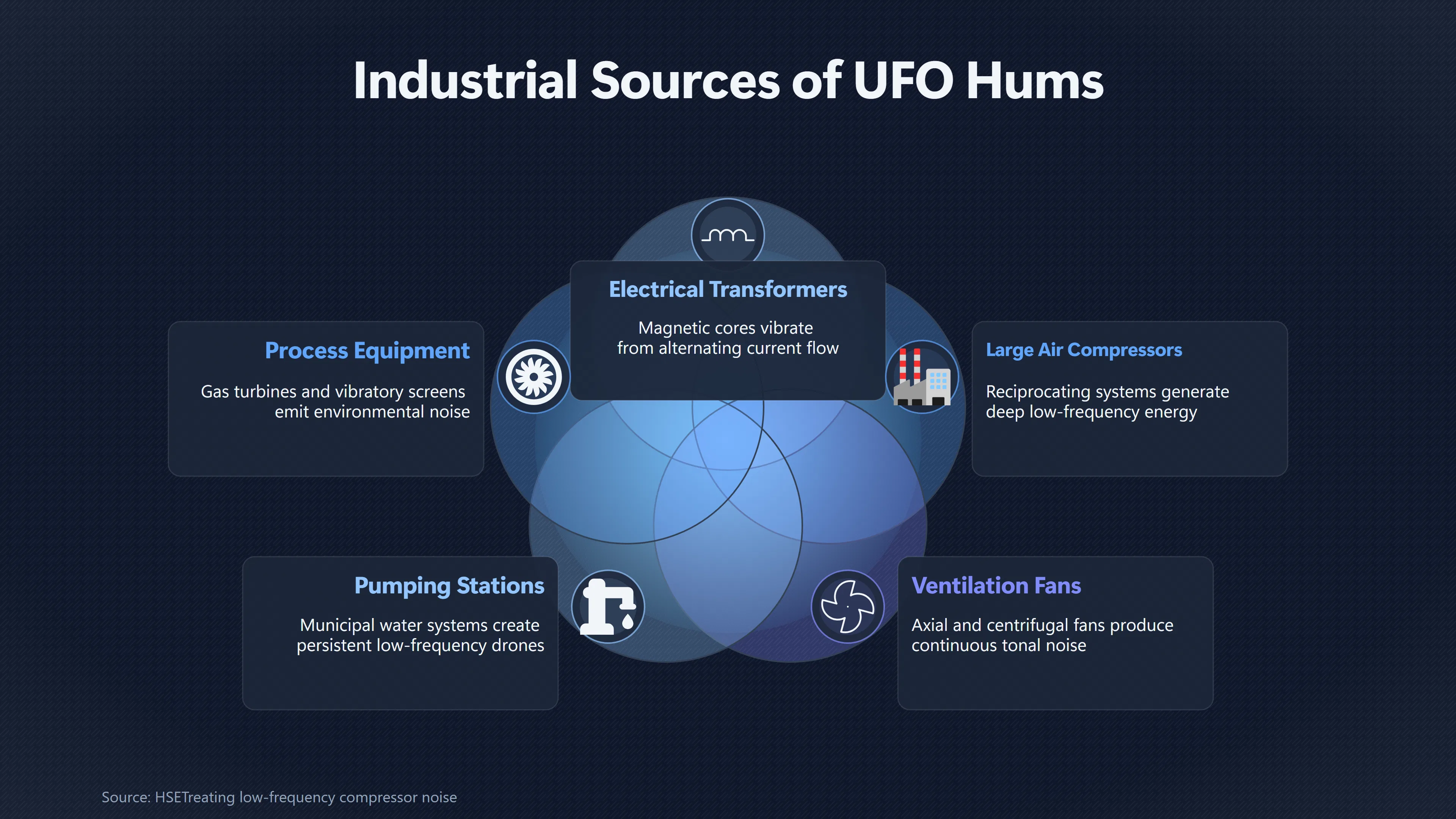
- Electrical transformers and substations: Power transformers naturally vibrate because alternating current causes their magnetic cores to expand and contract slightly, producing the familiar electrical hum. Whether this hum is audible beyond the site depends on transformer design, shielding and surrounding structures.[GOV.UK]GOV.UKNational Policy Statement for electricity networks infrastructure (EN-5), 2025 (accessible webpage) - GOV.UKJanuary 6, 2026…
- Large air compressors: Reciprocating and rotary compressors generate pronounced low-frequency energy, often concentrated around frequencies that travel efficiently through the environment. Industrial noise-control guidance specifically identifies compressors as challenging sources because conventional sound absorbers are less effective at these frequencies.[HSE]hse.gov.ukHSETreating low-frequency compressor noiseMarch 7, 2025…
- Industrial ventilation and extraction fans: Large axial and centrifugal fans can produce continuous tonal noise related to blade rotation and airflow. These tones may dominate the soundscape even when the machinery itself is hidden inside buildings or rooftop plant rooms.[arXiv]arxiv.orgNumerical and experimental study of tonal noise sources at the outlet of an isolated centrifugal fanNovember 27, 2020…
- Pumping stations and boilers: Municipal water systems, sewage pumping stations and large heating plants often operate continuously or cycle on for extended periods, producing an unobtrusive but persistent hum that residents may struggle to identify.[Environmental Protection]environmental-protection.org.ukEnvironmental Protection Low Frequency NoiseEnvironmental ProtectionLow Frequency Noise - Environmental Protection UK…
- Industrial process equipment: Gas turbines, vibratory screens, forced-draft fans and similar machinery are recognised sources of environmental low-frequency noise, particularly around manufacturing and energy facilities.[ScienceDirect]sciencedirect.comMethodology for the evaluation of low-frequency environmental noise: a case-study - ScienceDirect…
The important point is not simply that these machines are noisy, but that many produce stable, almost featureless tones. As distance increases, the distinctive rattles, clicks and mechanical details disappear first, leaving behind the deep humming quality that many witnesses describe.
How Distance Changes the Sound
Industrial machinery rarely sounds the same hundreds of metres away as it does beside the equipment.
Low-frequency sound behaves differently from higher-frequency noise in several important ways:
- It loses energy more slowly over distance.
- Long wavelengths bend around obstacles more effectively.
- Buildings and the ground can reflect and reinforce certain frequencies.
- Wind direction and temperature layers can carry sound unexpectedly far.
As a result, someone standing kilometres from an industrial site may hear only a smooth, continuous drone while all the higher-frequency clues that would identify the machinery have been absorbed or scattered. Environmental acoustics specialists note that low-frequency noise often appears difficult to trace because listeners lose many of the directional cues normally used to identify where a sound originates.[Environmental Protection]environmental-protection.org.ukEnvironmental Protection Low Frequency NoiseEnvironmental ProtectionLow Frequency Noise - Environmental Protection UK…
This explains why witnesses sometimes report that a hum seemed to come “from everywhere”, drifted across the landscape or appeared disconnected from any visible source.
Why Industrial Hums Can Be Mistaken for a Nearby Object
When a person is already focused on an unusual light or object in the sky, an unrelated environmental hum may naturally become associated with it.
Several acoustic effects contribute to this impression:
- Poor directional perception: Humans are much less accurate at locating very low-frequency sounds than higher-pitched ones.
- Visual dominance: Once attention is fixed on an unusual visual event, the brain tends to associate simultaneous sounds with the object being observed.
- Feature loss over distance: The sound no longer resembles a recognisable machine and instead becomes a simple, continuous vibration.
- Changing reflections: Nearby buildings, hills or woodland can alter apparent sound direction as a listener moves.
None of these effects proves that a particular UFO report involved industrial machinery, but they demonstrate how an authentic environmental sound can become linked with an unrelated visual observation.
Environmental Checks Near a Sighting
When evaluating reports that include a mysterious hum, investigators commonly examine the surrounding environment before treating the sound as evidence of an unusual craft.
Useful questions include:
- Is there a factory, warehouse or industrial estate within several kilometres?
- Are there electrical substations or high-voltage transformers nearby?
- Does the area contain water-treatment works or pumping stations?
- Are there large refrigeration plants, HVAC systems or rooftop ventilation equipment?
- Was the sound continuous, or did it cycle on and off in a pattern consistent with industrial machinery?
- Were weather conditions favourable for long-distance sound propagation, such as calm winds or temperature inversions?
Because many industrial systems operate overnight or outside normal working hours, witnesses may be unaware that nearby equipment was active when the observation occurred.

Why the Explanation Is Plausible—but Not Universal
Industrial machinery provides a strong explanation for many reports of unexplained humming because its acoustic characteristics closely match numerous witness descriptions. Environmental acoustics research consistently identifies pumps, fans, compressors, transformers and similar installations as common sources of persistent low-frequency hums that are difficult to localise and can travel considerable distances.[environmental-protection.org.uk]environmental-protection.org.ukEnvironmental Protection Low Frequency NoiseEnvironmental ProtectionLow Frequency Noise - Environmental Protection UK…
However, this explanation cannot automatically account for every UFO report involving a humming sound. Some sightings occur in remote areas with no obvious industrial infrastructure, while others include additional observations that require separate evaluation. The presence of a low hum alone is therefore best treated as a clue that warrants checking nearby industrial sources rather than as evidence either for or against an unidentified aerial phenomenon.
Amazon book picks
Further Reading
Books and field guides related to Which Machines Can Mimic a UFO Hum?. Use these as the next step if you want deeper reading beyond the article.
Handbook of Noise and Vibration Control
Two of the most acclaimed reference works in the area of acoustics in recent years have been our Encyclopedia of Acoustics, 4 Volume set...
Engineering Noise Control
The practice of engineering noise control demands a solid understanding of the fundamentals of acoustics, the practical application of cu...
Noise and Vibration Control Engineering
Noise and Vibration Control Engineering: Principles and Applications, Second Edition is the updated revision of the classic reference con...
Environmental Noise Pollution
Environmental Noise Pollution, Second Edition, addresses the key debates surrounding environmental noise pollution, its modelling and mit...
eBay marketplace picks
Marketplace Samples
Example marketplace items related to this page. Use the search link to explore similar finds on eBay.
Selected fromUFO decal oneBay.co.uk.

Current eBay listing
Alien UFO Glow In The Dark Sticker (Small) - Peel and Stick!

Endnotes
1.
Source: GOV.UK
Link:https://www.gov.uk/government/publications/national-policy-statement-for-electricity-networks-infrastructure-en-5-2025/national-policy-statement-for-electricity-networks-infrastructure-en-5-2025-accessible-webpage
Source snippet
National Policy Statement for electricity networks infrastructure (EN-5), 2025 (accessible webpage) - GOV.UKJanuary 6, 2026...
Published: January 6, 2026
2.
Source: hse.gov.uk
Title: HSETreating low-frequency compressor noise
Link:https://www.hse.gov.uk/noise/casestudies/soundsolutions/compressornoise.htm
Source snippet
March 7, 2025...
Published: March 7, 2025
3.
Source: arxiv.org
Link:https://arxiv.org/abs/2011.13645
Source snippet
Numerical and experimental study of tonal noise sources at the outlet of an isolated centrifugal fanNovember 27, 2020...
Published: November 27, 2020
4.
Source: sciencedirect.com
Link:https://www.sciencedirect.com/science/article/abs/pii/S0003682X21006113
Source snippet
Methodology for the evaluation of low-frequency environmental noise: a case-study - ScienceDirect...
5.
Source: sciencedirect.com
Link:https://www.sciencedirect.com/science/article/pii/S0003682X21006113
Source snippet
Methodology for the evaluation of low-frequency environmental noise: a case-study - ScienceDirect...
6.
Source: GOV.UK
Title: www.gov.uk Noise and vibration management: environmental permits
Link:https://www.gov.uk/government/publications/noise-and-vibration-management-environmental-permits/noise-and-vibration-management-environmental-permits
7.
Source: hse.gov.uk
Title: Reducing noise from screw compressors
Link:https://www.hse.gov.uk/noise/casestudies/soundsolutions/screwcompressors.htm
8.
Source: hse.gov.uk
Title: Noise in engineering
Link:https://www.hse.gov.uk/engineering/noise.htm
9.
Source: sciencedirect.com
Link:https://www.sciencedirect.com/science/article/pii/S0888327023008993
10.
Source: sciencedirect.com
Link:https://www.sciencedirect.com/science/article/pii/S0263224122004079
11.
Source: sciencedirect.com
Link:https://www.sciencedirect.com/science/article/abs/pii/S0263224122004079
12.
Source: GOV.UK
Title: www.gov.uk Noise and vibration management: environmental permits
Link:https://www.gov.uk/government/publications/noise-and-vibration-management-environmental-permits
13.
Source: sciencedirect.com
Link:https://www.sciencedirect.com/science/article/abs/pii/S0022460X17300123
14.
Source: sciencedirect.com
Link:https://www.sciencedirect.com/science/article/pii/S0003682X19313246
15.
Source: sciencedirect.com
Link:https://www.sciencedirect.com/science/article/pii/0003682X91900249
16.
Source: torridge.gov.uk
Link:https://www.torridge.gov.uk/article/21294/Low-frequency-noise
17.
Source: environmental-protection.org.uk
Title: Environmental Protection Low Frequency Noise
Link:https://www.environmental-protection.org.uk/policy-areas/noise/environmental-noise/low-frequency-noise/
Source snippet
Environmental ProtectionLow Frequency Noise - Environmental Protection UK...
18.
Source: kgigroep.nl
Link:https://kgigroep.nl/en/low-frequency-noise
Additional References
19.
Source: youtube.com
Title: Why Do Transformers HUM? | Normal vs. Concerning Transformer Sounds Explained
Link:https://www.youtube.com/watch?v=4mfwA6I-0k0
Source snippet
Industrial low frequency noise hum transformer compressor Humming Noise in Mechanical face seal Ravikiran Tate...
20.
Source: youtube.com
Title: HVAC Noise Control: Proven Ways to Quiet Loud Ducts & Equipment
Link:https://www.youtube.com/watch?v=yBfmZIMGcxA
Source snippet
Why Do Transformers HUM? | Normal vs. Concerning Transformer Sounds Explained...
21.
Source: youtube.com
Title: The Source Behind a Mystery Sound Heard Around the World
Link:https://www.youtube.com/watch?v=vul4SYL4QiQ
Source snippet
HVAC Noise Control: Proven Ways to Quiet Loud Ducts & Equipment...
22.
Source: berwickbank-eia.com
Link:https://berwickbank-eia.com/onshore-eia/vol4-scoping/part-5.html
23.
Source: author.ioa.org.uk
Link:https://author.ioa.org.uk/briefing-notes/low-frequency-noise-annoyance
24.
Source: research.unipd.it
Link:https://www.research.unipd.it/handle/11577/3407074
25.
Source: tugraz.elsevierpure.com
Link:https://tugraz.elsevierpure.com/en/publications/machinelearning-clustering-methods-applied-to-detection-of-noise-sources-in-lowspeed-axial-fan%28d253ff26-011c-4d9f-9445-9142dbc0777a%29.html
26.
Source: research-repository.uwa.edu.au
Link:https://research-repository.uwa.edu.au/en/publications/use-of-a-deep-convolutional-neural-network-and-beamforming-for-lo/
27.
Source: youtube.com
Title: Annoying Hum on Zug Island Finally Solved
Link:https://www.youtube.com/watch?v=JQPCtoO8ESA
Source snippet
The Source Behind a Mystery Sound Heard Around the World...
28.
Source: youtube.com
Title: Why do transformers make a humming noise?
Link:https://www.youtube.com/watch?v=r0YbIQobDRg
Source snippet
Annoying Hum on Zug Island Finally Solved...