Within Earth Booms
What Charleston's Earthquake Booms Sounded Like
Reports from the 1886 Charleston earthquake show how roaring main shocks and explosive-sounding aftershocks can shape regional boom folklore.
On this page
- Eyewitness descriptions during the main shock
- Why aftershocks produced repeated detonations
- How the case informs modern mystery boom reports
Page outline Jump by section
Introduction
The 1886 Charleston earthquake remains one of the strongest historical examples of how earthquakes can generate loud, mysterious sounds that are easily mistaken for explosions or other unexplained phenomena. Within the broader subject of earthquake booms and Seneca Guns, Charleston is especially important because contemporary witnesses documented not only the roaring noise of the main earthquake but also weeks of aftershocks accompanied by repeated cannon-like detonations. These accounts provide one of the clearest historical records linking audible booms directly to seismic activity rather than to atmospheric or unidentified aerial events.[U.S. Geological Survey]usgs.govOpen source on usgs.gov.
Unlike isolated reports of unexplained bangs, the Charleston sequence combined thousands of eyewitness observations with an extended series of aftershocks. That unusually rich historical record allows modern seismologists to compare reported sounds with known earthquake behaviour and better understand why some shallow earthquakes produce booming noises while others do not.[U.S. Geological Survey]usgs.gov1886 charleston south carolina earthquake intensities and ground motionsU.S. Geological SurveyThe 1886 Charleston, South Carolina, earthquake: Intensities and ground motions | U.S. Geological Survey…
What Charleston’s earthquake booms sounded like
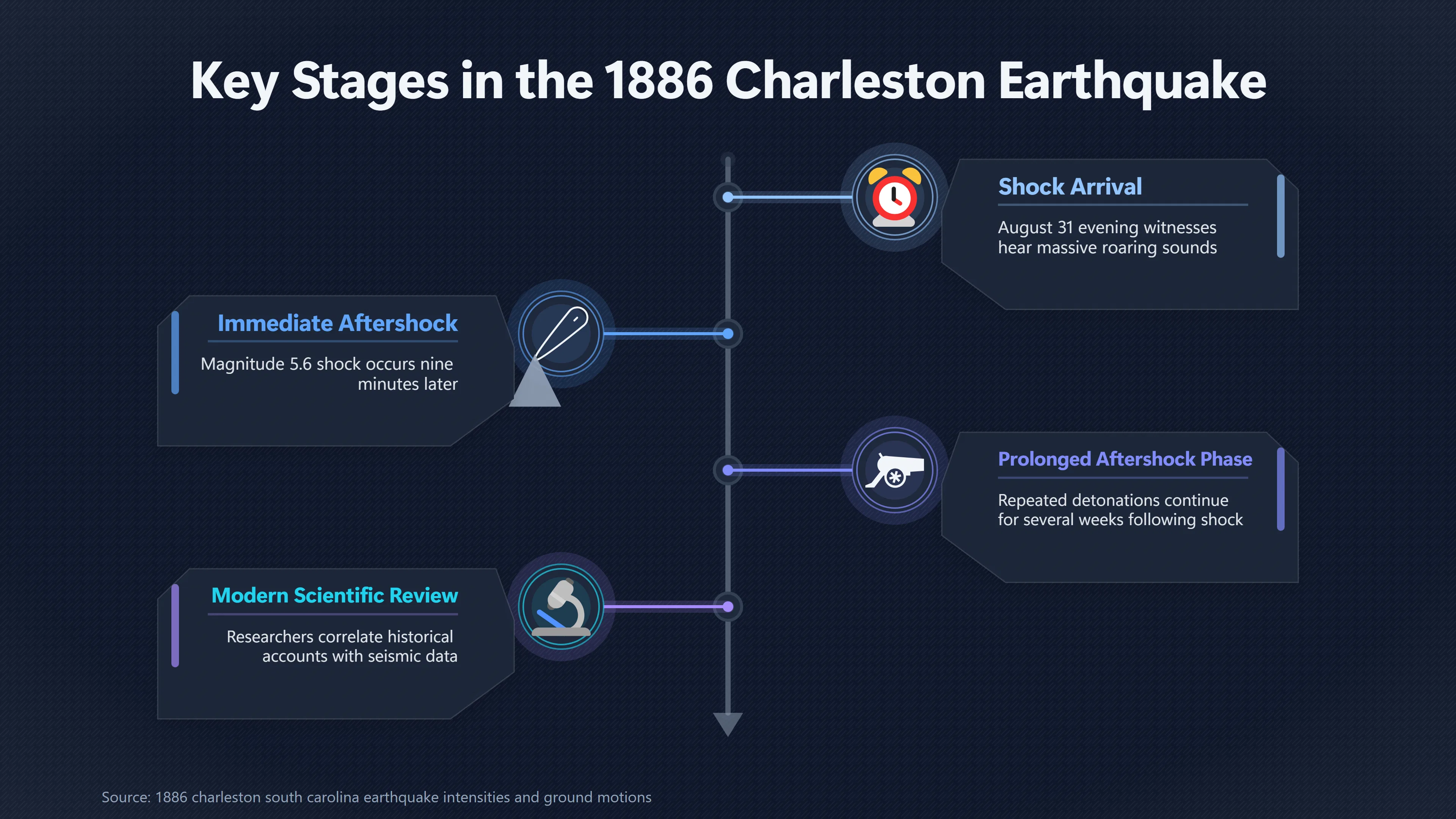
When the main earthquake struck on the evening of 31 August 1886, many witnesses described hearing the sound before, during or immediately alongside the strongest shaking. Contemporary reports consistently compared it to:
- heavy artillery fire;
- a freight train approaching at speed;
- continuous roaring;
- rolling thunder;
- violent underground explosions.
The roaring became part of the event’s defining memory because it spread across an exceptionally large area. The earthquake itself, now generally estimated at about magnitude 7.3, was felt across much of the eastern United States, and reports of the accompanying roar appeared throughout the region.[U.S. Geological Survey Publications]pubs.usgs.govCharleston, South Carolina, Earthquake-March 28, 2012…
Modern seismology explains these descriptions without requiring any unusual acoustic source. As seismic waves travelled through the shallow crust, high-frequency vibrations reached the ground surface and produced audible sound. Near the epicentral region, the sound and shaking were experienced almost simultaneously, making the earth itself appear to roar.[U.S. Geological Survey]usgs.govOpen source on usgs.gov.
Why the aftershocks produced repeated detonations
The main earthquake was only the beginning. For weeks afterwards, Charleston experienced frequent aftershocks, many of which were accompanied by loud explosive noises. The US Geological Survey specifically notes historical reports describing “loud detonations” during this prolonged aftershock sequence.[U.S. Geological Survey]usgs.govOpen source on usgs.gov.
Several factors made these aftershocks particularly noticeable.
First, the fault system remained highly active. Large earthquakes redistribute stress through surrounding rocks, allowing numerous smaller ruptures to occur as the crust gradually adjusted. Some of these aftershocks were strong enough to damage already weakened buildings. Modern reassessments of historical records have even identified a previously unrecognised sizeable aftershock roughly nine to ten minutes after the main shock, estimated at about magnitude 5.6.[U.S. Geological Survey]usgs.gov1886 charleston south carolina earthquake intensities and ground motionsU.S. Geological SurveyThe 1886 Charleston, South Carolina, earthquake: Intensities and ground motions | U.S. Geological Survey…
Second, many aftershocks were probably relatively shallow. Shallow earthquakes transmit higher-frequency vibrations to the surface more efficiently than deeper events, making audible booming much more likely. This is the same mechanism now recognised in many modern reports of earthquake sounds.[U.S. Geological Survey]usgs.govOpen source on usgs.gov.
Third, people were already on alert. Following the destruction of the main earthquake, residents remained outside or slept in temporary shelters because they feared additional shocks. This meant thousands of observers were awake and listening during every significant aftershock, greatly increasing the number of documented sound reports.[U.S. Geological Survey Publications]pubs.usgs.govCharleston, South Carolina, Earthquake-March 28, 2012…
Why Charleston became such an important historical case
Many mysterious boom reports suffer from one major problem: there is no confirmed source. Charleston differs because the source was unmistakable.
Researchers can directly compare:
- the timing of documented aftershocks;
- reports of shaking;
- descriptions of booming or roaring;
- patterns of structural damage.
Because these independent observations align so well, Charleston serves as a benchmark demonstrating that earthquakes can genuinely produce loud, explosion-like sounds rather than merely being associated with them through coincidence.[U.S. Geological Survey]usgs.gov1886 charleston south carolina earthquake intensities and ground motionsU.S. Geological SurveyThe 1886 Charleston, South Carolina, earthquake: Intensities and ground motions | U.S. Geological Survey…
The event also illustrates that audible earthquake sounds are not restricted to the initial rupture. A prolonged aftershock sequence can generate repeated booms over days or weeks, reinforcing local traditions that an area is haunted by mysterious cannon-like noises.
How Charleston helps explain later mystery booms
The Charleston sequence provides a useful comparison for later reports of unexplained booms along the Atlantic coast.
Without historical context, a resident hearing a sudden cannon-like bang with little obvious shaking might reasonably suspect:
- an explosion;
- military activity;
- a sonic boom;
- an unidentified object overhead.
Charleston demonstrates that another explanation must also be considered: a small, shallow earthquake whose acoustic energy is more noticeable than its ground motion. The USGS specifically discusses the Charleston earthquake alongside Seneca Guns because both involve reports of loud detonations that can originate from natural geological processes.[U.S. Geological Survey]usgs.govOpen source on usgs.gov.
This comparison does not mean every unexplained boom has a seismic origin. Seneca Guns almost certainly encompass several different natural and human-made causes depending on location and circumstance. Instead, Charleston provides a well-documented example showing that earthquakes belong on the list of plausible explanations whenever loud unexplained booms occur in seismically active regions.[U.S. Geological Survey]usgs.govOpen source on usgs.gov.
What the Charleston record teaches modern investigators
The Charleston earthquake highlights several practical lessons that remain relevant when evaluating reports of unexplained booming sounds:
- Booms may accompany only modest shaking. Especially during shallow events, witnesses may remember the sound more vividly than the ground motion itself.
- Repeated detonations do not necessarily indicate repeated explosions. They may instead reflect an ongoing sequence of aftershocks as stressed faults continue to adjust.
- Historical eyewitness accounts have scientific value. Thousands of descriptions collected after the Charleston earthquake have helped researchers reconstruct both shaking intensity and the behaviour of the aftershock sequence.[U.S. Geological Survey]usgs.gov1886 charleston south carolina earthquake intensities and ground motionsU.S. Geological SurveyThe 1886 Charleston, South Carolina, earthquake: Intensities and ground motions | U.S. Geological Survey…
- Context matters. A confirmed earthquake sequence provides a much stronger explanation for mysterious booms than speculation about aerial phenomena when the timing and location are consistent with seismic activity.
Within the wider study of UFO noises and other unexplained acoustic events, Charleston remains one of the strongest historical demonstrations that the Earth itself can generate sounds dramatic enough to resemble artillery, thunder or distant explosions. Rather than being an obscure curiosity, its documented roaring main shock and booming aftershocks provide a well-supported natural analogue against which later mystery-boom reports can be evaluated.[U.S. Geological Survey]usgs.govOpen source on usgs.gov.
Amazon book picks
Further Reading
Books and field guides related to What Charleston's Earthquake Booms Sounded Like. Use these as the next step if you want deeper reading beyond the article.
Upheaval in Charleston
History and suspense combine in this scholarly account of a city recovering from the Civil War and rocked by an earthquake and murder. On...
Earthquakes
The ultimate introduction to seismology, written by distinguished scholar and Professor Bruce Bolt, of the University of California, Berk...
Earthquakes in Human History
On November 1, 1755—All Saints' Day—a massive earthquake struck Europe's Iberian Peninsula and destroyed the city of Lisbon. Churches col...
A Crack in the Edge of the World
History: Specific Events & Topics;Earth Sciences; Geography; Environment; Planning;History Of The Americas
eBay marketplace picks
Marketplace Samples
Live-tested eBay searches with available results related to this page.
Selected fromUFO poster oneBay.co.uk.


Current eBay listing
VINTAGE UFO FLYING SAUCERS COMIC ADVERTISING A2 POSTER PRINT

Current eBay listing
I Want To Believe UFO Poster Giclée Fine Art Heavyweight Print

Endnotes
1.
Source: usgs.gov
Link:https://www.usgs.gov/programs/earthquake-hazards/earthquake-booms-seneca-guns-and-other-sounds
2.
Source: usgs.gov
Title: 1886 charleston south carolina earthquake intensities and ground motions
Link:https://www.usgs.gov/publications/1886-charleston-south-carolina-earthquake-intensities-and-ground-motions
Source snippet
U.S. Geological SurveyThe 1886 Charleston, South Carolina, earthquake: Intensities and ground motions | U.S. Geological Survey...
3.
Source: usgs.gov
Link:https://www.usgs.gov/publications/studies-related-charleston-south-carolina-earthquake-1886-tectonics-and-seismicity
Source snippet
U.S. Geological SurveyStudies related to the Charleston, South Carolina, earthquake of 1886 — Tectonics and seismicity | U.S. Geological...
4.
Source: pubs.usgs.gov
Link:https://pubs.usgs.gov/circ/1986/0985/report.pdf
Source snippet
Charleston, South Carolina, Earthquake-March 28, 2012...
Published: March 28, 2012
5.
Source: earthquake.usgs.gov
Title: Earthquake Hazards Program M 7.3 Scenario Earthquake
Link:https://earthquake.usgs.gov/scenarios/eventpage/gllegacycharleston_se/region-info
Source snippet
USGS Earthquake Hazards ProgramM 7.3 Scenario Earthquake - Charleston, SC Repeat...
6.
Source: usgs.gov
Title: studies related charleston south carolina earthquake 1886 a preliminary report
Link:https://www.usgs.gov/publications/studies-related-charleston-south-carolina-earthquake-1886-a-preliminary-report
Source snippet
U.S. Geological SurveyStudies related to the Charleston, South Carolina, earthquake of 1886: A preliminary report | U.S. Geological Survey...
7.
Source: pubs.usgs.gov
Link:https://pubs.usgs.gov/publication/70263628
Source snippet
1886 Charleston, South Carolina, earthquake: Intensities and ground motionsJanuary 17, 2024 — THE 1886 CHARLESTON, SOUTH CAROLINA, EARTHQ...
Published: January 17, 2024
8.
Source: pubs.usgs.gov
Link:https://pubs.usgs.gov/publication/70242758
9.
Source: usgs.gov
Link:https://www.usgs.gov/publications/shallow-faulting-and-folding-epicentral-area-1886-charleston-south-carolina-earthquake
10.
Source: usgs.gov
Title: 1886 charleston south carolina earthquake a 1986 perspective
Link:https://www.usgs.gov/publications/1886-charleston-south-carolina-earthquake-a-1986-perspective
11.
Source: usgs.gov
Title: list intensities 1886 charleston south carolina earthquake
Link:https://www.usgs.gov/publications/list-intensities-1886-charleston-south-carolina-earthquake
12.
Source: pubs.usgs.gov
Link:https://pubs.usgs.gov/publication/pp1313
13.
Source: pubs.usgs.gov
Link:https://pubs.usgs.gov/publication/ofr82311
14.
Source: pubs.usgs.gov
Link:https://pubs.usgs.gov/publication/pp1028
15.
Source: pubs.usgs.gov
Link:https://pubs.usgs.gov/publication/ofr7666
16.
Source: youtube.com
Title: The Sky Just BOOMED… But No One Knows Why
Link:https://www.youtube.com/watch?v=j7QOQ1IKYes
Source snippet
1886 Charleston Earthquake...
17.
Source: youtube.com
Link:https://www.youtube.com/watch?v=8VTM-TAIxyM
Source snippet
139 YEARS LATER: The Charleston Earthquake of 1886 This video is relevant because it explores the historical 1886 Charleston earthquake s...
Additional References
18.
Source: news.agu.org
Title: BUT IN THE U.S., SOME AREAS MAY BE EXPERI
Link:https://news.agu.org/press-release/some-of-todays-earthquakes-may-be-aftershocks-from-quakes-in-the-1800s/
Source snippet
of today’s earthquakes may be aftershocks from quakes in the 1800s - AGU NewsroomNovember 14, 2023 — SOME OF TODAY’S EARTHQUAKES MAY BE A...
Published: November 14, 2023
19.
Source: sciencedirect.com
Title: Rasanen, Brett W. Maure
Link:https://www.sciencedirect.com/science/article/abs/pii/S0013795222004434
Source snippet
Probabilistic seismic source inversion of the 1886 Charleston, South Carolina, earthquake from macroseismic evidence: A major updating...
20.
Source: youtube.com
Link:https://www.youtube.com/watch?v=H5lxT2CMU1M
Source snippet
What Are the Mystery Booms, Hums and "Trumpets" in the Sky? | Make This Make Sense...
21.
Source: youtube.com
Link:https://www.youtube.com/watch?v=P6_a314KiZo
Source snippet
The Sky Just BOOMED… But No One Knows Why...
22.
Source: youtube.com
Link:https://www.youtube.com/watch?v=tTWz19XzJt4
Source snippet
The 1886 Charleston Earthquake Opened Cracks That Never Fully Closed Again...
23.
Source: nature.com
Title: The Effects of an Earthquake on Human Beings | Nature
Link:https://www.nature.com/articles/063165b0
24.
Source: nature.com
Title: Report on the Charleston Earthquake 1 | Nature
Link:https://www.nature.com/articles/035031a0
25.
Source: nature.com
Title: The Recent Earthquakes | Nature
Link:https://www.nature.com/articles/034460a0
26.
Source: pubmed.ncbi.nlm.nih.gov
Link:https://pubmed.ncbi.nlm.nih.gov/17795896/
27.
Source: nature.com
Link:https://www.nature.com/articles/036269d0