Within Sound Travel
Why Distant Industry Can Sound Overhead
A nighttime inversion can make refineries, quarries and power stations sound airborne even when they are many kilometres away.
On this page
- How inversions bend sound back to the ground
- Industrial sources most likely to travel long distances
- Clues that separate airborne noise from ground machinery
Page outline Jump by section
Introduction
Many reports of unexplained nighttime “UFO noises” turn out to have an ordinary acoustic cause rather than an unusual airborne source. One of the most important mechanisms is a temperature inversion, where a layer of warmer air sits above cooler air near the ground. Under these stable conditions, the rumble of refineries, power stations, quarries, factories or other heavy industry can travel far beyond its usual range and appear to come from directly overhead. The machinery itself has not become louder; instead, the atmosphere has changed the path the sound takes. This makes inversion-driven industrial noise a distinctive explanation for mysterious humming, droning or roaring reported on calm evenings, especially when no obvious source is visible.[Met Office]weather.metoffice.gov.ukMet Office What is a temperature inversion?Met OfficeWhat is a temperature inversion? - Met Office…
How inversions bend sound back to the ground
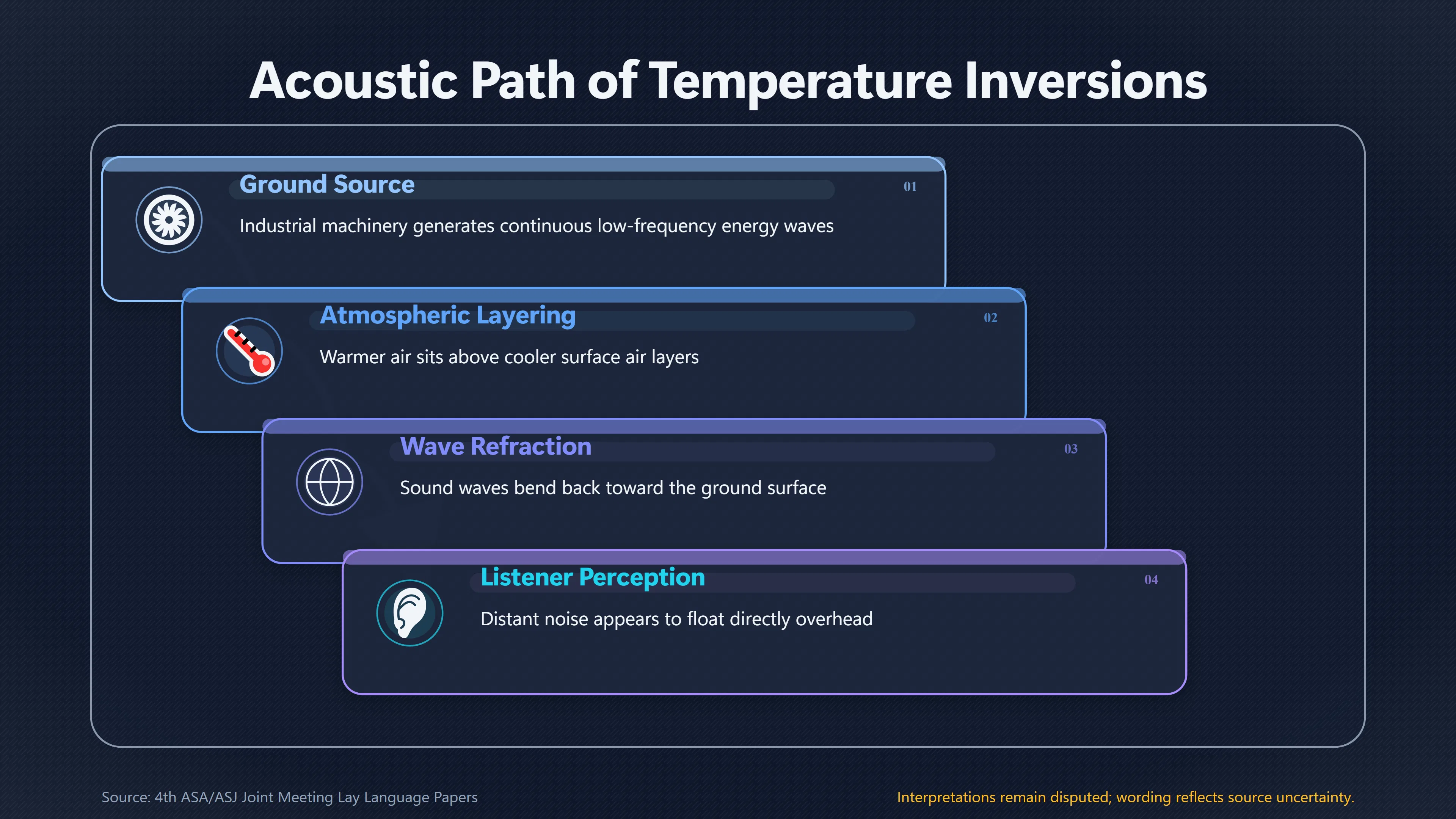
Under normal daytime conditions, sound from ground-level sources gradually spreads upward and weakens with distance. A temperature inversion changes that behaviour.
Because sound travels slightly faster through warmer air than colder air, a warm layer above cooler surface air causes sound waves to bend back towards the ground instead of continuing upward. Rather than escaping into the atmosphere, some of the acoustic energy repeatedly returns towards the surface. The result is an extended zone in which distant sounds remain unexpectedly strong.[Met Office]weather.metoffice.gov.ukMet Office What is a temperature inversion?Met OfficeWhat is a temperature inversion? - Met Office…
For a listener many kilometres away, this creates several effects at once:
- industrial noise carries much farther than expected;
- low-frequency rumbling remains particularly noticeable;
- the sound may seem detached from the true location of the machinery;
- echoes and multiple propagation paths make the source difficult to pinpoint;
- the noise can appear to float above the listener instead of coming from the horizon.
This is why witnesses sometimes describe an invisible object hovering overhead when the actual source is fixed on the ground.
Night-time inversions are especially effective because they often form during clear, calm, high-pressure weather, when the atmosphere is stable and vertical mixing is weak. These same conditions frequently accompany reports of mysterious humming or distant droning.[Met Office]weather.metoffice.gov.ukMet Office What is a temperature inversion?Met OfficeWhat is a temperature inversion? - Met Office…
Industrial sources most likely to travel long distances
Not every industrial sound propagates equally well. The most common long-range sources share one important characteristic: they produce continuous low-frequency energy.
Examples include:
- large refinery flare systems and compressors;
- power station cooling fans and turbines;
- quarry crushers and conveyor systems;
- steelworks and heavy manufacturing plants;
- large ventilation systems;
- pumping stations and industrial gas compressors.
Low-frequency sound loses less energy to the atmosphere than higher-pitched noise. During an inversion, these frequencies can remain audible over many kilometres while higher-frequency components fade away. The listener therefore hears a broad hum or distant roar rather than distinct machinery.
This filtering effect contributes to misidentification. Without the sharper mechanical noises normally associated with industrial equipment, the remaining sound may resemble an aircraft engine, hovering rotorcraft or an unidentified aerial source.
Why the sound often seems to come from the sky
Human hearing estimates direction by comparing tiny differences in arrival time and loudness between the two ears. Outdoors, this works best when sound travels directly from its source.
Temperature inversions disrupt those assumptions. The listener may receive sound that has followed a curved atmospheric path rather than a straight line. Reflections from terrain, buildings or multiple atmospheric layers can further confuse localisation.
Instead of pointing towards the actual refinery or quarry, the brain may interpret the strongest arriving wavefront as coming from above or from an entirely different compass direction.
Unlike visual illusions, this is not a failure of hearing. It is the consequence of the sound field itself being reshaped before it reaches the observer.

Why the effect is strongest after dark
Many reports occur shortly after sunset or during the early hours of the morning because these are the periods when radiational cooling produces the strongest surface inversions.
Typical favourable conditions include:
- clear skies;[thetimes.co.uk]thetimes.co.ukMoist air drawn in by high-pressure systems from surrounding seas creates a blanket of low cloud cover, particularly during autumn and wi…
- light or calm winds;
- high-pressure weather;[thetimes.co.uk]thetimes.co.ukMoist air drawn in by high-pressure systems from surrounding seas creates a blanket of low cloud cover, particularly during autumn and wi…
- winter evenings or cool nights in any season;
- valleys where cold air pools near the surface.
These same weather patterns are also associated with trapped fog and pollution because the inversion suppresses vertical mixing throughout the lower atmosphere.[Met Office]weather.metoffice.gov.ukMet Office What is a temperature inversion?Met OfficeWhat is a temperature inversion? - Met Office…
Once daytime sunshine warms the ground and breaks up the inversion, the unusual sound propagation usually disappears. A factory that seemed only a few kilometres away overnight may become effectively inaudible by late morning despite operating continuously.
Clues that separate airborne noise from ground machinery
Several practical observations help distinguish inversion-carried industrial sound from a genuine airborne object.
The sound remains steady. Industrial plants usually produce continuous humming or droning rather than rapidly changing engine notes.
No movement is apparent. The apparent position may stay fixed for long periods even though no aircraft or visible object is present.
The weather is unusually calm. Reports commonly occur during still evenings with little wind, clear skies or persistent fog.
Multiple people hear the same hum across a wide area. A single industrial source may become audible simultaneously over many communities lying beneath favourable acoustic conditions.
The sound disappears after sunrise. As atmospheric mixing resumes, long-distance propagation weakens quickly.
These features do not prove an industrial origin on their own, but together they are consistent with well-understood atmospheric acoustics rather than an unidentified object.
A real-world illustration of long-range sound propagation
Extreme events demonstrate how dramatically stable atmospheric conditions can extend the reach of sound. Following the 2005 explosion at the Buncefield oil storage depot in Hertfordshire, reports documented the blast being heard hundreds of kilometres away, including across parts of the Netherlands. While an explosion is far more energetic than ordinary industrial operations, it illustrates the same underlying principle: under suitable atmospheric conditions, sound can travel far beyond everyday expectations and be perceived in surprising locations.[thetimes.co.uk]thetimes.co.ukMoist air drawn in by high-pressure systems from surrounding seas creates a blanket of low cloud cover, particularly during autumn and wi…
Routine industrial machinery produces a much weaker effect, but the same physics applies. Instead of a single explosive event, a continuous hum may be carried over unexpectedly long distances, making an ordinary ground installation seem like an invisible source in the night sky.
Why this matters for reports of unexplained sky sounds
Temperature inversions do not create mysterious noises—they redirect familiar ones. When heavy industrial machinery operates beneath a stable nocturnal atmosphere, its sound can be refracted back towards the ground, stripped of higher frequencies and displaced from its true direction. To someone unaware of a distant refinery, quarry or power station, the result can convincingly resemble an airborne hum with no visible source.
Within the wider study of atmospheric conditions that distort sky sounds, inversion-carried industrial noise is one of the best-supported mechanisms for explaining reports of persistent nighttime droning that later prove to have entirely conventional origins.[Met Office]weather.metoffice.gov.ukMet Office What is a temperature inversion?Met OfficeWhat is a temperature inversion? - Met Office…
Amazon book picks
Further Reading
Books and field guides related to Why Distant Industry Can Sound Overhead. Use these as the next step if you want deeper reading beyond the article.
Engineering Noise Control: Theory and Practice
The practice of engineering noise control demands a solid understanding of the fundamentals of acoustics, the practical application of cu...
Predicting Outdoor Sound
Predicting Outdoor Sound provides a scholarly yet practical examination of the phenomena that affect outdoor sound close to the ground an...
Master Handbook of Acoustics
Practical Instruction on the Art and Science of Acoustic Design and Architecture Build your own acoustic environments such as recording s...
eBay marketplace picks
Marketplace Samples
Live-tested eBay searches with available results related to this page.
Selected fromRoswell UFO poster oneBay.co.uk.




Endnotes
1.
Source: thetimes.co.uk
Link:https://www.thetimes.co.uk/article/temperature-inversions-as-the-nights-draw-in-rg7z3259j
Source snippet
Moist air drawn in by high-pressure systems from surrounding seas creates a blanket of low cloud cover, particularly during autumn and wi...
2.
Source: acoustics.org
Title: 4th ASA/ASJ Joint Meeting Lay Language Papers
Link:https://acoustics.org/pressroom/httpdocs/152nd/wax.html
3.
Source: forecast.weather.gov
Link:https://forecast.weather.gov/glossary.php?word=r
4.
Source: weather.gov
Title: NW S Jet Stream
Link:https://www.weather.gov/source/zhu/ZHU_Training_Page/lightning_stuff/lightning2/thunder.html
5.
Source: forecast.weather.gov
Link:https://forecast.weather.gov/glossary.php?word=s
6.
Source: weather.metoffice.gov.uk
Title: Met Office What is a temperature inversion?
Link:https://weather.metoffice.gov.uk/learn-about/weather/types-of-weather/temperature/temperature-inversion
Source snippet
Met OfficeWhat is a temperature inversion? - Met Office...
7.
Source: metoffice.gov.uk
Title: Met Office Deep Dive: High-pressure, dry air and meteor showers
Link:https://www.metoffice.gov.uk/blog/2026/met-office-deep-dive-for-april-22
Source snippet
Deep Dive: High-pressure, dry air and meteor showers - Met OfficeApril 22, 2026 — Image: meteorcanva DEEP DIVE: HIGH-PRESSURE, DRY AIR AN...
Published: April 22, 2026
8.
Source: metoffice.gov.uk
Title: Met Office Mist, fog, and haze: What’s the difference?
Link:https://www.metoffice.gov.uk/blog/2025/whats-the-difference-between-mist-fog-and-haze
Source snippet
Met OfficeSeptember 10, 2025 — Image: fog-on-a-country-road MIST, FOG, AND HAZE: WHAT'S THE DIFFERENCE? Author: Press Office Wed 10 Sep 2...
Published: September 10, 2025
9.
Source: metoffice.gov.uk
Title: Temperature versus ‘feels like’: why they are not always the same
Link:https://www.metoffice.gov.uk/blog/2026/temperature-versus-feels-like-why-they-are-not-always-the-same
Source snippet
Met OfficeMay 12, 2026 — Image: wind-blown-tree TEMPERATURE VERSUS ‘FEELS LIKE’: WHY THEY ARE NOT ALWAYS THE SAME Author: Met Office Tue...
Published: May 12, 2026
10.
Source: metoffice.gov.uk
Title: Met Office Deep Dive: Hot weather to bring heatwave for many
Link:https://www.metoffice.gov.uk/blog/2025/met-office-deep-dive-hot-weather-to-bring-heatwaves-for-much-of-the-country
Source snippet
Met OfficeJune 18, 2025 — Image: screenshot-38 MET OFFICE DEEP DIVE: HOT WEATHER TO BRING HEATWAVE FOR MANY Author: Press Office Wed 18 J...
Published: June 18, 2025
11.
Source: metoffice.gov.uk
Title: What is the jet stream and how does it affect our weather?
Link:https://www.metoffice.gov.uk/blog/2025/what-is-the-jet-stream-and-how-does-it-affect-our-weather
Source snippet
Met OfficeMay 28, 2025 — Image: jet-streamhi WHAT IS THE JET STREAM AND HOW DOES IT AFFECT OUR WEATHER? Author: Press Office Wed 28 May 2...
Published: May 28, 2025
12.
Source: epa.nsw.gov.au
Title: estimating inversion strength
Link:https://www.epa.nsw.gov.au/Your-environment/Noise/industrial-noise/nsw-industrial-noise-policy/estimating-inversion-strength
13.
Source: epa.nsw.gov.au
Link:https://www.epa.nsw.gov.au/Publications/noise/140011invstrength
14.
Source: metoffice.gov.uk
Title: What is ‘feels like’ temperature?
Link:https://www.metoffice.gov.uk/blog/2012/what-is-feels-like-temperature
15.
Source: weather.metoffice.gov.uk
Title: metoffice.gov.uk Thunder and lightning
Link:https://weather.metoffice.gov.uk/learn-about/weather/types-of-weather/thunder-and-lightning
16.
Source: weather.metoffice.gov.uk
Title: metoffice.gov.uk What does this forecast mean?
Link:https://weather.metoffice.gov.uk/guides/what-does-this-forecast-mean
17.
Source: weather.metoffice.gov.uk
Title: metoffice.gov.uk What are Lee Waves?
Link:https://weather.metoffice.gov.uk/learn-about/weather/types-of-weather/wind/lee-waves
18.
Source: metoffice.gov.uk
Title: Aerodrome Weather Warnings
Link:https://www.metoffice.gov.uk/services/transport/aviation/regulated/training-resources-for-aviation/aerodrome-warnings
19.
Source: weather.metoffice.gov.uk
Title: metoffice.gov.uk What is frost and ice?
Link:https://weather.metoffice.gov.uk/learn-about/weather/types-of-weather/frost-and-ice
20.
Source: mocpa.com
Link:https://mocpa.com/inversion.html
Additional References
21.
Source: youtube.com
Title: why sound travels farther at night
Link:https://www.youtube.com/watch?v=fkds2MiS6l4
Source snippet
This ACOUSTICS: Refraction and Temperature Inversion video directly demonstrates how thermal atmospheric layers bend sound waves back to...
22.
Source: youtube.com
Title: ACOUSTICS: Refraction and Temperature Inversion
Link:https://www.youtube.com/watch?v=LkFQg1zhi2o
Source snippet
Refraction of Sound: How Sound Waves Bend Through Different Media...
23.
Source: sciencedirect.com
Link:https://www.sciencedirect.com/science/article/abs/pii/S0022460X78800339
24.
Source: sciencedirect.com
Link:https://www.sciencedirect.com/science/article/pii/S0022460X78800339
25.
Source: sciencedirect.com
Link:https://www.sciencedirect.com/science/article/abs/pii/0003682X82900032
26.
Source: sciencedirect.com
Link:https://www.sciencedirect.com/science/article/pii/0003682X82900032
27.
Source: strangesounds.org
Link:https://strangesounds.org/2014/01/strange-sounds-phenomenon-sound-can-travel-great-distances-depending-on-weather-conditions.html
28.
Source: youtube.com
Title: Refraction of Sound Waves
Link:https://www.youtube.com/watch?v=09aT3Ywf-tY
Source snippet
Reflection and Refraction of Sound | Edexcel IGCSE Physics Revision...
29.
Source: youtube.com
Title: Reflection and Refraction of Sound | Edexcel IGCSE Physics Revision
Link:https://www.youtube.com/watch?v=cDxFsEVb16U
Source snippet
why sound travels farther at night...
30.
Source: youtube.com
Title: Refraction of Sound: How Sound Waves Bend Through Different Media
Link:https://www.youtube.com/watch?v=4_B_pTxlQvE
Source snippet
Refraction of Sound Waves...