Within Silent Sightings
When a Head On Aircraft Looks Like a Hovering UFO
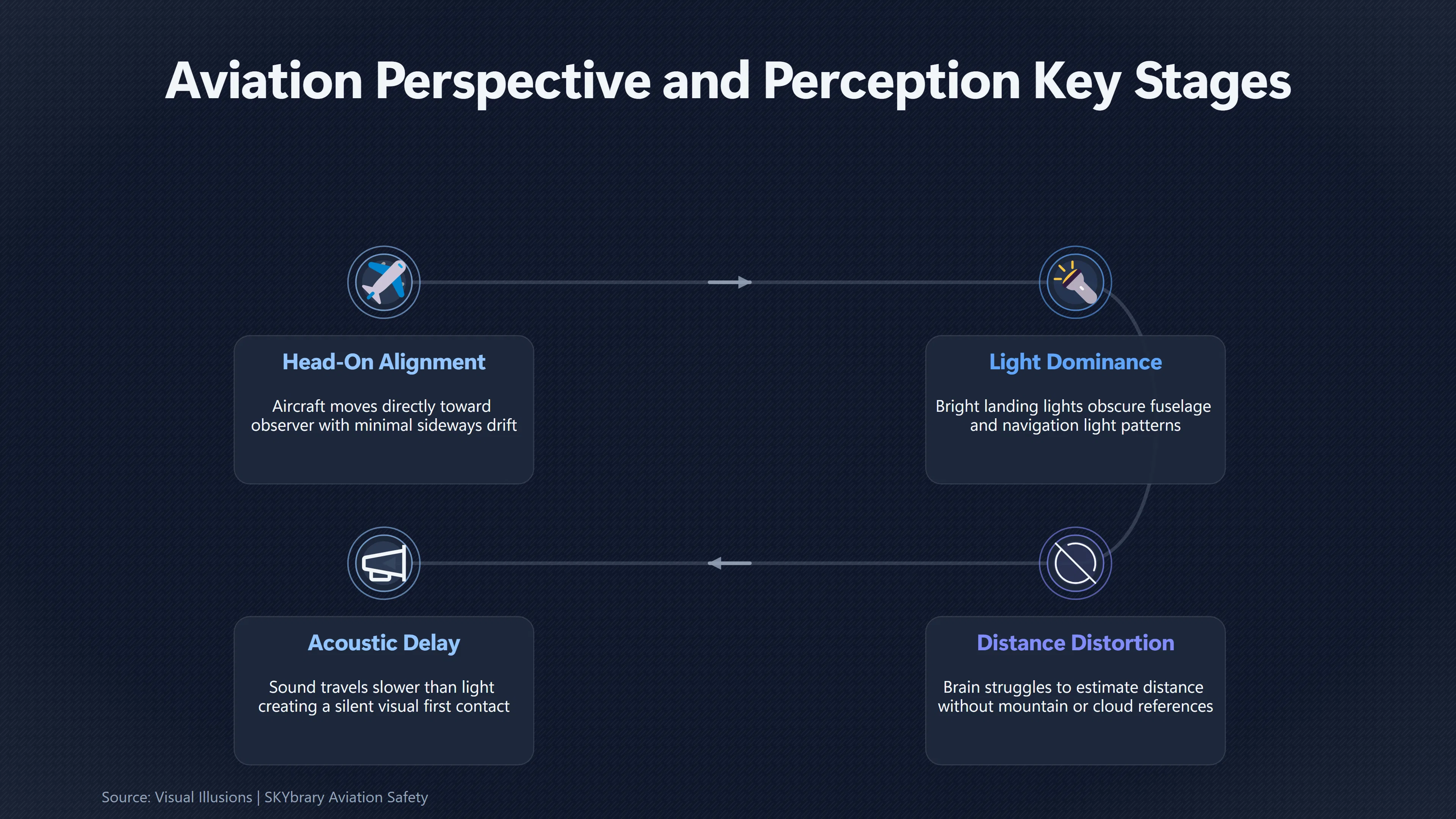
An aircraft flying toward or away from a witness can show little sideways motion, making ordinary flight look like silent hovering.
On this page
- Why head on motion is hard to judge
- How landing lights reinforce the hovering effect
- Clues that reveal an approaching or departing aircraft
Page outline Jump by section
Introduction
One of the most common conventional explanations for apparently silent, hovering UFOs is surprisingly simple: the object is an ordinary aircraft flying almost directly towards or away from the observer. When an aircraft’s motion is aligned with the viewer’s line of sight, it produces very little sideways movement across the sky. Combined with bright landing lights and uncertain distance perception, this geometry can create a powerful illusion that the aircraft is stationary, hovering, or moving in impossible ways. If the aircraft is still several kilometres away, its engine noise may be faint, delayed or masked by the surrounding environment, reinforcing the impression of an eerily silent object. This combination of perspective, lighting and acoustics has been recognised both in aviation safety literature and in investigations of mistaken aerial sightings.[Skybrary]skybrary.aeroVisual Illusions | SKYbrary Aviation SafetyVisual Illusions | SKYbrary Aviation Safety…
Why Head-On Motion Is Hard to Judge
Human vision is far better at detecting movement across the field of view than movement directly towards or away from the observer. A car driving across a road is obviously moving because its position changes rapidly against the background. A car driving straight towards you, however, changes very little in apparent position until it becomes quite close.
The same principle applies to aircraft. An airliner approaching on a landing path may travel at well over 200 km/h while appearing almost motionless because its angular position in the sky changes only slowly. Instead of sweeping sideways, it simply grows gradually larger.
Without reliable reference points such as mountains, buildings or clouds, the brain struggles to estimate:
- how far away the aircraft actually is;
- whether it is approaching or departing;
- how fast it is travelling;
- whether it is climbing, descending or maintaining altitude.
These limitations are well understood in aviation, where visual illusions affecting judgement of distance, movement and alignment are extensively documented because they can influence even trained pilots.[Skybrary]skybrary.aeroVisual Illusions | SKYbrary Aviation SafetyVisual Illusions | SKYbrary Aviation Safety…
How Landing Lights Reinforce the Hovering Effect
Landing lights are designed to be extremely bright and highly focused so that aircraft are visible over long distances during approach and departure.
Viewed nearly head-on, these lights can dominate everything else:
- the fuselage becomes difficult to distinguish;
- navigation lights may be overwhelmed by the white beam;
- the aircraft’s outline disappears into darkness;
- the observer effectively sees only one or two brilliant points of light.
This creates a misleading impression. Because the illuminated point changes position only slowly, the light appears suspended in space even though the aircraft is steadily closing the distance.
At night this effect becomes stronger because the observer loses most of the depth cues available during daylight. A single bright light floating against a dark sky provides little information about its true distance or speed.
A further complication is that brighter objects are often perceived as being closer than they really are. If a witness subconsciously assumes the aircraft is nearby, the absence of loud engine noise may seem extraordinary even though the aircraft is actually several kilometres away. Aviation guidance recognises that bright lighting and sparse visual references can distort judgement of distance and position during night operations.[Federal Aviation Administration]faa.govFederal Aviation Administration Chapter 8. Medical Facts for PilotsFederal Aviation Administration Chapter 8. Medical Facts for Pilots
Why the Aircraft May Seem Silent
The apparent silence is usually not because the aircraft is unusually quiet, but because the observer has overestimated how close it is.
Several ordinary factors contribute:
- Distance. Modern aircraft become much quieter at several kilometres’ range than many people expect.
- Sound delay. Light reaches the observer essentially instantaneously, while sound travels at roughly 343 metres per second under typical conditions. An approaching aircraft may therefore be seen well before noticeable engine noise arrives.
- Wind and atmosphere. Wind direction, temperature layers and background environmental noise can weaken or redirect aircraft sound.
- Expectation. If the object is mistakenly believed to be only a few hundred metres away, the lack of obvious engine noise appears mysterious even though it is entirely consistent with a much greater distance.
These acoustic factors complement the visual illusion rather than creating it independently.
Clues That Reveal an Approaching or Departing Aircraft
Although the hovering impression can be convincing, there are usually subtle clues that distinguish a conventional aircraft from an unidentified object.
Useful indicators include:
- Gradual brightening. The landing lights steadily increase in intensity as the aircraft approaches.
- Increasing apparent size. Even if sideways movement is minimal, the lights slowly separate and the aircraft eventually becomes visible.
- Navigation light pattern. As the viewing angle changes, the standard red, green and white aviation lights become easier to identify.
- Predictable track. The object continues along a straight approach or departure corridor rather than making abrupt manoeuvres.
- Eventual engine noise. As the aircraft draws nearer or passes abeam, engine sound often becomes noticeable and aligns with the visual observation.
Once the aircraft begins to pass the observer rather than remain nearly head-on, its sideways motion becomes much more obvious and the hovering illusion rapidly disappears.
Night-Time Perception Can Add Further Illusions
A head-on aircraft can be mistaken not only for a hovering object but also for one that changes direction unexpectedly.
One contributing factor is autokinesis, a well-known visual illusion in which a small light against a dark, featureless background appears to drift if stared at for several seconds. Aviation authorities teach pilots to avoid prolonged fixation on isolated lights because this effect can create false impressions of movement.[Skybrary]skybrary.aeroAutokinetic Effect | SKYbrary Aviation SafetyAutokinetic Effect | SKYbrary Aviation Safety…
This illusion does not mean the aircraft is actually manoeuvring. Instead, the observer’s visual system lacks stable reference points and begins interpreting tiny involuntary eye movements as movement of the light itself.
When combined with the genuine perspective effects of a head-on approach, autokinesis can make an otherwise ordinary aircraft seem to hover, wobble or drift unpredictably.
Why This Explanation Fits Many Silent UFO Reports
Not every silent aerial sighting can be identified with certainty, and some reports lack enough information for a definitive explanation. However, a head-on aircraft approach provides a particularly strong explanation for a recurring pattern of observations:
- a bright stationary light;[ufouap.net]ufouap.netAutokinesis: Why a Stationary Light Seems to Move | Global UFO ArchiveJuly 11, 2026 — Evidence / Updated 2026-07-11 / 7 min read AUTOKINE…
- little or no sideways movement;
- apparent hovering for several minutes;
- little immediate engine noise;
- eventual growth in brightness before normal aircraft features become visible.
This combination follows directly from ordinary viewing geometry rather than unusual aircraft behaviour. It illustrates how perspective can conceal true speed and direction, making a conventional aircraft appear to defy expectations without requiring any unconventional propulsion or genuinely silent flight. Aviation research into visual perception consistently shows that judging the distance and motion of isolated lights at night is one of the least reliable tasks for human observers, making this a significant source of mistaken UFO reports.[faa.gov]faa.govFederal Aviation AdministrationOffice of Aerospace Medicine Technical Reports | Federal Aviation AdministrationMarch 1, 1978…
Amazon book picks
Further Reading
Books and field guides related to When a Head On Aircraft Looks Like a Hovering UFO. Use these as the next step if you want deeper reading beyond the article.
UFOs Explained
Analyzing several UFO cases, the author exposes the myth of extraterrestrial visitors to earth.
Stick and Rudder: An Explanation of the Art of Flying
In the early 1940's, Wolfgang Langewiesche wrote a series of articles in Air Facts analyzing the various aspects of piloting techniques....
The Killing Zone: How and Why Pilots Die
This is not AI-generated content. The contents were written and verified by subject matter experts from Aviation Supplies & Academics, an...
Human Factors in Flight
The late Captain Frank H Hawkins FRAes, M Phil, was Human Factors Consultant to KLM, for whom he had flown for over 30 years as line capt...
eBay marketplace picks
Marketplace Samples
Live-tested eBay searches with available results related to this page.
Selected fromUFO sighting poster oneBay.co.uk.


Endnotes
1.
Source: skybrary.aero
Title: Visual Illusions | SKYbrary Aviation Safety
Link:https://skybrary.aero/index.php/articles/visual-illusions
Source snippet
Visual Illusions | SKYbrary Aviation Safety...
2.
Source: skybrary.aero
Title: Autokinetic Effect | SKYbrary Aviation Safety
Link:https://skybrary.aero/index.php/articles/autokinetic-effect
Source snippet
Autokinetic Effect | SKYbrary Aviation Safety...
3.
Source: skybrary.aero
Link:https://skybrary.aero/index.php/articles/runway-visual-perspective
4.
Source: faa.gov
Title: Federal Aviation Administration Chapter 8. Medical Facts for Pilots
Link:https://www.faa.gov/Air_traffic/publications/atpubs/aim_html/chap8_section_1.html
5.
Source: faa.gov
Link:https://www.faa.gov/data_research/research/med_humanfacs/oamtechreports/1970s/1978/197815
Source snippet
Federal Aviation AdministrationOffice of Aerospace Medicine Technical Reports | Federal Aviation AdministrationMarch 1, 1978...
Published: March 1, 1978
6.
Source: faa.gov
Title: Chapter 8
Link:https://www.faa.gov/air_traffic/publications/atpubs/aim/aim0801.html
Source snippet
Medical Facts for PilotsJanuary 8, 2015 — 1. Various complex motions and forces and certain visual scenes encountered in flight can creat...
Published: January 8, 2015
7.
Source: faa.gov
Title: Perceived Pitch Versus Actual Pitch
Link:https://www.faa.gov/data_research/research/med_humanfacs/aeromedical/aircraftaccident/charlotte
8.
Source: faa.gov
Link:https://www.faa.gov/air_traffic/publications/atpubs/aip_html/chap8_section_1.html
9.
Source: faa.gov
Link:https://www.faa.gov/air_traffic/publications/atpubs/aim_html/chap7_section_6.html
10.
Source: faa.gov
Link:https://www.faa.gov/data_research/research/med_humanfacs/oamtechreports/1970s/1977/197712
11.
Source: faa.gov
Link:https://www.faa.gov/air_traffic/publications/atpubs/aip_html/chap7_section_6.html
12.
Source: faa.gov
Link:https://www.faa.gov/air_traffic/publications/atpubs/aim_html/chap10_section_1.html
Additional References
13.
Source: tc.canada.ca
Link:https://tc.canada.ca/en/aviation/publications/handbook-civil-aviation-medical-examiners-tp-13312
Source snippet
for Civil Aviation Medical Examiners - TP 13312May 6, 2019 — VISUAL ILLUSIONS These may be foveal or vectional, that is concerned with ce...
Published: May 6, 2019
14.
Source: ufouap.net
Title: Aircraft Lights Mistaken for UFOs: Night Guide | Global UFO Archive
Link:https://www.ufouap.net/en/explainers/aircraft-lights-mistaken-for-ufos
Source snippet
July 16, 2026 — Skywatching / Updated 2026-07-16 / 7 min read AIRCRAFT LIGHTS MISTAKEN FOR UFOS: A NIGHT IDENTIFICATION GUIDE An aircraft...
Published: July 16, 2026
15.
Source: youtube.com
Title: Illusions In Flight Spaitial Disorientation Mzero A com
Link:https://www.youtube.com/watch?v=fIZpxEOsTg0
Source snippet
Plane looks frozen in air illusion parallax Why Plane Is Not Moving | Parallax Effect MarkoFacts...
16.
Source: youtube.com
Title: Spatial Disorientation Explained: Deadly Flight Illusions Every Pilot Must Know
Link:https://www.youtube.com/watch?v=6BD9fyyIJzY
Source snippet
Illusions In Flight Spaitial Disorientation MzeroA com...
17.
Source: youtube.com
Title: 3 Ways your BRAIN Tricks You into Thinking AIRPLANES HOVER!
Link:https://www.youtube.com/watch?v=3osSwf7dgUI
Source snippet
How Runway Illusions affect pilot’s perception | SIMPLY explained...
18.
Source: youtube.com
Title: How Runway Illusions affect pilot’s perception | SIMPLY explained
Link:https://www.youtube.com/watch?v=Zmux_WJ3Bcc
Source snippet
Night Illusions (Private Pilot Lesson 15d)...
19.
Source: youtube.com
Title: Night Illusions (Private Pilot Lesson 15d)
Link:https://www.youtube.com/watch?v=y_HvgmQ3NJs
Source snippet
Spatial Disorientation Explained: Deadly Flight Illusions Every Pilot Must Know...
20.
Source: journals.sagepub.com
Link:https://journals.sagepub.com/doi/full/10.1177/00187208261419347
Source snippet
Allison, Elizabeth L. Irving, Sion Jennings, Laurie M. Wilcox, 2026February 11, 2026 — VISUAL ILLUSIONS IN AVIATION: SIMULATING THE BLACK...
Published: February 11, 2026
21.
Source: ufouap.net
Link:https://www.ufouap.net/en/explainers/autokinesis-stationary-light-illusion
Source snippet
Autokinesis: Why a Stationary Light Seems to Move | Global UFO ArchiveJuly 11, 2026 — Evidence / Updated 2026-07-11 / 7 min read AUTOKINE...
Published: July 11, 2026
22.
Source: faraim.org
Link:https://www.faraim.org/faa/aim/chapter-8/section-8-1-5.html