Within UFO Noises
How Expectation Shapes UFO Sound Memories
Media coverage, surprise, and uncertain viewing conditions can influence how witnesses connect an unfamiliar noise with a strange light.
On this page
- Linking simultaneous sights and sounds
- Expectation after media coverage
- How memory changes uncertain events
Page outline Jump by section
Introduction
When people report hearing a strange hum, buzz or other unusual sound at the same time as seeing an unidentified light or object, it is tempting to assume the two experiences came from the same source. Research on perception and eyewitness memory suggests a more cautious interpretation. Under uncertain conditions—particularly at night, during unexpected events or after exposure to UFO stories—people can sincerely connect sights and sounds that were unrelated, misremember when they occurred, or gradually reshape their recollection as they discuss the event or encounter new information. This does not imply dishonesty. Instead, it reflects well-established features of human perception and memory that become especially important when interpreting reports of unidentified aerial phenomena (UAP).[nih.gov]pubmed.ncbi.nlm.nih.govPub Med Misinformation and memory: the creation of new memoriesMisinformation and memory: the creation of new memories - PubMed…
Why unfamiliar sounds become linked to unusual lights
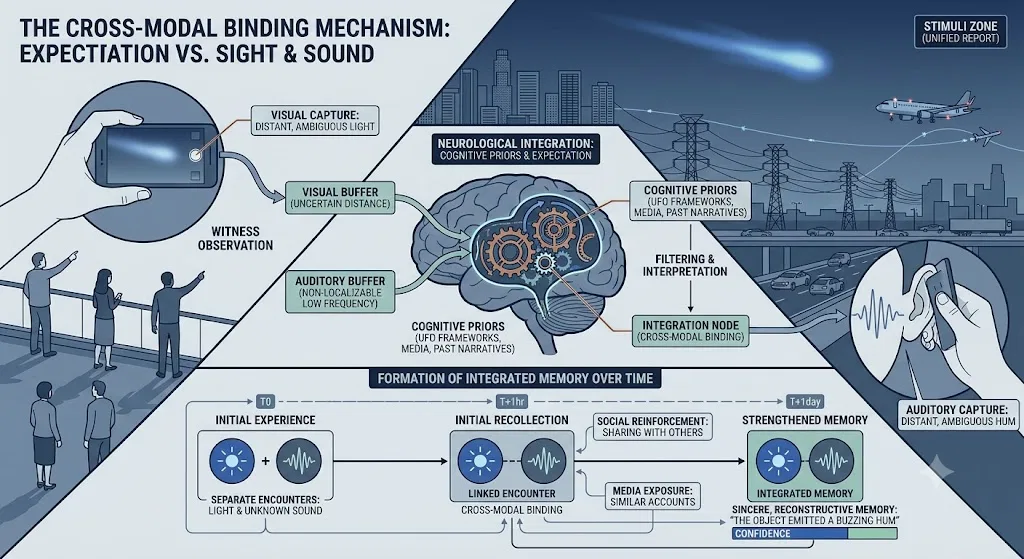
A key feature of perception is that the brain tries to combine information from different senses into a single, coherent account of what happened. If a bright light appears overhead and an unusual sound is heard at roughly the same time, people naturally infer that both came from the same object, even when the true source of the sound is uncertain.
This process, known as cross-modal binding, is normally helpful because sights and sounds from the same event usually do belong together. However, in ambiguous situations it can produce mistaken associations. Night-time viewing, poor distance cues, echoes, wind, delayed sound propagation and competing background noises all increase uncertainty about where a sound originated or whether it was connected to the observed light. Experimental neuroscience shows that the brain actively integrates auditory and visual signals into unified percepts, even when the relationship between them is not perfectly clear.[Nature]nature.comNeural correlates of cross-modal binding | Nature NeuroscienceNeural correlates of cross-modal binding | Nature Neuroscience…
In UFO sound reports, this means that a witness may accurately remember seeing an unusual light and accurately remember hearing an unfamiliar noise, yet still be mistaken in concluding that the sound came from the object itself.
Linking simultaneous sights and sounds
Several factors make these links especially compelling:
- Low-frequency sounds are difficult for humans to locate accurately.
- Darkness reduces reliable visual reference points for estimating distance and size.
- Unexpected events encourage rapid interpretation before complete information is available.
- Aircraft, distant industry, wildlife or atmospheric sounds may overlap with an unrelated visual event.
Because the brain prefers one coherent explanation over multiple unrelated ones, witnesses often recall the experience as a single integrated event rather than separate sensory observations.[Nature]nature.comNeural correlates of cross-modal binding | Nature NeuroscienceNeural correlates of cross-modal binding | Nature Neuroscience…
How expectation influences interpretation
Expectation affects perception long before anyone gives a formal witness statement. When people already have a mental model of what a UFO encounter “should” be like, ambiguous sounds are more likely to be interpreted within that framework.
Psychologists refer to this as top-down processing: existing knowledge, beliefs and expectations help interpret incomplete sensory information. If someone has recently watched documentaries, read news coverage about unexplained aerial phenomena or discussed UFO cases, those ideas become more readily available when an unusual experience occurs.
This does not mean media exposure creates sightings. Rather, it influences which interpretation feels most plausible when the available sensory information is incomplete. Statistical analysis of large UFO reporting databases has found that reporting activity itself is sensitive to media attention, suggesting that publicity affects both the likelihood of reporting and the way experiences are interpreted.[ScienceDirect]sciencedirect.comScienceDirect On the dynamics of reporting data: A case study of UFO sightingsOn the dynamics of reporting data: A case study of UFO sightings - ScienceDirectOctober 1, 2022…
Expectation after media coverage
Following periods of intense publicity, witnesses may be more inclined to:
- Notice unusual environmental sounds that would otherwise be ignored.
- Interpret an unidentified light and unrelated sound as belonging together.
- Describe sounds using familiar UFO-related language such as “electrical hum”, “buzzing” or “vibration”.
- Recall additional details after repeated discussion or media exposure.
These influences operate through ordinary cognitive processes and are not unique to UFO reports; similar effects have been documented across eyewitness testimony more generally.[PubMed]pubmed.ncbi.nlm.nih.govPub Med Misinformation and memory: the creation of new memoriesMisinformation and memory: the creation of new memories - PubMed…
How memory changes uncertain events
Memory is reconstructive rather than a perfect recording. Each recollection involves rebuilding the event from stored information, current knowledge and later experiences. As a result, memories can become more detailed, more coherent or more confident over time without necessarily becoming more accurate.
Research led by Elizabeth Loftus and colleagues has repeatedly shown that post-event information can alter what people later remember. Misleading questions, repeated discussions or exposure to alternative accounts may introduce details that become incorporated into an individual’s recollection while still feeling entirely genuine.[nih.gov]pubmed.ncbi.nlm.nih.govPub Med Misinformation and memory: the creation of new memoriesMisinformation and memory: the creation of new memories - PubMed…
For UFO sound reports, this can mean that an initially vague memory such as “I heard something unusual” gradually becomes “the object emitted a deep electrical humming noise” after repeated retelling, especially if similar descriptions are encountered elsewhere.

Why uncertain events are especially vulnerable
Several circumstances increase the likelihood of memory reconstruction:
- Brief observations.
- High emotional arousal or surprise.
- Darkness or poor visibility.
- Divided attention between multiple unusual events.
- Delays before writing or recording an account.
- Repeated conversations with other witnesses.
Laboratory studies also show that high perceptual load reduces recall accuracy and increases susceptibility to suggestion, affecting both visual and auditory aspects of eyewitness memory.[PubMed]pubmed.ncbi.nlm.nih.govPerceptual Load Affects Eyewitness Accuracy and Susceptibility to Leading Questions - PubMed…

Why sincere witnesses can disagree
One common misconception is that differing accounts automatically indicate fabrication. Cognitive psychology suggests the opposite: honest observers frequently remember different aspects of the same event because attention, viewpoint, stress and later reconstruction vary between individuals.
One witness may primarily remember the unusual sound, another the movement of the light and a third the emotional impact of the experience. As memories evolve independently, later comparisons can reveal genuine disagreements over timing, sequence or the characteristics of the reported noise.
Modern memory research further indicates that expectations at the time of recall—not only at the time of observation—can influence remembered event details, reinforcing the importance of documenting witness accounts as soon as possible after an incident.[PLOS]journals.plos.orgShared memories of event details in the human brain are altered by misinformation and test expectations | PLOS BiologyJuly 6, 2026…
What this means when evaluating UFO sound reports
Expectation and memory research neither proves nor disproves any individual UFO report. Instead, it provides a framework for understanding why unusual sound descriptions should be interpreted carefully, particularly when they depend on retrospective recollection under uncertain conditions.
A balanced assessment distinguishes between several separate questions:
- Was an unusual sound genuinely heard? Quite possibly.
- Was the sound accurately described? It may have been, but later reconstruction can alter details.
- Did the sound originate from the reported object? That cannot be assumed solely from simultaneous perception.
- Does a confident memory guarantee accuracy? No. Confidence and accuracy are related only imperfectly, especially after repeated recall or exposure to post-event information.[nih.gov]pubmed.ncbi.nlm.nih.govPub Med Misinformation and memory: the creation of new memoriesMisinformation and memory: the creation of new memories - PubMed…
Understanding these psychological mechanisms helps explain why UFO sound reports often contain vivid, sincerely remembered experiences while still leaving open the possibility that perception and memory combined separate or ambiguous events into a single narrative.
Amazon book picks
Further Reading
Books and field guides related to How Expectation Shapes UFO Sound Memories. Use these as the next step if you want deeper reading beyond the article.
The Seven Sins of Memory
Rating: 3.5/5 from 5 Google Books ratings
A New York Times Notable Book: A psychologist's "gripping and thought-provoking" look at how and why our brains sometimes fail us (Steven...
The Memory Illusion
THE INTERNATIONAL BESTSELLER 'Truly fascinating.' Steve Wright, BBC Radio 2 - Have you ever forgotten the name of someone you’ve met doze...
The Invisible Gorilla
NEW YORK TIMES BESTSELLER • Our minds don’t work the way we think they do. Two renowned psychologists explain how and why our intuitions...
eBay marketplace picks
Marketplace Samples
Live-tested eBay searches with available results related to this page.
Selected fromUFO poster oneBay.co.uk.

Current eBay listing
I Want To Believe UFO Poster Giclée Fine Art Heavyweight Print

Current eBay listing
VINTAGE UFO FLYING SAUCERS COMIC ADVERTISING A2 POSTER PRINT


Endnotes
1.
Source: nature.com
Title: Neural correlates of cross-modal binding | Nature Neuroscience
Link:https://www.nature.com/articles/nn993
Source snippet
Neural correlates of cross-modal binding | Nature Neuroscience...
2.
Source: sciencedirect.com
Title: ScienceDirect On the dynamics of reporting data: A case study of UFO sightings
Link:https://www.sciencedirect.com/science/article/pii/S0378437122005295
Source snippet
On the dynamics of reporting data: A case study of UFO sightings - ScienceDirectOctober 1, 2022...
Published: October 1, 2022
3.
Source: sciencedirect.com
Link:https://www.sciencedirect.com/science/article/pii/S000169181100223X
Source snippet
Repetition, not number of sources, increases both susceptibility to misinformation and confidence in the accuracy of eyewitn...
4.
Source: doi.org
Title: The history of an idea: The misinformation effect
Link:https://doi.org/10.1111/lcrp.70020
Source snippet
The history of an idea: The misinformation effect - Loftus - Legal and Criminological Psychology - Wiley Online Library...
5.
Source: journals.plos.org
Link:https://journals.plos.org/plosbiology/article?id=10.1371%2Fjournal.pbio.3003886
Source snippet
Shared memories of event details in the human brain are altered by misinformation and test expectations | PLOS BiologyJuly 6, 2026...
Published: July 6, 2026
6.
Source: sciencedirect.com
Link:https://www.sciencedirect.com/science/article/pii/S0042698916301018
7.
Source: nature.com
Link:https://www.nature.com/articles/srep03437
8.
Source: sciencedirect.com
Title: Utilizing the ventriloquism-effect to investigate audio-visual binding
Link:https://www.sciencedirect.com/science/article/pii/S0028393206000832
9.
Source: pubmed.ncbi.nlm.nih.gov
Title: Pub Med Misinformation and memory: the creation of new memories
Link:https://pubmed.ncbi.nlm.nih.gov/2522502/
Source snippet
Misinformation and memory: the creation of new memories - PubMed...
10.
Source: pubmed.ncbi.nlm.nih.gov
Link:https://pubmed.ncbi.nlm.nih.gov/27625628/
Source snippet
Perceptual Load Affects Eyewitness Accuracy and Susceptibility to Leading Questions - PubMed...
11.
Source: pubmed.ncbi.nlm.nih.gov
Link:https://pubmed.ncbi.nlm.nih.gov/22353539/
Source snippet
Synchronous sounds enhance visual sensitivity without reducing target uncertainty - PubMed...
12.
Source: pmc.ncbi.nlm.nih.gov
Link:https://pmc.ncbi.nlm.nih.gov/articles/PMC11543760/
13.
Source: pmc.ncbi.nlm.nih.gov
Link:https://pmc.ncbi.nlm.nih.gov/articles/PMC10492197/
14.
Source: pmc.ncbi.nlm.nih.gov
Link:https://pmc.ncbi.nlm.nih.gov/articles/PMC5003837/
15.
Source: pubmed.ncbi.nlm.nih.gov
Link:https://pubmed.ncbi.nlm.nih.gov/1834793/
16.
Source: pubmed.ncbi.nlm.nih.gov
Link:https://pubmed.ncbi.nlm.nih.gov/27475171/
17.
Source: pubmed.ncbi.nlm.nih.gov
Link:https://pubmed.ncbi.nlm.nih.gov/14516215/
18.
Source: pubmed.ncbi.nlm.nih.gov
Link:https://pubmed.ncbi.nlm.nih.gov/21417514/
Additional References
19.
Source: tandfonline.com
Link:https://www.tandfonline.com/doi/abs/10.1080/1068316X.2026.2637901
Source snippet
& Law: Vol 0, No 0March 7, 2026 — NEWS AS A FORM OF POST-EVENT INFORMATION: THE EFFECT OF ONLINE MEDIA TYPE AND SOURCE CREDIBILITY ON EYE...
Published: March 7, 2026
20.
Source: youtube.com
Title: The Mc Gurk Effect and Multisensory Integration
Link:https://www.youtube.com/watch?v=MjJgyUGZqaI
Source snippet
Eyewitness memory misremembering psychology perceptual bias You’re Misremembering Your Own Life (Here’s Why) Psyche Exposed...
21.
Source: psychologicalscience.org
Link:https://www.psychologicalscience.org/publications/observer/obsonline/how-our-ears-inform-our-eyes.html
22.
Source: ojp.gov
Link:https://www.ojp.gov/ncjrs/virtual-library/abstracts/distortions-eyewitness-memory-postevent-information-part-3
23.
Source: youtube.com
Title: Where is Sound Coming From? | How Humans Use Sound LOCALIZATION
Link:https://www.youtube.com/watch?v=dnDrAG8FZok
Source snippet
The McGurk Effect and Multisensory Integration...
24.
Source: youtube.com
Title: How We Make Memories: Crash Course Psychology #13
Link:https://www.youtube.com/watch?v=bSycdIx-C48
Source snippet
Are all of your memories real? - Daniel L. Schacter...
25.
Source: tandfonline.com
Link:https://www.tandfonline.com/doi/abs/10.1080/09658219308258229
26.
Source: cambridge.org
Link:https://www.cambridge.org/core/journals/international-journal-of-astrobiology/article/psychological-aspects-in-unidentified-anomalous-phenomena-uap-witnesses/7D23058E10309384DDAA8E15607485CC
27.
Source: researchers.mq.edu.au
Link:https://researchers.mq.edu.au/en/publications/news-as-a-form-of-post-event-information-the-effect-of-online-med/
28.
Source: ora.ox.ac.uk
Link:https://ora.ox.ac.uk/objects/uuid%3A97acffc3-d512-4c8c-b624-9586d61fb9b8