Within Perception
How to Record UFO Sound Reports Before Memory Shifts
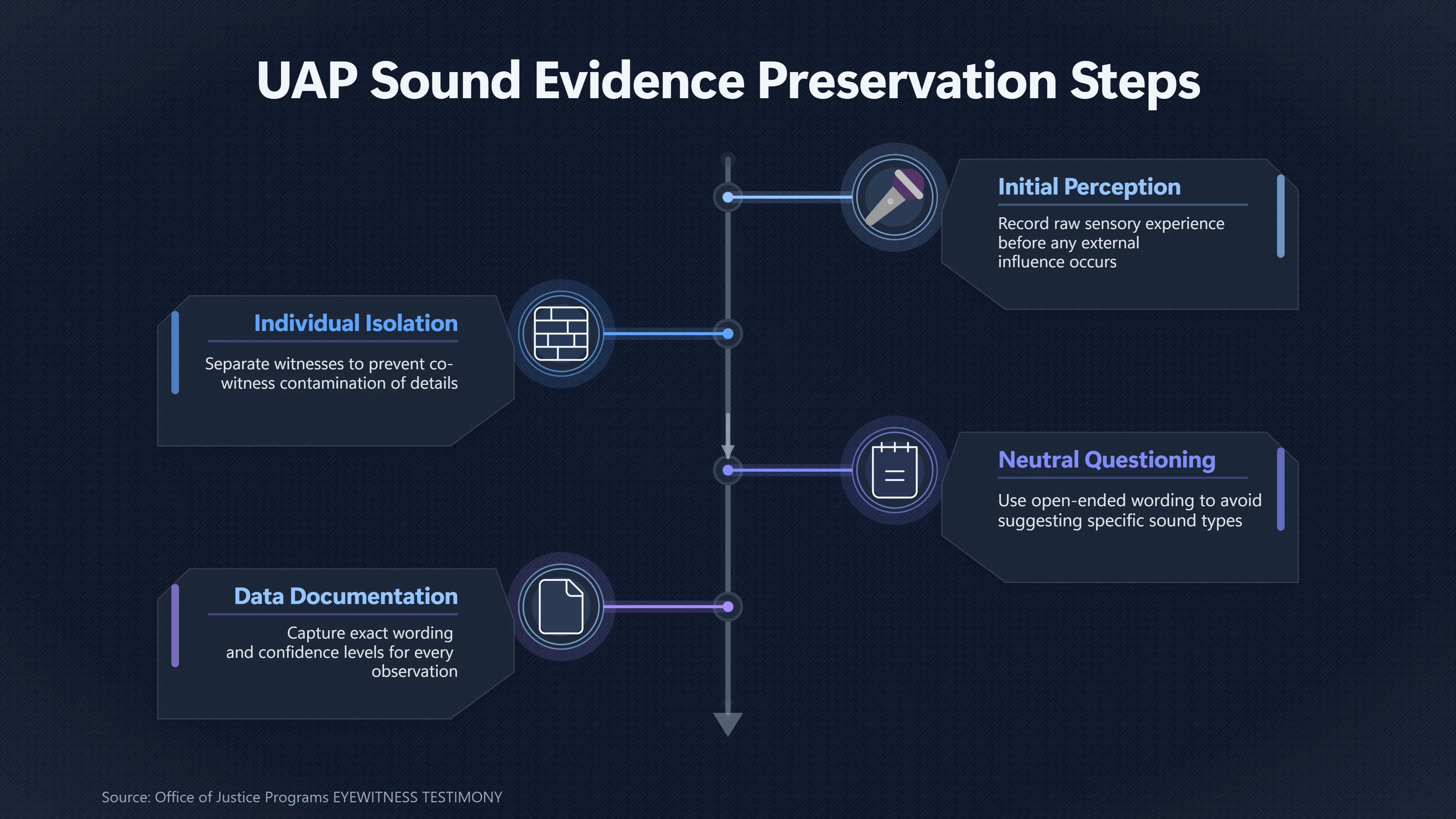
Prompt, separate and neutral witness interviews can preserve uncertainty before discussion and suggestion reshape a sound report.
On this page
- Why delays increase reconstruction risks
- How to separate witnesses and avoid leading questions
- What sensory details to record immediately
Page outline Jump by section
Introduction
When a witness reports hearing an unusual noise during a UFO or unidentified aerial phenomenon (UAP) sighting, the most valuable evidence is often the account recorded before memory begins to change. Psychological research consistently shows that human memory is reconstructive rather than a perfect recording. As time passes, conversations with other witnesses, exposure to media coverage, repeated questioning and leading interview techniques can all reshape what people sincerely believe they heard. For investigators interested in evaluating reported UFO sounds, prompt, independent and carefully documented interviews therefore serve an important purpose: they preserve uncertainty where uncertainty genuinely exists and help distinguish direct perception from later interpretation.[ojp.gov]nij.ojp.govNational Institute of JusticeInterviewing Victims and Witnesses of Crime | National Institute of JusticeJanuary 1, 1995…
This approach does not assume that unusual sounds are real, misidentified or extraordinary. Instead, it improves the quality of the evidence by recording the witness’s original sensory experience before post-event influences have an opportunity to alter it.
Why delays increase reconstruction risks
Memory begins changing almost immediately after an event. Every act of recall can strengthen some details while altering or omitting others. In ambiguous situations—such as hearing an unfamiliar hum, buzz or vibration at night while observing an unidentified light—later information can become incorporated into the witness’s recollection without conscious awareness. This process is one of the best-established findings in eyewitness memory research.[Office of Justice Programs]ojp.govOffice of Justice Programs EYEWITNESS TESTIMONYOffice of Justice ProgramsEYEWITNESS TESTIMONY - FINAL REPORT, SEPTEMBER 1975 | Office of Justice Programs…
For UFO sound reports, delays create several specific risks:
- Interpretation replaces observation. A witness may initially report, “I heard a low humming sound,” but later remember, “The object emitted a low electrical hum,” even if they never directly perceived the sound’s source.
- Descriptions become more specific over time. Initially uncertain impressions may evolve into detailed narratives after discussion, despite no new sensory evidence.
- Confidence can increase independently of accuracy. Repeated retelling often makes memories feel more certain, even when details have shifted.[National Institute of Justice]nij.ojp.govNational Institute of JusticeInterviewing Victims and Witnesses of Crime | National Institute of JusticeJanuary 1, 1995…
These changes are especially relevant for sounds because people are often less certain about the location, distance and origin of an unfamiliar noise than they are about whether they heard something at all. Early documentation therefore captures both the reported sound and the witness’s original level of confidence.
How separate interviews reduce contamination
One of the simplest ways to preserve the integrity of witness accounts is to interview people individually before they discuss the event with one another.
Laboratory studies repeatedly demonstrate that exposure to another witness’s account can introduce details a person never observed directly. This “co-witness contamination” can occur even when everyone involved is acting honestly and trying to remember accurately. Some witnesses later report another person’s observations as though they were their own.[PubMed]pubmed.ncbi.nlm.nih.govCo-witness information can have immediate effects on eyewitness memory reports - PubMed…
For UFO sound investigations, separating witnesses is particularly valuable because auditory experiences are often incomplete. One witness may remember a humming noise, another may not have heard anything unusual, while a third may recall wind or aircraft noise. Recording these differences before discussion preserves potentially important evidence instead of allowing the accounts to converge artificially.
Guidance developed for eyewitness investigations in criminal contexts similarly recommends separating witnesses during initial evidence collection to reduce inadvertent sharing of information. Although UFO investigations differ in purpose, the same memory principles apply.[National Institute of Justice]nij.ojp.govNational Institute of JusticeEyewitness Evidence: A Guide for Law Enforcement | National Institute of JusticeOctober 1, 1999…
How to avoid leading questions
The wording of interview questions matters because suggestions can unintentionally alter later memory.
Questions that assume a sound existed or imply its characteristics should be avoided. Instead of asking:
- “Did the UFO make the electrical humming sound?”
- “How loud was the buzzing?”
an interviewer can ask neutral questions such as:
- “What, if anything, did you hear?”
- “Can you describe every sound you noticed during the event?”
- “How certain are you that the sound came from the object you observed?”
Neutral wording allows witnesses to distinguish between direct perception and personal inference. Research pioneered by Elizabeth Loftus and many subsequent studies has shown that even subtle wording differences can influence later recollection of events.[Office of Justice Programs]ojp.govOffice of Justice Programs EYEWITNESS TESTIMONYOffice of Justice ProgramsEYEWITNESS TESTIMONY - FINAL REPORT, SEPTEMBER 1975 | Office of Justice Programs…
Equally important is allowing witnesses to say they are unsure. Recording uncertainty accurately is often more informative than encouraging a complete but potentially reconstructed account.
What sensory details should be recorded immediately?
The first interview should focus on observations rather than explanations. Practical documentation includes:
- Description of the sound: humming, buzzing, clicking, roaring, silence or another description using the witness’s own words.
- Timing: when the sound was first noticed relative to the visual observation.
- Duration: whether it was continuous, intermittent or brief.
- Perceived direction: where the witness believed the sound originated, while noting any uncertainty.
- Changes over time: whether the sound became louder, softer or changed character.
- Environmental conditions: wind, traffic, nearby machinery, animals or aircraft that could have contributed competing sounds.
- Confidence statements: how certain the witness feels about each observation rather than treating all details as equally reliable.
Recording exact wording is valuable because later summaries often replace the witness’s original language with interpretations. A statement such as “it reminded me of electricity” conveys something different from “it was an electrical sound.”
Preserving perception rather than producing agreement
An early interview is not intended to create a single, consistent narrative. In fact, differences between independent accounts may help investigators understand which details were genuinely perceived and which emerged later.
For example, if three witnesses independently report an unusual low-frequency hum before speaking with one another, that consistency deserves attention. Conversely, if only later interviews contain highly specific descriptions such as “oscillating electromagnetic vibration” after witnesses discussed the event together or consumed related media, investigators have reason to treat those additions more cautiously.
The aim is therefore not to eliminate disagreement but to preserve the original distribution of observations, uncertainty and confidence. That distinction allows later analysis to evaluate which elements remained stable from the earliest available accounts.
Why early interviews strengthen sound evidence
Early witness interviews cannot determine whether an unusual sound originated from an unidentified object, a conventional source or a perceptual misunderstanding. They do, however, improve the quality of the available evidence by reducing memory contamination before it occurs.
Prompt, independent and neutrally conducted interviews help preserve what witnesses directly experienced, separate observation from interpretation and retain valuable uncertainty that might otherwise disappear through discussion or suggestion. Within the study of UFO sound reports, these practices provide a stronger foundation for evaluating auditory claims than accounts reconstructed days, weeks or months after the event.
Amazon book picks
Further Reading
Books and field guides related to How to Record UFO Sound Reports Before Memory Shifts. Use these as the next step if you want deeper reading beyond the article.
The Seven Sins of Memory
Rating: 3.5/5 from 5 Google Books ratings
A New York Times Notable Book: A psychologist's "gripping and thought-provoking" look at how and why our brains sometimes fail us (Steven...
Investigative Interviewing
“Professors Milne and Bull have produced an updated magnus opus of the science of investigative interviewing. It is not only an indispens...
Witness for the Defense
Includes material on the case of Steve Titus, Ted Bundy, Timothy Hennis, Tony Herrerez, Howard Haupt, Clarence Von Williams, John Demjanj...
eBay marketplace picks
Marketplace Samples
Live-tested eBay searches with available results related to this page.
Selected fromUFO poster oneBay.co.uk.


Current eBay listing
VINTAGE UFO FLYING SAUCERS COMIC ADVERTISING A2 POSTER PRINT

Current eBay listing
I Want To Believe UFO Poster Giclée Fine Art Heavyweight Print

Endnotes
1.
Source: nij.ojp.gov
Link:https://nij.ojp.gov/library/publications/interviewing-victims-and-witnesses-crime
Source snippet
National Institute of JusticeInterviewing Victims and Witnesses of Crime | National Institute of JusticeJanuary 1, 1995...
Published: January 1, 1995
2.
Source: ojp.gov
Title: Office of Justice Programs EYEWITNESS TESTIMONY
Link:https://www.ojp.gov/ncjrs/virtual-library/abstracts/eyewitness-testimony-final-report-september-1975
Source snippet
Office of Justice ProgramsEYEWITNESS TESTIMONY - FINAL REPORT, SEPTEMBER 1975 | Office of Justice Programs...
Published: SEPTEMBER 1975
3.
Source: pubmed.ncbi.nlm.nih.gov
Link:https://pubmed.ncbi.nlm.nih.gov/9374604/
Source snippet
Co-witness information can have immediate effects on eyewitness memory reports - PubMed...
4.
Source: ojp.gov
Link:https://ojp.gov/ncjrs/virtual-library/abstracts/reports-suggested-memories-do-people-truly-believe-them-adult
Source snippet
(From Adult Eyewitness Testimony: Current Trends and Developments, P 3-26, 1994, David Frank Ross, et al, eds. -- See NCJ-159543) | Offic...
5.
Source: nij.ojp.gov
Link:https://nij.ojp.gov/library/publications/eyewitness-evidence-guide-law-enforcement
Source snippet
National Institute of JusticeEyewitness Evidence: A Guide for Law Enforcement | National Institute of JusticeOctober 1, 1999...
Published: October 1, 1999
6.
Source: ncbi.nlm.nih.gov
Link:https://www.ncbi.nlm.nih.gov/books/NBK621592/
Source snippet
ALBRIGHT AND BRANDON L. GARRETT Thomas D. Albright, Ph.D., is Professor and Director, Center for the Neurobiology of Vision, Con...
7.
Source: pmc.ncbi.nlm.nih.gov
Link:https://pmc.ncbi.nlm.nih.gov/articles/PMC11680610/
Source snippet
A systematic review - PMCMay 2, 2024 — THEORETICAL APPROACHES TO THE MISINFORMATION EFFECT There are many types of false memories and mem...
Published: May 2, 2024
8.
Source: pmc.ncbi.nlm.nih.gov
Link:https://pmc.ncbi.nlm.nih.gov/articles/PMC10492197/
9.
Source: pmc.ncbi.nlm.nih.gov
Link:https://pmc.ncbi.nlm.nih.gov/articles/PMC9487976/
10.
Source: pmc.ncbi.nlm.nih.gov
Link:https://pmc.ncbi.nlm.nih.gov/articles/PMC9225701/
11.
Source: pmc.ncbi.nlm.nih.gov
Link:https://pmc.ncbi.nlm.nih.gov/articles/PMC5855081/
12.
Source: nij.ojp.gov
Title: understanding rapport building investigative interviews does rapports effect 0
Link:https://nij.ojp.gov/library/publications/understanding-rapport-building-investigative-interviews-does-rapports-effect-0
13.
Source: pmc.ncbi.nlm.nih.gov
Link:https://pmc.ncbi.nlm.nih.gov/articles/PMC3789709/
14.
Source: pubmed.ncbi.nlm.nih.gov
Link:https://pubmed.ncbi.nlm.nih.gov/23521212/
15.
Source: nij.ojp.gov
Title: eyewitness evidence trainers manual law enforcement
Link:https://nij.ojp.gov/library/publications/eyewitness-evidence-trainers-manual-law-enforcement
16.
Source: nichd.nih.gov
Link:https://www.nichd.nih.gov/newsroom/releases/interviewing
17.
Source: ojp.gov
Title: Interviewing Victims and Witnesses of Crime | Office of Justice Programs
Link:https://www.ojp.gov/library/publications/interviewing-victims-and-witnesses-crime
18.
Source: ojp.gov
Title: Evaluation and Field Implementation of the Cognitive Interview, Executive
Link:https://www.ojp.gov/library/publications/evaluation-and-field-implementation-cognitive-interview-executive-summary
19.
Source: nij.ojp.gov
Title: evaluation and field implementation cognitive interview executive
Link:https://nij.ojp.gov/library/publications/evaluation-and-field-implementation-cognitive-interview-executive-summary
20.
Source: nij.ojp.gov
Title: evaluation and field implementation cognitive interview
Link:https://nij.ojp.gov/library/publications/evaluation-and-field-implementation-cognitive-interview
21.
Source: nij.ojp.gov
Title: enhancing enhanced eyewitness memory refining cognitive interview
Link:https://nij.ojp.gov/library/publications/enhancing-enhanced-eyewitness-memory-refining-cognitive-interview
22.
Source: ojp.gov
Link:https://www.ojp.gov/library/publications/enhancing-enhanced-eyewitness-memory-refining-cognitive-interview
23.
Source: nij.ojp.gov
Title: eyewitness responses leading and misleading questions under cognitive
Link:https://nij.ojp.gov/library/publications/eyewitness-responses-leading-and-misleading-questions-under-cognitive
24.
Source: ojp.gov
Link:https://www.ojp.gov/library/publications/memory-enhancement-techniques-interviewing-victims-and-witnesses-crime
25.
Source: nij.ojp.gov
Title: memory enhancement techniques interviewing victims and witnesses crime
Link:https://nij.ojp.gov/library/publications/memory-enhancement-techniques-interviewing-victims-and-witnesses-crime
26.
Source: ojp.gov
Link:https://www.ojp.gov/ncjrs/virtual-library/abstracts/eyewitness-evidence-guide-law-enforcement
27.
Source: ojp.gov
Link:https://ojp.gov/ncjrs/virtual-library/abstracts/effects-questioning-upon-witness-later-recollections
28.
Source: ojp.gov
Link:https://www.ojp.gov/ncjrs/virtual-library/abstracts/distortions-eyewitness-memory-postevent-information-part-3
29.
Source: ojp.gov
Link:https://ojp.gov/ncjrs/virtual-library/abstracts/eyewitness-evidence-trainers-manual-law-enforcement
30.
Source: nij.ojp.gov
Title: eyewitness testimony
Link:https://nij.ojp.gov/taxonomy/term/eyewitness-testimony
Additional References
31.
Source: researchportal.port.ac.uk
Title: port.ac.uk Witness interviewing and crime investigation
Link:https://researchportal.port.ac.uk/en/publications/witness-interviewing-and-crime-investigation/
Source snippet
interviewing and crime investigation - University of PortsmouthJuly 16, 2025 — WITNESS INTERVIEWING AND CRIME INVESTIGATION * Brandon May...
Published: July 16, 2025
32.
Source: youtube.com
Title: Elizabeth F. Loftus
Link:https://www.youtube.com/watch?v=CSo_esEgIjc
Source snippet
Cognitive interview technique eyewitness memory investigative interviewing The Cognitive Interview: How to Improve Eyewitness Testimony |...
33.
Source: youtube.com
Title: The Cognitive Interview: How to Improve Eyewitness Testimony
Link:https://www.youtube.com/watch?v=ee7g5SR7McA
Source snippet
THE COGNITIVE INTERVIEW - Geiselman (1984) & Fisher (1987)...
34.
Source: sciencedirect.com
Link:https://www.sciencedirect.com/science/article/pii/S0749596X03001116
35.
Source: youtube.com
Title: The Cognitive Interview
Link:https://www.youtube.com/watch?v=DHIxD_FMdCA
Source snippet
How We Make Memories: Crash Course Psychology #13...
36.
Source: college.police.uk
Title: College of Policing Witness separation | College of Policing
Link:https://www.college.police.uk/guidance/obtaining-initial-accounts/witness-separation
37.
Source: youtube.com
Title: THE COGNITIVE INTERVIEW
Link:https://www.youtube.com/watch?v=q5m5GlFNSLI
38.
Source: youtube.com
Title: How We Make Memories: Crash Course Psychology #13
Link:https://www.youtube.com/watch?v=bSycdIx-C48
Source snippet
Elizabeth F. Loftus - False Memories...
39.
Source: sciencedirect.com
Title: Leading questions and the eyewitness report
Link:https://www.sciencedirect.com/science/article/pii/0010028575900237