Within Drones
Does the Object Move Like a Drone?
Stable hovering, gradual acceleration and slow directional changes are more consistent with multirotor flight than extraordinary motion.
On this page
- Recognizable hovering behaviour
- Gradual turns and acceleration
- Movements that exceed normal drone performance
Page outline Jump by section
Introduction
A buzzing sound can suggest that an unidentified light is actually a drone, but movement patterns often provide even stronger clues. Modern multirotor drones are designed to hover with remarkable stability, make controlled directional changes and accelerate smoothly under computer-assisted flight control. When an object remains almost stationary, pivots gradually, or moves away in a measured and predictable manner, its behaviour is frequently consistent with a conventional drone rather than an unknown aircraft. At the same time, movement alone is not enough to identify what has been seen. The most reliable assessment comes from combining flight behaviour with sound, lighting, apparent distance and the surrounding environment.[Federal Aviation Administration]faa.govFederal Aviation AdministrationWhat To Know About Drones | Federal Aviation AdministrationJanuary 14, 2025…
Does the Object Hover Like a Drone?
One of the defining capabilities of a multirotor drone is sustained hovering. Unlike fixed-wing aircraft, which must keep moving forward to remain airborne, quadcopters and similar designs continuously adjust the speed of individual rotors to maintain a near-stationary position.
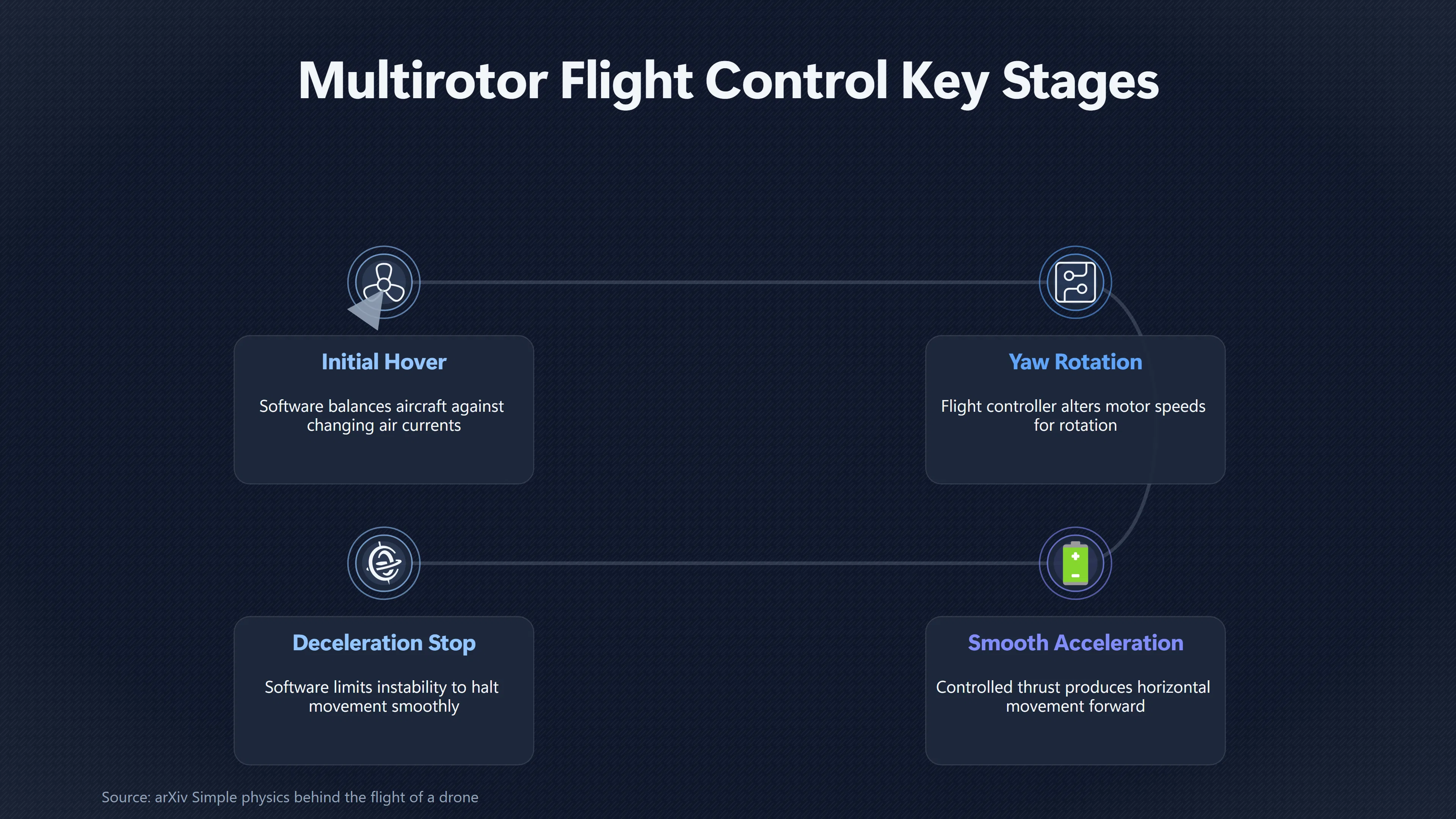
In calm conditions, a modern GPS-assisted drone can appear almost motionless from the ground. Even in light wind, it often makes tiny, continuous corrections rather than drifting freely. These subtle adjustments may be difficult to notice at a distance but are a normal consequence of the flight controller balancing the aircraft against changing air currents. Research into multirotor flight control consistently treats precise hover as a fundamental operating mode because the aircraft’s software is designed to maintain stability automatically.[NASA Technical Reports Server]ntrs.nasa.govNASA Technical Reports ServerHandling Qualities of Multirotor RPM-Controlled Electric-Vertical Take-Off and Landing (eVTOL) Aircraft for…
Observers sometimes interpret prolonged hovering as unusual because conventional aircraft cannot remain fixed in one location. In reality, sustained hovering is one of the most recognisable characteristics of multirotor drones.
Recognisable hovering behaviour
Movement consistent with a drone typically includes:
- Remaining in approximately the same position for many seconds or even several minutes.
- Small side-to-side or vertical corrections rather than perfectly motionless flight.
- Brief drift caused by wind, followed by an immediate return towards the previous position.
- Stable hovering while lights remain pointed in the same general direction.
These behaviours become more convincing when accompanied by the familiar pulsing rotor noise discussed elsewhere in the broader comparison between buzzing UFO sounds and drone acoustics.
Why Drone Turns Look Smooth Rather Than Instantaneous
Drone turns are normally deliberate and progressive rather than abrupt. When changing direction, the flight controller alters motor speeds to rotate the aircraft before producing horizontal movement. Even highly responsive consumer drones usually yaw—the rotation about the vertical axis—smoothly instead of snapping instantly through large angles.
This computer-controlled stability gives drone movement a characteristic appearance. A drone may pause, rotate towards a new heading, then accelerate away. Alternatively, it may combine a gentle turn with forward flight while maintaining altitude. These transitions often appear mechanical and controlled because onboard software constantly limits instability and overcorrection.[arXiv]arxiv.orgarXiv Simple physics behind the flight of a dronearXiv Simple physics behind the flight of a drone
From the ground, especially at night, these gradual movements can seem strangely deliberate. However, they are exactly what would be expected from an electronically stabilised multirotor.
Gradual turns and acceleration
Patterns commonly associated with drones include:
- Slow rotation before moving in a new direction.
- Smooth acceleration instead of explosive starts.
- Controlled deceleration before stopping to hover again.
- Repeated hover-turn-move sequences while surveying an area.
These movements are especially common during aerial photography, inspections or recreational flying, where the pilot intentionally avoids sudden manoeuvres to keep the camera stable.
Why Distance Can Make Drone Movements Look Stranger
Estimating aerial motion is surprisingly difficult without reliable depth cues. A nearby drone may appear to make dramatic sideways jumps simply because observers misjudge its distance, while a more distant drone can seem completely stationary even though it is travelling steadily.
Night conditions increase these perceptual errors. Bright navigation lights may be visible long before the body of the aircraft, making it difficult to judge orientation or speed. If only one light is visible, a gradual yaw rotation can even be mistaken for a sudden change in direction as different lights come into view.
Wind adds another complication. Although drones actively resist drift, stronger gusts can produce small corrections that, from certain viewpoints, appear as irregular movements rather than automatic stabilisation.
For these reasons, apparent flight behaviour should always be interpreted alongside sound, lighting configuration and environmental conditions rather than in isolation.
What Would Be Unusual Even for a Drone?
Recognising drone-like movement also means recognising behaviour that exceeds normal multirotor performance.
Most consumer drones remain subject to the same physical limits as any other aircraft. They require measurable time to accelerate, decelerate and change direction. Their turns are constrained by inertia, available thrust and flight-control software. Aviation regulators also require operators to fly responsibly and maintain visual awareness during most routine operations, reinforcing the expectation of controlled rather than reckless manoeuvres.[Federal Aviation Administration]faa.govFederal Aviation AdministrationSmall Unmanned Aircraft Systems (UAS) Regulations (Part 107) | Federal Aviation AdministrationJuly 6, 2026…
Movement that would be difficult to reconcile with ordinary multirotor flight includes:
- Instantaneous changes of direction without any visible transition.
- Immediate acceleration from stationary hover to extremely high speed.
- Sharp right-angle turns at high velocity with no slowing beforehand.
- Sustained motion that appears to ignore inertia or aerodynamic forces.
- Abrupt disappearance without any obscuration, lighting change or loss of visibility.
Reports containing these features deserve careful scrutiny, but they do not automatically demonstrate extraordinary technology. Errors in estimating distance, perspective, viewing angle, atmospheric conditions or multiple objects can all produce misleading impressions.
Using Flight Patterns as One Piece of the Puzzle
Hovering and turning patterns are most valuable when considered alongside other observations. A stable hover, gentle yaw, gradual acceleration and repeated controlled repositioning are all hallmarks of multirotor flight and therefore strengthen the case that a buzzing unidentified object is a drone.
Conversely, flight behaviour that genuinely appears incompatible with known drone performance should be examined carefully using all available evidence rather than movement alone. Sound, lighting, weather conditions, witness location and apparent distance all contribute to a more reliable assessment than any single characteristic in isolation.
Amazon book picks
Further Reading
Books and field guides related to Does the Object Move Like a Drone?. Use these as the next step if you want deeper reading beyond the article.
The Drone Pilot's Handbook
The perfect companion for anyone buying (or thinking of buying) a drone, whether it's just for fun, to race against friends, or to give t...
Drones For Dummies
The fast and easy way to pick out, set up, and learn to fly your drone Ready to soar into the world of unmanned aircraft? Drones For Dumm...
Small Unmanned Aircraft: Theory and Practice
Includes bibliographical references (p. [291]-298) and index.
Make: Drones: Teach an Arduino to Fly
Make: Drones will help the widest possible audience understand how drones work by providing several DIY drone projects based on the world...
eBay marketplace picks
Marketplace Samples
Live-tested eBay searches with available results related to this page.
Selected fromdrone display stand oneBay.co.uk.
Endnotes
1.
Source: ntrs.nasa.gov
Link:https://ntrs.nasa.gov/citations/20230005195
Source snippet
NASA Technical Reports ServerHandling Qualities of Multirotor RPM-Controlled Electric-Vertical Take-Off and Landing (eVTOL) Aircraft for...
2.
Source: arxiv.org
Title: arXiv Simple physics behind the flight of a drone
Link:https://arxiv.org/abs/1511.05916
3.
Source: ntrs.nasa.gov
Link:https://ntrs.nasa.gov/citations/20250006234
4.
Source: nasa.gov
Title: NAS A Flies Drones Autonomously for Air Taxi Research
Link:https://www.nasa.gov/aeronautics/nasa-flies-autonomous-drones/
5.
Source: nas.nasa.gov
Link:https://www.nas.nasa.gov/SC23/research/project6.html
6.
Source: nasa.gov
Title: Flow Visualization of Multirotor Test Bed Experiment
Link:https://www.nasa.gov/image-article/flow-visualization-of-multirotor-test-bed-experiment/
7.
Source: science.nasa.gov
Title: what were learning about ingenuitys flight control and aerodynamic performance
Link:https://science.nasa.gov/blog/what-were-learning-about-ingenuitys-flight-control-and-aerodynamic-performance/
8.
Source: nas.nasa.gov
Link:https://www.nas.nasa.gov/SC17/demos/demo5.html
9.
Source: nasa.gov
Title: Exploring Drone Aerodynamics with Computers
Link:https://www.nasa.gov/aeronautics/exploring-drone-aerodynamics-with-computers/
10.
Source: technology.nasa.gov
Title: LAR TOPS 283
Link:https://technology.nasa.gov/patent/LAR-TOPS-283
11.
Source: software.nasa.gov
Title: LAR 19479 1
Link:https://software.nasa.gov/software/LAR-19479-1
12.
Source: technology.nasa.gov
Title: LAR TOPS 232
Link:https://technology.nasa.gov/patent/LAR-TOPS-232
13.
Source: youtube.com
Title: Drones | The complete flight dynamics
Link:https://www.youtube.com/watch?v=C0KBu2ihp-s
Source snippet
How a Quadcopter Works - Flight Mechanics, Components, & Sensors (2)...
14.
Source: faa.gov
Link:https://www.faa.gov/newsroom/what-know-about-drones
Source snippet
Federal Aviation AdministrationWhat To Know About Drones | Federal Aviation AdministrationJanuary 14, 2025...
Published: January 14, 2025
15.
Source: faa.gov
Link:https://www.faa.gov/uas
16.
Source: faa.gov
Link:https://www.faa.gov/newsroom/small-unmanned-aircraft-systems-uas-regulations-part-107
Source snippet
Federal Aviation AdministrationSmall Unmanned Aircraft Systems (UAS) Regulations (Part 107) | Federal Aviation AdministrationJuly 6, 2026...
Published: July 6, 2026
17.
Source: faa.gov
Link:https://www.faa.gov/uas/recreational_flyers
18.
Source: faa.gov
Link:https://www.faa.gov/uas/commercial_operators
19.
Source: faa.gov
Link:https://www.faa.gov/faq/do-i-need-permission-faa-fly-uas-or-drone-recreation-or-hobby
20.
Source: faa.gov
Link:https://www.faa.gov/Air_Traffic/publications/atpubs/aim_html/chap_11.html
21.
Source: sciencedirect.com
Title: Flight Control
Link:https://www.sciencedirect.com/topics/earth-and-planetary-sciences/flight-control
22.
Source: caa.co.uk
Link:https://www.caa.co.uk/drones/
Additional References
23.
Source: goodiesrc.com
Link:https://www.goodiesrc.com/how-to-practice-drone-hovering/
Source snippet
June 23, 2026 — HOW TO PRACTICE DRONE HOVERING: A STEP-BY-STEP GUIDE FOR STABLE, CONFIDENT FLIGHT June 23, 2026 by Editor In Chief Learni...
Published: June 23, 2026
24.
Source: goodiesrc.com
Title: HOW TO MAKE A DRONE HOVER STEADY A steady hover dep
Link:https://www.goodiesrc.com/how-to-make-a-drone-hover-steady/
Source snippet
How to Make a Drone Hover Steady: Calibration, Controls, and Flight Tips -June 16, 2026 — HOW TO MAKE A DRONE HOVER STEADY: CALIBRATION...
Published: June 16, 2026
25.
Source: learnrobotix.com
Title: How Do Quadcopters Fly, Physics and Flight Controllers
Link:https://learnrobotix.com/how-do-quadcopters-fly/
Source snippet
Knowing the difference helps when reading tuning guides. HOVER In hover, all four motors spin...
26.
Source: youtube.com
Title: DJI Mini 4 Pro|Waypoint Flight
Link:https://www.youtube.com/watch?v=878OJOwcCVI
Source snippet
Drone hover stability GPS position hold flight controller Betaflight 4.6 / 2025-12 POSHOLD / ALTHOLD setup guide Joshua Bardwell...
27.
Source: youtube.com
Title: How Drones Fly and Maneuver – Basic Physics Explained
Link:https://www.youtube.com/watch?v=J4RkNxjpKy0
Source snippet
FPV drone controls explained - throttle, pitch, roll, yaw | FPV 101: Phase 1, Episode 7...
28.
Source: youtube.com
Title: How a Quadcopter Works
Link:https://www.youtube.com/watch?v=u-LfLW9Kgis
Source snippet
How Drones Fly and Maneuver – Basic Physics Explained...
29.
Source: nature.com
Link:https://www.nature.com/articles/s41586-022-05182-2
30.
Source: ardupilot.org
Link:https://ardupilot.org/copter/docs/what-is-a-multicopter-and-how-does-it-work.html
31.
Source: px4.gitbook.io
Link:https://px4.gitbook.io/px4-user-guide/flying/basic_flying
32.
Source: px4.gitbook.io
Link:https://px4.gitbook.io/px4-user-guide/flying/flight_modes/manual_stabilized_mc