Within Aircraft Noise
Why the Roar Comes After the Aircraft Passes
Because sound travels slowly, the loudest engine noise may reach the ground seconds after the aircraft has already moved on.
On this page
- How far sound lags behind a moving aircraft
- Why the apparent source trails the visible plane
- Simple timing checks for witness reports
Page outline Jump by section
Introduction
One of the most common reasons an ordinary aircraft is mistaken for something unusual is that the loudest noise often arrives after the aircraft has already passed overhead. To an observer, this can feel counter-intuitive: the aircraft is visibly moving away, yet the roar appears to come from where it was a few seconds earlier. In UFO witness reports, this timing mismatch sometimes creates the impression that the sound belongs to a different object or that an unidentified craft has suddenly disappeared.
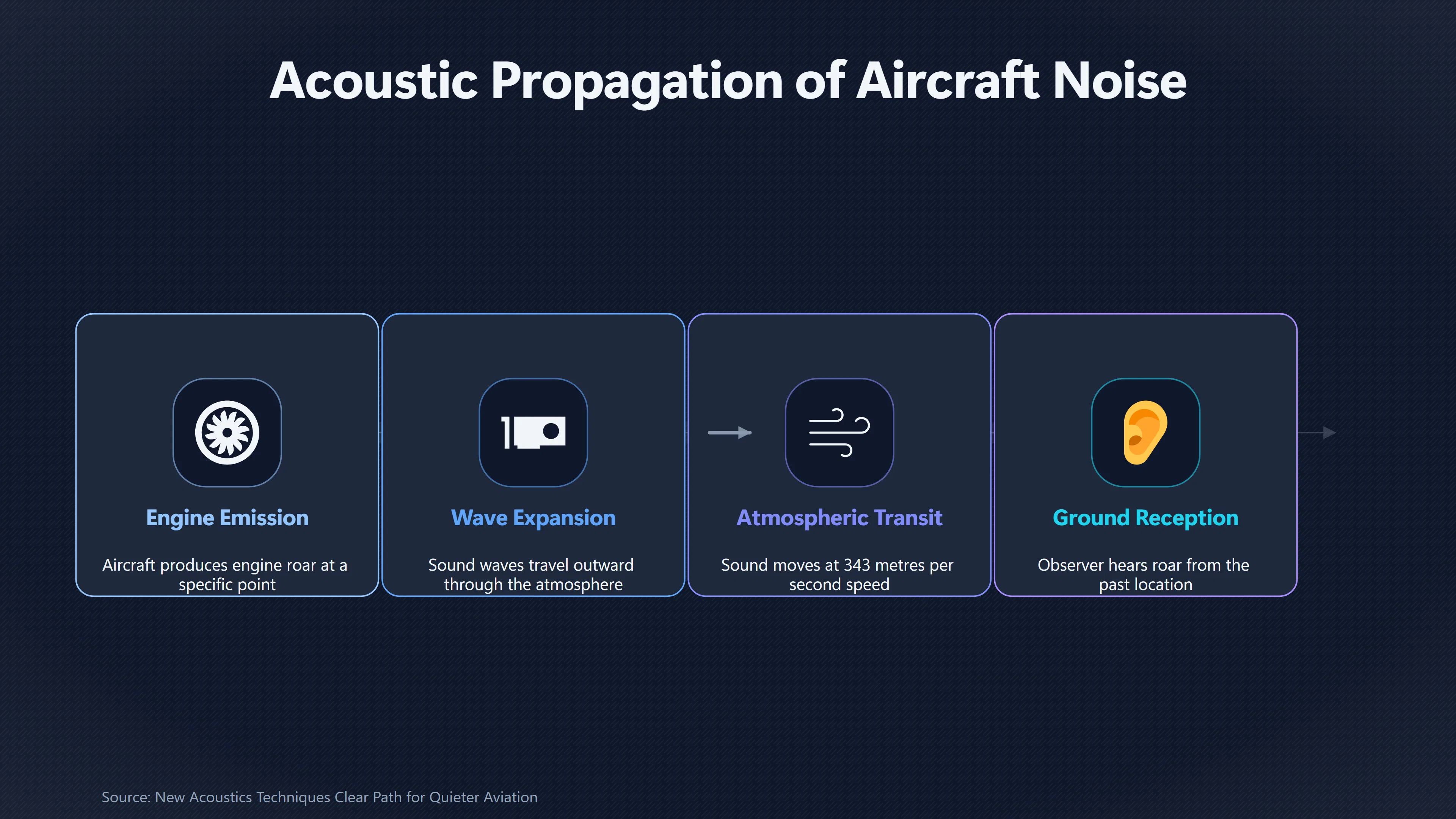
The explanation is straightforward. Light reaches your eyes almost instantly, while sound travels through air at only about 343 metres per second under typical conditions. A fast-moving aircraft covers a significant distance while the sound it produced earlier is still travelling towards the ground. The result is a natural delay between what you see and what you hear, sometimes amplified by the aircraft’s speed, altitude and the atmosphere.[Federal Aviation Administration]faa.govFederal Aviation AdministrationFundamentals of Noise and Sound | Federal Aviation AdministrationMarch 29, 2022…
How Far Sound Lags Behind a Moving Aircraft
The key point is that every sound you hear was generated in the past.
Suppose an airliner is flying at around 250 metres per second (roughly 900 km/h) at an altitude of 3,000 metres. Even if it flies directly overhead, the sound produced when it was nearest to you requires approximately 8–9 seconds to travel down to ground level. During that time, the aircraft has travelled more than 2 kilometres along its flight path.
This means that:
- you see the aircraft overhead almost immediately because light reaches you effectively instantaneously;
- several seconds later, you hear the loudest engine noise;
- by then, the aircraft is already well ahead of the point where that sound originated.
The delay varies continuously with altitude and geometry. A low aircraft on approach may produce only a brief lag, while a high-altitude jet can seem almost disconnected from its sound. FAA guidance on moving noise sources notes that aircraft sound levels naturally rise as the aircraft approaches and decrease after it passes, but the observer is always hearing sound emitted earlier because of the finite speed of sound.[Federal Aviation Administration]faa.govFederal Aviation AdministrationFundamentals of Noise and Sound | Federal Aviation AdministrationMarch 29, 2022…
Why the Apparent Source Trails the Visible Plane
People often assume they are hearing sound from the aircraft’s current position. In reality, they are hearing sound emitted when the aircraft occupied an earlier point along its route.
Imagine taking a series of snapshots every second. Each snapshot shows the aircraft somewhere new, but each also launches expanding sound waves that spread outward in all directions. By the time one of those expanding wavefronts reaches a listener on the ground, the aircraft has already moved on.
This produces two common perceptions:
- The roar seems to come from behind the aircraft. Your ears naturally associate the arriving sound with the location where it originated rather than where the aircraft is now.
- The aircraft appears unusually quiet overhead. The strongest engine noise may not coincide with the instant the aircraft is directly above you because that sound has not yet reached your ears.
NASA’s aircraft-noise modelling explicitly accounts for aircraft motion, Doppler effects and atmospheric sound propagation because all three influence what listeners actually perceive during a flyover.[NASA]nasa.govNew Acoustics Techniques Clear Path for Quieter AviationNew Acoustics Techniques Clear Path for Quieter Aviation - NASA…
Why the Delay Can Seem Even Longer
The basic travel-time delay explains most cases, but several factors can increase the apparent separation between sight and sound.
Greater altitude. The higher the aircraft, the farther the sound must travel before reaching the ground.
Aircraft speed. Faster aircraft cover more distance during the sound’s travel time, increasing the apparent gap between the visible aircraft and the arriving noise.
Wind. Wind can speed up or slow down sound travelling towards a listener. A headwind or tailwind changes the effective travel time, making the delay seem slightly shorter or longer depending on conditions.
Temperature layering. Differences in air temperature with height can bend sound waves (a process called refraction), causing the loudest sound to arrive from an unexpected direction or making certain parts of the flight path seem louder than others.[Federal Aviation Administration]faa.govFederal Aviation AdministrationFundamentals of Noise and Sound | Federal Aviation AdministrationMarch 29, 2022…
Why This Can Confuse UFO Witnesses
Within reports of unexplained aerial sounds, delayed aircraft noise is a recurring source of confusion because human perception naturally links simultaneous events.
A witness may:
- see an aircraft already moving away;
- hear a sudden roar overhead;
- conclude the visible aircraft cannot be responsible because it appears too far away.
Without considering sound-travel time, it is easy to assume the noise belongs to another unseen object. At night or under cloud cover, where visual references are limited, this disconnect becomes even more convincing.
The effect is particularly noticeable with large transport aircraft and military jets, whose powerful engines remain audible over long distances. Because these aircraft continue moving rapidly while earlier sound propagates through the atmosphere, the visible aircraft and the audible source can appear strikingly separated.

Simple Timing Checks for Witness Reports
When evaluating reports of mysterious overhead sounds, a few practical observations can help determine whether delayed aircraft noise is a likely explanation.
- Estimate the aircraft’s altitude. A high aircraft naturally produces a longer delay than a low one.
- Notice whether the loudest roar follows the flyover. A delay of several seconds is entirely consistent with ordinary aircraft acoustics.
- Watch the aircraft after it passes. If it continues steadily away while the noise reaches its peak, the timing matches expected sound propagation.
- Consider weather conditions. Wind and temperature inversions can make the sound seem displaced or unusually loud without requiring an unusual source.
These simple checks cannot identify every aircraft, but they often explain why an apparently mysterious roaring sound seems disconnected from the visible aeroplane. In many cases, the “late-arriving” noise is simply the unavoidable consequence of sound travelling much more slowly than light, combined with an aircraft moving rapidly across the sky.[Federal Aviation Administration]faa.govFederal Aviation AdministrationFundamentals of Noise and Sound | Federal Aviation AdministrationMarch 29, 2022…
Amazon book picks
Further Reading
Books and field guides related to Why the Roar Comes After the Aircraft Passes. Use these as the next step if you want deeper reading beyond the article.
Master Handbook of Acoustics
The goal of this book is to apply the principles of acoustics to the audio arts. This involves serving as an interpreter of major trends...
The Science of Sound
Written for students without a background in mathematics or physics, this textbook provides an introduction to the study of acoustics. It...
Understanding Flight
The simplest, most intuitive book on the toughest lessons of flight--addresses the science of flying in terms, explanations, and illustra...
Why You Hear What You Hear
Why You Hear What You Hear is the first book on the physics of sound for the nonspecialist to empower readers with a hands-on, ears-open...
eBay marketplace picks
Marketplace Samples
Live-tested eBay searches with available results related to this page.
Selected fromUFO disclosure poster oneBay.co.uk.



Endnotes
1.
Source: faa.gov
Link:https://www.faa.gov/regulations_policies/policy_guidance/noise/basics
Source snippet
Federal Aviation AdministrationFundamentals of Noise and Sound | Federal Aviation AdministrationMarch 29, 2022...
Published: March 29, 2022
2.
Source: nasa.gov
Title: New Acoustics Techniques Clear Path for Quieter Aviation
Link:https://www.nasa.gov/aeronautics/new-acoustics-techniques-clear-path-for-quieter-aviation/
Source snippet
New Acoustics Techniques Clear Path for Quieter Aviation - NASA...
3.
Source: faa.gov
Title: Aircraft Noise | Federal Aviation Administration
Link:https://www.faa.gov/noise/aircraft_noise
Source snippet
January 31, 2025 — AIRCRAFT NOISE Who to contact about noise complaints TOPICS ON THIS PAGE * Aircraft and airport noise programs * High...
Published: January 31, 2025
4.
Source: science.nasa.gov
Title: chapter6 4
Link:https://science.nasa.gov/learn/basics-of-space-flight/chapter6-4/
Source snippet
6: Electromagnetics - NASA ScienceJanuary 16, 2025 — CHAPTER 6: ELECTROMAGNETICS Page One | Page Two | Page Three | Page Four | Page Five...
Published: January 16, 2025
5.
Source: faa.gov
Title: Noise | Federal Aviation Administration
Link:https://www.faa.gov/noise
Source snippet
While there are many benefits to air travel, aviation noise can be a concern for communities. The FAA is limited b...
6.
Source: faa.gov
Title: For air traffic controllers
Link:https://www.faa.gov/air_traffic/weather/tdwr
Source snippet
Terminal Doppler Weather Radar (TDWR) | Federal Aviation AdministrationNovember 27, 2024 — TERMINAL DOPPLER WEATHER RADAR (TDWR) Air Traf...
Published: November 27, 2024
7.
Source: nasa.gov
Title: ’s Glenn Research Ce
Link:https://www.nasa.gov/general/nasa-has-helped-hush-aircraft-engine-noise-for-decades/
Source snippet
NASA Has Helped Hush Aircraft Engine Noise for Decades - NASAAugust 24, 2023 — 4 min read NASA HAS HELPED HUSH AIRCRAFT ENGINE NOISE FOR...
Published: August 24, 2023
8.
Source: faa.gov
Title: Fundamentals of Noise and Sound | Federal Aviation Administration
Link:https://www.faa.gov/noise/aviation_noise/fundamentals_of_noise
Source snippet
July 22, 2022 — FUNDAMENTALS OF NOISE AND SOUND * Using the Day-Night Average Sound Level * Comparative Noise Levels * Annoyance Due to N...
Published: July 22, 2022
9.
Source: faa.gov
Title: Community Response to Noise | Federal Aviation Administration
Link:https://www.faa.gov/noise/aviation_noise/community_response
10.
Source: nasa.gov
Title: NAS A Partners with Boeing on Test Flights to Advance Aviation
Link:https://www.nasa.gov/aeronautics/nasa-partners-with-boeing-on-test-flights-to-advance-aviation/
11.
Source: science.nasa.gov
Title: eavesdropping in space how nasa records eerie sounds around earth
Link:https://science.nasa.gov/blogs/the-sun-spot/2018/12/11/eavesdropping-in-space-how-nasa-records-eerie-sounds-around-earth/
12.
Source: jpl.nasa.gov
Title: art turns public eyes and ears toward space
Link:https://www.jpl.nasa.gov/news/art-turns-public-eyes-and-ears-toward-space/
13.
Source: nasa.gov
Title: NAS A Test Flights Examine Effect of Atmospheric Turbulence on Sonic Booms
Link:https://www.nasa.gov/centers-and-facilities/armstrong/nasa-test-flights-examine-effect-of-atmospheric-turbulence-on-sonic-booms/
14.
Source: nasa.gov
Title: Listening for the Boom and Rattle of Supersonic Flight
Link:https://www.nasa.gov/centers-and-facilities/langley/listening-for-the-boom-and-rattle-of-supersonic-flight/
15.
Source: nasa.gov
Title: NAS A Investigates the ‘Fa INT’ Side of Sonic Booms
Link:https://www.nasa.gov/aeronautics/nasa-investigates-the-faint-side-of-sonic-booms/
16.
Source: nas.nasa.gov
Title: feature landing gear khorrami
Link:https://nas.nasa.gov/pubs/stories/2011/feature_landing_gear_khorrami.html
17.
Source: ntrs.nasa.gov
Link:https://ntrs.nasa.gov/citations/19800002614
18.
Source: faa.gov
Link:https://www.faa.gov/faq/what-dnl-and-why-does-faa-use-it
19.
Source: aspm.faa.gov
Title: Delay Propagation
Link:https://www.aspm.faa.gov/aspmhelp/index/Delay_Propagation.html
20.
Source: www3.nasa.gov
Title: science of sound
Link:https://www3.nasa.gov/specials/Quesst/science-of-sound.html
Additional References
21.
Source: youtube.com
Title: Doppler Effect like never before (Pure Logic)
Link:https://www.youtube.com/watch?v=t3Giszj3ofY
Source snippet
High Speed Flight: Part 1 - Approaching the Speed of Sound...
22.
Source: af.mil
Link:https://www.af.mil/About-Us/Fact-Sheets/Display/article/104540/sonic-boom/
23.
Source: youtube.com
Title: Speed of Sound in a Medium & Doppler Effect Explained
Link:https://www.youtube.com/watch?v=lEz_Uy3P0iM
Source snippet
Neil deGrasse Tyson Explains Sonic Booms...
24.
Source: youtube.com
Title: What Happens When You Break the Sound Barrier
Link:https://www.youtube.com/watch?v=pD77DIO034A
Source snippet
Doppler Effect like never before (Pure Logic)...
25.
Source: youtube.com
Title: Neil de Grasse Tyson Explains Sonic Booms
Link:https://www.youtube.com/watch?v=GQSeTNctYig
Source snippet
What Happens When You Break the Sound Barrier...
26.
Source: howthingsfly.si.edu
Title: why it when jet flies overhead its sound changes right after it passes me
Link:https://howthingsfly.si.edu/ask-an-explainer/why-it-when-jet-flies-overhead-its-sound-changes-right-after-it-passes-me
27.
Source: sciencedirect.com
Title: Signal Processing Of Aircraft Flyover Noise
Link:https://www.sciencedirect.com/science/article/pii/S0022460X83710400
28.
Source: youtube.com
Title: High Speed Flight: Part 1
Link:https://www.youtube.com/watch?v=jfic0f0eJm4