Within Silent Sightings
Why Night Lights Make Silent UFOs Look Nearby
At night, isolated navigation or landing lights can make a distant aircraft look much closer, larger and quieter than it really is.
On this page
- How darkness removes distance cues
- Why brightness distorts perceived range
- Ways landmarks and flight data can correct the illusion
Page outline Jump by section
Introduction
Many reports of apparently silent UFOs occur after dark, when witnesses see only one or more bright lights rather than the outline of an aircraft. Under these conditions, people lose many of the visual cues needed to judge distance, altitude and size. A distant aircraft can therefore appear surprisingly low, unusually large and almost silent, even though its engine noise is entirely consistent with its true range. This is one of the best-understood mechanisms behind some night-time UFO reports and fits within the broader pattern of silent sightings caused by distance misjudgement rather than by unusual propulsion. Research on human vision and aviation has long recognised that darkness, isolated lights and featureless surroundings make distance estimation particularly unreliable.[Federal Aviation Administration]faa.govFederal Aviation Administration Chapter 8. Medical Facts for PilotsFederal Aviation Administration Chapter 8. Medical Facts for Pilots
How Darkness Removes Distance Cues
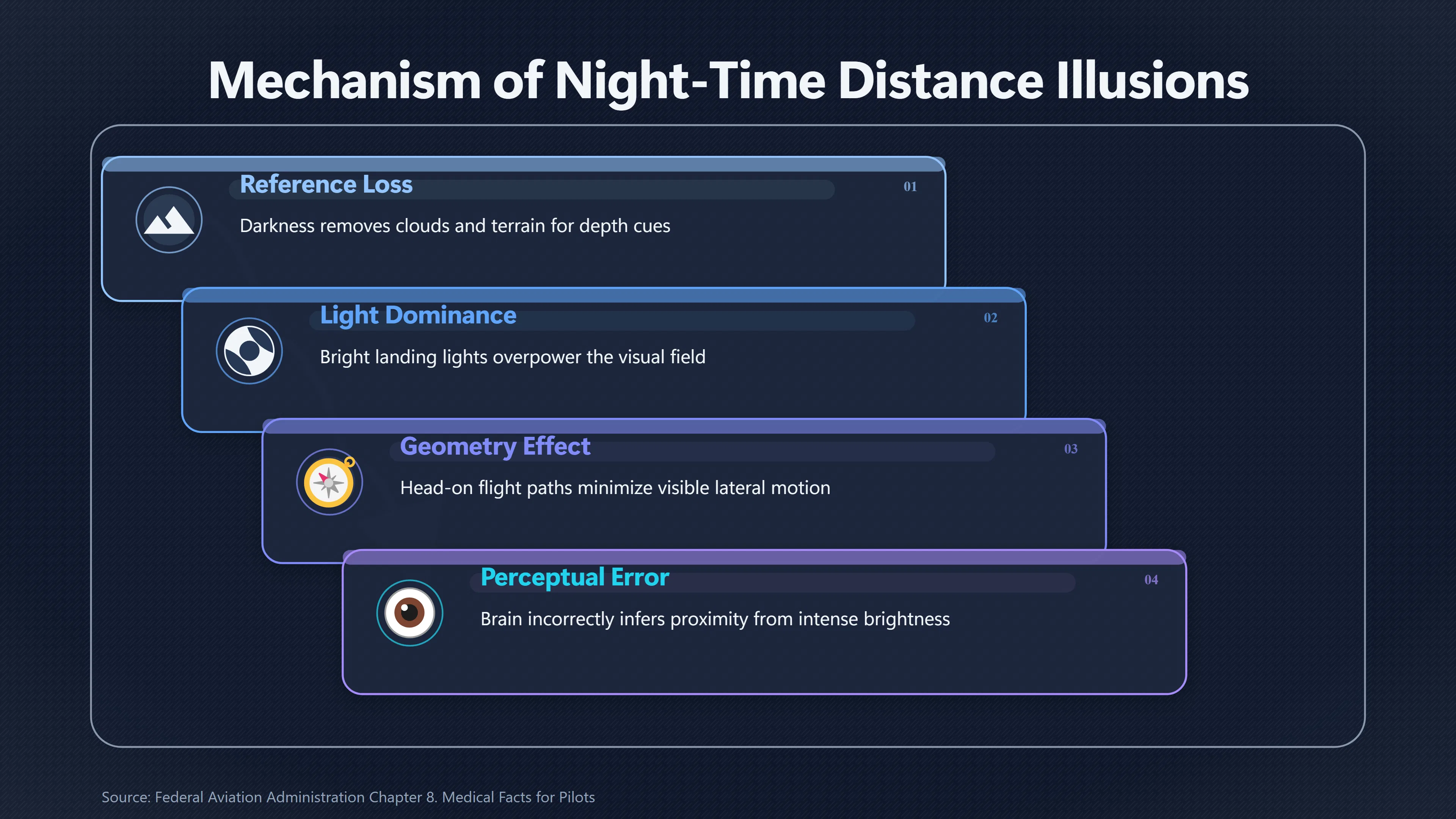
During daylight, the brain estimates distance using many overlapping clues. The apparent size of an aircraft can be compared with clouds, terrain, trees, buildings or the horizon. Surface texture, atmospheric haze and shadows also provide depth information.
At night, many of these references disappear. An observer may see only a few navigation lights, flashing anti-collision strobes or bright landing lights suspended against a black sky. Without a visible aircraft body or reliable background, the brain must infer distance from incomplete information. These inferences are often wrong because there is no dependable scale against which to judge the lights. Aviation training material warns pilots that darkness and featureless terrain greatly increase susceptibility to visual illusions involving height, distance and orientation.[Federal Aviation Administration]faa.gov12 afh ch11Federal Aviation AdministrationAirplane Flying Handbook (FAA-H-8083-3C)…
This explains why many witnesses sincerely believe an object is only a few hundred metres away when it may actually be several kilometres distant.
Why Bright Lights Can Look Much Closer Than They Are
Brightness is a powerful but imperfect cue for distance. In everyday life, nearby objects often appear brighter than distant ones, so the visual system naturally associates intense light with proximity. At night, however, aircraft landing lights are designed to be visible from long distances and can remain conspicuous even when the aircraft itself cannot be seen.
A bright forward-facing landing light viewed head-on may therefore create several misleading impressions simultaneously:
- the aircraft appears closer than it is;
- the object seems larger because the light dominates the view;
- engine noise seems unexpectedly weak;
- forward motion appears unusually slow because the aircraft is still far away.
The effect is strongest when the aircraft is approaching the observer, since its relative motion across the sky is small. Instead of sweeping sideways, the light appears almost stationary while gradually increasing in brightness, making it seem to hover or creep silently towards the observer.
FAA guidance also notes that bright lighting can distort perceived range in operational settings, illustrating how light intensity alters human judgement of distance under low-light conditions.[Federal Aviation Administration]faa.govFederal Aviation Administration Chapter 8. Medical Facts for PilotsFederal Aviation Administration Chapter 8. Medical Facts for Pilots
Why an Aircraft Can Seem Low Yet Produce Little Noise
The expectation that a low aircraft should be loud is generally correct. The illusion arises when the aircraft is not actually low.
If an observer assumes an aircraft is only 300 metres away instead of several kilometres away, the lack of loud engine noise appears mysterious. In reality:
- sound intensity decreases rapidly with distance;
- wind direction may carry engine noise away from the observer;
- modern turbofan aircraft are quieter than many people expect, especially during stable flight;
- the observer’s estimate of altitude may be based entirely on the apparent position of lights rather than the aircraft’s true location.
Because the perceived distance is incorrect from the beginning, the apparent silence becomes part of a misleading but internally consistent interpretation of the sighting.

Why Approaching Aircraft Often Look Like Hovering Objects
Many well-known UFO descriptions involve a bright object that appears almost motionless before suddenly changing position or passing overhead.
A conventional explanation is simple geometry. An aircraft flying almost directly towards an observer changes its bearing only slowly despite travelling at high speed. The light therefore appears fixed against the background while steadily becoming brighter.
Only after the aircraft passes to one side does its true lateral motion become obvious. At that point, observers often recognise the navigation lights or hear engine noise that was previously faint or delayed by distance.
This head-on viewing geometry is especially misleading when only the landing lights are visible and the aircraft’s outline remains invisible against the night sky.
Night-Time Visual Illusions That Add to the Effect
The absence of reference points can trigger additional perceptual effects that reinforce distance errors.
Autokinesis
When a person stares at a single light against a dark background for several seconds, the light may appear to drift or move even though it is stationary. This phenomenon, known as autokinesis, is well documented in aviation because it can mislead pilots during night flight. An isolated aircraft light may therefore appear to execute subtle movements that encourage interpretations of unusual manoeuvring.[Federal Aviation Administration]faa.gov12 afh ch11Federal Aviation AdministrationAirplane Flying Handbook (FAA-H-8083-3C)…
Featureless Surroundings
Dark countryside, open water or overcast skies remove visual texture that would normally help estimate altitude and distance. Aviation authorities warn that such “featureless terrain” increases errors in judging height and range, even for trained pilots. The same conditions affect ground observers trying to estimate how high an aircraft is flying.[Federal Aviation Administration]faa.govFederal Aviation Administration Chapter 8. Medical Facts for PilotsFederal Aviation Administration Chapter 8. Medical Facts for Pilots
Using Landmarks and Flight Data to Test the Impression
Night-time distance illusions can often be checked using independent evidence rather than relying solely on visual impressions.
Useful cross-checks include:
- Fixed landmarks. Compare the lights with hills, towers, buildings or known terrain features. If the object passes behind a distant ridge, it cannot be nearby.
- The horizon. A visible horizon or cloud layer provides a better estimate of elevation than isolated lights alone.
- Navigation light patterns. Red, green and white position lights, together with regular anti-collision strobes, strongly indicate a conventional aircraft viewed from a particular angle.
- Flight-tracking services. Public ADS-B flight-tracking data can often identify commercial and many private aircraft in the area, allowing observers to compare the reported position, heading and altitude with what they saw.
None of these methods explains every unidentified sighting, but they frequently resolve reports in which a supposedly low, silent object proves to have been a much more distant aircraft viewed under poor depth-perception conditions.
Why This Mechanism Matters in Silent UFO Reports
Night-time aircraft lights demonstrate how ordinary perception can produce extraordinary impressions without requiring unusual aircraft behaviour. Darkness removes reliable depth cues, bright landing lights exaggerate apparent proximity, and head-on flight paths minimise visible motion. Together, these factors can make a distant aircraft seem surprisingly low, unusually large and almost silent.
For investigators assessing silent UFO reports, recognising these well-established perceptual mechanisms is an essential first step before considering more unusual explanations.
Amazon book picks
Further Reading
Books and field guides related to Why Night Lights Make Silent UFOs Look Nearby. Use these as the next step if you want deeper reading beyond the article.
The UFO Handbook: A Guide to Investigating, Evaluating, and R...
An explanation of the usual reasons for confusing IFOs (identified flying objects) with UFOs and a survey of the tools used to investigat...
UFOs Explained
Analyzing several UFO cases, the author exposes the myth of extraterrestrial visitors to earth.
The Invisible Gorilla: How Our Intuitions Deceive Us
NEW YORK TIMES BESTSELLER • Our minds don’t work the way we think they do. Two renowned psychologists explain how and why our intuitions...
Visual Intelligence: Sharpen Your Perception, Change Your Life
An engrossing guide to seeing—and communicating—more clearly from the groundbreaking course that helps FBI agents, cops, CEOs, ER docs, a...
eBay marketplace picks
Marketplace Samples
Live-tested eBay searches with available results related to this page.
Selected fromaircraft art print oneBay.co.uk.

Endnotes
1.
Source: faa.gov
Title: Federal Aviation Administration Chapter 8. Medical Facts for Pilots
Link:https://www.faa.gov/Air_traffic/publications/atpubs/aim_html/chap8_section_1.html
2.
Source: faa.gov
Title: 12 afh ch11
Link:https://www.faa.gov/sites/faa.gov/files/regulations_policies/handbooks_manuals/aviation/airplane_handbook/12_afh_ch11.pdf
Source snippet
Federal Aviation AdministrationAirplane Flying Handbook (FAA-H-8083-3C)...
3.
Source: faa.gov
Link:https://www.faa.gov/Air_traffic/publications/atpubs/aim_html/chap2_section_1.html
4.
Source: faa.gov
Title: Federal Aviation Administration Fitness for Flight
Link:https://www.faa.gov/air_traffic/publications/atpubs/aip_html/chap8_section_1.html
5.
Source: faa.gov
Title: Chapter 8
Link:https://www.faa.gov/air_traffic/publications/atpubs/aim/aim0801.html
Source snippet
Medical Facts for PilotsJanuary 8, 2015 — 8-1-4. Carbon Monoxide Poisoning in Flight a. Carbon monoxide is a colorless, odorless, and tas...
Published: January 8, 2015
6.
Source: faa.gov
Title: Chapter 2
Link:https://www.faa.gov/air_traffic/publications/atpubs/AIM/aim0201.html
Source snippet
Aeronautical Lighting and Other Airport Visual AidsJanuary 8, 2015 — CHAPTER 2. AERONAUTICAL LIGHTING AND Other Airport Visual Aids SECTI...
Published: January 8, 2015
7.
Source: faa.gov
Title: Office of Aerospace Medicine Technical Reports | Federal Aviation Administration
Link:https://www.faa.gov/data_research/research/med_humanfacs/oamtechreports/1970s/1978/197815
8.
Source: faa.gov
Link:https://www.faa.gov/air_traffic/publications/atpubs/aip_html/chap2_section_1.html
9.
Source: faa.gov
Link:https://www.faa.gov/air_traffic/publications/atpubs/aim_html/chap10_section_2.html
10.
Source: faa.gov
Link:https://www.faa.gov/data_research/research/med_humanfacs/oamtechreports/1970s/1977/197712
11.
Source: faa.gov
Link:https://www.faa.gov/data_research/research/med_humanfacs/oamtechreports/1960s/1966/196624
12.
Source: faa.gov
Link:https://www.faa.gov/air_traffic/publications/atpubs/aip_html/chap7_section_6.html
13.
Source: skybrary.aero
Link:https://skybrary.aero/index.php/articles/visual-illusions
Additional References
14.
Source: aopa.org
Title: The stillness of the air, the faint glow of city lights, and the seemingly endl
Link:https://www.aopa.org/news-and-media/all-news/2023/july/pilot/asi-safety-tips-night-terrors
Source snippet
Night terrors - AOPAMay 25, 2023 — NIGHT TERRORS THE BLACK HOLE DEPARTURE May 25, 2023 By Terrie Mead There’s something alluring about fl...
Published: May 25, 2023
15.
Source: medium.com
Title: Your Senses in the Shadows
Link:https://medium.com/faa/your-senses-in-the-shadows-5ed018e015b5
Source snippet
Nighttime Visual Illusions and Spatial… | by FAA Safety Briefing Magazine | Cleared for Takeoff | MediumJanuary 17, 2025 — Cleared for Ta...
Published: January 17, 2025
16.
Source: pubhtml5.com
Title: The light may even b
Link:https://pubhtml5.com/xrzz/fnvy/basic/151-200
Source snippet
FAA-H-8083-3B Airplane Flying Handbook, 2016 - Pilot-Landing gear-Flight | PubHTML5August 17, 2020 — The landing light is sometimes ineff...
Published: August 17, 2020
17.
Source: youtube.com
Title: FAA-Archived: Multiple Pilots Report Mysterious UFO Lights at FL370
Link:https://www.youtube.com/watch?v=tNiJz-U0mcs
Source snippet
UFOs or PILOT Error? The Disappearance of Frederick Valentich...
18.
Source: youtube.com
Title: UFOs or PILOT Error? The Disappearance of Frederick Valentich
Link:https://www.youtube.com/watch?v=6LNnWxi_lw4
Source snippet
Are They Aliens? Science Writer Mick West Explains UFO Footage...
19.
Source: youtube.com
Title: UFO Videos Explained: Mick West’s Expert Analysis
Link:https://www.youtube.com/watch?v=-_4QF__92q0
Source snippet
FAA-Archived: Multiple Pilots Report Mysterious UFO Lights at FL370...
20.
Source: youtube.com
Title: [Drones]({{ ‘drones/’ | relative_url }}), Airplanes, Or UAPs? How To Tell The Difference
Link:https://www.youtube.com/watch?v=lnIxGL_fP9E
Source snippet
The SHOCKING Math Error Behind Viral UFO Videos | Mick West...
21.
Source: youtube.com
Title: The SHOCKING Math Error Behind Viral UFO Videos | Mick West
Link:https://www.youtube.com/watch?v=ypfbhfEXnBo
Source snippet
UFO Videos Explained: Mick West's Expert Analysis...
22.
Source: faraim.org
Link:https://www.faraim.org/faa/aim/chapter-8/section-8-1-5.html
23.
Source: faraim.org
Link:https://www.faraim.org/faa/aim/chapter-8/section-8-1-6.html