Within Myths
What Evidence Makes a UFO Sound Convincing?
Audio becomes more useful when its timing can be compared with calibrated video, radar, weather records and aircraft traffic data.
On this page
- Matching audio with independent instruments
- Testing timing and source consistency
- How combined data eliminates ordinary explanations
Page outline Jump by section
Introduction
A recorded hum, buzz or roar does not become convincing evidence of an unidentified aerial phenomenon (UAP) simply because it sounds unusual. Modern investigations instead ask a more demanding question: does the sound agree with independent measurements collected at the same time? This multi-sensor approach is central to current scientific and government-led UAP research. Rather than treating microphones as proof on their own, investigators compare audio with calibrated video, radar or radio observations, weather measurements, aircraft tracking data and precise timestamps. When several independent systems tell the same physical story, confidence increases. When they disagree, the sound is often explained as a recording artefact, environmental noise or a conventional aircraft. This shift from isolated witness accounts to synchronised sensor networks represents one of the biggest changes in how UFO sound claims are evaluated today.[Galileo Project]galileo.hsites.harvard.eduGalileo ProjectThe Scientific Investigation of Unidentified Aerial Phenomena (UAP) Using Multimodal Ground-Based Observatories | The Gali…
Matching Audio with Independent Instruments
The strongest investigations begin by asking whether every sensor observed the same event.
A microphone may capture a low-frequency rumble while a camera records a distant light. That coincidence alone is not enough. Investigators test whether the timing, direction and expected physics all match. If the sound arrives too early, too late or from a different direction than the object appears to be travelling, the simplest explanation is that the two observations are unrelated.
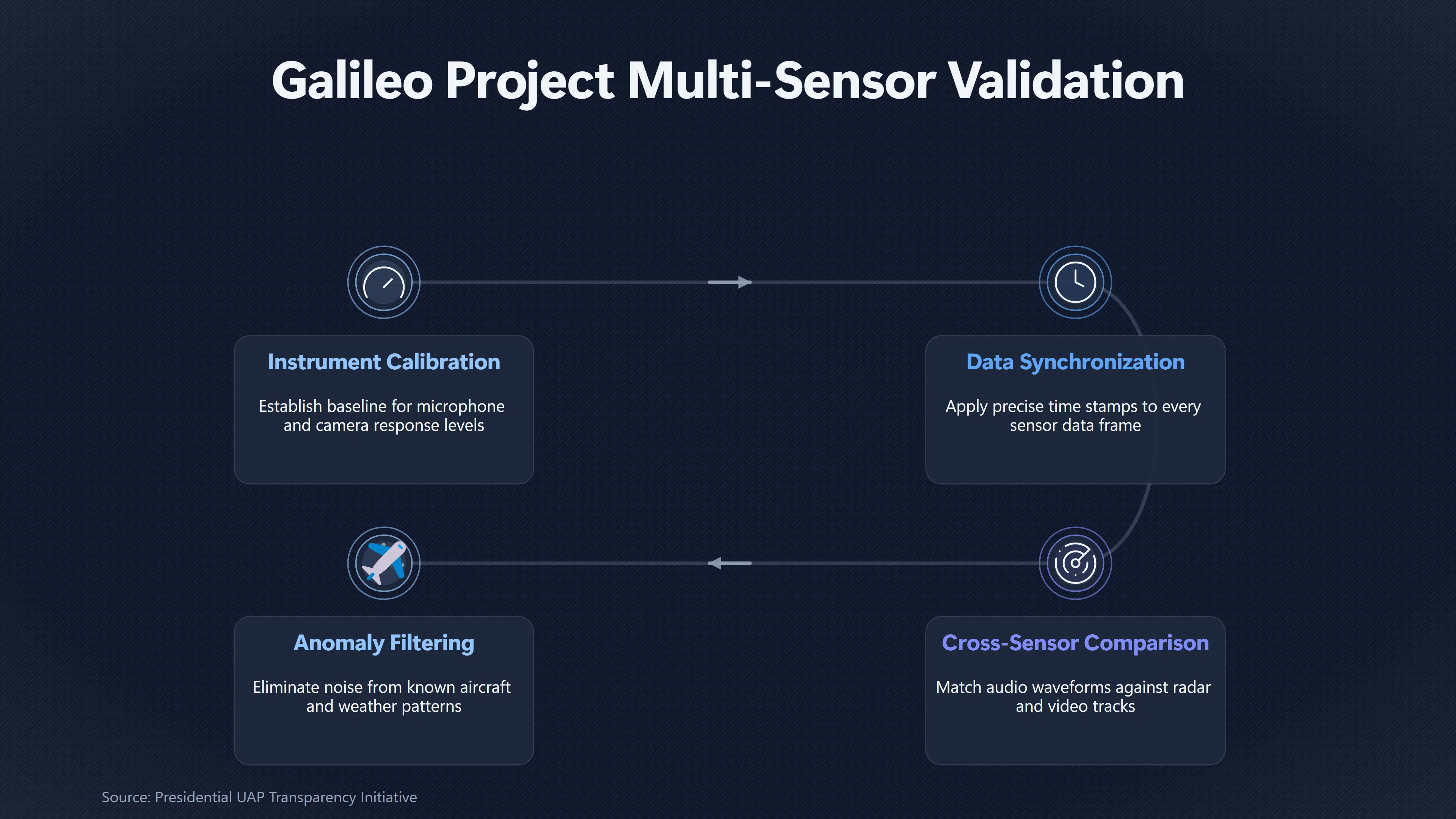
Modern multi-sensor observatories therefore synchronise all instruments using highly accurate clocks. Each frame of video, acoustic waveform and environmental measurement receives a precise timestamp so that investigators can reconstruct the sequence of events rather than relying on human memory. This allows analysts to distinguish between genuine simultaneous observations and unrelated background sounds that merely happened nearby.[Galileo Project]galileo.hsites.harvard.eduGalileo ProjectThe Scientific Investigation of Unidentified Aerial Phenomena (UAP) Using Multimodal Ground-Based Observatories | The Gali…
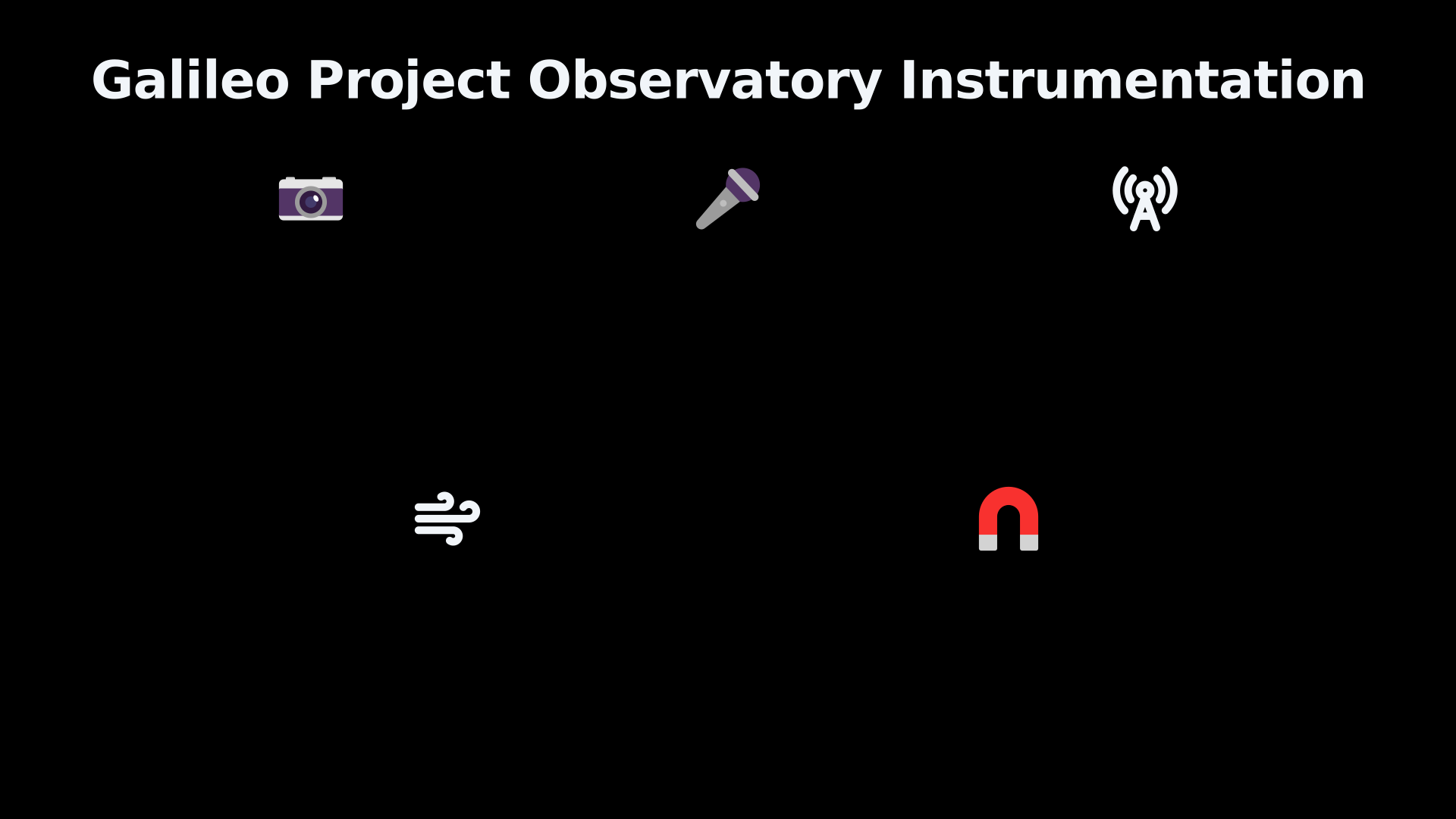
Scientific UAP observatory proposals typically combine:
- Wide-field and narrow-field calibrated cameras.
- Microphones covering infrasonic, audible and ultrasonic frequencies.
- Passive radar or radio-frequency receivers.
- Weather stations measuring wind, pressure and humidity.
- Electric and magnetic field sensors.
- Position and timing systems that keep every instrument synchronised.
No single instrument is expected to identify an extraordinary object. Instead, each contributes one independent measurement that can either reinforce or contradict the others.[Galileo Project]galileo.hsites.harvard.eduGalileo ProjectThe Scientific Investigation of Unidentified Aerial Phenomena (UAP) Using Multimodal Ground-Based Observatories | The Gali…
Testing Timing and Source Consistency
The most valuable test is whether the recorded sound behaves as expected for a real physical source.
Sound travels much more slowly than light. If an aerial object is filmed several kilometres away, any genuine acoustic signal should arrive after a predictable delay determined by atmospheric conditions. A sound that appears before the visual event, or with an impossible delay, suggests that the recording captured something else entirely.
Investigators also compare:
- Direction: Does the sound originate from the same bearing as the visual target?
- Movement: Does the apparent motion of the sound source match the object’s measured trajectory?
- Frequency changes: Are pitch shifts consistent with expected Doppler effects for the measured speed?
- Duration: Does the sound persist for the same interval as the observed object?
- Intensity: Is the recorded loudness physically plausible for the estimated distance?
Because these comparisons rely on independently measured quantities, they are far more informative than witness impressions such as “the sound seemed to follow the object”. A mismatch in even one of these areas can eliminate an otherwise persuasive claim.[Galileo Project]galileo.hsites.harvard.eduGalileo ProjectThe Scientific Investigation of Unidentified Aerial Phenomena (UAP) Using Multimodal Ground-Based Observatories | The Gali…
How Combined Data Eliminates Ordinary Explanations
Most unusual aerial sounds have several ordinary possibilities. Multi-sensor evidence allows investigators to test those possibilities directly instead of relying on speculation.
For example, a mysterious humming noise may initially seem remarkable. However, if aircraft transponder data (such as ADS-B broadcasts), calibrated video and the acoustic spectrum all point to a distant aircraft climbing behind cloud, the mystery largely disappears.
Likewise, weather measurements can identify conditions that bend or reflect sound over unexpectedly long distances. Temperature inversions, wind gradients and humidity all affect how sound propagates. A microphone alone cannot distinguish these effects, but environmental sensors can reveal whether unusual atmospheric conditions were present.[Galileo Project]galileo.hsites.harvard.eduGalileo ProjectThe Scientific Investigation of Unidentified Aerial Phenomena (UAP) Using Multimodal Ground-Based Observatories | The Gali…
Independent datasets are also checked against:
- Civil and military aircraft traffic records.
- Satellite and rocket activity.
- Meteorological observations.
- Known drone operations where available.
- Local industrial or infrastructure noise sources.
Each successful match removes one conventional explanation from consideration. Only events that survive multiple independent checks remain candidates for further investigation.
Why Calibration Matters More Than Dramatic Audio
A dramatic recording is far less valuable than a calibrated one.
Consumer recordings often contain automatic gain control, wind noise reduction, compression and microphone limitations that alter the original sound. Phones also rarely preserve detailed information about microphone response or absolute sound pressure levels.
Research observatories instead calibrate microphones before deployment. Calibration establishes how accurately an instrument measures different frequencies and sound levels, allowing later analysis to distinguish genuine acoustic signatures from equipment artefacts.
The same principle applies to cameras. Lens distortion, exposure settings and pointing direction are characterised before observations begin. Because every instrument’s limitations are understood, unexpected measurements become easier to interpret scientifically rather than anecdotally.[Galileo Project]galileo.hsites.harvard.eduGalileo ProjectThe Scientific Investigation of Unidentified Aerial Phenomena (UAP) Using Multimodal Ground-Based Observatories | The Gali…
Cross-Checking Sensor Disagreements
Disagreement between sensors is often as informative as agreement.
Suppose a witness reports a loud humming object overhead, but:
- calibrated cameras record nothing,
- radar detects no corresponding target,
- nearby microphones do not record the hum,
- weather data show strong winds capable of carrying distant industrial noise.
Rather than strengthening the UFO interpretation, these inconsistencies encourage investigators to examine perceptual errors, local environmental effects or recording limitations.
Conversely, if multiple independent sensors simultaneously detect the same object’s location, motion and physical characteristics, confidence that a real aerial object existed increases substantially—even if its exact identity remains unknown.
Importantly, “real object” and “extraordinary object” are separate conclusions. Multi-sensor agreement demonstrates that an event occurred; it does not by itself establish exotic technology or extraterrestrial origin.[Galileo Project]galileo.hsites.harvard.eduGalileo ProjectThe Scientific Investigation of Unidentified Aerial Phenomena (UAP) Using Multimodal Ground-Based Observatories | The Gali…
Lessons from Current UAP Programmes
Recent scientific and official UAP efforts consistently emphasise better measurements rather than more witness testimony.
The Galileo Project’s proposed observatories explicitly integrate broadband microphones with optical cameras, infrared imaging, radio receivers, environmental monitoring and data-fusion software. In this framework, acoustic measurements provide an additional independent line of evidence rather than a standalone identification tool. Algorithms compare multiple sensor streams to recognise known aircraft, detect inconsistencies and flag only those events that remain unusual after cross-validation.[Galileo Project]galileo.hsites.harvard.eduGalileo ProjectThe Scientific Investigation of Unidentified Aerial Phenomena (UAP) Using Multimodal Ground-Based Observatories | The Gali…
Similarly, the US All-domain Anomaly Resolution Office (AARO) has repeatedly noted that many unresolved cases remain unresolved because they lack sufficient corroborating technical data. Public releases also caution that incidental audio in some videos is unrelated to the visual event, illustrating why synchronised, well-documented sensor information is essential before drawing conclusions.[AARO]aaro.milNext - AARO UAP Report Documents…
What Makes a UFO Sound Convincing?
A convincing UFO sound is not one that is strange, frightening or difficult to identify. It is one that survives independent testing.
The most persuasive evidence would include a calibrated audio recording whose timing, direction and characteristics agree with synchronised video, radar or radio observations, weather data, aircraft traffic records and other environmental measurements. Such agreement would demonstrate that the sound originated from the same physical event rather than from coincidence or misinterpretation.
Current evidence does not show that any particular hum, buzz or other noise uniquely identifies a UFO. Instead, modern investigations treat sound as one valuable measurement within a broader network of independent observations. The credibility of a sound claim therefore depends less on the sound itself than on how well it fits every other available piece of evidence.[Galileo Project]galileo.hsites.harvard.eduGalileo ProjectThe Scientific Investigation of Unidentified Aerial Phenomena (UAP) Using Multimodal Ground-Based Observatories | The Gali…
Amazon book picks
Further Reading
Books and field guides related to What Evidence Makes a UFO Sound Convincing?. Use these as the next step if you want deeper reading beyond the article.
UFOs: Generals, Pilots, and Government Officials Go on the Re...
An in-depth investigation into UFO phenomena documents the author's survey of official extra-terrestrial encounters as experienced by sci...
The UFO Enigma
"A comprehensive investigation of encounters with unidentified flying objects, all the more riveting because it is both skeptical and scr...
The Demon-Haunted World
Rating: 4.5/5 from 43 Google Books ratings
NEW YORK TIMES BESTSELLER • From the renowned astronomer and author of Cosmos comes a “powerful [and] stirring defense of informed ration...
Modern Recording Techniques
Expanded to include the latest digital audio technology, the 7th edition now includes sections on podcasting, new surround sound formats...
eBay marketplace picks
Marketplace Samples
Live-tested eBay searches with available results related to this page.
Selected fromUFO disclosure poster oneBay.co.uk.



Endnotes
1.
Source: aaro.mil
Link:https://www.aaro.mil/Next-AARO-Home-redesign/Next-Parent/Next-UAP-Report-Documents/
Source snippet
Next - AARO UAP Report Documents...
2.
Source: aaro.mil
Link:https://www.aaro.mil/Next-AARO-Home-redesign/Next-Parent/Next-AARO-UAP-Imagery-Acc-Table/
Source snippet
AARO UAP Imagery Acc TableMay 8, 2026 — UAP IMAGERY DATATABLE FOR NEXT RELEASE UAP Imagery Imagery | Release Date | Release Number | Titl...
Published: May 8, 2026
3.
Source: aaro.mil
Title: Presidential UAP Transparency Initiative
Link:https://www.aaro.mil/Next-AARO-Home-redesign/Next-Parent/Presidential-UAP-Transparency-Initiative/
Source snippet
Next - AARO Presidential UAP Transparency InitiativeJanuary 1, 2026 — * Download * Embed * Share DOW-UAP-PR49, UNRESOLVED UAP REPORT, DEP...
Published: January 1, 2026
4.
Source: aaro.mil
Title: Official UAP Imagery
Link:https://www.aaro.mil/UAP-Cases/Official-UAP-Imagery/4/
5.
Source: aaro.mil
Link:https://www.aaro.mil/
6.
Source: aaro.mil
Link:https://www.aaro.mil/Next-AARO-Home-redesign/Next-Parent/Next-UAP-Case-RR-Data-Table/
7.
Source: youtube.com
Title: Harvard Professor: The Truth About UFOs | Prof. Avi Loeb
Link:https://www.youtube.com/watch?v=s_LBjvnegcI
Source snippet
Galileo Project UAP multi sensor scientific investigation Episode 3: The Galileo Project: Can Science Finally Detect UFOs? | Prof. Avi...
8.
Source: galileo.hsites.harvard.edu
Link:https://galileo.hsites.harvard.edu/publications/scientific-investigation-unidentified-aerial-phenomena-uap-using-multimodal
Source snippet
Galileo ProjectThe Scientific Investigation of Unidentified Aerial Phenomena (UAP) Using Multimodal Ground-Based Observatories | The Gali...
9.
Source: galileo.hsites.harvard.edu
Link:https://galileo.hsites.harvard.edu/publications/multi-band-acoustic-monitoring-aerial-signatures
10.
Source: galileo.hsites.harvard.edu
Link:https://galileo.hsites.harvard.edu/FAQ
11.
Source: galileo.hsites.harvard.edu
Title: integrated computing platform detection and tracking unidentified aerial
Link:https://galileo.hsites.harvard.edu/publications/integrated-computing-platform-detection-and-tracking-unidentified-aerial
12.
Source: galileo.hsites.harvard.edu
Title: hardware and software platform aerial object localization
Link:https://galileo.hsites.harvard.edu/publications/hardware-and-software-platform-aerial-object-localization
Additional References
13.
Source: uap-archive.org
Title: NAS A UAP Independent Study — Public Meeting & Briefings | UAP Records Archive
Link:https://uap-archive.org/uap/records/nasa-uap-independent-study-public-events/
Source snippet
NASA UAP Independent Study — Public Meeting & Briefings | UAP Records ArchiveJune 6, 2026 — NASA UAP INDEPENDENT STUDY — PUBLIC MEETING &...
Published: June 6, 2026
14.
Source: ufouap.net
Title: NAS A UAP Study: Findings and Remaining Questions | Global UFO Archive
Link:https://www.ufouap.net/en/explainers/nasa-uap-study
Source snippet
NASA UAP Study: Findings and Remaining Questions | Global UFO ArchiveJuly 23, 2026 — Science / Updated 2026-07-23 / 9 min read NASA AND U...
Published: July 23, 2026
15.
Source: youtube.com
Title: Public Meeting on Unidentified Anomalous Phenomena (Official NASA Broadcast)
Link:https://www.youtube.com/watch?v=bQo08JRY0iM
Source snippet
Breaking Down UAP Footage with the Head of The Pentagon’s UAP Taskforce...
16.
Source: science.nasa.gov
Link:https://science.nasa.gov/uap/
Source snippet
NASA ScienceFebruary 23, 2026 — Explore This Section UAP CONTENTS * NASA Unidentified Anomalous Phenomena Independent Study * Final Repor...
Published: February 23, 2026
17.
Source: youtube.com
Title: Game-Changer for UFO/UAP Science: Inside UAlbany’s New UAPx Program
Link:https://www.youtube.com/watch?v=CoKU5Pa6clE
Source snippet
Harvard Professor: The Truth About UFOs | Prof. Avi Loeb...
18.
Source: defense.gov
Link:https://www.defense.gov/News/News-Stories/Article/Article/3701297/dod-report-discounts-sightings-of-extraterrestrial-technology/
19.
Source: gi.copernicus.org
Link:https://gi.copernicus.org/articles/14/335/2025/index.html
Source snippet
The deployment of a geomagnetic variometer station as auxiliary instrumentation for the study of Unidentified Aerial PhenomenaNovember 26...
20.
Source: ufotransparency.com
Link:https://ufotransparency.com/files/2024-02-26-aaro-western-united-states-uap-case-resolution-aaro-western-us-case-resolution
21.
Source: uap-archive.org
Link:https://uap-archive.org/uap/records/aaro-historical-record-report-vol1/
22.
Source: uap-archive.org
Link:https://uap-archive.org/uap/learn/aaro-case-resolution-reports-overview/