Within Aircraft Noise
When Helicopter Rotors Sound Like an Unseen Craft
Helicopter rotors can create pulsing thumps or a continuous roar that remains hard to place when the aircraft is hidden.
On this page
- What creates helicopter blade slap
- Why the sound changes with angle and weather
- How to distinguish rotor noise from jet noise
Page outline Jump by section
Introduction
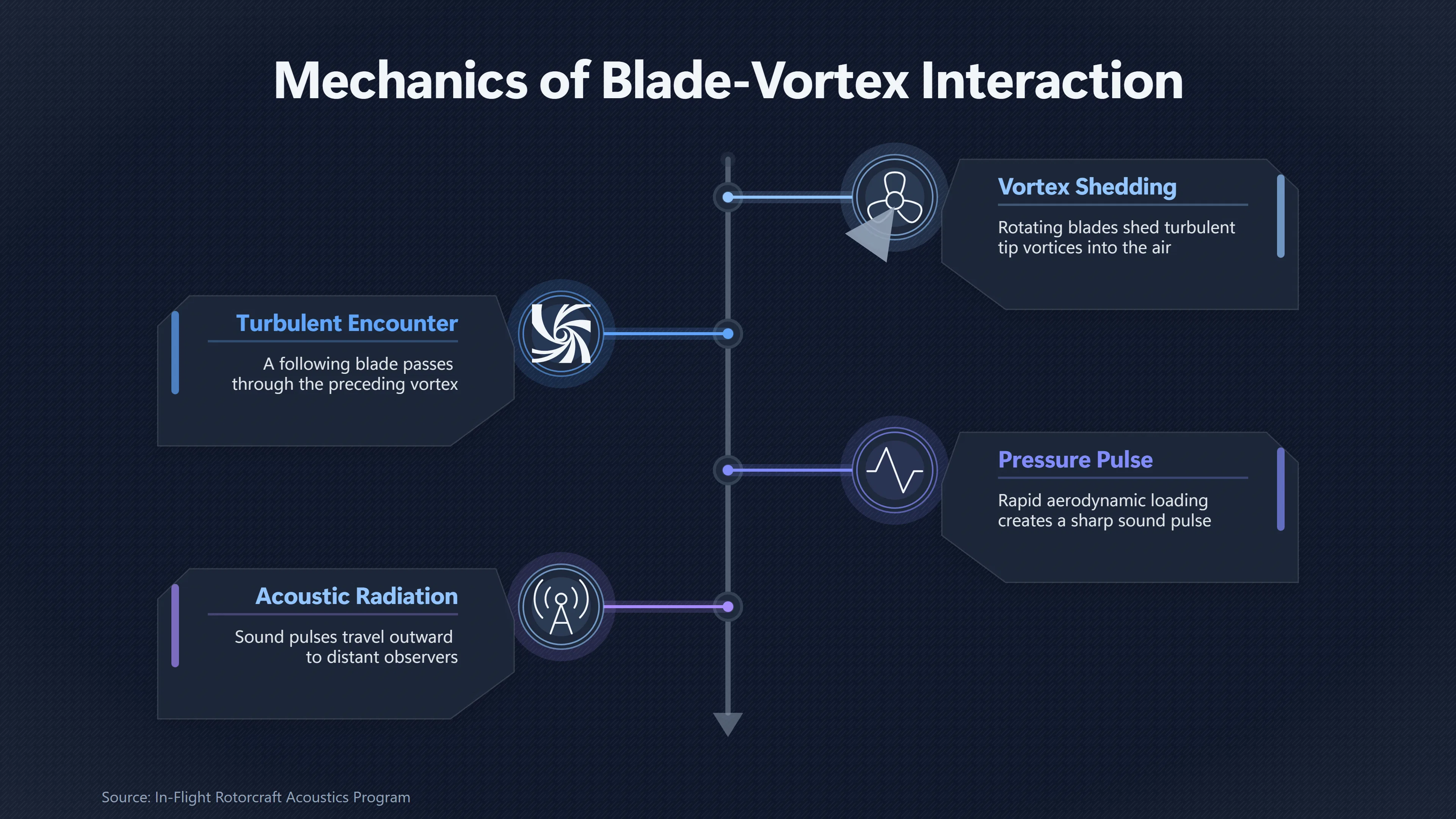
Among ordinary aircraft sounds that are sometimes mistaken for mysterious “UFO noises”, helicopter blade slap is one of the most distinctive. A helicopter hidden behind hills, trees or cloud can produce a deep pulsing thump or broad mechanical roar that seems detached from any visible aircraft. The effect is not produced simply by the engine. Instead, it arises primarily from complex aerodynamic interactions between the rotating blades and the swirling air they leave behind. Under the right flight conditions, these interactions generate short, powerful pressure pulses that can travel surprising distances and create the impression of an unseen object moving overhead. Decades of rotorcraft research have identified this mechanism as blade–vortex interaction (BVI), a well-studied source of helicopter noise rather than an unexplained phenomenon.[rotorcraft.arc.nasa.gov]rotorcraft.arc.nasa.govIn-Flight Rotorcraft Acoustics ProgramIntroduction…
What creates helicopter blade slap?
The familiar “chop-chop” sound of a helicopter comes from several overlapping sources, including the main rotor, tail rotor, engine and gearbox. Blade slap is a specific component of that sound. It occurs when one rotor blade passes through the turbulent tip vortex shed by the blade ahead of it. The encounter causes a rapid change in aerodynamic loading, producing a sharp pulse of sound that radiates away from the rotor.[rotorcraft.arc.nasa.gov]rotorcraft.arc.nasa.govIn-Flight Rotorcraft Acoustics ProgramIntroduction…
Researchers have shown that the strength of the sound depends on factors such as:
- the shape and strength of the trailing vortex,
- the distance between the blade and the vortex,
- blade speed and loading,
- the helicopter’s forward speed and rate of descent.
Even small changes in these conditions can make blade slap much louder or almost disappear. This explains why the same helicopter may sound completely different from one flight to the next.[NASA Technical Reports Server]ntrs.nasa.govNASA Technical Reports ServerThe effect of tip vortex structure on helicopter noise due to blade/vortex interaction - NASA Technical Repo…
NASA and other rotorcraft researchers have spent decades studying blade–vortex interaction because it is one of the principal external noise sources affecting communities near helicopter routes and landing sites.[rotorcraft.arc.nasa.gov]rotorcraft.arc.nasa.govIn-Flight Rotorcraft Acoustics ProgramIntroduction…
Why the sound changes with viewing angle and weather
One reason blade slap can seem mysterious is that listeners rarely hear the same sound from every direction.
Directional radiation
Blade slap is highly directional. The strongest pulses are projected into particular regions around the helicopter rather than equally in every direction. Someone beneath the flight path may hear sharp rhythmic impacts, while another observer a short distance away hears only a subdued rotor beat. NASA flight-test programmes were specifically designed to measure how blade-vortex interaction changes with observer position because the sound field varies so dramatically.[rotorcraft.arc.nasa.gov]rotorcraft.arc.nasa.govIn-Flight Rotorcraft Acoustics ProgramIntroduction…
This directional behaviour explains why witnesses often disagree about how loud or unusual a helicopter sounded even when describing the same aircraft.
Flight condition matters
Blade slap becomes especially noticeable during certain manoeuvres, particularly forward flight with moderate descent, such as approaches for landing. Under these conditions the rotor blades are more likely to intersect the vortices produced by preceding blades, strengthening the impulsive noise. Hovering helicopters generally produce a different acoustic character because the geometry of the rotor wake changes.[rotorcraft.arc.nasa.gov]rotorcraft.arc.nasa.govIn-Flight Rotorcraft Acoustics ProgramIntroduction…
Atmospheric effects
Weather also alters how the sound is perceived. Wind can carry the louder part of the acoustic pattern towards or away from an observer, while temperature gradients can refract sound so that it appears to originate from an unexpected direction. Moist or cloudy conditions may further reduce visual cues, leaving listeners with a loud, apparently disembodied roar before they identify the helicopter itself. These effects are consistent with established principles of outdoor acoustics and aircraft noise propagation.[rotorcraft.arc.nasa.gov]rotorcraft.arc.nasa.govIn-Flight Rotorcraft Acoustics ProgramIntroduction…
Why blade slap can resemble an unidentified roaring object
People often expect helicopters to produce a smooth, continuous whir. In reality, blade slap consists of repeated pressure pulses that merge together at distance.
Close to the helicopter, the sound is usually recognisable as rhythmic chopping. Farther away, atmospheric absorption removes more of the higher frequencies than the lower ones. The remaining low-frequency energy blends into a heavy rumble or mechanical roar. Reflections from hillsides, buildings or woodland can further smear the individual pulses, making the source difficult to locate by ear.
Because the helicopter may be hidden behind terrain or cloud, the listener may first encounter only the sound. Without visual confirmation, the combination of delayed arrival, shifting direction and deep pulsing can easily be interpreted as an unfamiliar airborne object rather than a conventional rotorcraft.[NASA Technical Reports Server]ntrs.nasa.govNASA Technical Reports ServerThe effect of tip vortex structure on helicopter noise due to blade/vortex interaction - NASA Technical Repo…

How to distinguish rotor noise from jet noise
Although helicopters and jets can both produce loud roaring sounds, several features help separate them.
CharacteristicHelicopter blade slapJet aircraftRhythmRepeating pulses or chopping that may merge into a roarMostly continuous broadband roar with changing pitchMain sourceRotor blades interacting with vorticesTurbofan or turbojet exhaust and fan noiseStrongest duringCertain forward-flight and descent conditionsHigh engine power, especially take-off and climbPitch behaviourRepetitive beat often remains audiblePronounced Doppler pitch shift before and after passing
A helicopter’s sound also tends to fluctuate more noticeably as the aircraft turns or changes its flight path because the directional radiation pattern of blade slap swings relative to the listener. Jets generally produce a steadier noise field dominated by engine thrust rather than discrete aerodynamic pulses.[rotorcraft.arc.nasa.gov]rotorcraft.arc.nasa.govIn-Flight Rotorcraft Acoustics ProgramIntroduction…
Why this matters in reports of unusual aerial sounds
Many reports of unexplained aerial noises begin with descriptions such as “a deep roar”, “heavy mechanical thumping”, or “something huge passing overhead without being seen”. Blade slap provides a well-supported explanation for a significant subset of these accounts when helicopters are operating nearby but remain concealed by darkness, weather or terrain.
This does not mean every unexplained sound is caused by a helicopter. However, rotorcraft acoustics are sufficiently complex that even experienced observers can misjudge the source, distance or direction of the noise. Controlled experiments, flight testing and decades of aerodynamic modelling consistently show that blade–vortex interaction can generate unusually intense, directional and rapidly changing sounds that match many descriptions of an unseen roaring aircraft.[nasa.gov]rotorcraft.arc.nasa.govIn-Flight Rotorcraft Acoustics ProgramIntroduction…
Amazon book picks
Further Reading
Books and field guides related to When Helicopter Rotors Sound Like an Unseen Craft. Use these as the next step if you want deeper reading beyond the article.
Principles of Helicopter Aerodynamics
An internationally recognized expert explains the aerodynamic principles of helicopters and other rotating-wing vertical lift aircraft. B...
Fundamentals of Aerodynamics
Rating: 4.0/5 from 8 Google Books ratings
This book is for students?to be read, understood, and enjoyed. It is consciously written i n a clear, informal, and direct styie designed...
eBay marketplace picks
Marketplace Samples
Live-tested eBay searches with available results related to this page.
Selected fromhelicopter model oneBay.co.uk.
Endnotes
1.
Source: rotorcraft.arc.nasa.gov
Title: In-Flight Rotorcraft Acoustics Program
Link:https://rotorcraft.arc.nasa.gov/Research/Programs/IRAP.html
Source snippet
Introduction...
2.
Source: ntrs.nasa.gov
Link:https://ntrs.nasa.gov/citations/19780017889
Source snippet
NASA Technical Reports ServerThe effect of tip vortex structure on helicopter noise due to blade/vortex interaction - NASA Technical Repo...
3.
Source: ntrs.nasa.gov
Link:https://ntrs.nasa.gov/citations/19860019440
Source snippet
NASA Technical Reports ServerAn analysis of blade vortex interaction aerodynamics and acoustics - NASA Technical Reports Server (NTRS)...
4.
Source: ntrs.nasa.gov
Link:https://ntrs.nasa.gov/citations/19870061636
Source snippet
NASA Technical Reports ServerMach number scaling of helicopter rotor blade/vortex interaction noise - NASA Technical Reports Server (NTRS)...
5.
Source: technology.nasa.gov
Link:https://technology.nasa.gov/patent/LAR-TOPS-282
Source snippet
NASA Technology TransferDevice for Providing Real-Time Rotorcraft Noise Abatement Information | T2 Portal...
6.
Source: ntrs.nasa.gov
Link:https://ntrs.nasa.gov/archive/nasa/casi.ntrs.nasa.gov/19970003317.pdf
Source snippet
Blade-Vortex Interaction Noise with Comparisons to CFD Calculations - NASA Technical Reports Server (NTRS)December 1, 1996 — NTRS NTRS...
Published: December 1, 1996
7.
Source: ntrs.nasa.gov
Link:https://ntrs.nasa.gov/citations/19830005666
8.
Source: ntrs.nasa.gov
Link:https://ntrs.nasa.gov/citations/19800068475
9.
Source: rotorcraft.arc.nasa.gov
Title: irap ref
Link:https://rotorcraft.arc.nasa.gov/Research/Programs/IRAP/irap_ref.html
10.
Source: rotorcraft.arc.nasa.gov
Title: IRAP BO105
Link:https://rotorcraft.arc.nasa.gov/Research/Programs/IRAP/IRAP-BO105.html
11.
Source: faa.gov
Title: Aircraft Noise | Federal Aviation Administration
Link:https://www.faa.gov/noise/aircraft_noise
Source snippet
January 31, 2025 — AIRCRAFT NOISE Who to contact about noise complaints TOPICS ON THIS PAGE * Aircraft and airport noise programs * High...
Published: January 31, 2025
12.
Source: sciencedirect.com
Title: Helicopter blade slap
Link:https://www.sciencedirect.com/science/article/pii/0022460X66901325
13.
Source: sciencedirect.com
Title: Helicopter blade slap
Link:https://www.sciencedirect.com/science/article/abs/pii/0022460X66901325
Additional References
14.
Source: youtube.com
Title: Can We Really Have Stealth Helicopters When They’re So Loud?
Link:https://www.youtube.com/watch?v=CVYU6tQgomE
Source snippet
HAI@Work Webinar: Fly Neighborly Training with Latest Robinson R44 Noise Abatement Guidance...
15.
Source: files.gao.gov
Link:https://files.gao.gov/reports/GAO-26-107758/index.html
Source snippet
AreaMarch 23, 2026 — AIRCRAFT NOISE: MILITARY HELICOPTER OPERATORS SHOULD IMPROVE OUTREACH TO AFFECTED COMMUNITIES IN THE D.C. AREA GAO-2...
Published: March 23, 2026
16.
Source: youtube.com
Title: Decoding Blade Vortex Interaction: The Science Behind Helicopter Noise
Link:https://www.youtube.com/watch?v=iTvAVrX-Zns
Source snippet
Eurocopter Blue Edge Rotor Blade Noise Reduction...
17.
Source: researchgate.net
Link:https://www.researchgate.net/publication/235074363_Parametric_Studies_of_Model_Helicopter_Blade_Slap_and_Rotational_Noise
18.
Source: researchgate.net
Link:https://www.researchgate.net/publication/23919364_The_effect_of_tip_vortex_structure_on_helicopter_noise_due_to_bladevortex_interaction
19.
Source: airbus.com
Link:https://www.airbus.com/en/newsroom/stories/2020-10-quieter-city-skies
20.
Source: youtube.com
Title: Why Are Helicopters So Loud?
Link:https://www.youtube.com/watch?v=Yt7oQ879A9A
Source snippet
Can We Really Have Stealth Helicopters When They're So Loud?...
21.
Source: youtube.com
Link:https://www.youtube.com/watch?v=XQSIOD8iUTY
22.
Source: airbus.com
Link:https://www.airbus.com/en/newsroom/stories/2019-12-quiet-please
23.
Source: researchgate.net
Title: 259208517 Helicopter Noise Due to Blade Vortex Interaction
Link:https://www.researchgate.net/publication/259208517_Helicopter_Noise_Due_to_Blade-Vortex_Interaction