Within Official Files
Can Weather Make a UFO Sound Unexplained?
Wind, temperature layers, terrain and uncertain range can make an ordinary aircraft seem strangely quiet, delayed or directionless.
On this page
- How wind and temperature layers bend sound
- Why distance errors change expected loudness
- How investigators separate sound distortion from object behavior
Page outline Jump by section
Introduction
Reports of unusual sounds accompanying unidentified anomalous phenomena (UAP) often appear puzzling because witnesses compare what they hear with what they expect to hear from an apparently nearby object. However, sound rarely travels through the atmosphere in a simple, straight path. Wind, temperature layers, humidity, terrain and uncertainty about an object’s true distance can all make ordinary aircraft or other sound sources seem strangely quiet, unexpectedly loud, delayed or difficult to locate. These well-established acoustic effects are one reason official UAP investigations treat witness descriptions of sound as supporting evidence rather than as proof of an object’s behaviour. Instead of assuming that an unexplained sound reflects unusual propulsion, investigators first ask whether the atmosphere itself could have altered how the sound reached the listener.[faa.gov]faa.govAircraft Noise | Federal Aviation AdministrationJanuary 31, 2025…

How wind and temperature layers bend sound
Sound waves are refracted, or bent, as they move through air whose temperature or wind speed changes with height. Under some conditions, this causes sound to travel much farther than expected; under others, it can create “shadow zones” where a noisy aircraft seems almost silent.
A common example is a temperature inversion, in which cooler air sits beneath warmer air instead of the normal daytime pattern. Because the speed of sound changes slightly with temperature, these layers can bend sound back towards the ground, allowing engine noise to remain audible over unexpectedly long distances. Similar refraction occurs when wind speed increases with altitude. If the wind blows from the sound source towards an observer, it can curve sound downwards, strengthening what is heard at ground level. Against the wind, sound may bend upwards, making the same aircraft seem much quieter.[ScienceDirect]sciencedirect.comMeteorological and ground effects on the propagation of aircraft noise close to the Earth's surface - ScienceDirectSeptember…
These effects matter because witnesses rarely know the atmospheric structure at the time of an observation. An aircraft that appears visually distant may sound unusually loud, while another that appears nearby may seem almost silent. Either impression can arise from ordinary atmospheric physics rather than from an unconventional propulsion system.[faa.gov]faa.govCommunity Response to Noise | Federal Aviation AdministrationCommunity Response to Noise | Federal Aviation Administration
Terrain also alters sound propagation. Hills, forests, buildings and valleys can reflect, absorb or scatter acoustic energy. A listener may hear echoes arriving from different directions or receive only part of the original sound spectrum. Low-frequency components often travel farther than high-frequency ones, causing distant aircraft to produce a deep rumble with little of the sharper engine noise expected at closer range.[ScienceDirect]sciencedirect.comMeteorological and ground effects on the propagation of aircraft noise close to the Earth's surface - ScienceDirectSeptember…
Why distance errors change expected loudness
One of the largest sources of confusion in UAP reports is uncertainty about how far away the observed object actually was.
Human observers estimate distance using familiar visual cues such as apparent size, contrast and motion. At night, or against an empty sky, many of these cues disappear. If a conventional aircraft is mistakenly perceived as being only hundreds of metres away instead of several kilometres away, its sound can appear surprisingly weak or delayed. Conversely, if a distant object is assumed to be much farther away than it really is, its noise may seem inexplicably loud.
The timing between sight and sound can also mislead. Light reaches an observer effectively instantaneously, while sound travels through air at roughly 343 metres per second under typical conditions. An aircraft several kilometres away may therefore be seen well before its sound arrives. Witnesses unfamiliar with the true distance may associate the delayed sound with another object or conclude that the observed object only began producing noise after passing overhead.
Motion adds another complication. Aircraft noise changes continuously as the source approaches and recedes, and the familiar Doppler effect alters the perceived pitch. Combined with uncertain range estimates, this can make a routine overflight seem acoustically inconsistent with what the witness expected.[faa.gov]faa.govFundamentals of Noise and Sound | Federal Aviation AdministrationFundamentals of Noise and Sound | Federal Aviation Administration
Why direction and location can seem wrong
People naturally expect to identify where a sound originates, but the atmosphere can interfere with that judgement.
Sound reflected from cloud layers, buildings or terrain may appear to come from a different direction than the visual object. Wind-driven refraction can shift the apparent source sideways, while multiple reflections may produce echoes that seem detached from the original object. In complex environments, listeners may hear an engine only after it has moved well beyond the point where they first saw it.
These effects become especially important during night-time observations, when visual information is limited and listeners rely more heavily on hearing. An observer may honestly report that the sound “came from nowhere” or “did not match the object’s position”, even though the discrepancy resulted from atmospheric propagation rather than unusual flight characteristics.
How investigators separate sound distortion from object behaviour
Modern UAP investigations do not assume that unusual acoustic reports are either accurate or inaccurate. Instead, they compare them with independent evidence to determine whether atmospheric effects provide a sufficient explanation.
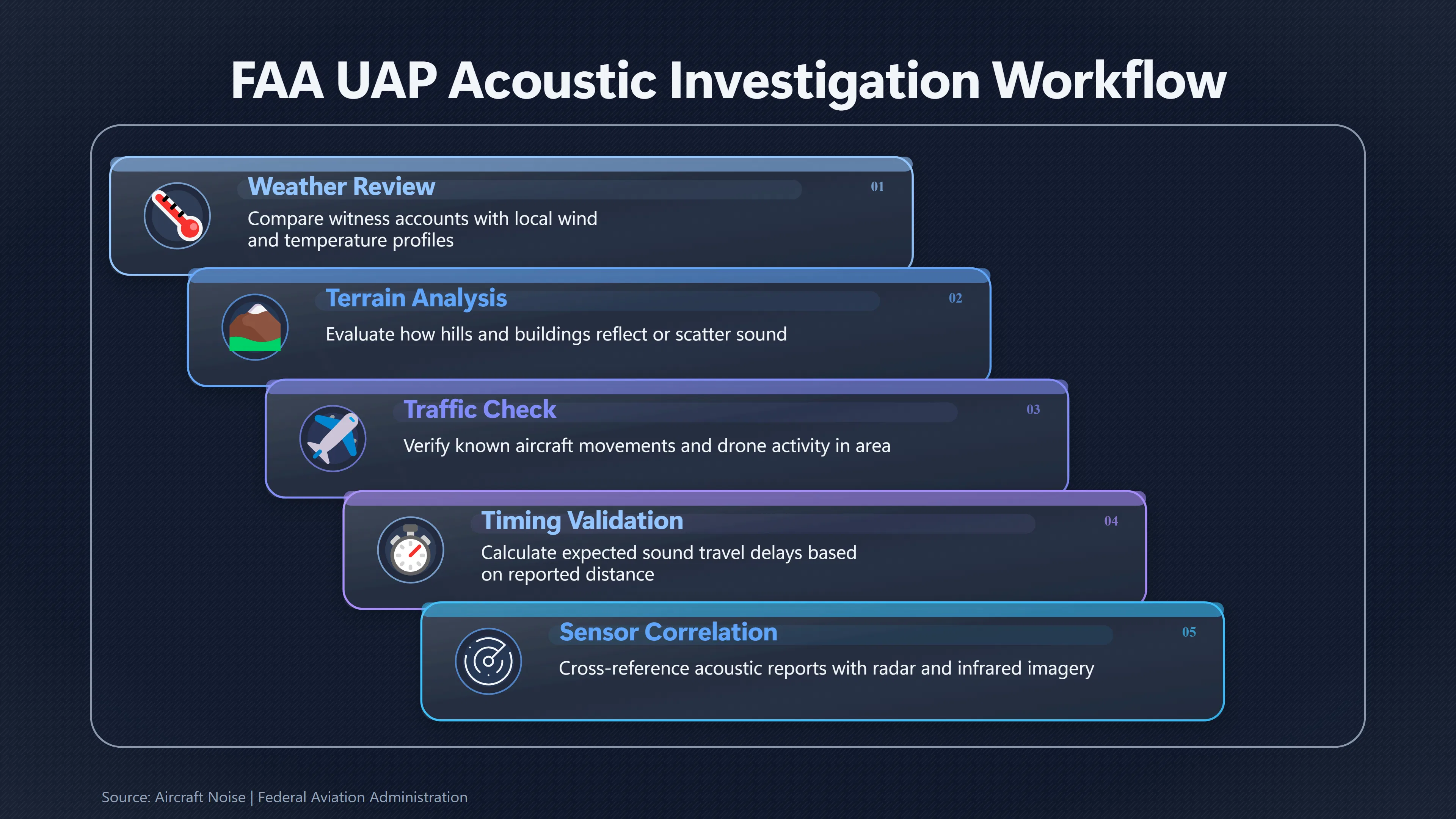
Typical investigative steps include:
- Comparing witness accounts with local weather observations, including wind profiles and temperature inversions.
- Reviewing terrain, buildings and topography that could influence sound propagation.
- Checking known aircraft movements, helicopter operations and drone activity.
- Comparing reported timing with expected sound travel delays.
- Looking for recordings from multiple locations to determine whether the same sound behaved consistently over a wider area.
- Comparing acoustic reports with radar, infrared imagery, flight data and other sensor records before drawing conclusions.
This multi-sensor approach reflects the fact that atmospheric conditions can alter perceived loudness, direction and timing without changing the object’s actual behaviour. Consequently, investigators generally treat sound reports as contextual information that must be interpreted alongside environmental data rather than in isolation.[faa.gov]faa.govAircraft Noise | Federal Aviation AdministrationJanuary 31, 2025…

What this means for reported UAP sounds
The absence of an expected sound—or the presence of an unexpected one—is not, by itself, evidence that an observed object used unconventional technology. Atmospheric refraction, wind, terrain and errors in judging distance routinely produce surprising acoustic experiences around conventional aircraft and other airborne sources.
For that reason, official investigations into UAP place relatively little weight on isolated descriptions of humming, silence, delayed engine noise or apparently misplaced sounds. Unless these reports are supported by calibrated recordings and corroborating sensor data, they are more reliably interpreted as observations filtered through complex atmospheric acoustics than as indicators of extraordinary object performance.[faa.gov]faa.govAircraft Noise | Federal Aviation AdministrationJanuary 31, 2025…
Amazon book picks
Further Reading
Books and field guides related to Can Weather Make a UFO Sound Unexplained?. Use these as the next step if you want deeper reading beyond the article.
The Science of Sound
Written for students without a background in mathematics or physics, this textbook provides an introduction to the study of acoustics. It...
The Sound Book: The Science of the Sonic Wonders of the World
A professor of acoustic engineering provides a tour of the world's most amazing sound phenomena, including creaking glaciers, whispering...
Sound: A Very Short Introduction
Sound is integral to how we experience the world, in the form of noise as well as music. But what is sound? What is the physical basis of...
Why You Hear What You Hear: An Experiential Approach to Sound...
First published 2012.
eBay marketplace picks
Marketplace Samples
Live-tested eBay searches with available results related to this page.
Selected fromUFO poster oneBay.co.uk.

Current eBay listing
VINTAGE UFO FLYING SAUCERS COMIC ADVERTISING A2 POSTER PRINT


Current eBay listing
I Want To Believe UFO Poster Giclée Fine Art Heavyweight Print

Endnotes
1.
Source: faa.gov
Title: Aircraft Noise | Federal Aviation Administration
Link:https://www.faa.gov/noise/aircraft_noise
Source snippet
January 31, 2025...
Published: January 31, 2025
2.
Source: faa.gov
Title: Fundamentals of Noise and Sound | Federal Aviation Administration
Link:https://www.faa.gov/regulations_policies/policy_guidance/noise/basics
3.
Source: sciencedirect.com
Link:https://www.sciencedirect.com/science/article/pii/S0022460X78800339
Source snippet
Meteorological and ground effects on the propagation of aircraft noise close to the Earth's surface - ScienceDirectSeptember...
4.
Source: faa.gov
Title: Community Response to Noise | Federal Aviation Administration
Link:https://www.faa.gov/regulations_policies/policy_guidance/noise/community
5.
Source: faa.gov
Title: Noise | Federal Aviation Administration
Link:https://www.faa.gov/noise
Source snippet
While there are many benefits to air travel, aviation noise can be a concern for communities. The FAA is limited b...
6.
Source: airporttech.tc.faa.gov
Link:https://www.airporttech.tc.faa.gov/Products/Airport-Safety-Papers-Publications/Airport-Safety-Detail/feasibility-of-unmanned-aircraft-system-mounted-loudspeaker-for-measurement-of-noise-reduction
7.
Source: faa.gov
Title: Fundamentals of Noise and Sound | Federal Aviation Administration
Link:https://www.faa.gov/noise/aviation_noise/fundamentals_of_noise
8.
Source: faa.gov
Title: FA A History of Noise | Federal Aviation Administration
Link:https://www.faa.gov/regulations_policies/policy_guidance/noise/history
9.
Source: acoustics.org
Link:https://acoustics.org/weather-or-not-meteorology-affects-presence-of-shock-waves-in-fighter-aircraft-noise-kent-gee/
10.
Source: sciencedirect.com
Link:https://www.sciencedirect.com/science/article/abs/pii/S0022460X78800339
11.
Source: sciencedirect.com
Link:https://www.sciencedirect.com/science/article/abs/pii/S0003682X02001044
Additional References
12.
Source: nps.gov
Title: Changing Weather Influences What We Hear in Remote Areas (U.S
Link:https://www.nps.gov/articles/000/psv39n1rr_changing-weather-influences-what-we-hear-in-remote-areas.htm
Source snippet
National Park Service)January 20, 2025 — CHANGING WEATHER INFLUENCES WHAT WE HEAR IN REMOTE AREAS Atmospheric inversions play a crucial r...
Published: January 20, 2025
13.
Source: nasa.gov
Title: 6.0 Natural and Induced Environments
Link:https://www.nasa.gov/reference/6-0-natural-and-induced-environments-vol-2/
Source snippet
April 21, 2026 — 6.6.1.13 NARROW-BAND NOISE LIMITS [V2 6084] The maximum SPL of narrow-band noise components and tones shall be limit...
Published: April 21, 2026
14.
Source: youtube.com
Title: Speed of Sound: 343 m/s Explained | Factors Affecting Sound Propagation in Air
Link:https://www.youtube.com/watch?v=Oqsgnj8c0Kg
Source snippet
Class 10 Physics Chapter 13 | Refraction and Diffraction of Sound...
15.
Source: science.nasa.gov
Link:https://science.nasa.gov/uap/
Source snippet
NASA ScienceFebruary 23, 2026 — Explore This Section UAP CONTENTS * NASA Unidentified Anomalous Phenomena Independent Study * Final Repor...
Published: February 23, 2026
16.
Source: data.nasa.gov
Link:https://data.nasa.gov/dataset/small-uas-flyover-acoustics-data
Source snippet
UAS Flyover Acoustics Data - Dataset - NASA Open Data PortalMay 14, 2025 — SMALL UAS FLYOVER ACOUSTICS DATA Total Views 921 Recent Views...
Published: May 14, 2025
17.
Source: youtube.com
Title: ACOUSTICS: Refraction and Temperature Inversion
Link:https://www.youtube.com/watch?v=LkFQg1zhi2o
Source snippet
Speed of Sound: 343 m/s Explained | Factors Affecting Sound Propagation in Air...
18.
Source: nasa.gov
Title: NAS A Test Flights Examine Effect of Atmospheric Turbulence on Sonic Booms
Link:https://www.nasa.gov/centers-and-facilities/armstrong/nasa-test-flights-examine-effect-of-atmospheric-turbulence-on-sonic-booms/
19.
Source: af.mil
Link:https://www.af.mil/About-Us/Fact-Sheets/Display/article/104540/sonic-boom/
20.
Source: mdpi.com
Link:https://www.mdpi.com/2073-4433/12/11/1424
21.
Source: khazna.ku.ac.ae
Link:https://khazna.ku.ac.ae/en/publications/sound-propagation-modelling-for-manned-and-unmanned-aircraft-nois/