Within Meteor Booms
Why One Fireball Can Produce Several Bangs
A bolide that breaks apart can send several pressure pulses toward the ground, producing a rapid series of loud reports.
On this page
- What happens when a bolide fragments
- Why pressure waves may arrive in sequence
- How repeated bangs differ from engine noise
Page outline Jump by section
Introduction
A single fireball can produce several loud bangs because a large meteoroid rarely remains intact as it races through the atmosphere. Instead, intense aerodynamic pressure and heating cause it to fracture into multiple pieces. Each major fragmentation episode releases energy into the surrounding air, creating additional shock waves that can travel to the ground. To people below, those pressure waves may arrive as a rapid sequence of explosive reports rather than one isolated boom. This behaviour explains why some meteor events are initially mistaken for aircraft accidents, explosions or even unexplained aerial phenomena, despite having a well-understood physical cause.[amsmeteors.org]amsmeteors.orgAmerican Meteor Society Fireball FAQsAmerican Meteor SocietyFireball FAQs - American Meteor Society…
What happens when a bolide fragments?
A bolide is an exceptionally bright meteor that undergoes a violent atmospheric breakup. As it enters the atmosphere at many kilometres per second, the air in front of it is compressed into a powerful shock wave. The stresses become so great that cracks spread rapidly through the rock until it separates into multiple fragments.
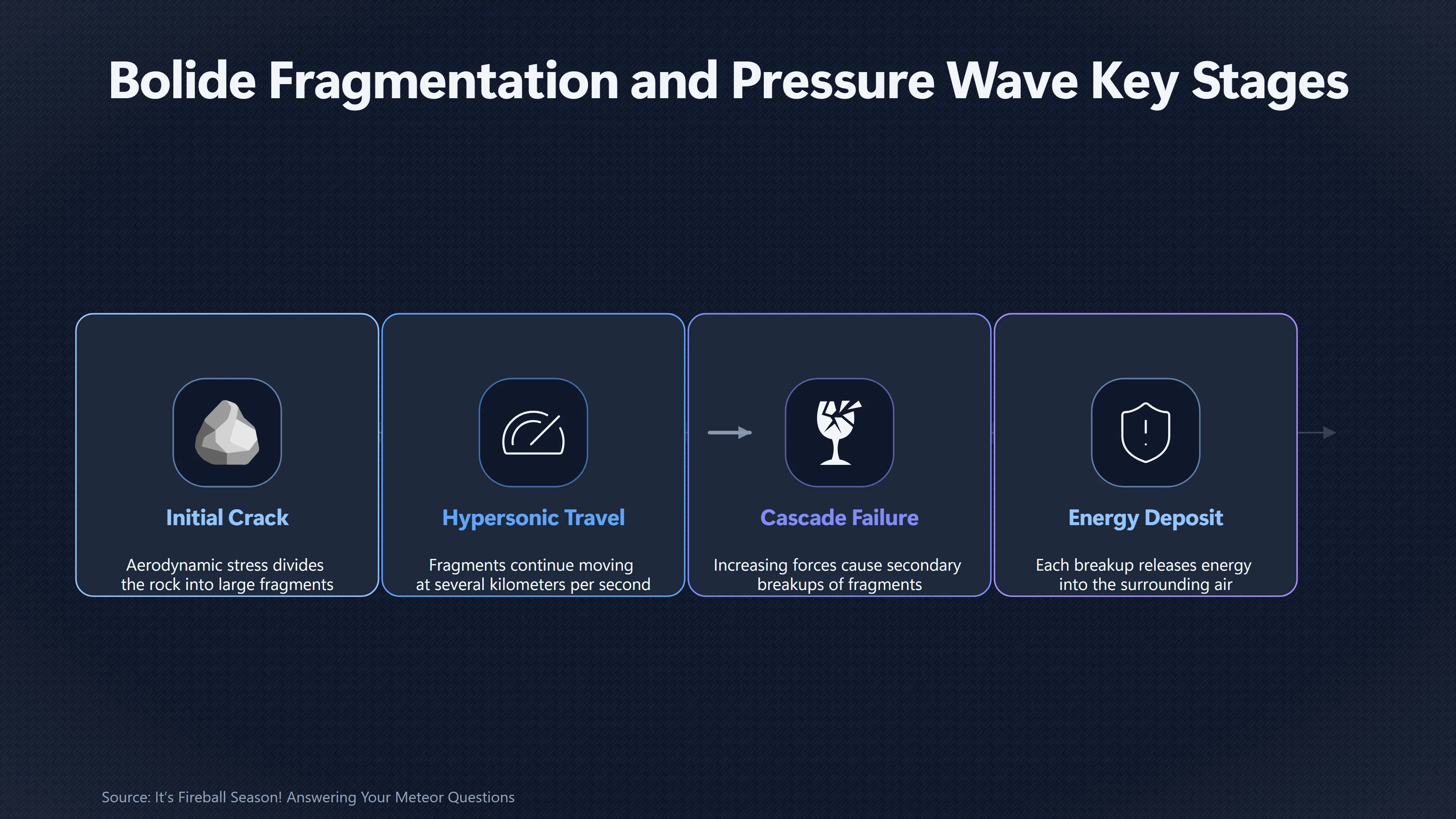
This breakup is rarely a single event. Instead, a large meteoroid often experiences a cascade of failures:
- An initial crack divides the body into several large fragments.
- Each fragment continues travelling at hypersonic speed.
- Some fragments undergo further breakups as aerodynamic forces increase.
- Every significant fragmentation deposits additional energy into the atmosphere.
Rather than behaving like one exploding object, the meteoroid becomes a chain of moving energy sources distributed along its flight path. Researchers modelling major airbursts, including the 2013 Chelyabinsk event, represent the explosion as energy being released over an extended section of the trajectory instead of at a single point.[DOI.org]doi.orgSimulation of the airwave caused by the Chelyabinsk superbolideAvramenko - 2014 - Journal of Geophysical Research: Atmospheres - Wiley Online Library…
Why pressure waves may arrive in sequence
The multiple bangs heard on the ground are not necessarily separate explosions in the everyday sense. They result from pressure waves generated at different locations and times along the meteoroid’s path.
Several factors contribute to the sequence:
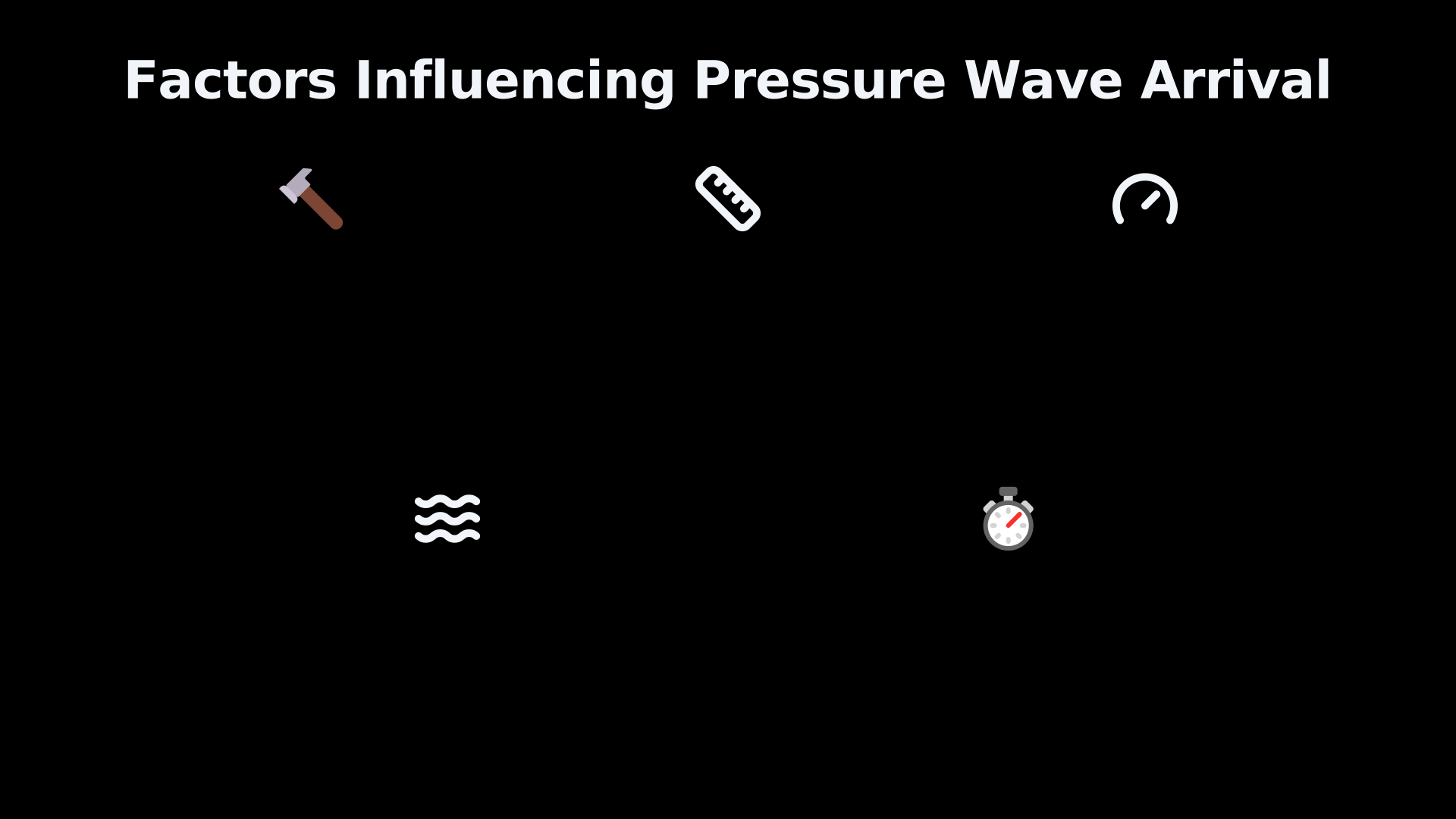
- Successive fragmentation events. Each major breakup produces its own strong pressure pulse.
- Different distances to the observer. Pressure waves originating at different points along the trajectory travel different distances before reaching the ground.
- Varying atmospheric paths. Wind, temperature layers and altitude influence how efficiently each wave propagates.
- Separate fragment shock waves. Large surviving fragments can continue producing strong bow shocks before breaking apart again.
Because sound travels much more slowly than light, these waves may reach an observer seconds apart even though the fragmentation happened almost instantaneously from the meteor’s perspective. The result is a distinctive pattern of two, three or more explosive reports rather than a single clap.[amsmeteors.org]amsmeteors.orgAmerican Meteor Society Fireball FAQsAmerican Meteor SocietyFireball FAQs - American Meteor Society…
Why repeated bangs differ from engine noise
Witnesses often compare meteor sounds to artillery, cannon fire or a succession of explosions. Although repeated bangs can initially resemble aircraft activity, they differ from engine or propulsion noise in several important ways.
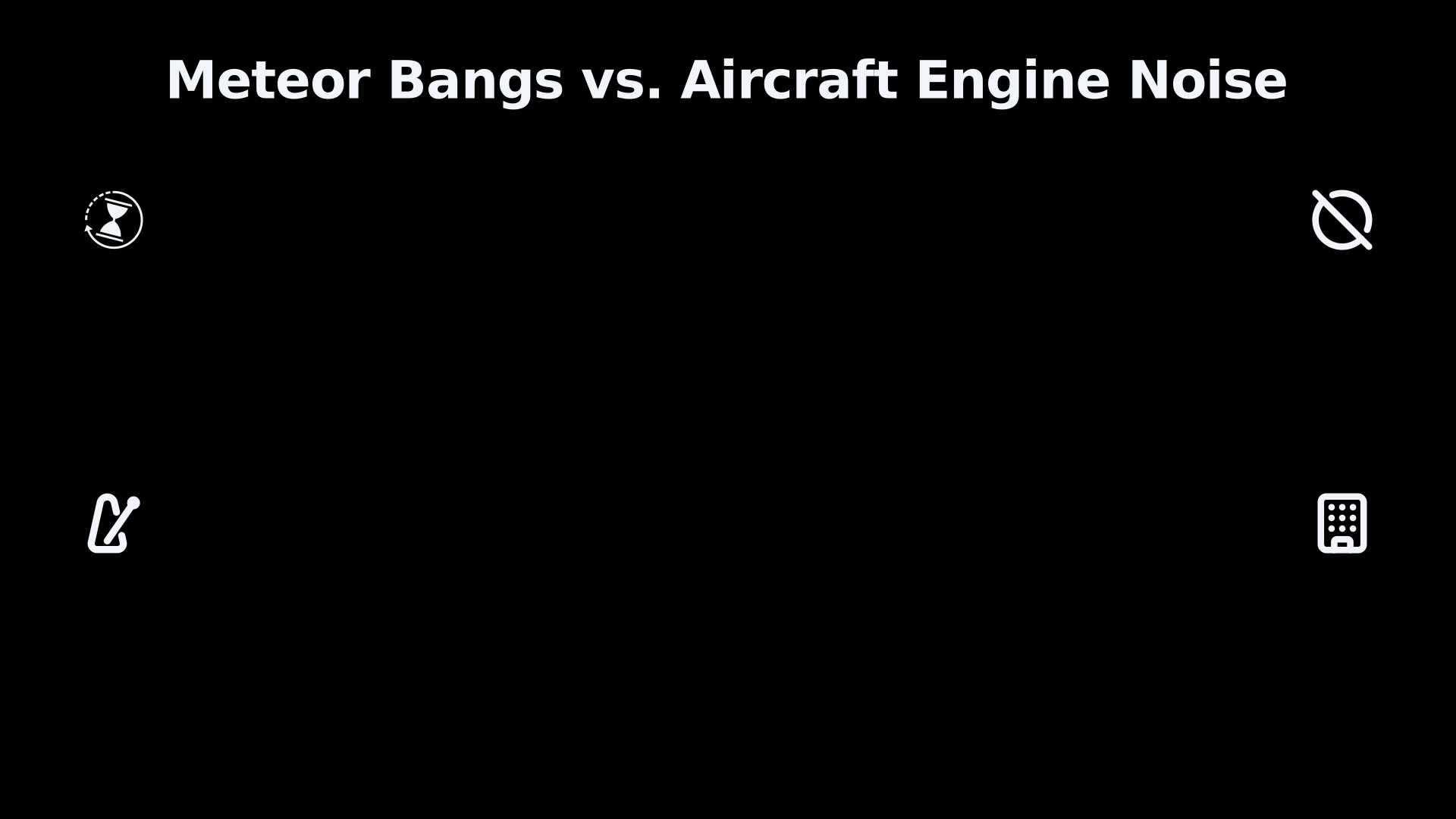
Meteor fragmentation typically produces:
- Short, powerful pressure pulses rather than a continuous roar.
- Little or no audible sound before the first boom because the object is travelling far faster than sound.
- Several closely spaced reports that may vary in loudness.
- Window rattling and building vibration over a broad area.
By contrast, aircraft engines generate sustained mechanical noise, while a jet sonic boom usually produces a characteristic one-time “double boom” associated with the aircraft’s nose and tail shock waves. A fragmenting bolide can create a more irregular series of reports because numerous fragments and breakup events contribute independently to the pressure field.[usgs.gov]usgs.govU.S. Geological Survey Sonic Booms | U.S. Geological SurveyU.S. Geological Survey Sonic Booms | U.S. Geological Survey
Chelyabinsk: a clear example of multiple pressure pulses
The Chelyabinsk superbolide over Russia on 15 February 2013 remains one of the best-studied examples of atmospheric fragmentation producing powerful acoustic effects.
High-speed video, satellite observations and numerical modelling showed that the meteoroid did not simply explode once. Instead, it underwent catastrophic fragmentation while continuing downrange, depositing enormous amounts of energy over an extended section of its flight. Researchers reconstructed the airburst by matching simulated pressure-wave arrival times with recordings from numerous communities, demonstrating that the complex acoustic signature reflected distributed fragmentation rather than a single point explosion.[DOI.org]doi.orgSimulation of the airwave caused by the Chelyabinsk superbolideAvramenko - 2014 - Journal of Geophysical Research: Atmospheres - Wiley Online Library…
Many recordings from the event captured multiple loud reports separated by short intervals. These reflected the arrival of different components of the atmospheric shock generated as fragmentation progressed, rather than independent mysterious explosions.
Why these sounds are sometimes mistaken for UFO activity
Multiple explosive bangs can be especially misleading because observers often hear them without seeing the meteor itself. Clouds, daylight or the delay between the flash and the arriving sound may leave only the acoustic evidence.
The sequence can resemble reports of:
- Explosions with no visible source.
- Military aircraft operating overhead.
- Industrial accidents.
- Unidentified aerial phenomena.
Scientific investigations, however, consistently show that these sounds correspond to known atmospheric physics. Networks that monitor fireballs, infrasound and seismic signals can often reconstruct the meteor’s path and identify fragmentation episodes responsible for the observed pressure waves. Even when witnesses describe several distinct explosions, that pattern is fully consistent with a bolide breaking into multiple energetic fragments rather than requiring multiple unidentified objects.[amsmeteors.org]amsmeteors.orgAmerican Meteor Society Fireball FAQsAmerican Meteor SocietyFireball FAQs - American Meteor Society…
Amazon book picks
Further Reading
Books and field guides related to Why One Fireball Can Produce Several Bangs. Use these as the next step if you want deeper reading beyond the article.
Meteorites: The Story of Our Solar System
Meteorite tells the fascinating story of the stones from outer space scattered across our planet. From the impact that finished off the d...
Rocks from Space
Appendices A-C: Meteorite verification laboratories, Commercial meteorite dealers, Selected list of suspected impact craters worldwide.
Meteorites
Meteorites give us a unique insight into the nature of material that was present at the formation of the solar system. Learn what they ar...
The Cambridge Encyclopedia of Meteorites
Beautifully illustrated with over 140 full colour images, The Cambridge Encyclopedia of Meteorites provides a thorough guide to these fas...
eBay marketplace picks
Marketplace Samples
Live-tested eBay searches with available results related to this page.
Selected fromRoswell UFO poster oneBay.co.uk.




Endnotes
1.
Source: nasa.gov
Title: It’s Fireball Season! Answering Your Meteor Questions
Link:https://www.nasa.gov/blogs/watch-the-skies/2026/03/26/its-fireball-season-answering-your-meteor-questions/
Source snippet
Answering Your Meteor Questions - NASAMarch 26, 2026 — WATCH THE SKIES Image Janet Sudnik March 26, 2026 5:18PM CATEGORIES Marshall Space...
Published: March 26, 2026
2.
Source: doi.org
Title: Simulation of the airwave caused by the Chelyabinsk superbolide
Link:https://doi.org/10.1002/2013JD021028
Source snippet
Avramenko - 2014 - Journal of Geophysical Research: Atmospheres - Wiley Online Library...
3.
Source: nas.nasa.gov
Link:https://www.nas.nasa.gov/pubs/ams/2021/09-23-21.html
Source snippet
A Advanced SupercomputingAerodynamic Separation of Fragmented Bodies in High-Speed Flow...
4.
Source: data.nasa.gov
Title: fireball and bolide reports
Link:https://data.nasa.gov/dataset/fireball-and-bolide-reports
5.
Source: nasa.gov
Title: interesting fact of the month 2021
Link:https://www.nasa.gov/space-science-and-astrobiology-at-ames/interesting-fact-of-the-month-current/interesting-fact-of-the-month-2021/
6.
Source: nasa.gov
Title: Loud fireball spotted over southern Mississippi mostly heard, hardly seen
Link:https://www.nasa.gov/blogs/watch-the-skies/2022/04/28/loud-fireball-spotted-over-southern-mississippi-mostly-heard-hardly-seen/
7.
Source: fireballs.ndc.nasa.gov
Link:https://fireballs.ndc.nasa.gov/skyfalls/events/20181110-104951
8.
Source: doi.org
Link:https://doi.org/10.1111/maps.13085
9.
Source: doi.org
Link:https://doi.org/10.1126/SCIENCE.1242642
10.
Source: nasa.gov
Title: NAS A Investigates the ‘Fa INT’ Side of Sonic Booms
Link:https://www.nasa.gov/aeronautics/nasa-investigates-the-faint-side-of-sonic-booms/
11.
Source: ares.jsc.nasa.gov
Link:https://ares.jsc.nasa.gov/meteorite-falls/events/
12.
Source: youtube.com
Title: What Exploded Over Russia? Chelyabinsk Meteor
Link:https://www.youtube.com/watch?v=l_MfWQ36Zl0
Source snippet
NASA | NPP Sees Aftermath of the Chelyabinsk Meteor...
13.
Source: youtube.com
Title: NASA | NPP Sees Aftermath of the Chelyabinsk Meteor
Link:https://www.youtube.com/watch?v=Q9KwK0izt5c
Source snippet
Fireball stuns the Southeast after meteor explodes over Georgia...
14.
Source: amsmeteors.org
Title: American Meteor Society Fireball FAQs
Link:https://www.amsmeteors.org/fireballs/faqf/
Source snippet
American Meteor SocietyFireball FAQs - American Meteor Society...
15.
Source: usgs.gov
Title: U.S. Geological Survey Sonic Booms | U.S. Geological Survey
Link:https://www.usgs.gov/programs/earthquake-hazards/sonic-booms
16.
Source: amsmeteors.org
Title: ams q1 2026 fireball analysis
Link:https://www.amsmeteors.org/ams-q1-2026-fireball-analysis.html?ICID=ref_fark
17.
Source: usgs.gov
Link:https://www.usgs.gov/faqs/how-does-usgs-tell-difference-between-earthquake-and-a-sonic-boom
18.
Source: agupubs.onlinelibrary.wiley.com
Link:https://agupubs.onlinelibrary.wiley.com/doi/epdf/10.1002/2013JD021028
19.
Source: amsmeteors.org
Link:https://www.amsmeteors.org/fireballs/
21.
Source: agupubs.onlinelibrary.wiley.com
Title: AGU Publications Simulation of the airwave caused by the Chelyabinsk superbolide
Link:https://agupubs.onlinelibrary.wiley.com/doi/full/10.1002/2013JD021028
Source snippet
AGU PublicationsSimulation of the airwave caused by the Chelyabinsk superbolide - Avramenko - 2014 - Journal of Geophysical Research: Atm...
22.
Source: phys.org
Title: Sonic booms from meteors can release the energy of hundreds of tons of TNT
Link:https://phys.org/news/2026-06-sonic-booms-meteors-energy-hundreds.html
Source snippet
Here's how they workJune 20, 2026 — June 20, 2026 SONIC BOOMS FROM METEORS CAN RELEASE THE ENERGY OF HUNDREDS OF TONS OF TNT. HERE'S HOW...
Published: June 20, 2026
23.
Source: now.tufts.edu
Title: what are these meteors go boom
Link:https://now.tufts.edu/2026/06/08/what-are-these-meteors-go-boom
Source snippet
Tufts NowJune 8, 2026 — Image: A streak of light against a star-covered night sky, with the silhouette of trees seen nearer the ground...
Published: June 8, 2026
24.
Source: nature.com
Link:https://www.nature.com/articles/nature12741
25.
Source: youtube.com
Title: Fireball stuns the Southeast after meteor explodes over Georgia
Link:https://www.youtube.com/watch?v=5G7dUIyWO3k
Source snippet
Fireball flies across the sky and causes sonic boom...
26.
Source: youtube.com
Title: Fireball flies across the sky and causes sonic boom
Link:https://www.youtube.com/watch?v=PWdya32j0d8
Source snippet
Sonic Boom Explained: Breaking the Sound Barrier & Shock Waves...
27.
Source: scrippsnews.com
Link:https://www.scrippsnews.com/science-and-tech/space/meteor-over-massachusetts-causes-sonic-boom
28.
Source: pbs.org
Link:https://www.pbs.org/wgbh/nova/barrier/boom/concept5.html
29.
Source: umaine.edu
Link:https://umaine.edu/news/2026/06/sonic-booms-from-meteors-can-release-the-energy-of-hundreds-of-tons-of-tnt-heres-how-they-work/
30.
Source: repository.kulib.kyoto-u.ac.jp
Link:https://repository.kulib.kyoto-u.ac.jp/handle/2433/210092