Within Identify Sources
Why Your Phone May Miss the Deep Hum
Smartphones can preserve timing and pitch changes, but their microphones often suppress the deep frequencies witnesses remember most.
On this page
- What phone microphones capture well
- Why low frequencies are reduced
- How to make a more useful recording
Page outline Jump by section
Introduction
If you hear an unusual deep humming, rumbling or droning sound overhead and suspect it may be connected to a UFO report, a phone recording can still be valuable—but it should not be treated as a perfect record of what you heard. Modern smartphones are designed primarily for speech, video and everyday environmental sounds. Their microphones and recording software often alter very low-frequency audio through filtering, automatic gain control and noise suppression. As a result, a recording may preserve the timing of a mysterious sound and reveal changes in pitch or rhythm while failing to reproduce the deep bass that made the experience seem unusual in person.[Android Developers]developer.android.comDevelopers Microphone Info | API reference | Android DevelopersAndroid DevelopersMicrophoneInfo | API reference | Android DevelopersFebruary 13, 2026…
Understanding these limitations helps prevent a common mistake during investigations: assuming that a weak or thin recording proves the original sound was equally weak. Instead, recordings should be considered one piece of evidence alongside witness observations, weather conditions and checks for ordinary overhead sources.
What Phone Microphones Capture Well
Smartphone microphones are remarkably capable within the range they are designed for. They usually capture:
- Changes in pitch over time.
- Rhythmic pulsing or modulation.
- The duration of an event.
- Relative loudness changes.
- Directional clues when recorded with multiple microphones.
These characteristics can be useful when comparing a reported sound with known aircraft, helicopters or industrial machinery. For example, the distinctive pulse rate of helicopter rotor blades or the gradual frequency shift of an aircraft passing overhead may remain visible in the recording even if the deepest components are reduced.
Modern phones often contain multiple MEMS (micro-electro-mechanical systems) microphones. Operating systems can expose information about each microphone’s characteristics, including frequency response, because different microphones and recording modes may behave differently.[Android Developers]developer.android.comDevelopers Microphone Info | API reference | Android DevelopersAndroid DevelopersMicrophoneInfo | API reference | Android DevelopersFebruary 13, 2026…
Why Low Frequencies Are Reduced
The most important limitation for reports involving deep humming is that many phones do not preserve very low frequencies in the same way human listeners perceive them.
Several factors contribute:
- Small microphone design. Tiny MEMS microphones are engineered for compact devices and generally prioritise the frequency range most important for speech rather than extremely deep bass.
- High-pass filtering. Many recording paths intentionally reduce very low frequencies to minimise wind noise, handling noise and mechanical vibration.
- Noise suppression. Signal-processing algorithms may classify steady low-frequency sounds as unwanted background noise and reduce them before the recording is saved.
- Automatic gain control (AGC). Phones frequently adjust recording level automatically. A loud rumble can cause the recording level to drop, making surrounding sounds seem quieter or altering how the event is remembered.[android.com]developer.android.comDevelopers Noise Suppressor | API reference | Android DevelopersAndroid DevelopersNoiseSuppressor | API reference | Android Developers…
This processing is beneficial for voice calls and video recording but can unintentionally remove exactly the type of low-frequency content that witnesses often describe in reports of mysterious overhead sounds.
Independent laboratory measurements also show that microphone response varies noticeably between phone models. Some newer devices reproduce low frequencies better than others, but none should be assumed to provide a perfectly flat, laboratory-quality recording across the entire audible spectrum.[Faber Acoustical]faberacoustical.comFaber AcousticalMeasured: iPhone 15 Pro Max microphone frequency response and directivity – Faber Acoustical BlogSeptember 12, 2024…
Why the Recording May Sound Different From What You Heard
People do not experience sound in exactly the same way as a phone.
Very low-frequency sound can be felt as vibration or pressure as much as it is heard. Buildings, furniture and the listener’s own body can reinforce these sensations. A phone microphone does not experience these physical effects in the same way.
In addition, many playback systems—including laptop speakers, phone speakers and inexpensive headphones—cannot reproduce deep bass accurately. Even if the phone captured some low-frequency information, the playback device may remove it again, making the recording seem much less dramatic than the original experience.
This explains why witnesses sometimes report that “the recording doesn’t sound anything like it did in person.” That difference is consistent with known properties of consumer recording equipment and does not automatically indicate either an extraordinary event or a faulty memory.
How to Make a More Useful Recording
A phone recording can still be highly valuable if it is collected carefully.
For the best investigative value:
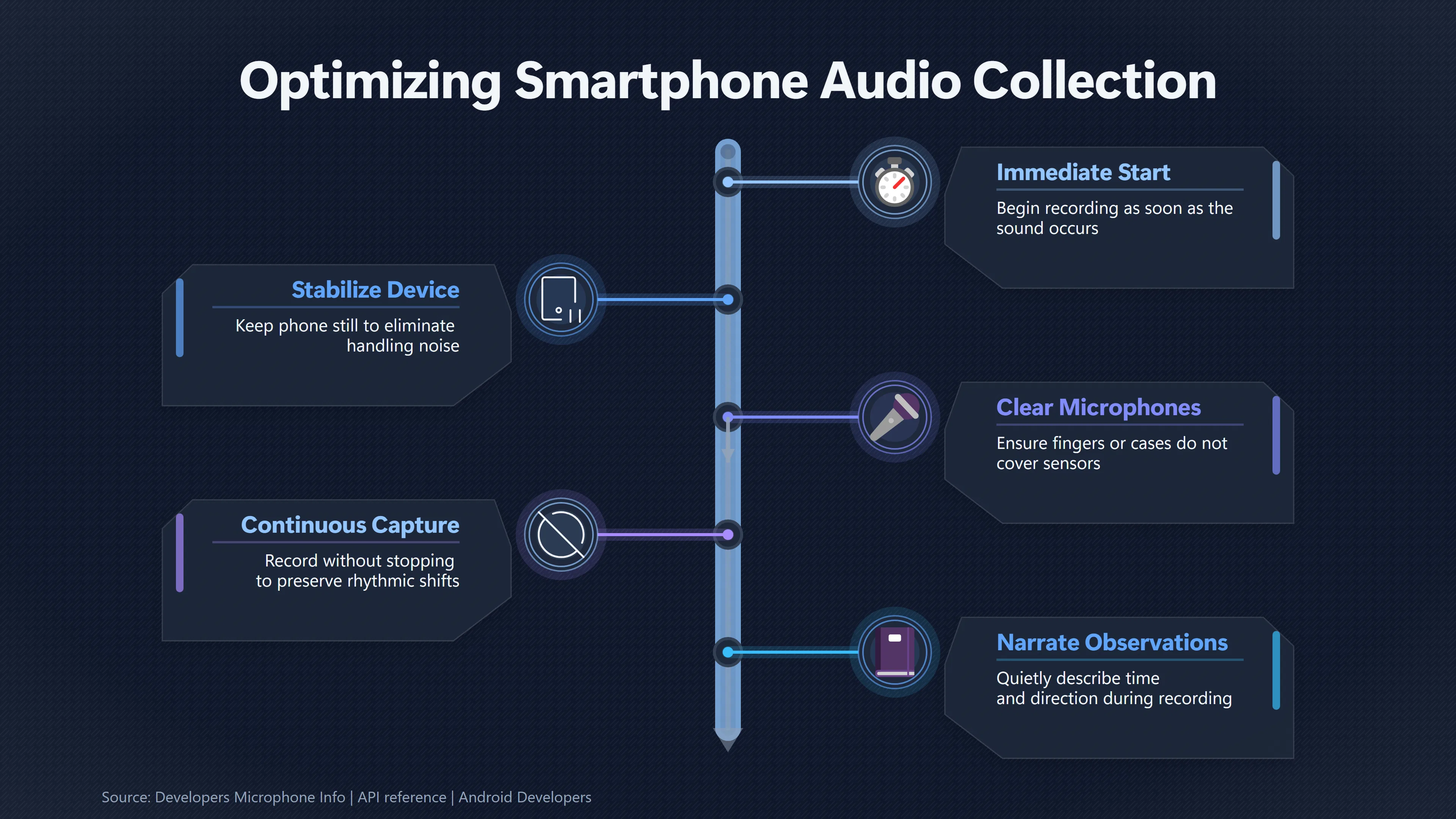
- Start recording as soon as possible. Capturing the beginning and end of the event helps establish timing.
- Keep the phone still. Handling noise can create its own low-frequency rumble that obscures genuine sounds.
- Avoid covering the microphones. Fingers, clothing or phone cases may alter the recording.
- Record continuously. Do not stop and restart repeatedly, as this can interrupt useful changes in the sound.
- Narrate key observations quietly. Mention the time, direction you are facing and whether the sound appears to move. Spoken notes can later be matched with the audio.
- If safe, record from more than one location. A short recording indoors followed by one outdoors may help distinguish building vibrations from airborne sound.
These steps improve the recording’s usefulness without requiring specialist equipment.
Interpreting the Recording Carefully
A phone recording should be interpreted with an understanding of its technical limitations.
A recording that lacks strong bass does not necessarily mean the original sound contained little low-frequency energy. Likewise, a recording dominated by low-frequency rumble may reflect wind striking the microphones, movement of the phone or nearby mechanical vibration rather than an overhead source.
Investigators should compare the recording with other evidence, including:
- The witness’s written description made as soon as possible after the event.
- Weather conditions that may have affected sound propagation.
- Aircraft and helicopter activity.
- Other independent recordings or witness accounts from nearby locations.
Looking for agreement across these sources is generally more informative than relying on the audio file alone.
When Better Equipment Makes a Difference
If unusual low-frequency sounds occur repeatedly in the same location, a dedicated audio recorder with an external microphone designed for environmental recording is likely to provide a more accurate record than a smartphone. Professional and scientific microphones can offer a flatter response into much lower frequencies than typical phone microphones, avoiding some of the aggressive filtering built into consumer devices.[Analog Devices]analog.coman 1328Analog DevicesAN-1328: High Performance, Low Noise Studio Microphone with MEMS Microphones, Analog Beamforming, and Power Management | An…
For isolated, unexpected events, however, the best recorder is usually the one already in your pocket. Even if the deepest hum is reduced, a smartphone recording can still preserve timing, pitch changes and other acoustic clues that help distinguish ordinary overhead sources from sounds that warrant closer investigation.
Amazon book picks
Further Reading
Books and field guides related to Why Your Phone May Miss the Deep Hum. Use these as the next step if you want deeper reading beyond the article.
Sound and Recording
Providing vital reading for audio students and trainee engineers, Sound and Recording is the essential guide for anyone who wants a solid...
Modern Recording Techniques
Expanded to include the latest digital audio technology, the 7th edition now includes sections on podcasting, new surround sound formats...
The Art of Digital Audio
First Published in 2000. Routledge is an imprint of Taylor & Francis, an informa company.
Handbook of Recording Engineering
The Handbook of Recording Engineering is a logical outgrowth of the first two editions of Sound Recording. The ten years since the first...
eBay marketplace picks
Marketplace Samples
Live-tested eBay searches with available results related to this page.
Selected fromRoswell UFO patch oneBay.co.uk.




Endnotes
1.
Source: developer.android.com
Title: Developers Microphone Info | API reference | Android Developers
Link:https://developer.android.com/reference/android/media/MicrophoneInfo
Source snippet
Android DevelopersMicrophoneInfo | API reference | Android DevelopersFebruary 13, 2026...
Published: February 13, 2026
2.
Source: developer.android.com
Title: Developers Noise Suppressor | API reference | Android Developers
Link:https://developer.android.com/reference/android/media/audiofx/NoiseSuppressor.html
Source snippet
Android DevelopersNoiseSuppressor | API reference | Android Developers...
3.
Source: source.android.com
Link:https://source.android.com/docs/core/audio/implement-pre-processing?hl=en
Source snippet
Android Open Source ProjectConfigure preprocessing effects | Android Open Source Project...
4.
Source: developer.android.com
Title: Developers Microphone Info | API reference | Android Developers
Link:https://developer.android.com/reference/kotlin/android/media/MicrophoneInfo
Source snippet
Android DevelopersMicrophoneInfo | API reference | Android Developers...
5.
Source: analog.com
Title: an 1328
Link:https://www.analog.com/en/resources/app-notes/an-1328.html
Source snippet
Analog DevicesAN-1328: High Performance, Low Noise Studio Microphone with MEMS Microphones, Analog Beamforming, and Power Management | An...
6.
Source: source.android.com
Title: 16 cdd
Link:https://source.android.com/docs/compatibility/16/android-16-cdd?authuser=1
Source snippet
AUDIO RECORDING While some of the requirements outlined in this section are listed as SHOULD since Android 4.3, the Compatibility Definit...
7.
Source: developer.android.com
Link:https://developer.android.com/media/platform/mediarecorder
8.
Source: faberacoustical.com
Link:https://www.faberacoustical.com/blog/2024/ios/iphone/measured-iphone-15-pro-max-microphone-frequency-response-and-directivity/
Source snippet
Faber AcousticalMeasured: iPhone 15 Pro Max microphone frequency response and directivity – Faber Acoustical BlogSeptember 12, 2024...
Published: September 12, 2024
9.
Source: faberacoustical.com
Link:https://www.faberacoustical.com/blog/2025/ios/iphone/measured-iphone-17-pro-microphone-frequency-response-and-directivity/
10.
Source: faberacoustical.com
Link:https://www.faberacoustical.com/blog/?p=2349
11.
Source: faberacoustical.com
Title: i Phone Microphone Frequency Response Comparison – Faber Acoustical Blog
Link:https://www.faberacoustical.com/blog/2009/ios/iphone/iphone-microphone-frequency-response-comparison/
Additional References
12.
Source: doi.org
Link:https://doi.org/10.1121/10.0028379
13.
Source: signalessence.com
Link:https://www.signalessence.com/blog/can-you-use-an-iphones-internal-microphone-for-acoustic-testing-and-accurate-recordings
14.
Source: hakaru.net
Link:https://hakaru.net/1Take-support/blog/en/2026-01-24-iphone-mic-secrets/
15.
Source: experts.com
Link:https://www.experts.com/articles/forensic-sound-analyses-cellular-telephone-recordings-by-durand-begault
16.
Source: itu.int
Link:https://www.itu.int/en/ITU-T/C-I/Pages/HFT-mobile-tests/issues_QoE.aspx
17.
Source: itu.int
Link:https://www.itu.int/epublications/en/publication/itu-t-p-1120-2025-10-super-wideband-and-fullband-hands-free-communication-in-motor-vehicles
18.
Source: research.polyu.edu.hk
Link:https://research.polyu.edu.hk/en/publications/you-can-hear-but-you-cannot-record-privacy-protection-by-jamming-/
19.
Source: eprints.soton.ac.uk
Link:https://eprints.soton.ac.uk/418751/
20.
Source: youtube.com
Title: High-Pass Filter: Better Mixes Made Simple
Link:https://www.youtube.com/watch?v=LQruBdoWUbs
Source snippet
Best Microphone for YouTube 2026: What I'd Actually Buy...
21.
Source: itu.int
Title: itu t p 1100 2025 10 narrowband hands free communication in motor vehicles
Link:https://www.itu.int/epublications/en/publication/itu-t-p-1100-2025-10-narrowband-hands-free-communication-in-motor-vehicles