Within The Hum
Could The Hum Be Coming From Inside the Ear?
Head movement, sound interactions and hearing tests suggest that many Hum experiences may begin inside the auditory system rather than outside it.
On this page
- Clues that point to an internal sound
- How low frequency tinnitus differs from ordinary noise
- Why one explanation cannot fit every Hum report
Page outline Jump by section
Introduction
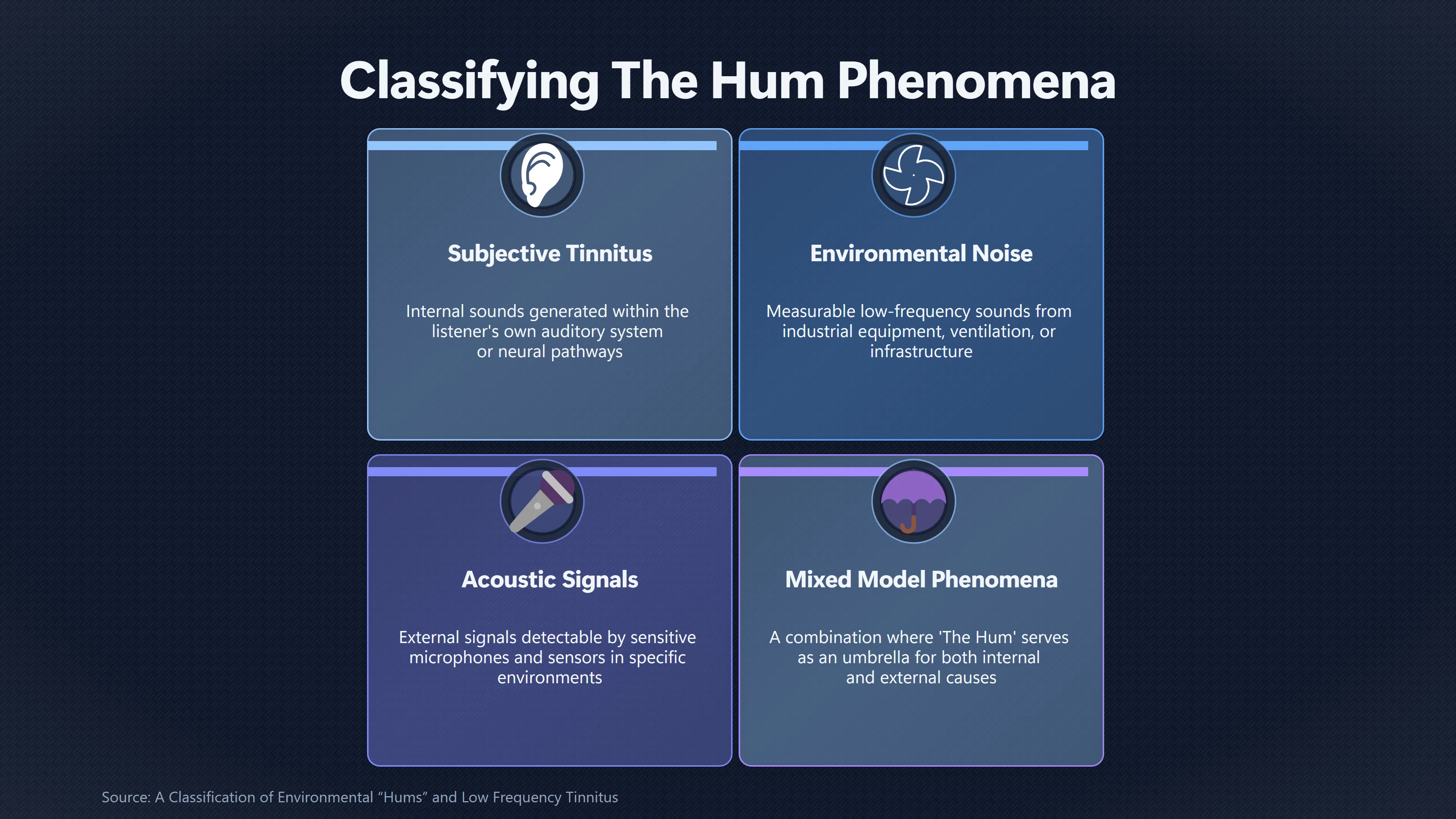
Many reports of The Hum are described as an external low-frequency sound, yet medical research suggests that a significant proportion may instead originate within the listener’s own auditory system. In these cases, the experience resembles a rare form of low-frequency subjective tinnitus—the perception of sound without a corresponding external acoustic source. This possibility is especially relevant when the sound is heard by only one person, changes with head movement, interacts with other sounds, or cannot be detected by sensitive acoustic measurements. At the same time, not every Hum report fits this pattern. Well-documented cases such as Windsor, Ontario demonstrate that genuine environmental low-frequency noise can also occur. The evidence therefore points towards multiple mechanisms rather than a single explanation.[PLOS]journals.plos.orgOn the potential sources of a low-frequency sound percept that only a few can perceive | PLOS OneMarch 27, 2026…
Clues That Point to an Internal Sound
One of the strongest arguments for an internal origin comes from patterns that would be difficult to explain if the sound were produced entirely by an external source.
Researchers studying people who identify as “hearers” found that many describe distinctive behaviours, including:
- the Hum disappearing or changing after turning the head;
- the perceived tone forming beats or interference patterns with external sounds;
- delays before the sound returns after air travel or changes in pressure;
- hearing the Hum when nearby people cannot, even in otherwise quiet environments.
These observations are consistent with changes occurring within the ear or auditory pathways rather than with a fixed environmental sound. In a questionnaire study involving more than 160 people reporting the Hum, around three-quarters displayed at least one of these characteristic features, leading the author to argue that many cases represent an unusual form of tinnitus rather than an unidentified external signal.[PubMed]pubmed.ncbi.nlm.nih.govManifestations of a low-frequency sound of unknown origin perceived worldwide, also known as "the Hum" or the "Taos Hum" - PubMedJu…
Head movement is particularly interesting because altering the position of the neck, jaw or inner ear can temporarily change sensory input reaching the brain. Many forms of tinnitus are known to vary with movements of the jaw or head, reflecting interactions between hearing pathways and nerves controlling muscles and balance rather than changes in the outside environment. Although this does not prove tinnitus in every Hum case, it provides a biologically plausible explanation for experiences that seem to move or disappear with body position.[PLOS]journals.plos.orgOn the potential sources of a low-frequency sound percept that only a few can perceive | PLOS OneMarch 27, 2026…
How Low-Frequency Tinnitus Differs From Ordinary Noise
Most people associate tinnitus with high-pitched ringing, but tinnitus can also occur as a deep humming, rumbling or droning sound. Low-frequency tinnitus is less common and can therefore be mistaken for distant machinery, electrical equipment or even aircraft.
Several features distinguish it from ordinary environmental noise:
- It often lacks a clear direction. People may be unable to point towards where the sound is coming from.
- Only one person may hear it. Others in the same room may hear nothing at all.
- The loudness may fluctuate without changes in the surroundings.
- Quiet indoor environments often make it more noticeable, not because the sound becomes stronger but because there is less competing background noise.
Unlike genuine low-frequency environmental noise, subjective tinnitus cannot usually be recorded with microphones because the sound exists as a perception generated somewhere along the auditory system. This distinction explains why extensive acoustic surveys sometimes fail to detect anything matching a sufferer’s experience.[Sage Journals]journals.sagepub.comSage JournalsA Classification of Environmental “Hums” and Low Frequency Tinnitus - R.E. Walford, 1983…
What Hearing Tests Can and Cannot Show
Medical assessment aims to determine whether the sound is more likely to be internal or external rather than assuming either explanation from the outset.
Audiologists may use:
- conventional and low-frequency hearing tests;
- tinnitus pitch-matching, where patients compare their perceived sound with generated tones;
- examination for hearing loss, ear disease or middle-ear disorders;
- assessment of whether jaw movement, neck movement or pressure changes alter the sound.
Earlier work comparing people reporting environmental Hums with patients already diagnosed with low-frequency tinnitus found substantial overlap in the frequencies they perceived. While this did not prove that all Hum reports were tinnitus, it demonstrated that many complaints closely resembled recognised clinical cases.[Sage Journals]journals.sagepub.comSage JournalsA Classification of Environmental “Hums” and Low Frequency Tinnitus - R.E. Walford, 1983…
Recent research has strengthened this view. A 2026 study examined people reporting persistent low-frequency sound percepts, measuring unusually sensitive hearing and spontaneous otoacoustic emissions—tiny sounds naturally generated by the inner ear. The researchers found little evidence that exceptional low-frequency hearing or self-generated ear emissions explained most cases. Instead, they concluded that subjective low-frequency tinnitus is often the most likely explanation when no external sound source can be identified, while emphasising that genuine external sounds remain possible in some situations.[PLOS]journals.plos.orgOn the potential sources of a low-frequency sound percept that only a few can perceive | PLOS OneMarch 27, 2026…
Why One Explanation Cannot Fit Every Hum Report
The tinnitus hypothesis explains many personal Hum experiences, but it cannot account for every well-investigated case.
Some communities have documented measurable low-frequency sound or vibration affecting multiple residents simultaneously. In those situations, investigators have identified industrial equipment, ventilation systems or other infrastructure as likely contributors. Such findings demonstrate that authentic environmental Hums exist alongside medically generated auditory perceptions.
Conversely, many reports share features far more typical of tinnitus:
- only a minority of residents perceive the sound;
- the sound changes with head or jaw movement;
- extensive environmental measurements fail to detect a matching acoustic signal;
- clinical examination finds patterns compatible with auditory dysfunction.
Rather than forcing every report into one category, researchers increasingly favour a mixed model in which “The Hum” serves as an umbrella label for several different phenomena that produce remarkably similar subjective experiences.[sagepub.com]journals.sagepub.comSage JournalsA Classification of Environmental “Hums” and Low Frequency Tinnitus - R.E. Walford, 1983…

What This Means for UFO Speculation
Within discussions of unexplained aerial phenomena, the Hum has sometimes been presented as evidence of hidden aircraft, experimental propulsion systems or extraterrestrial technology. The existence of low-frequency tinnitus offers a more ordinary explanation for many reports that appear mysterious at first.
Importantly, recognising an internal auditory mechanism does not imply that every Hum complaint is imagined or psychological. Subjective tinnitus is a genuine neurological perception that can be persistent, intrusive and distressing. At the same time, documented environmental Hum cases show that external low-frequency sound also occurs in the real world.
The most evidence-based approach is therefore to investigate each report individually. If acoustic measurements repeatedly fail to identify an external source and the perceived sound varies with head movement, hearing tests or other recognised tinnitus characteristics, an internal auditory origin becomes increasingly plausible. Where measurable low-frequency sound is present and affects multiple listeners, environmental explanations deserve equal attention. Current research supports this case-by-case view far more strongly than any single theory linking all Hum reports to UFOs or other extraordinary causes.[plos.org]journals.plos.orgOn the potential sources of a low-frequency sound percept that only a few can perceive | PLOS OneMarch 27, 2026…
Amazon book picks
Further Reading
Books and field guides related to Could The Hum Be Coming From Inside the Ear?. Use these as the next step if you want deeper reading beyond the article.
Rewiring Tinnitus: How I Finally Found Relief from the Ringin...
Through the author's inspiring story, and with dozens of actionable techniques and tools, you can finally find the relief you deserve fro...
Living with Tinnitus and Hyperacusis
'This book offers real hope' David Stockdale, CEO, British Tinnitus Association Tinnitus can be a difficult and distressing condition to...
Hallucinations
Hallucinations, for most people, imply madness. But there are many different types of non-psychotic hallucination caused by various illne...
Tinnitus: A Self-Management Guide for the Ringing in Your Ears
Tinnitus: A Self Management Guide for the Ringing in Your Ears provides a comprehensive self-help program to managing tinnitus ("ringing...
eBay marketplace picks
Marketplace Samples
Live-tested eBay searches with available results related to this page.
Selected fromUFO disclosure print oneBay.co.uk.




Endnotes
1.
Source: journals.plos.org
Link:https://journals.plos.org/plosone/article?id=10.1371%2Fjournal.pone.0326818
Source snippet
On the potential sources of a low-frequency sound percept that only a few can perceive | PLOS OneMarch 27, 2026...
Published: March 27, 2026
2.
Source: journals.sagepub.com
Link:https://journals.sagepub.com/doi/10.1177/026309238300200203
Source snippet
Sage JournalsA Classification of Environmental “Hums” and Low Frequency Tinnitus - R.E. Walford, 1983...
3.
Source: pubmed.ncbi.nlm.nih.gov
Link:https://pubmed.ncbi.nlm.nih.gov/27488996/
Source snippet
Manifestations of a low-frequency sound of unknown origin perceived worldwide, also known as "the Hum" or the "[Taos Hum]({{ 'taos-hum/' | relative_url }})" - PubMedJu...
4.
Source: pubmed.ncbi.nlm.nih.gov
Link:https://pubmed.ncbi.nlm.nih.gov/41894429/
Source snippet
2026 Mar 27;21(3):e0326818. doi: 10.1371/journal.pone.0326818. eCollection 2026. ON THE POTENTIAL SOURCES OF A LOW-FREQUENCY SOUND PERCEP...
5.
Source: pubmed.ncbi.nlm.nih.gov
Link:https://pubmed.ncbi.nlm.nih.gov/41894429/?fc=None&ff=20260403130224&v=2.19.0.post6+133c1fe
Source snippet
the potential sources of a low-frequency sound percept that only a few can perceive - PubMedMarch 27, 2026 — ABSTRACT A small percentage...
Published: March 27, 2026
6.
Source: pmc.ncbi.nlm.nih.gov
Link:https://pmc.ncbi.nlm.nih.gov/articles/PMC13028376/
Source snippet
the potential sources of a low-frequency sound percept that only a few can perceive - PMCMarch 27, 2026 — ON THE POTENTIAL SOURCES OF A L...
Published: March 27, 2026
7.
Source: nidcd.nih.gov
Link:https://www.nidcd.nih.gov/health/tinnitus
8.
Source: pubmed.ncbi.nlm.nih.gov
Link:https://pubmed.ncbi.nlm.nih.gov/35861457/
9.
Source: pmc.ncbi.nlm.nih.gov
Link:https://pmc.ncbi.nlm.nih.gov/articles/PMC7399790/
10.
Source: pmc.ncbi.nlm.nih.gov
Link:https://pmc.ncbi.nlm.nih.gov/articles/PMC5063499/
11.
Source: pubmed.ncbi.nlm.nih.gov
Link:https://pubmed.ncbi.nlm.nih.gov/1814151/
12.
Source: ncbi.nlm.nih.gov
Link:https://www.ncbi.nlm.nih.gov/books/NBK557024/
13.
Source: pubmed.ncbi.nlm.nih.gov
Link:https://pubmed.ncbi.nlm.nih.gov/12856295/
14.
Source: pubmed.ncbi.nlm.nih.gov
Link:https://pubmed.ncbi.nlm.nih.gov/16081009/
15.
Source: doi.org
Title: A Classification of Environmental “Hums” and Low Frequency Tinnitus
Link:https://doi.org/10.1177/026309238300200203?urlappend=%3Futm_source%3Dresearchgate.net%26utm_medium%3Darticle
16.
Source: bshaa.org
Title: Tinnitus | BSHAATINNITUS
Link:https://bshaa.org/patients/tinnitus.aspx
17.
Source: baaudiology.org
Link:https://baaudiology.org/public-information/tinnitus/
18.
Source: contact.org.uk
Link:https://contact.org.uk/conditions/tinnitus/
Additional References
19.
Source: youtube.com
Title: The Hum (Taos Hum for 12 Hours)
Link:https://www.youtube.com/watch?v=3WXUOLHp54w
Source snippet
This video examines the phenomenon of "The Hum," analyzing both potential environmental sources and internal auditory causes like low-fre...
20.
Source: youtube.com
Title: What is Tinnitus? Causes & Treatment Strategies
Link:https://www.youtube.com/watch?v=qyFaUA14-KQ
Source snippet
Mayo Clinic Minute: Is tinnitus causing that ringing in your ear?...
21.
Source: tinnitusjournal.com
Link:https://www.tinnitusjournal.com/abstract/a-resonant-circuit-involving-the-vestibule-and-cochlea-base-could-cause-extremely-lowfrequency-tinnitus-also-called-the-hum-or-tao-20851.html
22.
Source: tinnitusjournal.com
Link:https://www.tinnitusjournal.com/articles/a-resonant-circuit-involving-the-vestibule-and-cochlea-base-could-cause-extremely-lowfrequency-tinnitus-also-called-the-hum-or-tao-20851.html
23.
Source: wuth.nhs.uk
Link:https://www.wuth.nhs.uk/our-departments/a-z-of-departments/audiology-hearing-aids/adult-audiology-and-hearing-aids/tinnitus/all-about-tinnitus/?docType=login&siteData=staffawards
24.
Source: thebsa.org.uk
Link:https://www.thebsa.org.uk/guidance-and-resources/current-guidance/
25.
Source: tinnitusjournal.com
Link:https://www.tinnitusjournal.com/articles/manifestations-of-a-lowfrequency-sound-of-unknown-origin-perceived-worldwide-also-known-as-the-hum-or-the-taos-hum.html
26.
Source: tinnitusjournal.com
Link:https://www.tinnitusjournal.com/articles/possible-joint-involvement-of-the-cochlea-and-semicircular-canals-in-the-perception-of-lowfrequency-tinnitus-also-called-the-hum-o.html
27.
Source: youtube.com
Title: The Controversial Sound Only 2% Of People Hear
Link:https://www.youtube.com/watch?v=zy_ctHNLan8
Source snippet
The Mysterious Hum - Learn English with Mystery...
28.
Source: rnid.org.uk
Title: Tinnitus causes
Link:https://rnid.org.uk/information-and-support/tinnitus/causes/
Source snippet
It’s rarely a sign of a serious condition. Many people get tinnitus for a short time – for example, after bei...