Within Drones
Why Drone Lights and Buzz Seem Misaligned
Darkness, wind and reflections can make a nearby drone look distant while its buzzing seems to come from somewhere else.
On this page
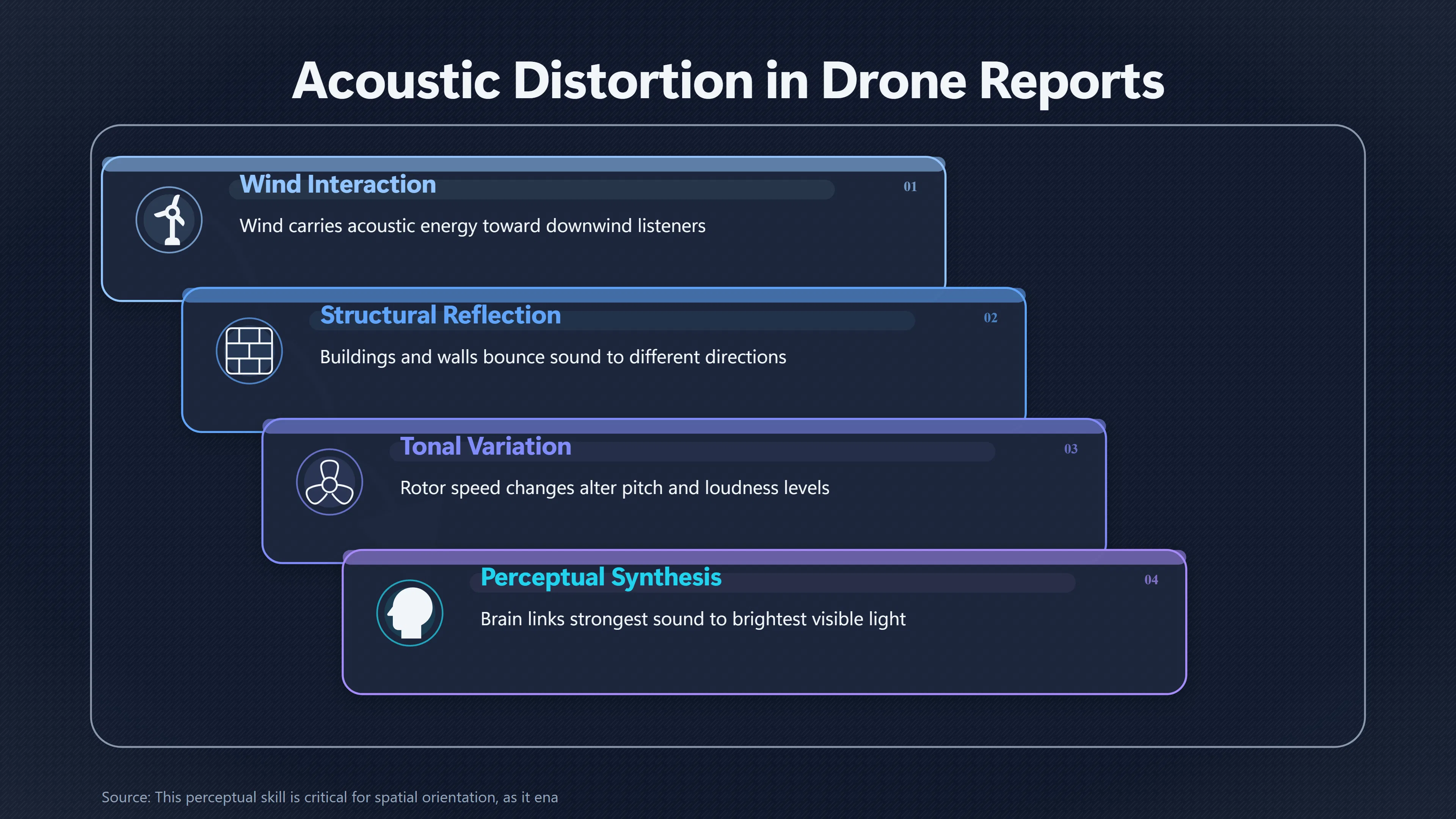
- Why darkness distorts size and distance
- How wind and buildings redirect sound
- Clues that reconnect the light with the noise
Page outline Jump by section
Introduction
When people report a bright light in the night sky but insist that its buzzing seemed to come from somewhere else, the mismatch can feel mysterious. In many cases, however, the combination of darkness, limited visual references and complex sound propagation provides a conventional explanation. A nearby drone may appear much farther away than it really is, while wind, echoes and the directional nature of rotor noise make the buzzing seem detached from the visible light. These perception errors are well documented in research on spatial hearing and aviation acoustics, and they are especially relevant when assessing reports of buzzing “UFOs” that turn out to be ordinary drones.[caa.co.uk]caa.co.ukCivil Aviation AuthorityCAP2962: The Effects of Emerging Technology Aviation Noise on Humans | UK Civil Aviation AuthorityAugust 27, 2024…
Why darkness distorts size and distance
At night, observers lose many of the visual cues that normally help estimate the position of an aircraft. Trees, buildings, hills and cloud layers become difficult to judge, leaving only a small cluster of lights against a dark background.
This creates several common perceptual errors:
- Size becomes ambiguous. A bright navigation light can appear to belong to a much larger object if the aircraft itself cannot be seen.
- Distance is underestimated or overestimated. Without foreground landmarks, a drone tens of metres away may be perceived as hundreds of metres distant, or vice versa.
- Height becomes difficult to judge. A low-flying drone can appear to hover high overhead when the observer lacks a reliable horizon.
- Movement is misread. Slow sideways motion or hovering can appear unusual because there are few fixed reference points against which to compare it.
Vision normally helps calibrate how humans interpret three-dimensional space. Research on auditory distance perception has shown that visual information plays an important role in maintaining accurate estimates of where sounds originate. When visual references are degraded or absent, localisation errors become more likely.[PubMed]pubmed.ncbi.nlm.nih.govPartial visual loss disrupts the relationship between judged room size and sound source distance - PubMed…
For reports involving alleged UFO noises, this matters because the apparent position of the light may already be incorrect before the sound is considered.
How wind and buildings redirect sound
Even if the light is correctly identified, the accompanying buzz may not appear to come from the same direction.
Unlike light, sound travels relatively slowly through air and is strongly influenced by the environment. Rotor noise from multirotor drones contains prominent tonal components that interact with surrounding terrain and structures in ways that can alter where listeners believe the sound originates.[PubMed Central (PMC)]pmc.ncbi.nlm.nih.govPubMed Central (PMC)Quantification of the Psychoacoustic Effect of Noise from Small Unmanned Aerial Vehicles - PMCAugust 24, 2021…
Wind can shift the apparent source
Wind affects sound far more than it affects light.
A listener standing downwind from a drone may hear the buzzing more clearly because the wind carries acoustic energy towards them. Someone standing upwind may hear very little despite looking directly at the aircraft. As wind strength and direction change, the perceived source of the buzz may seem to drift independently of the visible light.
These changes do not move the aircraft itself; they only alter how efficiently its sound reaches the observer.
Echoes create misleading directions
Urban and suburban environments introduce another complication.
Buildings, walls, parked vehicles and even large industrial structures reflect sound. If reflected sound reaches the listener nearly as strongly as the direct sound, the brain may attribute the source to the reflected direction instead of the drone’s true position.
The effect is most noticeable when:
- the drone is flying between buildings;
- the listener is close to reflective surfaces;
- direct sound is weakened by wind or obstacles;
- surrounding ambient noise is otherwise low.
The result can be a convincing impression that the buzzing comes from behind, beside or above the visible light.

Rotor noise is not equally loud in every direction
Drone propellers do not radiate sound uniformly. Their tonal blade-passing frequencies and harmonics vary with aircraft orientation, rotor speed and manoeuvres, producing directional changes in perceived loudness. A drone banking or turning may therefore sound stronger from one position than another without changing location dramatically.[nih.gov]pmc.ncbi.nlm.nih.govPubMed Central (PMC)Quantification of the Psychoacoustic Effect of Noise from Small Unmanned Aerial Vehicles - PMCAugust 24, 2021…
Why the light and buzz seem disconnected
Observers often assume that a nearby sound must belong to a nearby object. Under night-time conditions, that assumption is not always reliable.
Several effects combine to separate the perceived light from the perceived sound:
- Visual distance errors make the illuminated object appear farther away than it really is.
- Acoustic reflections redirect the buzzing.
- Wind changes which listener hears the strongest sound.
- Low ambient noise makes intermittent buzzing seem unusually prominent.
- Expectation encourages the brain to link whichever sound is most noticeable with the brightest visible object.
Importantly, this does not imply that witnesses are inventing their observations. Instead, it illustrates that human perception naturally integrates imperfect visual and acoustic information into a single interpretation, even when the two signals have been distorted by the environment.[Federal Aviation Administration]faa.govOpen source on faa.gov.
Clues that reconnect the light with the noise
When investigating whether a buzzing light is likely to be a drone rather than something unidentified, a few practical observations can reduce the chance of being misled by night-time perception.
Look for patterns rather than relying on a single impression:
- Observe whether the buzzing becomes stronger when you move a short distance. Large changes over only a few metres often suggest reflections or shielding by nearby structures.
- Compare the object’s apparent motion against fixed landmarks such as rooftops or trees instead of judging it against empty sky.
- Notice whether the sound changes during climbs, descents or turns. Drone rotor speed commonly varies during these manoeuvres, producing changes in pitch and loudness.
- If multiple observers are present, compare descriptions from different locations. People standing only tens of metres apart may report different apparent sound directions because of local reflections and wind.
These checks cannot identify every aerial object, but they help distinguish genuine anomalies from the well-understood ways darkness and acoustics separate visible lights from their associated sounds.
What this means for buzzing UFO reports
Night-time reports of buzzing aerial lights deserve careful evaluation, but a perceived mismatch between where a light is seen and where a buzz is heard is not, by itself, evidence of an unconventional object.
The combination of poor night-time depth perception, ambiguous visual scale, wind-driven sound propagation, directional rotor noise and echoes provides a plausible explanation for many cases in which a drone appears visually distant while its buzzing seems to originate elsewhere. Recognising these perception limits helps avoid treating an ordinary acoustic illusion as evidence that the light and the sound must have come from different objects.[caa.co.uk]caa.co.ukCivil Aviation AuthorityCAP2962: The Effects of Emerging Technology Aviation Noise on Humans | UK Civil Aviation AuthorityAugust 27, 2024…
Amazon book picks
Further Reading
Books and field guides related to Why Drone Lights and Buzz Seem Misaligned. Use these as the next step if you want deeper reading beyond the article.
Master Handbook of Acoustics
Practical Instruction on the Art and Science of Acoustic Design and Architecture Build your own acoustic environments such as recording s...
Spatial Hearing
The field of spatial hearing has exploded in the decade or so since Jens Blauert's classic work on acoustics was first published in Engli...
Sound Reproduction
Covering designing listening experiences, acoustics and psychoacoustics this book shows how to design the best possible listening experie...
The Complete Book of Drones
Grâce à ce guide très illustré, vous allez acquérir toutes les compétences et les connaissances pour faire voler votre drone à la perfect...
eBay marketplace picks
Marketplace Samples
Live-tested eBay searches with available results related to this page.
Selected fromdrone carrying case oneBay.co.uk.


Endnotes
1.
Source: sciencedirect.com
Link:https://www.sciencedirect.com/science/article/pii/S0022460X26000118
Source snippet
Tonal noise produced by a UAV propeller due to unsteady rotational motion - ScienceDirect...
2.
Source: sciencedirect.com
Title: This perceptual skill is critical for spatial orientation, as it ena
Link:https://www.sciencedirect.com/science/article/pii/S0003682X26001155
Source snippet
The influence of visual context on auditory distance perception: A comparison between real and virtual visual environments - ScienceDirec...
3.
Source: nature.com
Link:https://www.nature.com/articles/s44384-024-00001-6
4.
Source: sciencedirect.com
Link:https://www.sciencedirect.com/science/article/pii/S1270963823004340
5.
Source: nature.com
Link:https://www.nature.com/articles/s41598-020-64306-8
6.
Source: nature.com
Title: Loudness constancy with varying sound source distance | Nature Neuroscience
Link:https://www.nature.com/articles/nn0101_78
7.
Source: nature.com
Title: Auditory distance perception in rooms | Nature
Link:https://www.nature.com/articles/17374
8.
Source: sciencedirect.com
Link:https://www.sciencedirect.com/science/article/pii/S1270963826011168
9.
Source: sciencedirect.com
Link:https://www.sciencedirect.com/science/article/pii/S0195925526001447
10.
Source: sciencedirect.com
Title: Distance Perception
Link:https://www.sciencedirect.com/topics/medicine-and-dentistry/distance-perception
11.
Source: caa.co.uk
Link:https://www.caa.co.uk/our-work/publications/documents/content/cap2962/
Source snippet
Civil Aviation AuthorityCAP2962: The Effects of Emerging Technology Aviation Noise on Humans | UK Civil Aviation AuthorityAugust 27, 2024...
Published: August 27, 2024
12.
Source: faa.gov
Link:https://www.faa.gov/regulations_policies/policy_guidance/noise/basics
13.
Source: pubmed.ncbi.nlm.nih.gov
Link:https://pubmed.ncbi.nlm.nih.gov/34623459/
Source snippet
Partial visual loss disrupts the relationship between judged room size and sound source distance - PubMed...
14.
Source: pmc.ncbi.nlm.nih.gov
Link:https://pmc.ncbi.nlm.nih.gov/articles/PMC8430946/
Source snippet
PubMed Central (PMC)Quantification of the Psychoacoustic Effect of Noise from Small Unmanned Aerial Vehicles - PMCAugust 24, 2021...
Published: August 24, 2021
15.
Source: pubmed.ncbi.nlm.nih.gov
Link:https://pubmed.ncbi.nlm.nih.gov/40938113/
16.
Source: pubmed.ncbi.nlm.nih.gov
Link:https://pubmed.ncbi.nlm.nih.gov/40938113/?fc=20240316053740&ff=20251027051854&v=2.18.0.post22+67771e2
17.
Source: caa.co.uk
Link:https://www.caa.co.uk/data-and-publications/publications/documents/content/cap3076/
18.
Source: pmc.ncbi.nlm.nih.gov
Link:https://pmc.ncbi.nlm.nih.gov/articles/PMC11841372/
19.
Source: pubmed.ncbi.nlm.nih.gov
Link:https://pubmed.ncbi.nlm.nih.gov/39981297/
20.
Source: pubmed.ncbi.nlm.nih.gov
Link:https://pubmed.ncbi.nlm.nih.gov/38310607/
21.
Source: airporttech.tc.faa.gov
Link:https://www.airporttech.tc.faa.gov/Products/Airport-Safety-Papers-Publications/Airport-Safety-Detail/feasibility-of-unmanned-aircraft-system-mounted-loudspeaker-for-measurement-of-noise-reduction
22.
Source: faa.gov
Title: Fundamentals of Noise and Sound | Federal Aviation Administration
Link:https://www.faa.gov/noise/aviation_noise/fundamentals_of_noise
23.
Source: caa.co.uk
Link:https://www.caa.co.uk/data-and-publications/publications/publication-categories/drones/
Additional References
24.
Source: researchportal.hkust.edu.hk
Link:https://researchportal.hkust.edu.hk/en/publications/experimental-evaluation-of-a-frequency-domain-acoustic-model-for-/
Source snippet
HKUST Research PortalExperimental evaluation of a frequency-domain acoustic model for drone rotor noise prediction in non-axial flows - T...
25.
Source: research-portal.uea.ac.uk
Link:https://research-portal.uea.ac.uk/en/publications/how-do-people-with-vision-loss-judge-distances-of-sound-sources/
Source snippet
University of East AngliaHow do people with vision loss judge distances of sound sources? - University of East Anglia...
26.
Source: research.tudelft.nl
Link:https://research.tudelft.nl/en/publications/sound-quality-directivity-characterization-of-a-hovering-drone-us/
Source snippet
Yupa Villanueva *, R. Merino Martinez *, A.M. Morin *, M. Snellen * Operations & Environ...
27.
Source: youtube.com
Title: Lecture 28: Meteorological Conditions and Sound Propagation
Link:https://www.youtube.com/watch?v=s7DA_KjetSw
Source snippet
Auditory distance perception sound localization cues Where is Sound Coming From? | How Humans Use Sound LOCALIZATION Doctor Cliff, AuD...
28.
Source: youtube.com
Title: Spatial Disorientation Explained: Deadly Flight Illusions Every Pilot Must Know
Link:https://www.youtube.com/watch?v=6BD9fyyIJzY
Source snippet
Lecture 28: Meteorological Conditions and Sound Propagation...
29.
Source: youtube.com
Title: Where is Sound Coming From? | How Humans Use Sound LOCALIZATION
Link:https://www.youtube.com/watch?v=dnDrAG8FZok
Source snippet
Spatial Disorientation Explained: Deadly Flight Illusions Every Pilot Must Know...
30.
Source: youtube.com
Title: Night Illusions (Private Pilot Lesson 15d)
Link:https://www.youtube.com/watch?v=y_HvgmQ3NJs
Source snippet
Where is Sound Coming From? | How Humans Use Sound LOCALIZATION...
31.
Source: tandfonline.com
Link:https://www.tandfonline.com/doi/abs/10.1080/10508414.2013.833755
32.
Source: skybrary.aero
Link:https://skybrary.aero/index.php/articles/night-visual-approaches
33.
Source: doi.org
Link:https://doi.org/10.2514/6.2026-3462