Within Silent Sightings
How Investigators Check Whether a Silent UFO Was Distant
Investigators compare witness estimates with tracking data, landmarks, radar and multiple viewpoints before treating silence as unusual.
On this page
- Why witness range estimates receive low confidence
- Which external records can establish distance
- How confirmed range changes sound expectations
Page outline Jump by section
Introduction
Reports of silent UFOs often become far less unusual once investigators establish how far away the reported object actually was. Human observers are generally poor at estimating the range of isolated objects in the sky, particularly at night or when there are no familiar landmarks. For that reason, experienced investigators rarely treat the absence of sound as meaningful until they have independently reconstructed the object’s likely distance. If an object that appeared to be a few hundred metres away was actually several kilometres distant, faint or absent engine noise may be entirely consistent with ordinary aircraft acoustics. Conversely, if reliable evidence places an object genuinely close to witnesses while remaining silent, that observation deserves closer scrutiny. The central task is therefore not explaining silence first, but testing the distance estimate on which the claim depends.[Federal Aviation Administration]faa.govFederal Aviation Administration Noise | Federal Aviation AdministrationFederal Aviation AdministrationNoise | Federal Aviation AdministrationDecember 13, 2024…

Why Witness Range Estimates Receive Low Confidence
Investigators begin from the assumption that eyewitness estimates of aerial distance are provisional rather than precise. Unlike ground objects, airborne targets often lack reliable visual cues for judging scale. A bright light may appear closer than it is, while an unfamiliar aircraft silhouette can seem either much larger or much smaller depending on atmospheric conditions and viewing angle.
Distance estimates are especially vulnerable to several recurring errors:
- No fixed reference points. Without buildings, hills or known terrain beneath the object, observers cannot use normal depth perception.
- Unknown object size. An observer cannot calculate range if the true dimensions of the object are unknown.
- Night-time observations. Darkness removes texture, horizon cues and contrast, leaving only isolated lights.
- Perspective illusions. Objects travelling towards or away from an observer may appear nearly stationary despite covering large distances.
For these reasons, modern investigations usually separate what witnesses actually observed from what they inferred. Statements such as “it was only 200 metres away” are treated as hypotheses to be tested rather than established facts.
Which External Records Can Establish Distance
The strongest investigations attempt to replace subjective estimates with independently verifiable measurements. No single source is decisive in every case, so investigators compare multiple datasets to see whether they converge on a consistent reconstruction.
Flight Tracking and ADS-B Records
Many civilian aircraft continuously broadcast their identity, position and altitude through Automatic Dependent Surveillance–Broadcast (ADS-B). Historical ADS-B archives can reveal whether a conventional aircraft occupied the reported location at the relevant time.
If a tracked aircraft was, for example, eight kilometres away rather than the witness’s estimated one kilometre, expectations about engine noise change dramatically. Modern investigations increasingly combine ADS-B data with radar information because the two systems complement one another and improve positional accuracy.[Ukrainian Scientific Journals]journals.uran.uaUkrainian Scientific JournalsMethod for determining coordinates of airborne objects by radars with additional use of ADS-B receivers | Ea…
Primary and Secondary Radar
Where radar data are available, investigators can estimate an aircraft’s range independently of witness testimony.
Primary surveillance radar determines an object’s distance by measuring the return time of reflected radio pulses, while secondary surveillance radar supplements this with transponder-derived identification and altitude for cooperative aircraft. These measurements provide objective spatial information that can either support or contradict visual estimates.[Federal Aviation Administration]faa.govOpen source on faa.gov.
Radar evidence is not universal, however. Small objects, balloons, drones, stealthy designs, terrain masking or limited radar coverage may all reduce detectability. Therefore, the absence of a radar return does not automatically imply that no object was present.
Landmarks, Maps and Viewing Geometry
When radar is unavailable, investigators reconstruct geometry using photographs, videos and known landmarks.
Common techniques include:
- identifying buildings, hills or towers visible beneath the object;
- calculating sightlines from the witness position;
- comparing elevation angles with topographic maps;
- estimating whether the reported altitude is physically consistent with surrounding terrain.
Even approximate geometric reconstruction can show that an object believed to be overhead was actually much closer to the horizon and therefore much farther away.
Multiple Independent Witnesses
Independent observers located in different places provide one of the most useful opportunities for estimating range.
If two witnesses observed the same object from different locations at roughly the same time, investigators can compare viewing directions. Where those sightlines intersect, they provide a form of triangulation that often constrains the object’s position far more effectively than either witness alone.
Modern scientific proposals for studying unidentified aerial phenomena similarly emphasise simultaneous observations from multiple sensors and locations because they permit direct estimation of position and motion rather than relying on subjective judgement.[arXiv]arxiv.orgThe Scientific Investigation of Unidentified Aerial Phenomena (UAP) Using Multimodal Ground-Based ObservatoriesMay 29, 2023…
How Confirmed Range Changes Sound Expectations
Once investigators establish a more reliable distance, they reassess whether silence remains unusual.
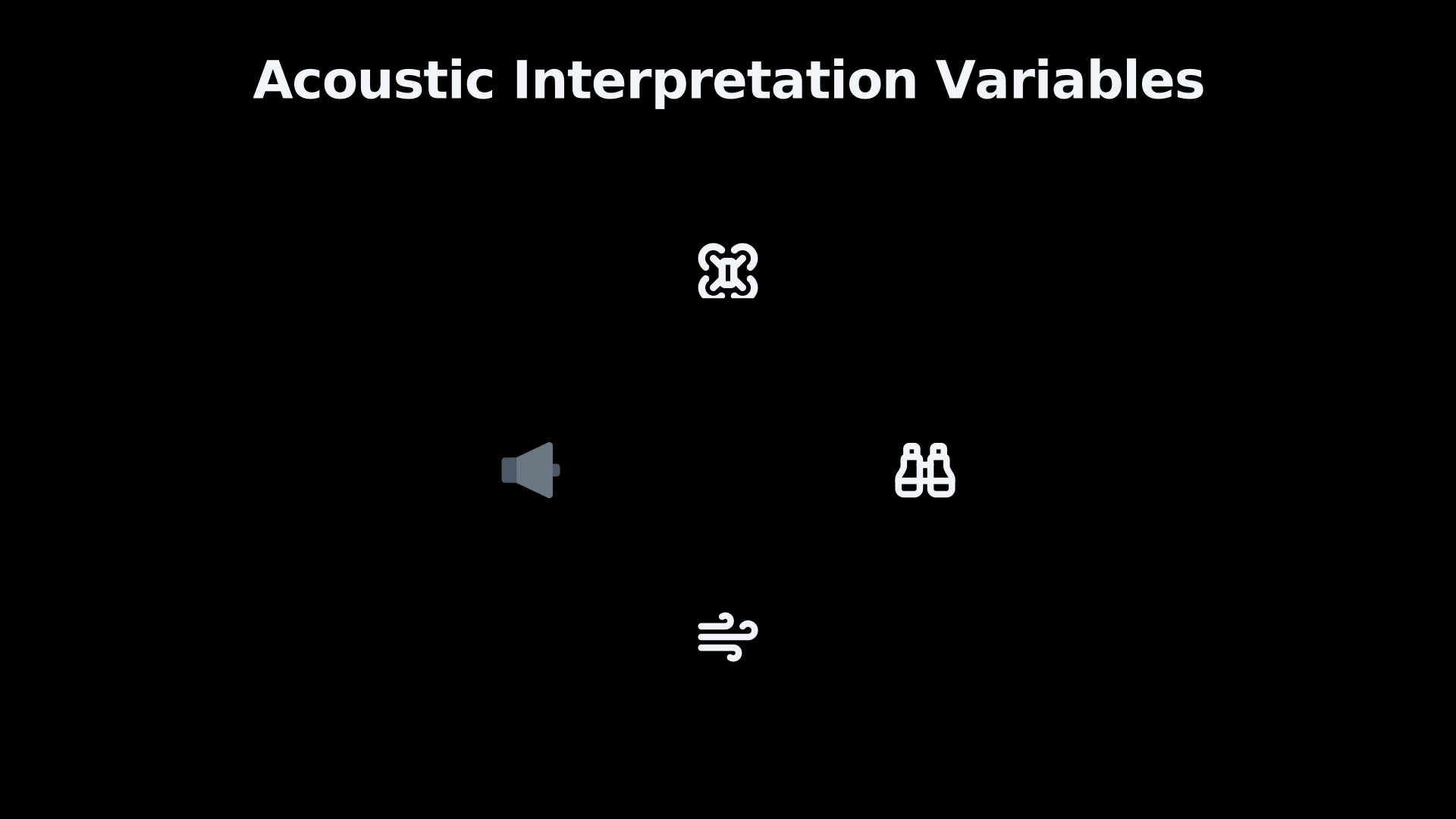
If reconstructed evidence indicates the object was several kilometres away, weak or absent sound may be expected because:
- sound intensity decreases rapidly with distance;
- atmospheric conditions can refract or absorb sound;
- wind direction can carry engine noise away from observers;
- background environmental noise can mask faint aircraft sounds.
The Federal Aviation Administration notes that aircraft noise varies substantially with distance, aircraft operation and environmental conditions, making simple assumptions about how loud an aircraft “should” sound unreliable.[Federal Aviation Administration]faa.govFederal Aviation Administration Noise | Federal Aviation AdministrationFederal Aviation AdministrationNoise | Federal Aviation AdministrationDecember 13, 2024…
Conversely, if multiple independent measurements indicate an object passed at genuinely low altitude and short range, investigators then examine whether the reported silence remains compatible with known aircraft types, balloons, drones or environmental masking before considering more unusual explanations.
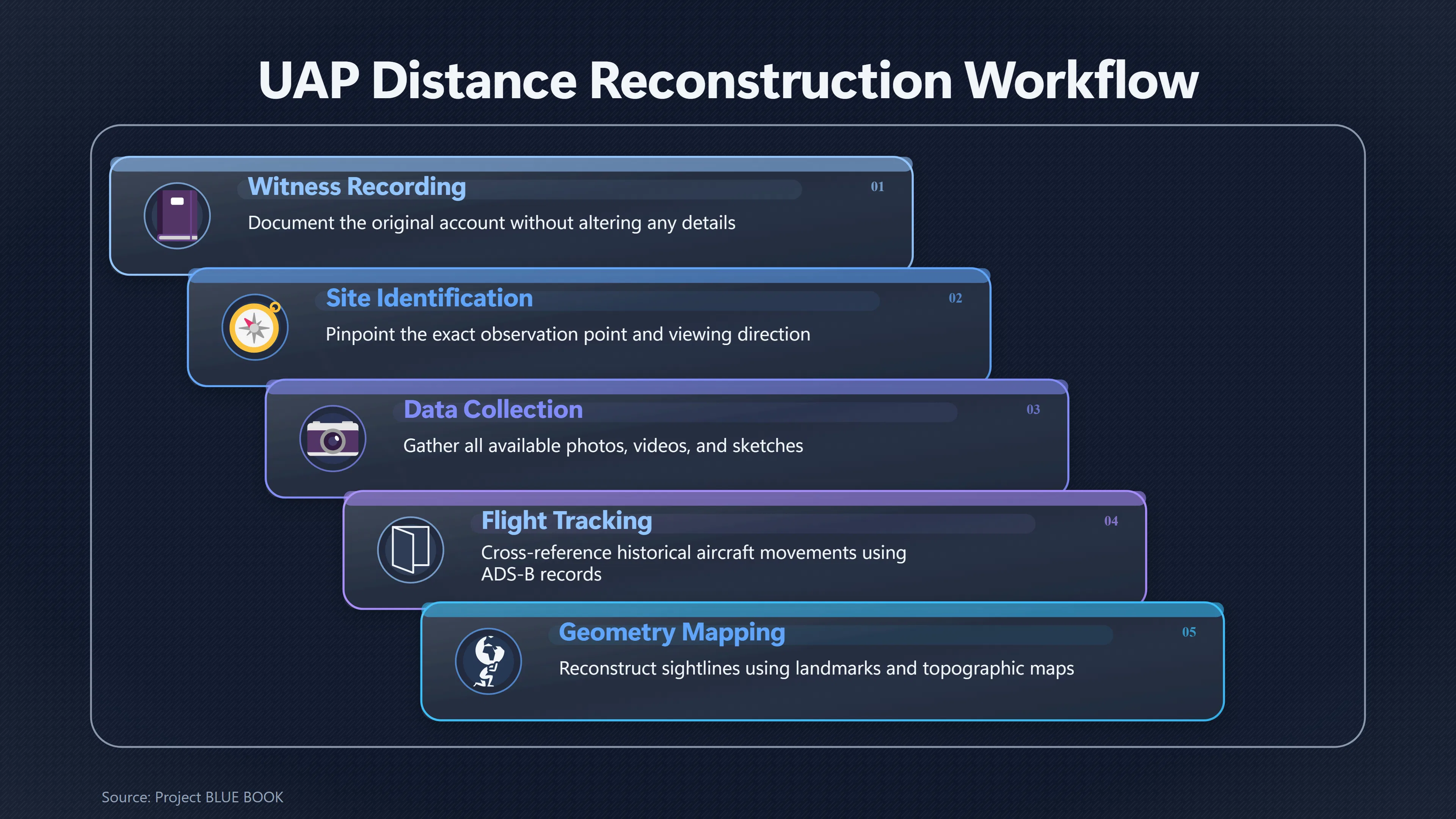
A Practical Investigation Workflow
Experienced investigators typically follow a sequence designed to reduce uncertainty before interpreting the acoustic evidence.
- Record the witness account without altering it.
- Identify the precise observation point and viewing direction.
- Collect photographs, videos or sketches made at the time.
- Check historical aircraft movements using flight-tracking records.
- Compare available radar, air traffic or other official records.
- Reconstruct geometry using landmarks and maps.
- Compare independent witness accounts for consistency.
- Re-evaluate whether the reported silence matches the reconstructed distance.
This approach deliberately delays conclusions about anomalous silence until the object’s likely range has been constrained as well as available evidence allows.
Why Distance Reconstruction Often Resolves the Mystery
Many investigations conclude that the witness accurately described what they experienced but substantially misjudged how far away the object was. That single correction frequently explains several reported anomalies simultaneously: the object appears quieter, slower, larger or more unusual than it really was because its assumed distance was incorrect.
This does not mean every silent UFO report has an ordinary explanation. Rather, it illustrates why investigators place far greater evidential weight on independently established range than on intuitive visual estimates. Until distance has been tested against tracking records, radar data, landmarks or multiple viewpoints, the absence of sound carries relatively little evidential value on its own.[uran.ua]journals.uran.uaUkrainian Scientific JournalsMethod for determining coordinates of airborne objects by radars with additional use of ADS-B receivers | Ea…
Amazon book picks
Further Reading
Books and field guides related to How Investigators Check Whether a Silent UFO Was Distant. Use these as the next step if you want deeper reading beyond the article.
The UFO Handbook: A Guide to Investigating, Evaluating, and R...
An explanation of the usual reasons for confusing IFOs (identified flying objects) with UFOs and a survey of the tools used to investigat...
The UFO Experience: A Scientific Inquiry
Cited by the New York Review of Books as "the best brief for visitation," this classic study presents an analysis of UFO reports and conc...
UFOs Explained
Analyzing several UFO cases, the author exposes the myth of extraterrestrial visitors to earth.
eBay marketplace picks
Marketplace Samples
Live-tested eBay searches with available results related to this page.
Selected fromUFO patch oneBay.co.uk.

Endnotes
1.
Source: arxiv.org
Link:https://arxiv.org/abs/2305.18566
Source snippet
The Scientific Investigation of Unidentified Aerial Phenomena (UAP) Using Multimodal Ground-Based ObservatoriesMay 29, 2023...
Published: May 29, 2023
2.
Source: archives.gov
Title: Project BLUE BOOK
Link:https://www.archives.gov/research/military/air-force/ufos
3.
Source: archives.gov
Link:https://www.archives.gov/research/guide-fed-records/groups/341.html/1000
4.
Source: faa.gov
Title: Federal Aviation Administration Noise | Federal Aviation Administration
Link:https://www.faa.gov/noise
Source snippet
Federal Aviation AdministrationNoise | Federal Aviation AdministrationDecember 13, 2024...
Published: December 13, 2024
5.
Source: faa.gov
Link:https://www.faa.gov/noise/aviation_noise/fundamentals_of_noise
6.
Source: journals.uran.ua
Link:https://journals.uran.ua/eejet/article/view/238407
Source snippet
Ukrainian Scientific JournalsMethod for determining coordinates of airborne objects by radars with additional use of ADS-B receivers | Ea...
7.
Source: faa.gov
Link:https://www.faa.gov/air_traffic/technology/asr-11
8.
Source: faa.gov
Link:https://www.faa.gov/noise/inquiries/noise-complaint-inquiry-policy
Source snippet
May 13, 2026 — Nationwide Data for 2025 NOISE PORTAL RESPONSES Inquiry Received Response | 6,384 Received No Response (Response Not Reque...
Published: May 13, 2026
9.
Source: faa.gov
Title: Noise Complaints & Inquiries | Federal Aviation Administration
Link:https://www.faa.gov/noise/inquiries
10.
Source: faa.gov
Title: Noise | Federal Aviation Administration
Link:https://www.faa.gov/about/office_org/headquarters_offices/apl/aee/noise
11.
Source: faa.gov
Title: Neighborhood Environmental Survey | Federal Aviation Administration
Link:https://www.faa.gov/regulations_policies/policy_guidance/noise/survey
12.
Source: faa.gov
Link:https://www.faa.gov/air_traffic/publications/atpubs/foa_html/chap4_section_7.html
Additional References
13.
Source: ufouap.net
Link:https://www.ufouap.net/en/explainers/radar-uap-evidence
Source snippet
July 16, 2026 — Evidence / Updated 2026-07-16 / 6 min read RADAR UAP EVIDENCE: WHY RADAR CASES MATTER AND WHY THEY CAN STILL BE WRONG Rad...
Published: July 16, 2026
14.
Source: sentinel-files.com
Link:https://www.sentinel-files.com/files/dow-uap-d077-unresolved-case-analysis-update-western-united-state-sf-2026-000256
Source snippet
The reporters also described the phenomena as “silent.” The agents provided consistent accounts using similar language to characteriz...
15.
Source: youtube.com
Title: Congress Fell for a BALLOON? | MICK WEST Breaks Down The Hellfire Missile UFO
Link:https://www.youtube.com/watch?v=FY4aRfx17vQ
Source snippet
Quantum physicists REanalyze GOFAST UFO video footage released by the US Navy and Pentagon...
16.
Source: youtube.com
Link:https://www.youtube.com/watch?v=y5Uf4N-JkQY
Source snippet
The "Windfarm UFO" - analyzed, 3D-recreated and debunked...
17.
Source: nature.com
Link:https://www.nature.com/articles/s41598-023-49527-x
18.
Source: youtube.com
Title: The “Windfarm UFO”
Link:https://www.youtube.com/watch?v=xkgTajUDORs
Source snippet
Pentagon UFO Footage Looks Impossible. Here's the Catch...
19.
Source: youtube.com
Title: Videogame Science and UFOs with Mick West
Link:https://www.youtube.com/watch?v=fYQNEC7SeSU
Source snippet
Congress Fell for a BALLOON? | MICK WEST Breaks Down The Hellfire Missile UFO...
20.
Source: aaro.mil
Link:https://www.aaro.mil/Next-AARO-Home-redesign/Next-Parent/Next-UAP-Report-Documents/
Source snippet
AARO UAP Report DocumentsMay 8, 2026 — UAP Imagery Imagery | Release Date | Title | DVIDS Page | Description --- | --- | --- | --- |...
Published: May 8, 2026
21.
Source: researchgate.net
Link:https://www.researchgate.net/publication/354343461_Method_for_determining_coordinates_of_airborne_objects_by_radars_with_additional_use_of_ADS-B_receivers
22.
Source: sciencedirect.com
Link:https://www.sciencedirect.com/science/article/pii/S2590123024020292