Within Low Hums
Why Does a Low Hum Seem Overhead?
Long wavelengths and weak directional cues can make a distant fixed hum feel as though it is coming from the sky.
On this page
- How ears locate sound
- Why low frequencies blur direction
- How buildings and terrain redirect perception
Page outline Jump by section
Introduction
Reports of a low humming sound that seems to come from directly overhead are common in UFO accounts, yet the sensation itself is not unusual from an acoustics perspective. A deep, continuous hum can appear to descend from the sky even when its true source is on the ground or many kilometres away. The effect arises because human hearing relies on directional cues that become much less reliable at low frequencies. Long sound wavelengths, reflections from buildings and terrain, and atmospheric conditions can all blur the apparent origin of a hum until it seems to come from “everywhere”—or from above. This mechanism helps explain why witnesses may sincerely perceive an overhead sound without that perception, by itself, demonstrating that an airborne object produced it.[Environmental Protection]environmental-protection.org.ukEnvironmental Protection Low Frequency NoiseEnvironmental ProtectionLow Frequency Noise - Environmental Protection UK…
How ears determine where a sound comes from
Human hearing locates most sounds by comparing what reaches each ear. Two principal cues are used:
- Interaural time difference (ITD): the tiny difference in arrival time between the ears.
- Interaural level difference (ILD): the slight difference in loudness caused by the head blocking part of the sound.
For higher-pitched sounds, these cues are usually strong because their short wavelengths interact noticeably with the head. The brain can therefore estimate direction with remarkable precision.
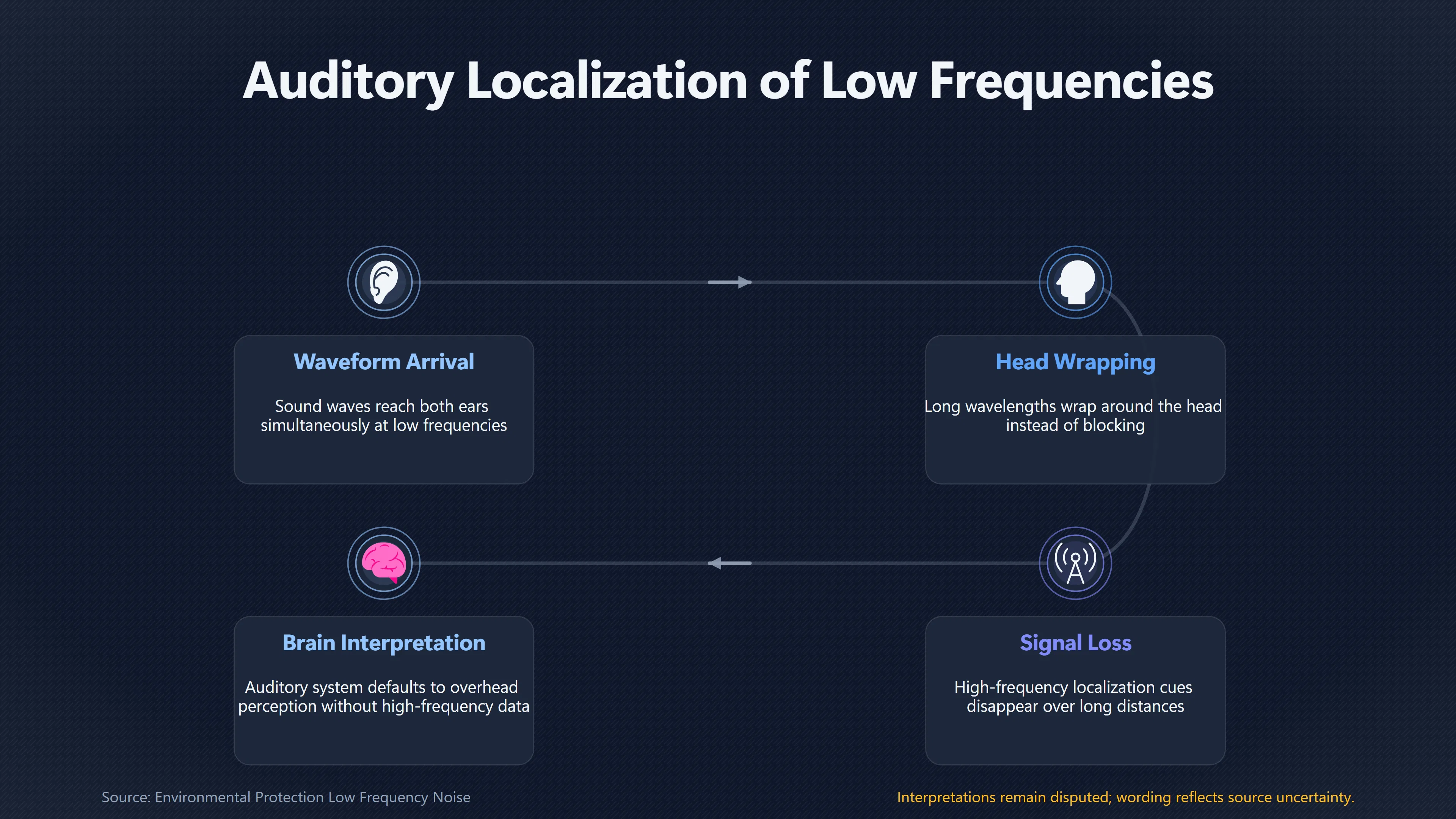
Deep humming sounds behave differently. Their wavelengths are often much larger than the width of a human head, so they wrap around it rather than being significantly blocked. As a result, the loudness difference between the ears becomes extremely small, depriving the auditory system of one of its strongest directional signals. At low frequencies, listeners rely mainly on timing cues, but these too become less reliable in real environments where reflections and reverberation are present.[nih.gov]pmc.ncbi.nlm.nih.govPub Med Central (PMC)Auditory localization: a comprehensive practical reviewPubMed Central (PMC)Auditory localization: a comprehensive practical review - PMC…
Why low frequencies blur direction
A persistent low hum is especially difficult to place because several effects reinforce one another.
First, low-frequency waves spread efficiently around obstacles instead of casting sharp acoustic “shadows”. Unlike a bird call or a whistle, which may point clearly towards its source, a deep hum reaches both ears with nearly identical characteristics.
Second, these frequencies travel long distances with comparatively little loss. By the time they reach a listener, many of the higher-frequency components that would normally provide localisation cues may have disappeared, leaving only a diffuse low-frequency component.
Third, the brain is much better at identifying horizontal direction than elevation. Humans infer whether a sound is above or below largely from subtle filtering by the outer ear, but those spectral cues are strongest at higher frequencies. When a sound contains little high-frequency energy, the brain has fewer clues about height, making an overhead interpretation more likely.[PubMed Central (PMC)]pmc.ncbi.nlm.nih.govPub Med Central (PMC)Auditory localization: a comprehensive practical reviewPubMed Central (PMC)Auditory localization: a comprehensive practical review - PMC…
How buildings and terrain redirect perception
The environment often contributes as much to the illusion as the original sound source.
Low-frequency sound reflects from large surfaces such as hillsides, warehouse walls, tower blocks and broad roof structures. Multiple reflected paths can arrive almost simultaneously, creating a diffuse sound field in which no single direction dominates. Rather than hearing a sound coming from one side, listeners may perceive it as surrounding them.
Buildings can also resonate at particular low frequencies. Structural vibration may make ceilings, walls or windows radiate sound into a room, causing the apparent source to shift from outdoors to the building itself. Because ceilings occupy much of the upper visual field indoors, listeners may naturally interpret the sound as coming from above rather than from a distant industrial source or transport corridor. Environmental noise specialists note that low-frequency noise is frequently reported as difficult or impossible to trace, with indoor resonance often making it seem detached from its true origin.[Environmental Protection]environmental-protection.org.ukEnvironmental Protection Low Frequency NoiseEnvironmental ProtectionLow Frequency Noise - Environmental Protection UK…
Terrain produces similar effects. Valleys, embankments and uneven ground can redirect or channel sound so that a distant source is heard from an unexpected direction. Under favourable conditions, listeners may therefore attribute an ordinary ground-based hum to the sky.
Why UFO witnesses may experience an overhead hum
Within UFO reports, the perception of an overhead hum often occurs while witnesses are already looking upwards. That visual focus can reinforce the brain’s interpretation of an otherwise ambiguous sound.
Imagine a witness observing an unusual light while simultaneously hearing a low mechanical hum. If the sound lacks reliable directional information and the visual attention is fixed on the object overhead, the auditory system has little evidence to contradict the impression that both sensations share the same source. This process is a well-known characteristic of multisensory perception: when hearing is uncertain, vision often dominates the perceived location of an event.[PubMed Central (PMC)]pmc.ncbi.nlm.nih.govPub Med Central (PMC)Auditory localization: a comprehensive practical reviewPubMed Central (PMC)Auditory localization: a comprehensive practical review - PMC…
Importantly, this does not imply that witnesses are fabricating their experience. The impression of an overhead sound can be genuine even if the physical source lies elsewhere.

Why “coming from above” is not strong evidence by itself
An overhead hum is therefore a useful observation but not a diagnostic one. Similar descriptions can arise from:
- distant transformers or substations;
- large ventilation or HVAC systems;
- industrial machinery;
- road, rail or marine infrastructure under favourable propagation conditions;
- building resonance transmitting low-frequency energy indoors.
Environmental investigations of persistent low-frequency hums repeatedly show that such sounds can appear detached from their origins and may resist straightforward localisation, even during detailed acoustic surveys. In some cases the exact source remains unresolved, but the difficulty of locating it is itself consistent with the known behaviour of low-frequency sound rather than evidence of an aerial origin.[Environmental Protection]environmental-protection.org.ukEnvironmental Protection Low Frequency NoiseEnvironmental ProtectionLow Frequency Noise - Environmental Protection UK…
For that reason, investigators evaluating UFO reports generally treat an apparent overhead hum as one observation among many. Its evidential value depends on whether it is supported by independently verifiable data—such as multiple synchronised recordings or instrument measurements—rather than on the perceived direction of the sound alone.
Amazon book picks
Further Reading
Books and field guides related to Why Does a Low Hum Seem Overhead?. Use these as the next step if you want deeper reading beyond the article.
The Science of Sound
Written for students without a background in mathematics or physics, this textbook provides an introduction to the study of acoustics. It...
Master Handbook of Acoustics
Practical Instruction on the Art and Science of Acoustic Design and Architecture Build your own acoustic environments such as recording s...
Fundamentals of Acoustics
Dargestellt werden die physikalischen und mathematischen Konzepte zur Beschreibung der Erzeugung, Weiterleitung und Wahrnehmung von Schal...
Auditory Neuroscience
An integrated overview of hearing and the interplay of physical, biological, and psychological processes underlying it. Every time we lis...
eBay marketplace picks
Marketplace Samples
Live-tested eBay searches with available results related to this page.
Selected fromUFO poster oneBay.co.uk.

Current eBay listing
I Want To Believe UFO Poster Giclée Fine Art Heavyweight Print

Current eBay listing
VINTAGE UFO FLYING SAUCERS COMIC ADVERTISING A2 POSTER PRINT


Endnotes
1.
Source: environmental-protection.org.uk
Title: Environmental Protection Low Frequency Noise
Link:https://www.environmental-protection.org.uk/policy-areas/noise/environmental-noise/low-frequency-noise/
Source snippet
Environmental ProtectionLow Frequency Noise - Environmental Protection UK...
2.
Source: pmc.ncbi.nlm.nih.gov
Title: Pub Med Central (PMC)Auditory localization: a comprehensive practical review
Link:https://pmc.ncbi.nlm.nih.gov/articles/PMC11267622/
Source snippet
PubMed Central (PMC)Auditory localization: a comprehensive practical review - PMC...
3.
Source: pubmed.ncbi.nlm.nih.gov
Title: Pub Med Reassessing mechanisms of low-frequency sound localisation
Link:https://pubmed.ncbi.nlm.nih.gov/15302352/
Source snippet
Reassessing mechanisms of low-frequency sound localisation - PubMed...
4.
Source: pmc.ncbi.nlm.nih.gov
Link:https://pmc.ncbi.nlm.nih.gov/articles/PMC4769260/
Source snippet
PubMed Central (PMC)Transaural experiments and a revised duplex theory for the localization of low-frequency tones - PMC...
5.
Source: GOV.UK
Title: www.gov.uk Electromagnetic fields: sources and health effects
Link:https://www.gov.uk/government/publications/electromagnetic-fields/electromagnetic-fields-sources-and-health-effects
Source snippet
Units of electric and magnetic fields 2. Exposure to electromagnetic fields 3. Static fields 4. Low frequency ele...
6.
Source: pubmed.ncbi.nlm.nih.gov
Link:https://pubmed.ncbi.nlm.nih.gov/1564201/
7.
Source: ncbi.nlm.nih.gov
Link:https://www.ncbi.nlm.nih.gov/books/NBK207834/?report=reader
8.
Source: torridge.gov.uk
Link:https://www.torridge.gov.uk/article/21294/Low-frequency-noise
Additional References
9.
Source: earth.com
Title: Mysterious ‘Hum’ heard worldwide may finally be explained
Link:https://www.earth.com/news/mysterious-hum-heard-worldwide-may-finally-be-explained/
Source snippet
6, 2026 — 06-06-2026 MYSTERIOUS 'HUM' HEARD WORLDWIDE MAY FINALLY BE EXPLAINED Image: Rodielon Putol ByRodielon Putol Earth.com staff wri...
10.
Source: author.ioa.org.uk
Title: Not everyone can hear it, as our range of hearing dif
Link:https://author.ioa.org.uk/news/low-frequency-noise-annoyance-new-briefing-note
Source snippet
of Acoustics: Low Frequency Noise Annoyance - New Briefing Note3 days ago — LOW FREQUENCY NOISE ANNOYANCE - NEW BRIEFING NOTE Low Frequen...
11.
Source: sciencedirect.com
Title: ScienceDirect Investigation of environmental low-frequency noise
Link:https://www.sciencedirect.com/science/article/pii/S0003682X9600059X
Source snippet
Investigation of environmental low-frequency noise - ScienceDirect...
12.
Source: nature.com
Link:https://www.nature.com/articles/s41370-023-00599-x
Source snippet
Long-term measurement study of urban environmental low frequency noise | Journal of Exposure Science & Environmental EpidemiologySeptembe...
13.
Source: youtube.com
Title: ‘The Hum’: The [Unexplained]({{ ‘unexplained/’ | relative_url }}) Noise 2% of People Can Hear
Link:https://www.youtube.com/watch?v=ZwE8kIBd1xY
Source snippet
Sound localization interaural time level difference low frequency sound localization mantismundi...
14.
Source: sciencedirect.com
Link:https://www.sciencedirect.com/science/article/abs/pii/S0003682X04001598
15.
Source: sfu.ca
Link:https://www.sfu.ca/sonic-studio-webdav/cmns/Handbook5/handbook/Diffraction.html
16.
Source: epa.ie
Link:https://www.epa.ie/environment-and-you/radiation/emf/what-is-emf/extremely-low-frequency-fields-/
17.
Source: lfresearch.org
Link:https://lfresearch.org/
18.
Source: jamanetwork.com
Link:https://jamanetwork.com/journals/jamaotolaryngology/fullarticle/1558015