Within UFO Noises
How Weather Makes Sky Sounds Seem Mysterious
Wind, temperature layers, clouds, and terrain can bend, weaken, or redirect sound until its source seems distant or airborne.
On this page
- Temperature inversions and sound refraction
- Wind direction and acoustic shadows
- Terrain, clouds, and delayed arrival
Page outline Jump by section
Introduction
Many reports of mysterious “UFO noises” involve sounds that seem detached from any visible source, arrive from the wrong direction, or appear to hover overhead despite originating many kilometres away. In many cases, atmospheric acoustics provide a well-understood explanation. The atmosphere is not a uniform medium: temperature, wind, humidity and terrain continuously alter the way sound travels. Under the right conditions, ordinary aircraft, distant industry, explosions or traffic can sound unexpectedly loud, strangely quiet or as though they are coming from the sky itself. Understanding these mechanisms helps explain why unusual sounds are often sincere observations without requiring an unusual source.[RMetS]rmets.orgRMet SUnder a cloud or walking on sunshine? | Royal Meteorological SocietyUnder a cloud or walking on sunshine? | Royal Meteorological SocietyJanuary 13, 2022…
Temperature inversions and sound refraction
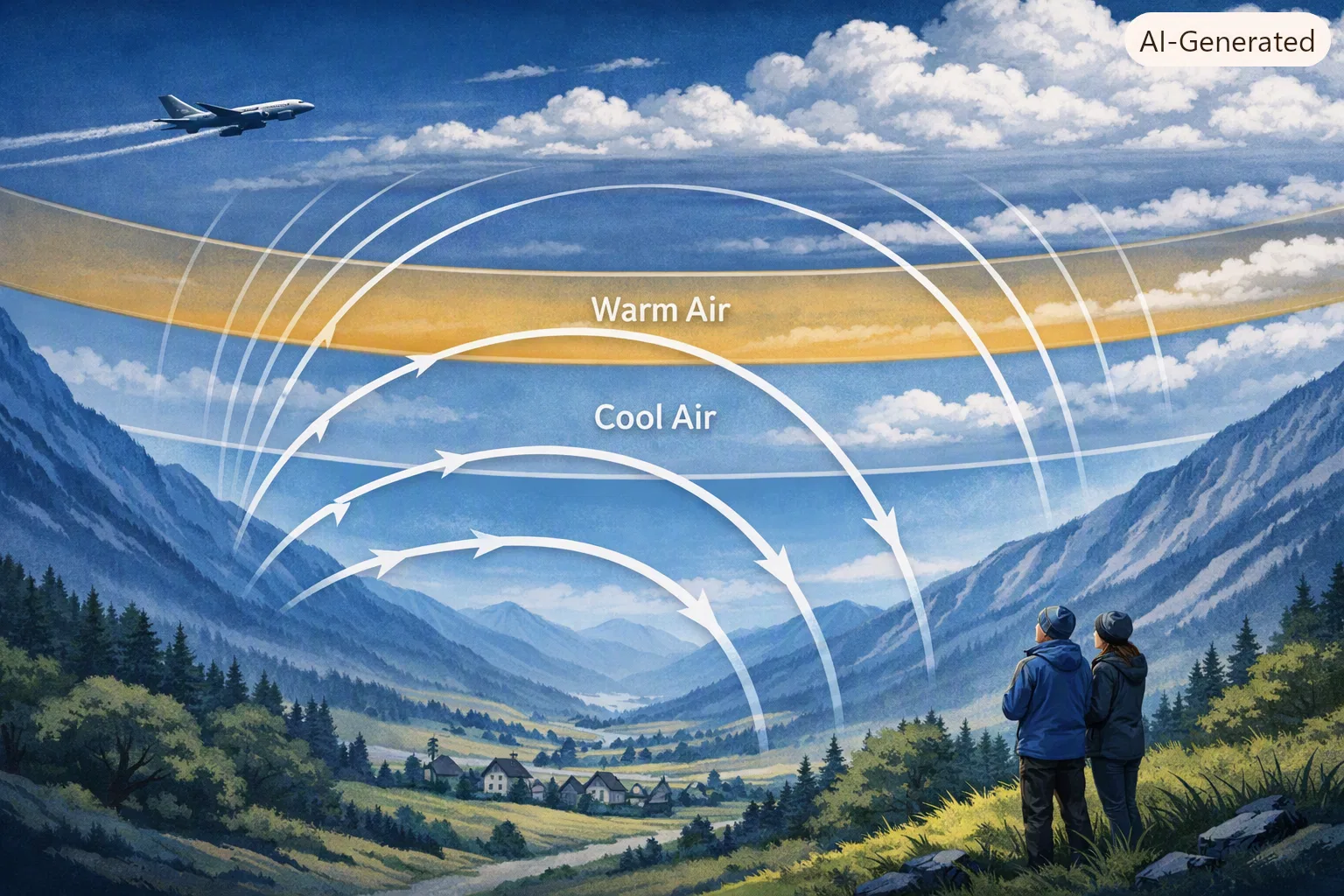
The single most important weather condition that alters how sky sounds are perceived is a temperature inversion. Normally, air becomes colder with height. During an inversion, however, a layer of warmer air sits above cooler air near the ground. This often develops on clear, calm nights or beneath persistent high-pressure systems.[RMetS]rmets.orgRMet SUnder a cloud or walking on sunshine? | Royal Meteorological SocietyUnder a cloud or walking on sunshine? | Royal Meteorological SocietyJanuary 13, 2022…
Because the speed of sound increases in warmer air, sound waves passing into warmer layers bend, or refract, back towards the cooler air below instead of continuing upwards. The result is similar to a giant invisible acoustic lens.
For someone on the ground, this can produce several surprising effects:
- sounds travel much farther than expected;
- distant aircraft become unusually prominent;
- industrial machinery many kilometres away becomes audible;
- the apparent direction of a sound shifts away from its true source;
- sounds may seem to emerge from the sky rather than the horizon.
People commonly notice this effect on still winter evenings, when trains, motorways or airports suddenly seem much closer than usual. Although dramatic, this behaviour follows ordinary acoustic physics rather than indicating an unusual airborne object.[RMetS]rmets.orgRMet SUnder a cloud or walking on sunshine? | Royal Meteorological SocietyUnder a cloud or walking on sunshine? | Royal Meteorological SocietyJanuary 13, 2022…
Why aircraft sometimes sound overhead when they are not
Aircraft are particularly prone to acoustic misidentification because observers often see them at one location while hearing sound that has followed a different path.
An aircraft flying tens of kilometres away may be hidden by darkness or cloud while its engine noise is bent towards listeners by an inversion layer. Conversely, an aircraft that is clearly visible may appear almost silent if atmospheric conditions direct much of its sound away from the observer.
This helps explain reports in which witnesses describe humming or roaring overhead without locating any corresponding aircraft, even though radar or flight records later identify conventional traffic in the area.
Wind direction and acoustic shadows
Wind changes more than the movement of air—it also changes how sound propagates through it.
If wind speed increases with altitude, as it often does, sound travelling downwind is gradually bent back towards the ground. Listeners positioned downwind therefore receive stronger, clearer sound over longer distances. By contrast, sound travelling upwind bends upward, creating regions where surprisingly little sound reaches the ground.[arXiv]arxiv.orgObservational Evidence for Wind-Driven Low-Pass Filtering of Infrasound at Short RangeJanuary 31, 2026…
This creates what acousticians call an acoustic shadow.
A person standing within such a shadow may experience:
- an aircraft becoming suddenly quieter despite remaining visible;
- an engine apparently switching off before becoming audible again;
- sounds that appear to “jump” from one location to another;
- inconsistent loudness between nearby observers.
Because wind speed and direction change with height rather than remaining constant, these effects are often patchy. Two witnesses only a short distance apart may report noticeably different sound levels from the same aircraft.
Recent field experiments using controlled explosions have shown that atmospheric wind structure alone can significantly alter the frequencies and apparent characteristics of low-frequency sound, even over relatively short distances.[arXiv]arxiv.orgObservational Evidence for Wind-Driven Low-Pass Filtering of Infrasound at Short RangeJanuary 31, 2026…
Terrain, clouds and delayed arrival
Hills and valleys reshape sound paths
Topography strongly influences outdoor acoustics.
Mountain ridges, escarpments and large hills can block direct sound while reflecting or diffracting portions around obstacles. Valleys may channel sound for considerable distances, allowing aircraft or industrial noise to emerge from unexpected directions.
For example:
- a jet beyond a ridge may remain inaudible until it reaches a point where reflected sound becomes dominant;
- a quarry hidden behind hills may sound airborne because only reflected sound reaches the listener;
- a valley can carry engine noise much farther than surrounding open ground.
These effects become stronger when combined with stable atmospheric conditions.
Clouds are rarely the main cause
Clouds themselves are often blamed for mysterious sky sounds, but their direct effect on audible sound is generally modest.
Low cloud can contribute slightly by scattering or reflecting some higher-frequency sound, and cloud often accompanies the stable weather patterns that also favour temperature inversions. However, the atmosphere’s temperature and wind structure usually play a much larger role than the cloud layer itself in determining how far sound travels.[RMetS]rmets.orgRMet SUnder a cloud or walking on sunshine? | Royal Meteorological SocietyUnder a cloud or walking on sunshine? | Royal Meteorological SocietyJanuary 13, 2022…
Why sound sometimes arrives late
Many reports describe seeing an object before hearing it.
This delay has several ordinary causes:
- sound travels at roughly 343 metres per second under typical conditions, much slower than light;
- aircraft may already have moved significantly before their sound arrives;
- atmospheric refraction can lengthen the sound’s path;
- terrain may block the direct route while allowing a later reflected path to reach the observer.
The resulting delay can make a conventional aircraft appear disconnected from its own sound, especially at night when judging distance is difficult.
Why atmospheric distortion makes sound hard to locate
Humans are remarkably poor at locating certain outdoor sounds.
Our brains estimate direction primarily by comparing the tiny differences in arrival time and loudness between the two ears. When atmospheric refraction bends sound along curved paths instead of straight lines, these cues become less reliable.
Low-frequency sounds—often described in UFO reports as humming, droning or distant rumbling—are especially difficult to pinpoint because their long wavelengths provide weaker directional information. When refraction and wind are added, listeners may perceive the sound as:
- directly overhead;
- moving independently of any visible object;
- stationary despite an aircraft passing;
- coming from multiple directions at once.
This uncertainty is a recognised feature of atmospheric acoustics rather than evidence that the sound has no ordinary source.
Practical examples linked to UFO sound reports
Several common situations illustrate how atmospheric conditions can create convincing but misleading impressions:
- Night-time airport traffic: During strong inversions, aircraft many kilometres away may produce loud engine noise while remaining visually inconspicuous.
- Military training flights: High-altitude aircraft may appear nearly silent until changing wind or flight geometry suddenly redirects sound towards observers.
- Industrial facilities: Refineries, power stations or quarries can become audible over unusually long distances during stable weather, leading listeners to assume the source is airborne.
- Meteor events and sonic booms: Atmospheric layers can refract or delay shock waves, causing loud booms to be heard over wide regions or from unexpected directions.
In each case, the unusual perception arises from changing atmospheric conditions rather than a change in the sound source itself.
What this means when evaluating unusual sky sounds
Atmospheric acoustics cannot explain every report of unexplained aerial sounds, but they account for many of the characteristics that make ordinary noises seem mysterious. Temperature inversions can bend sound back towards the ground, wind can redirect it into or away from listeners, and terrain can reflect or channel it along unexpected paths. Together, these mechanisms can make aircraft and industrial activity appear silent, louder than expected or strangely detached from their true location.
For investigations of reported UFO noises, weather conditions at the time—including wind profiles, temperature inversions and local geography—are therefore essential context. Before concluding that a sound originated from an unidentified object, it is often necessary to determine whether the atmosphere itself could have reshaped the journey from a perfectly ordinary source to the listener.[RMetS]rmets.orgRMet SUnder a cloud or walking on sunshine? | Royal Meteorological SocietyUnder a cloud or walking on sunshine? | Royal Meteorological SocietyJanuary 13, 2022…
Amazon book picks
Further Reading
Books and field guides related to How Weather Makes Sky Sounds Seem Mysterious. Use these as the next step if you want deeper reading beyond the article.
The Sound Book
A professor of acoustic engineering provides a tour of the world's most amazing sound phenomena, including creaking glaciers, whispering...
Sonic Wonderland
As an acoustic engineer, Trevor Cox has spent his career eradicating unwanted noises – echoes in concert halls, clamour in classrooms. Un...
Atmospheric Science
Atmospheric Science, Second Edition, is the long-awaited update of the classic atmospheric science text, which helped define the field ne...
Why You Hear What You Hear
Why You Hear What You Hear is the first book on the physics of sound for the nonspecialist to empower readers with a hands-on, ears-open...
eBay marketplace picks
Marketplace Samples
Live-tested eBay searches with available results related to this page.
Selected fromUFO poster oneBay.co.uk.

Current eBay listing
VINTAGE UFO FLYING SAUCERS COMIC ADVERTISING A2 POSTER PRINT


Current eBay listing
I Want To Believe UFO Poster Giclée Fine Art Heavyweight Print

Endnotes
1.
Source: rmets.org
Title: RMet SUnder a cloud or walking on sunshine? | Royal Meteorological Society
Link:https://www.rmets.org/metmatters/under-cloud-or-walking-sunshine
Source snippet
Under a cloud or walking on sunshine? | Royal Meteorological SocietyJanuary 13, 2022...
Published: January 13, 2022
2.
Source: rmets.org
Title: RMet SWhen is air stable or unstable? | Royal Meteorological Society
Link:https://www.rmets.org/metmatters/when-air-stable-or-unstable
3.
Source: arxiv.org
Link:https://arxiv.org/abs/2602.00421
Source snippet
Observational Evidence for Wind-Driven Low-Pass Filtering of Infrasound at Short RangeJanuary 31, 2026...
Published: January 31, 2026
4.
Source: rmets.org
Title: What is wind? | Royal Meteorological Society
Link:https://www.rmets.org/metmatters/what-wind
5.
Source: rmets.org
Title: The Föhn effect | Royal Meteorological Society
Link:https://www.rmets.org/metmatters/fohn-effect
6.
Source: rmets.org
Title: a z weather
Link:https://www.rmets.org/metmatters/a-z-weather
7.
Source: rmets.org
Link:https://www.rmets.org/weather
8.
Source: marine.weather.gov
Link:https://marine.weather.gov/glossary.php?word=inversion
9.
Source: rmets.onlinelibrary.wiley.com
Link:https://rmets.onlinelibrary.wiley.com/doi/abs/10.1002/qj.49707733111
Additional References
10.
Source: faa.gov
Link:https://www.faa.gov/regulationspolicies/handbooksmanuals/aviation/faa-h-8083-28b-aviation-weather-handbook
Source snippet
H-8083-28B, Aviation Weather Handbook | Federal Aviation AdministrationApril 13, 2026 — FAA-H-8083-28B, AVIATION WEATHER HANDBOOK FAA...
Published: April 13, 2026
11.
Source: faa.gov
Title: Handbooks & Manuals | Federal Aviation Administration
Link:https://www.faa.gov/regulations_policies/handbooks_manuals
Source snippet
July 11, 2023 — HANDBOOKS & MANUALS TOP TASKS * Read the Aeronautical Information Manual * Download the Airplane Flying Handbook * Downlo...
Published: July 11, 2023
12.
Source: youtube.com
Title: Noise Pollution L-7: Outdoor Sound Propagation | Environmental Science | UGC NET
Link:https://www.youtube.com/watch?v=PV8dF4ceNyc
Source snippet
Refraction of Sound: How Sound Waves Bend Through Different Media This video is relevant because it explicitly details the physics of aco...
13.
Source: faa.gov
Title: Airman Testing Standards Branch publi
Link:https://www.faa.gov/regulations_policies/handbooks_manuals/aviation
Source snippet
Aviation Handbooks & Manuals | Federal Aviation AdministrationJuly 16, 2026 — AVIATION HANDBOOKS & MANUALS Any reproduction or modificati...
Published: July 16, 2026
14.
Source: youtube.com
Title: What’s Behind These Mysterious Sky Sounds? | WION Podcast
Link:https://www.youtube.com/watch?v=u2LEg-HfQ7c
Source snippet
What Are the Mystery Booms, Hums and "Trumpets" in the Sky? | Make This Make Sense...
15.
Source: youtube.com
Link:https://www.youtube.com/watch?v=P6_a314KiZo
Source snippet
The Sky Just BOOMED… But No One Knows Why...
16.
Source: youtube.com
Title: Refraction of Sound: How Sound Waves Bend Through Different Media
Link:https://www.youtube.com/watch?v=4_B_pTxlQvE
Source snippet
What's Behind These Mysterious Sky Sounds? | WION Podcast...
17.
Source: studylib.net
Title: 5-11 5.8.2 Isothermal Layer
Link:https://studylib.net/doc/28228878/weather
Source snippet
Aviation Weather Handbook FAA 2024November 26, 2024 — 5-11 5.8.1 Atmospheric Sounding...
Published: November 26, 2024
18.
Source: faa.gov
Link:https://www.faa.gov/Air_traffic/publications/atpubs/aim_html/chap_7.html
19.
Source: faa.gov
Link:https://www.faa.gov/Air_traffic/publications/atpubs/aim_html/chap8_section_1.html