Within Aircraft Noise
Why Military Aircraft Sound More Mysterious at Night
Rapid climbs, formation flying and high-power manoeuvres can make military aircraft sound unfamiliar even when their behaviour is routine.
On this page
- Flight patterns that create changing noise
- Why military silhouettes and lights are hard to identify
- Evidence to check near training areas
Page outline Jump by section
Introduction
Military aircraft account for a significant share of reports describing mysterious roaring, whining or rapidly changing sounds that are initially interpreted as UFOs. The reason is not that military flights are inherently mysterious, but that they often operate differently from scheduled passenger traffic. Fast climbs, abrupt power changes, formation flying, night training and low-level routes can produce unfamiliar sounds while making the aircraft themselves difficult to identify. In darkness, observers may hear an intense engine note long before seeing any lights, or may see only a single bright light without recognising the aircraft’s shape. These ordinary military operations can therefore create convincing UFO noise reports, especially near training areas or air bases.[GOV.UK]GOV.UKLow flying military aircraft: OverviewLow flying military aircraft: Overview
Flight patterns that create changing noise
Unlike commercial airliners that generally follow predictable airways and relatively smooth climb profiles, military aircraft regularly practise manoeuvres designed to simulate operational conditions.
These activities can produce sound patterns that seem inconsistent with everyday aviation:
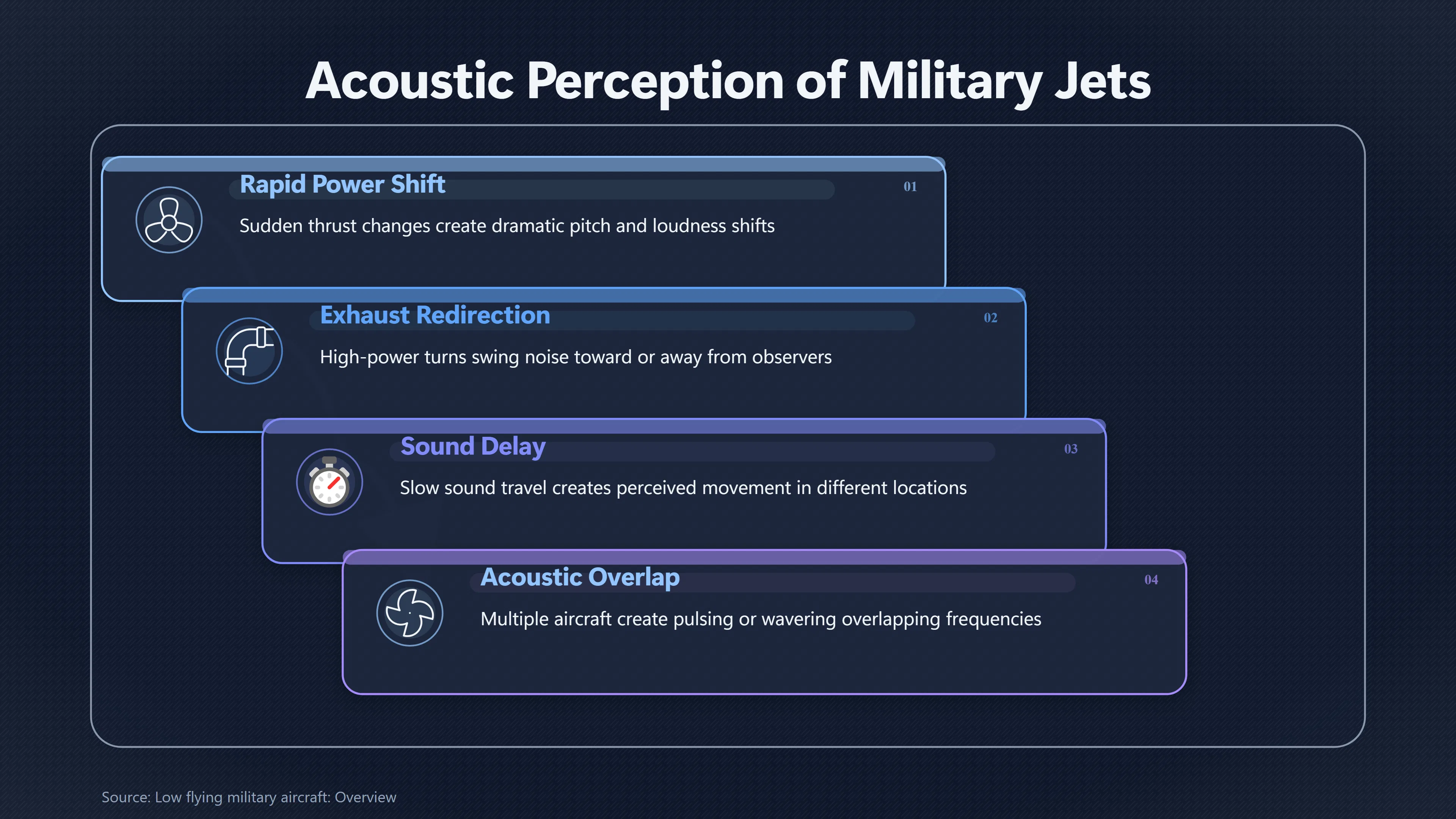
- Rapid climbs and descents change engine power quickly, creating dramatic shifts in pitch and loudness.
- High-power turns redirect engine exhaust and noise toward or away from observers, making the sound swell unexpectedly.
- Formation flying means multiple aircraft may be heard as one continuously changing source rather than several separate aircraft.
- Low-level navigation training brings aircraft much closer to listeners than commercial traffic, greatly increasing perceived loudness.
Because sound travels much more slowly than a fast-moving jet, witnesses may hear an aircraft after it has already moved elsewhere in the sky. The combination of delayed sound, changing engine settings and limited visual references can give the impression that an unknown object accelerated, hovered or changed direction when the aircraft was simply following a planned training profile.
Military authorities openly acknowledge that low-flying training is conducted because it is necessary to prepare crews for operational missions, including flights at altitudes far below those normally used by civil aviation.[GOV.UK]GOV.UKLow flying military aircraft: OverviewLow flying military aircraft: Overview
Why military aircraft sound different from passenger jets
Military aircraft often use engines at power settings rarely encountered on commercial flights.
For example, fighter aircraft may:
- accelerate aggressively after take-off;
- repeatedly increase and reduce thrust during exercises;
- remain at relatively low altitude for extended periods;
- perform training circuits that pass the same location several times.
These behaviours generate rapidly changing acoustic signatures rather than the steady engine noise typical of an airliner cruising overhead.
Helicopters used by military forces also contribute distinctive sounds. Heavy-lift helicopters produce deep rotor beats that carry over long distances, while attack or utility helicopters can generate rhythmic blade noise that changes dramatically with manoeuvring. When several aircraft operate together, overlapping frequencies can create unusual pulsing or “wavering” sounds that listeners may struggle to identify.
Why military silhouettes and lights are hard to identify
The sound alone rarely convinces people they have encountered something unusual. The uncertainty usually comes from the combination of unfamiliar noise and poor visual information.
Night operations reduce the visual clues that normally identify an aircraft:
- only one or two lights may be visible at long range;
- the aircraft’s outline often disappears against the night sky;
- dark camouflage colours make military aircraft especially difficult to see;
- viewing angle can hide wings or tail surfaces, leaving only a bright point of light.
Perspective further complicates matters. A fighter flying directly towards an observer may appear almost stationary despite approaching at high speed because its sideways motion is minimal from that viewpoint. If engine noise grows rapidly while the apparent movement remains slow, observers may conclude they are watching an unidentified object rather than an aircraft.
These visual limitations are one reason aviation experts caution against identifying aircraft solely from isolated lights seen at night.[AP News]apnews.comAP News Is that a drone or a plane?Experts help explain the differencesDecember 16, 2024 — Distinguishing drones from planes and helicopters can be challenging from a dista…
Why reports increase near military training areas
Many well-known UFO noise reports occur close to locations where military aviation is common.
Training areas differ from ordinary air routes because they may involve:
- repeated circuits over the same landscape;
- multiple aircraft arriving from different directions;
- temporary periods of unusually intense flying;
- exercises continuing into the evening or night.
People who live near these areas often become familiar with routine aircraft sounds. Visitors or residents experiencing an unusually busy training period, however, may encounter combinations of noise that seem entirely unfamiliar.
In the United Kingdom, for example, the Ministry of Defence publishes information explaining that low-flying military training occurs across designated areas and that Tactical Training Areas allow especially realistic low-level exercises during scheduled periods.[GOV.UK]GOV.UKMilitary low flyingMilitary low flying
Evidence to check near training areas
When an unexplained roaring or whining sound is reported, several practical checks can help determine whether military aviation is the most likely explanation.
Useful evidence includes:
- proximity to known military airfields or training routes;
- published low-flying or tactical training schedules where available;
- reports from nearby residents describing similar aircraft activity;
- weather conditions that may enhance or redirect sound;
- multiple independent witnesses describing conventional aircraft shortly afterwards.
It is also worth remembering that not every military aircraft appears on publicly accessible flight-tracking websites. Operational, training and security considerations mean some flights may have limited or delayed public tracking data, so the absence of an aircraft from a consumer flight-tracking service does not by itself demonstrate that an unidentified object was present. Aviation regulators likewise caution that consumer tracking platforms are not definitive evidence of an aircraft’s location.[Civil Aviation Authority]caa.co.ukOpen source on caa.co.uk.
Why military flights remain a persuasive explanation
Military aviation combines several characteristics that naturally generate convincing UFO noise reports: higher engine power, lower operating altitudes, rapid manoeuvres, formation flying and frequent night exercises. Each factor independently makes aircraft harder to recognise, while together they can create striking experiences in which loud, unfamiliar sounds seem disconnected from any visible aircraft.
This does not mean every unexplained report has a military origin. Rather, it explains why investigators routinely consider nearby military activity before concluding that an unusual noise requires an extraordinary explanation. In many cases, the combination of aircraft acoustics, night-time perception and realistic training operations provides a complete and evidence-based account of sounds that initially seemed mysterious.[GOV.UK]GOV.UKLow flying military aircraft: OverviewLow flying military aircraft: Overview
Amazon book picks
Further Reading
Books and field guides related to Why Military Aircraft Sound More Mysterious at Night. Use these as the next step if you want deeper reading beyond the article.
The Complete Book of Fighters
A unique work of aviation reference: authoritative descriptions of every fighter aircraft type which has flown to date Includes the devel...
Skunk Works
This classic history of America's high-stakes quest to dominate the skies is "a gripping technothriller in which the technology is real"...
Introduction to Flight
Noted for its highly readable style, the new edition of this bestseller provides an updated overview of aeronautical and aerospace engine...
eBay marketplace picks
Marketplace Samples
Live-tested eBay searches with available results related to this page.
Selected fromUFO disclosure print oneBay.co.uk.




Endnotes
1.
Source: GOV.UK
Title: Low flying military aircraft: Overview
Link:https://www.gov.uk/low-flying-in-your-area
2.
Source: GOV.UK
Title: Military low flying
Link:https://www.gov.uk/military-low-flying
3.
Source: GOV.UK
Title: Low flying military aircraft: Where and when low flying happens
Link:https://www.gov.uk/low-flying-in-your-area/where-and-when-low-flying-happens
4.
Source: GOV.UK
Title: www.gov.uk Military Aviation Noise Contours
Link:https://www.gov.uk/government/publications/military-aviation-noise-contours/military-aviation-noise-contours
Source snippet
Aviation Noise Contours - GOV.UKMay 15, 2026 — MILITARY AVIATION NOISE CONTOURS Updated 15 May 2026 [Button: Print this page] Image © Cro...
Published: May 15, 2026
5.
Source: GOV.UK
Title: the pattern of military low flying across the uk 20242025
Link:https://www.gov.uk/government/statistics/the-pattern-of-military-low-flying-across-the-uk-20242025/the-pattern-of-military-low-flying-across-the-uk-20242025
6.
Source: GOV.UK
Title: the pattern of military low flying across the uk 20232024
Link:https://www.gov.uk/government/statistics/the-pattern-of-military-low-flying-across-the-uk-20232024/the-pattern-of-military-low-flying-across-the-uk-20232024
7.
Source: GOV.UK
Title: www.gov.uk Low flying military aircraft: Find out about low flying in your area
Link:https://www.gov.uk/low-flying-in-your-area/find-out-about-low-flying-in-your-area
8.
Source: apnews.com
Title: AP News Is that a drone or a plane?
Link:https://apnews.com/article/57a0d051a2a94d21787089ceaf47b175
Source snippet
Experts help explain the differencesDecember 16, 2024 — Distinguishing [drones]({{ 'drones/' | relative_url }}) from planes and helicopters can be challenging from a dista...
Published: December 16, 2024
9.
Source: caa.co.uk
Link:https://www.caa.co.uk/about-us/make-a-report-or-complaint/report-something/report-a-potential-breach-of-aviation-law/
10.
Source: caa.co.uk
Link:https://www.caa.co.uk/about-us/make-a-report-or-complaint/make-a-complaint/[aircraft-noise
11.
Source: caa.co.uk
Link:https://www.caa.co.uk/environmental-sustainability/local-impacts/local-impacts-noise/
12.
Source: caa.co.uk
Link:https://www.caa.co.uk/about-us/make-a-report-or-complaint/make-a-complaint/
Additional References
13.
Source: faa.gov
Link:https://www.faa.gov/noise/inquiries
Source snippet
Noise Complaints & Inquiries | Federal Aviation AdministrationFebruary 20, 2026 — NOISE COMPLAINTS & INQUIRIES The FAA's mission is to en...
Published: February 20, 2026
14.
Source: denix.osd.mil
Title: * Home * Do D Noise Pr
Link:https://www.denix.osd.mil/dodnoise/understanding-community-and-environmental-noise/
Source snippet
Community and Environmental Noise – Department of Defense Noise ManagementJanuary 12, 2026 — DEPARTMENT OF DEFENSE NOISE MANAGEMENT Under...
Published: January 12, 2026
15.
Source: faa.gov
Link:https://www.faa.gov/air_traffic/publications/atpubs/aim_html/chap3_section_5.html
16.
Source: faa.gov
Link:https://www.faa.gov/air_traffic/publications/atpubs/so_html/chap_6.html
17.
Source: faa.gov
Link:https://www.faa.gov/air_traffic/publications/atpubs/so_html/chap6_section_1.html
18.
Source: faa.gov
Link:https://www.faa.gov/air_traffic/publications/atpubs/so_html/chap6_section_4.html
19.
Source: faa.gov
Link:https://www.faa.gov/air_traffic/publications/atpubs/so_html/chap6_section_8.html
20.
Source: faa.gov
Link:https://www.faa.gov/air_traffic/publications/atpubs/aip_html/part2_enr_section_5.2.html
21.
Source: youtube.com
Title: Listen To The Deafening Roar Of F-16 Jet Engine Full Afterburner
Link:https://www.youtube.com/watch?v=nuTrh5Hio5M
Source snippet
Mach Loop Wales: 3 Minutes of Low Level Military Jets...
22.
Source: youtube.com
Title: Why Fighter Jets Are So Much Louder Than Passenger Planes
Link:https://www.youtube.com/watch?v=rcB62t6vo5A
Source snippet
Pure F-15 Strike Eagle Low Level Flying Sounds Without Music...