Within Low Frequency
Why A Steady Hum Has No Clear Origin
Continuous narrow-band hums give the brain fewer clear timing landmarks than knocks, clicks or other sudden broadband sounds.
On this page
- Why sudden sounds provide stronger timing clues
- How narrow frequency bands create directional ambiguity
- Why background noise and echoes worsen continuous hums
Page outline Jump by section
Introduction
When people describe a mysterious “UFO hum” as coming from everywhere at once, the continuous nature of the sound is often as important as its low frequency. The human auditory system is generally much better at locating a brief knock, click or bang than an unbroken, narrow-band hum. Sudden sounds provide clear timing landmarks that allow the brain to compare what reaches each ear, whereas a steady tone offers far fewer distinct reference points. If that hum is also low in frequency, distant or reflected by buildings, directional information becomes even less reliable. Rather than indicating an unusual source, this combination of acoustic properties can make an ordinary sound seem detached from any obvious origin.[nih.gov]pubmed.ncbi.nlm.nih.govPub Med Auditory localization: a comprehensive practical reviewAuditory localization: a comprehensive practical review - PubMedJuly 10, 2024…
Why sudden sounds provide stronger timing clues
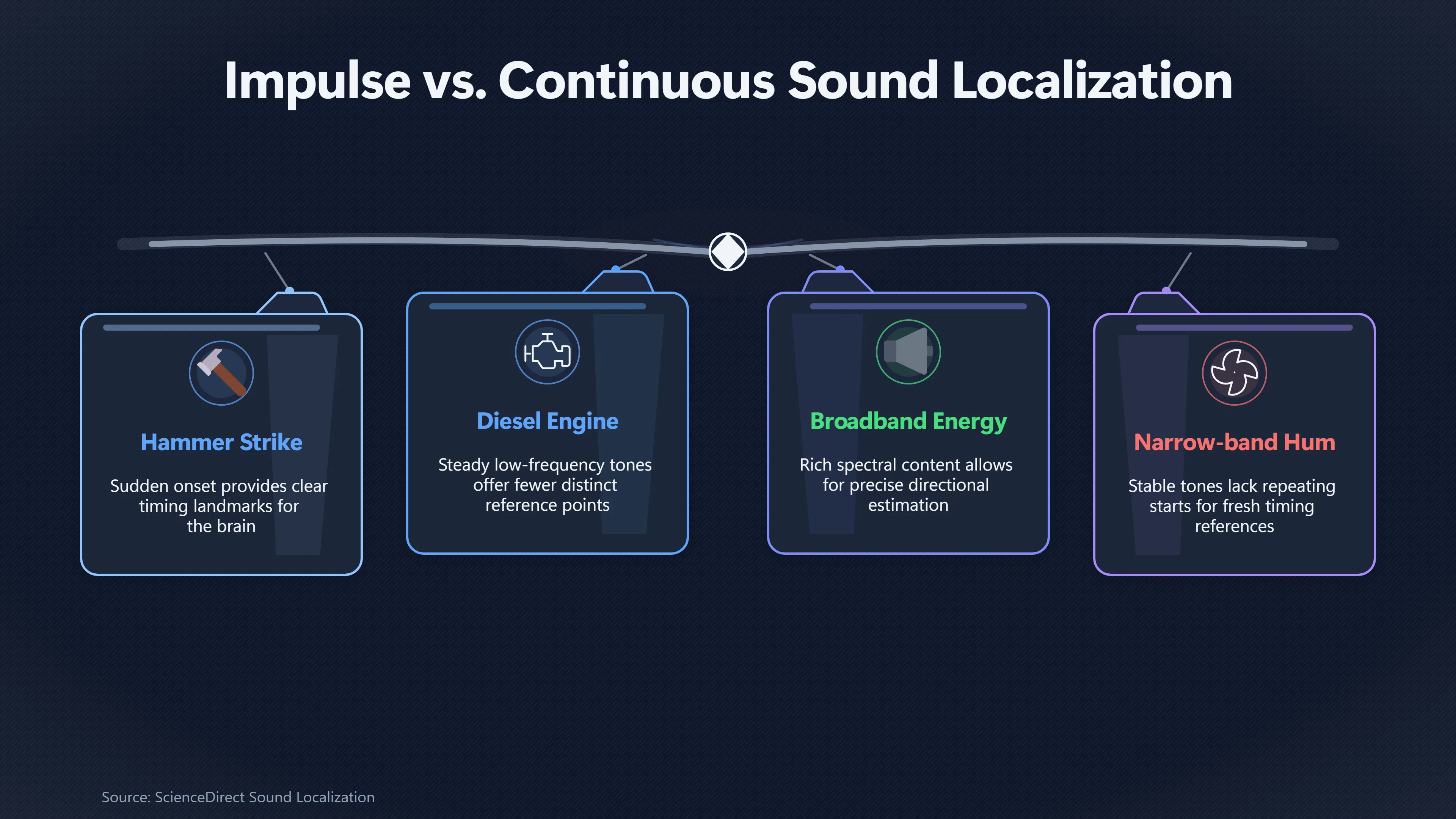
A short, broadband sound such as a hand clap, hammer strike or door slam contains a rapid onset and energy across many frequencies. Those features give the auditory system multiple independent cues to compare between the two ears. The brain can measure tiny differences in arrival time—known as interaural time differences (ITDs)—and combine them with loudness differences and frequency-dependent filtering caused by the head and outer ears to estimate direction with remarkable precision.[PubMed]pubmed.ncbi.nlm.nih.govPub Med Auditory localization: a comprehensive practical reviewAuditory localization: a comprehensive practical review - PubMedJuly 10, 2024…
A continuous hum is different. Once the sound has settled into a stable tone, there is no repeating “start” for the brain to use as a fresh timing reference. Instead, the auditory system must rely on the ongoing phase or fine structure of the waveform, which becomes more vulnerable to ambiguity, masking and reverberation. This does not mean continuous sounds cannot be localised, but they generally provide weaker spatial information than abrupt sounds containing rich spectral content.[PubMed Central (PMC)]pmc.ncbi.nlm.nih.govOpen source on nih.gov.
Historically, psychoacoustic experiments consistently showed that listeners identify the direction of clicks, impulses and broadband noise bursts more accurately than isolated pure tones. This distinction has become a cornerstone of modern auditory localisation research because it demonstrates that sound duration alone is not the deciding factor; the richness of the available timing and frequency cues is equally important.[PubMed]pubmed.ncbi.nlm.nih.govPub Med Auditory localization: a comprehensive practical reviewAuditory localization: a comprehensive practical review - PubMedJuly 10, 2024…
How narrow frequency bands create directional ambiguity
Many reported environmental hums are dominated by a relatively narrow range of low frequencies rather than a wide spectrum. That limits the amount of directional information reaching the brain.
Several mechanisms contribute:
- Few independent localisation cues: A narrow-band tone contains much less spectral information than broadband sound, reducing opportunities for the brain to cross-check direction.
- Phase ambiguity: Pure or nearly pure tones can produce similar phase relationships at more than one possible source direction, making some positions difficult to distinguish.
- Minimal head shadow: At low frequencies, long wavelengths bend around the head, so both ears receive nearly the same sound level, weakening interaural level differences.
- Reduced spectral shaping: High-frequency components normally interact with the folds of the outer ear, helping distinguish front from back and above from below. A low, narrow-band hum lacks much of this information.[nih.gov]pmc.ncbi.nlm.nih.govPub Med Central (PMC)Auditory localization: a comprehensive practical reviewPubMed Central (PMC)Auditory localization: a comprehensive practical review - PMC…
The result is not complete loss of localisation but greater uncertainty. Listeners may know that a hum is present without confidently identifying whether it originates ahead, behind, above or from one side.
Why background noise and echoes worsen continuous hums
Real environments rarely contain only one sound. Wind, traffic, ventilation systems and other background noises partially mask steady tones, making already subtle localisation cues even harder to detect.
Reflections further complicate the problem. Indoors, walls, ceilings and floors create multiple delayed copies of the original sound. Outdoors, large buildings, hillsides or other structures can produce similar reflections. Because a continuous hum never truly stops, these reflected waves overlap with the direct sound instead of arriving as clearly separated events. The auditory system must interpret a constantly changing mixture rather than one clean directional signal.[PubMed Central (PMC)]pmc.ncbi.nlm.nih.govOpen source on nih.gov.
Research on binaural hearing has shown that reduced interaural coherence—the similarity of what reaches each ear after reflections—degrades sensitivity to timing cues. As coherence falls, listeners become less certain about source direction even when the sound itself remains audible.[PubMed Central (PMC)]pmc.ncbi.nlm.nih.govOpen source on nih.gov.
This helps explain why a distant industrial hum or large ventilation system may seem to “fill the air” instead of pointing back to a single building.
Why pulses often reveal a source that hums conceal
A useful comparison is the difference between hearing an idling diesel engine and hearing a hammer striking metal nearby.
The engine produces a largely continuous low-frequency sound. Even if it is loud, the listener may struggle to judge its exact location because the signal changes slowly over time and contains relatively weak localisation cues.
A hammer strike, by contrast, generates:
- a sudden onset,
- broadband energy extending into higher frequencies,
- distinct timing information,
- and a short duration that separates the direct sound from later echoes.[sciencedirect.com]sciencedirect.comScienceDirect Sound LocalizationSound Localization - an overview | ScienceDirect Topics…
These characteristics allow the auditory system to identify the source far more accurately, often within a few degrees under favourable conditions.[nih.gov]pubmed.ncbi.nlm.nih.govPub Med Auditory localization: a comprehensive practical reviewAuditory localization: a comprehensive practical review - PubMedJuly 10, 2024…
Why this matters when interpreting reported UFO hums
Many reports of unexplained aerial hums describe a sound that appears stationary, overhead or impossible to trace. The acoustic properties of a continuous, low-frequency hum provide a well-established explanation for why such impressions occur without requiring an unusual source.
When a sound is steady instead of impulsive, dominated by a narrow low-frequency band instead of broad frequencies, and further degraded by distance, background noise or reflections, the auditory system loses many of the cues it normally uses to determine direction. In those circumstances, the sound may genuinely seem to come from everywhere at once even though it originates from an ordinary terrestrial source.[nih.gov]pubmed.ncbi.nlm.nih.govPub Med Auditory localization: a comprehensive practical reviewAuditory localization: a comprehensive practical review - PubMedJuly 10, 2024…
Amazon book picks
Further Reading
Books and field guides related to Why A Steady Hum Has No Clear Origin. Use these as the next step if you want deeper reading beyond the article.
The Sound Book
A professor of acoustic engineering provides a tour of the world's most amazing sound phenomena, including creaking glaciers, whispering...
An Introduction to the Psychology of Hearing
Now available in a Fourth Edition, Introduction to the Psychology of Hearing is the leading textbook in the field of auditory perception-...
The Universal Sense
A surprising, entertaining book about how what we hear with our ears affects what's between them.
Why You Hear What You Hear
Why You Hear What You Hear is the first book on the physics of sound for the nonspecialist to empower readers with a hands-on, ears-open...
eBay marketplace picks
Marketplace Samples
Live-tested eBay searches with available results related to this page.
Selected fromUFO poster oneBay.co.uk.

Current eBay listing
I Want To Believe UFO Poster Giclée Fine Art Heavyweight Print


Current eBay listing
VINTAGE UFO FLYING SAUCERS COMIC ADVERTISING A2 POSTER PRINT

Endnotes
1.
Source: journals.plos.org
Link:https://journals.plos.org/plosone/article?id=10.1371%2Fjournal.pone.0089033
Source snippet
Modelling of Human Low Frequency Sound Localization Acuity Demonstrates Dominance of Spatial Variation of Interaural Time Difference...
2.
Source: sciencedirect.com
Title: ScienceDirect Sound Localization
Link:https://www.sciencedirect.com/topics/social-sciences/sound-localization
Source snippet
Sound Localization - an overview | ScienceDirect Topics...
3.
Source: nature.com
Link:https://www.nature.com/articles/s41562-021-01244-z
4.
Source: sciencedirect.com
Title: Sound Localization
Link:https://www.sciencedirect.com/topics/medicine-and-dentistry/sound-localization
5.
Source: sciencedirect.com
Link:https://www.sciencedirect.com/science/article/pii/S0378595515000258
6.
Source: nature.com
Link:https://www.nature.com/articles/nrn1136
7.
Source: pubmed.ncbi.nlm.nih.gov
Title: Pub Med Auditory localization: a comprehensive practical review
Link:https://pubmed.ncbi.nlm.nih.gov/39049946/
Source snippet
Auditory localization: a comprehensive practical review - PubMedJuly 10, 2024...
Published: July 10, 2024
8.
Source: pmc.ncbi.nlm.nih.gov
Title: Pub Med Central (PMC)Auditory localization: a comprehensive practical review
Link:https://pmc.ncbi.nlm.nih.gov/articles/PMC11267622/
Source snippet
PubMed Central (PMC)Auditory localization: a comprehensive practical review - PMC...
9.
Source: pmc.ncbi.nlm.nih.gov
Link:https://pmc.ncbi.nlm.nih.gov/articles/PMC8667050/
Source snippet
PubMed Central (PMC)Interaural-time-difference thresholds for broad band-limited pulses are affected by relative bandwidth not temporal e...
10.
Source: pmc.ncbi.nlm.nih.gov
Link:https://pmc.ncbi.nlm.nih.gov/articles/PMC3003727/
11.
Source: pubmed.ncbi.nlm.nih.gov
Link:https://pubmed.ncbi.nlm.nih.gov/26827002/
12.
Source: pubmed.ncbi.nlm.nih.gov
Link:https://pubmed.ncbi.nlm.nih.gov/3552112/
13.
Source: pubmed.ncbi.nlm.nih.gov
Link:https://pubmed.ncbi.nlm.nih.gov/2018391/
14.
Source: pubmed.ncbi.nlm.nih.gov
Link:https://pubmed.ncbi.nlm.nih.gov/25726265/
Additional References
15.
Source: eneuro.org
Link:https://www.eneuro.org/content/13/4/ENEURO.0342-25.2026
Source snippet
Neural and Behavioral Correlates of Evidence Accumulation in Human Click-Based Echolocation | eNeuroApril 6, 2026 — * EEG * evidence accu...
Published: April 6, 2026
16.
Source: orbit.dtu.dk
Link:https://orbit.dtu.dk/en/publications/localization-of-broadband-sounds-carrying-interaural-time-differe/
Source snippet
Welcome to DTU Research DatabaseLocalization of broadband sounds carrying interaural time differences: Effects of frequency, reference lo...
17.
Source: frontiersin.org
Title: Frontiers | Auditory localization: a comprehensive practical review
Link:https://www.frontiersin.org/journals/psychology/articles/10.3389/fpsyg.2024.1408073/full
Source snippet
Psychol., 10 July 2024 Sec. Auditory Cognitive Neuroscience Volume 15 - 2024 | [https://doi.org/10.3389/fpsyg.2024.1408073](https://doi.org/10.3389/fpsyg.2024.1408073) Published in Fr...
Published: July 2024
18.
Source: youtube.com
Title: Sound Localization, Pitch, Timbre, and Loudness
Link:https://www.youtube.com/watch?v=pTe0A8ZOAGk
Source snippet
How we locate sounds sound localization ITD ILD Where is Sound Coming From? | How Humans Use Sound LOCALIZATION Doctor Cliff, AuD...
19.
Source: youtube.com
Title: Where is Sound Coming From? | How Humans Use Sound LOCALIZATION
Link:https://www.youtube.com/watch?v=dnDrAG8FZok
Source snippet
Auditory Localization and the Precedence Effect...
20.
Source: researchers.mq.edu.au
Link:https://researchers.mq.edu.au/en/publications/localization-of-broadband-sounds-carrying-interaural-time-differe
22.
Source: youtube.com
Title: How Your Brain Uses Sound to Map Space
Link:https://www.youtube.com/watch?v=zhFUTtuOKI4
Source snippet
Sound Localization, Pitch, Timbre, and Loudness...
23.
Source: pure.psu.edu
Title: lateralization of low frequency tones and narrow bands of noise
Link:https://pure.psu.edu/en/publications/lateralization-of-low-frequency-tones-and-narrow-bands-of-noise/
24.
Source: youtube.com
Title: Auditory Localization and the Precedence Effect
Link:https://www.youtube.com/watch?v=xCGt0BfdGu8
Source snippet
sound localization...