Within UFO Noises
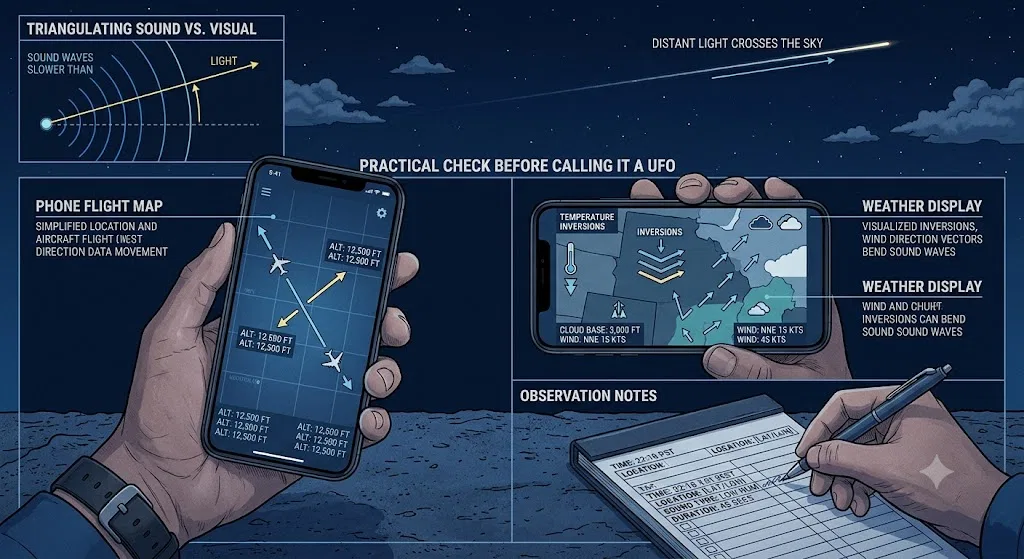
A Practical Check Before Calling It a UFO
Aircraft trackers, weather records, local activity, and witness locations can narrow the source of a strange sound before speculation begins.
On this page
- Check aircraft, drones, and helicopters
- Review weather and local activity
- Compare timing across multiple locations
Page outline Jump by section
Introduction
When an unusual sound overhead is associated with a suspected UFO, the most useful first step is to rule out ordinary explanations before considering extraordinary ones. Most reports of unexplained humming, booming, buzzing or roaring can be investigated using publicly available information, including aircraft tracking data, weather records, local activity reports and observations from other locations. This approach does not assume that every unusual sound has a simple explanation, but it helps separate genuinely unexplained events from those caused by aircraft, helicopters, drones, atmospheric conditions or nearby industrial activity. A careful, evidence-based check is often more informative than relying on memory or first impressions.
Check Aircraft, Drones and Helicopters First
Aircraft are among the most common sources of unexpected overhead noise, particularly at night or in poor visibility when the sound is heard before the aircraft is seen.
Flight-tracking services can show whether a commercial aircraft, business jet or many general aviation flights were overhead at the relevant time. Most modern aircraft broadcast their position using Automatic Dependent Surveillance–Broadcast (ADS-B), allowing websites and mobile apps to reconstruct their flight path in near real time.[Flightradar24]flightradar24.comAutomatic Dependent SurveillanceAutomatic Dependent Surveillance - Broadcast (ADS-B) | Flightradar24…
When comparing a flight track with a reported sound, note:
- The exact time the sound began and ended.
- The observer’s location.
- The aircraft’s altitude and direction of travel.
- Whether the sound continued after the aircraft had passed.
A delay between seeing an aircraft and hearing it is normal because sound travels much more slowly than light. High-altitude jets may be several kilometres beyond the point directly overhead before their noise reaches an observer.
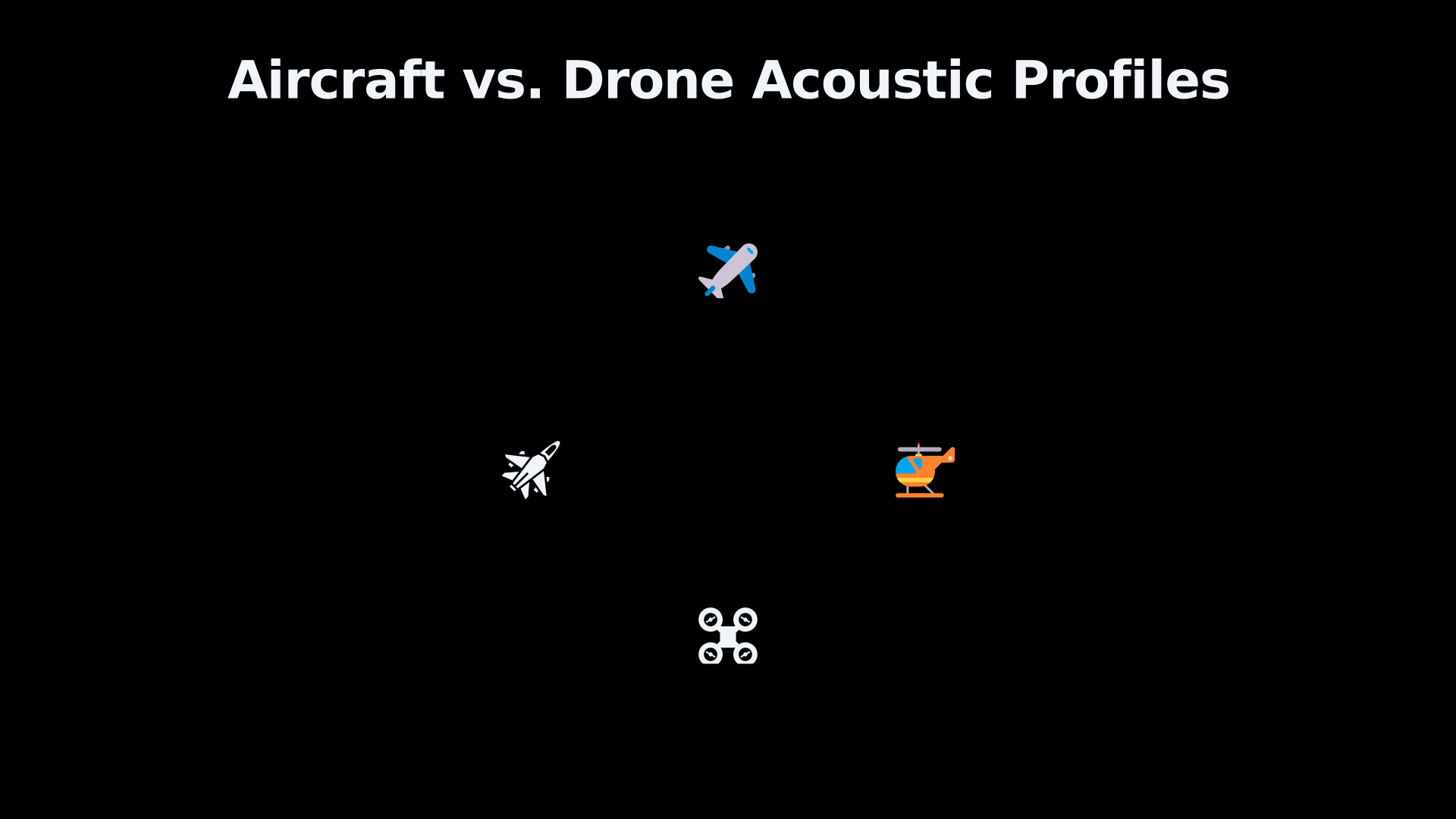
Helicopters deserve separate attention because they can hover, circle or fly slowly while producing distinctive low-frequency rotor noise that may seem difficult to locate. Air ambulances, police helicopters, military training flights and utility inspections can all generate prolonged sounds that unfamiliar listeners may interpret as unusual.
It is also important to recognise the limits of flight trackers. Not every aircraft appears on every service. Some military flights, older aircraft, aircraft with disabled or unavailable transponders, and some low-level operations may be absent or only partially tracked. A missing aircraft on one website should therefore not be treated as proof that no aircraft was present.[support.adsbexchange.com]support.adsbexchange.comMay 19, 2025…
Drones present a different challenge. Consumer drones usually operate at much lower altitudes and produce a high-pitched buzzing sound rather than a deep hum. They are often difficult to see at dusk or night, particularly when flying against a dark background. In many countries there is no universally accessible public tracker showing every drone flight, so visual observation and local context remain important.

Review Weather and Local Activity
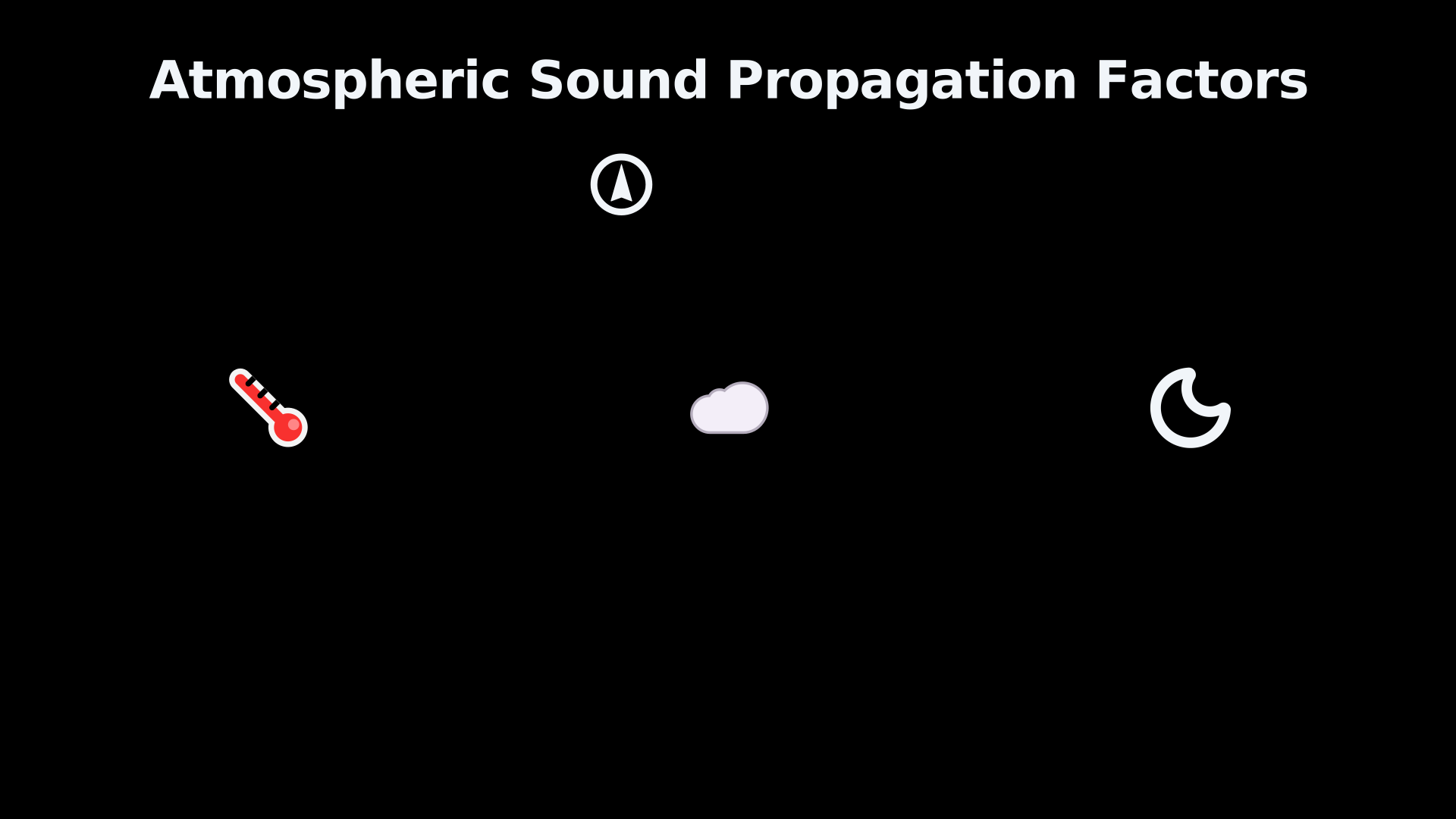
Atmospheric conditions can significantly alter how sound travels. Temperature inversions, wind direction and humidity may allow distant noises to carry much farther than expected while making their apparent direction difficult to judge.
For example:
- Wind can carry aircraft or industrial noise well beyond its usual range.
- Temperature inversions may refract sound back towards the ground, making distant sources seem surprisingly close.
- Calm night-time conditions reduce background noise, allowing faint mechanical sounds to become much more noticeable.
- Low cloud can reflect sound, creating the impression that it originates directly overhead rather than from the horizon.[arXiv]arxiv.orgObservational Evidence for Wind-Driven Low-Pass Filtering of Infrasound at Short RangeJanuary 31, 2026…
Checking historical weather records for the date and time of an event can therefore provide valuable context. Wind speed, wind direction and cloud cover often explain why a familiar source sounded unfamiliar.
Local activity should also be considered. Possible sources include:
- Construction work.
- Quarry blasting.
- Railway traffic.
- Industrial plants.
- Large ventilation systems.
- Agricultural machinery.
- Sporting events or concerts using sound systems.
- Fireworks or ceremonial displays.
These activities may not be visible from the observer’s location but can still produce sounds that travel considerable distances under favourable atmospheric conditions.
Compare Timing Across Multiple Locations
One witness can accurately report what they experienced, but multiple independent observations provide a stronger basis for identifying a sound’s origin.
If several people in neighbouring areas report hearing the same noise, compare:
- The reported time.
- The apparent direction.
- The duration.
- Whether the sound changed pitch or intensity.
- Whether it appeared stationary or moving.
A moving aircraft generally produces reports that progress across locations in a predictable sequence. By contrast, a fixed industrial source affected by wind may be heard over a broad area simultaneously.
Social media posts, neighbourhood forums and local community groups can sometimes reveal whether many people heard the same sound. These reports should be treated cautiously because later accounts may be influenced by earlier descriptions, but independently timed posts can help establish whether an event was widespread.
Record the Details Before Memory Changes
Witness memory naturally changes over time, especially after discussion or media coverage. Recording observations immediately makes later comparison much more reliable.
Useful details include:
- Date and exact time.
- Precise location.
- Weather conditions.
- Estimated direction.
- Duration.
- Whether the sound rose or fell in pitch.
- Whether any lights or aircraft were visible.
- Whether nearby animals reacted.
Even simple smartphone recordings can provide objective evidence for later analysis, although many phone microphones reduce low-frequency sounds automatically and may not reproduce what the listener actually heard.
Common Misidentifications
Several ordinary sources repeatedly appear in reports initially described as mysterious overhead noises:
- High-altitude jet traffic: Deep rumbling may arrive long after the aircraft passes overhead.
- Helicopters: Rotor beats can echo and appear to come from unexpected directions.
- Drones: High-frequency buzzing may seem unusually loud when flying nearby at night.
- Military exercises: Fast jets, transport aircraft and helicopters often operate outside familiar commercial routes and may not always be visible on public trackers.
- Industrial equipment: Compressors, turbines and ventilation systems can create persistent humming that varies with wind conditions.
- Atmospheric acoustics: Temperature inversions and changing winds can make distant sources appear local or overhead.[flightradar24.com]flightradar24.comHow Flightradar24 works | Flightradar24How Flightradar24 works | Flightradar24…
These explanations account for many reports without implying that every unusual sound will always receive a definitive identification.
A Practical Decision Path
When confronted with a genuinely unusual overhead sound, a systematic approach is more reliable than immediate speculation.
- Record the exact time and location.
- Check aircraft tracking services for nearby flights, remembering that not every aircraft will appear.
- Consider helicopters, local airports and known flight paths.
- Review weather conditions, particularly wind direction and cloud cover.
- Look for reports of nearby industrial work, construction, events or military activity.
- Compare observations with independent witnesses in surrounding locations.
- Assess whether the available evidence consistently supports an ordinary source before concluding that the event remains unexplained.
Following these steps does not guarantee an identification, but it substantially reduces the likelihood of mistaking a familiar overhead activity or an atmospheric acoustic effect for an extraordinary aerial phenomenon.
Amazon book picks
Further Reading
Books and field guides related to A Practical Check Before Calling It a UFO. Use these as the next step if you want deeper reading beyond the article.
The UFO Experience: A Scientific Inquiry
Cited by the New York Review of Books as "the best brief for visitation," this classic study presents an analysis of UFO reports and conc...
The Report on Unidentified Flying Objects
The Report on Unidentified Flying Objects is a book by Edward J. Ruppelt which described the study of UFOs by United States Air Force fro...
UFOs: The Public Deceived
"For much too long, the public has been misled by half-truths, by cover-ups, and by outright falsehoods . . . It is time to talk sense to...
The Demon-Haunted World: Science as a Candle in the Dark
NEW YORK TIMES BESTSELLER • From the renowned astronomer and author of Cosmos comes a “powerful [and] stirring defense of informed ration...
eBay marketplace picks
Marketplace Samples
Live-tested eBay searches with available results related to this page.
Selected fromaircraft model oneBay.co.uk.

Endnotes
1.
Source: flightradar24.com
Title: Automatic Dependent Surveillance
Link:https://www.flightradar24.com/how-it-works/ads-b
Source snippet
Automatic Dependent Surveillance - Broadcast (ADS-B) | Flightradar24...
2.
Source: support.adsbexchange.com
Link:https://support.adsbexchange.com/hc/en-us/articles/36733937229837-Why-Can-t-I-See-a-Specific-Aircraft-or-Aircraft-in-a-Certain-Area
Source snippet
May 19, 2025...
Published: May 19, 2025
3.
Source: flightradar24.com
Title: How Flightradar24 works | Flightradar24
Link:https://www.flightradar24.com/how-it-works
Source snippet
How Flightradar24 works | Flightradar24...
4.
Source: arxiv.org
Link:https://arxiv.org/abs/2602.00421
Source snippet
Observational Evidence for Wind-Driven Low-Pass Filtering of Infrasound at Short RangeJanuary 31, 2026...
Published: January 31, 2026
5.
Source: arxiv.org
Link:https://arxiv.org/abs/2004.07972
6.
Source: support.adsbexchange.com
Title: 44653064937741 Map Help
Link:https://support.adsbexchange.com/hc/en-us/articles/44653064937741-Map-Help
7.
Source: support.adsbexchange.com
Title: 36737581489037 How Can My Aircraft Be Removed From the ADS B Exchange Website
Link:https://support.adsbexchange.com/hc/en-us/articles/36737581489037-How-Can-My-Aircraft-Be-Removed-From-the-ADS-B-Exchange-Website
8.
Source: support.adsbexchange.com
Link:https://support.adsbexchange.com/hc/en-us/articles/37363784987405-Is-there-any-way-to-get-my-flight-aircraft-removed-from-your-website
9.
Source: flightradar24.com
Title: How does Flightradar24 track aircraft? | Flightradar24 Blog
Link:https://www.flightradar24.com/blog/inside-flightradar24/how-does-fr24-track-aircraft/
10.
Source: free.flightradar24.com
Link:https://free.flightradar24.com/how-it-works/ads-b
11.
Source: free.flightradar24.com
Link:https://free.flightradar24.com/glossary
12.
Source: deploy-test.flightradar24.com
Title: apply for receiver
Link:https://deploy-test.flightradar24.com/apply-for-receiver
13.
Source: forecast.weather.gov
Link:https://forecast.weather.gov/glossary.php?word=propagation
14.
Source: marine.weather.gov
Link:https://marine.weather.gov/glossary.php?word=inversion
15.
Source: weather.gov
Title: NW S Jet Stream
Link:https://www.weather.gov/source/zhu/ZHU_Training_Page/lightning_stuff/lightning2/thunder.html
16.
Source: forecast.weather.gov
Link:https://forecast.weather.gov/glossary.php?word=Sounding
Additional References
17.
Source: faa.gov
Title: FA A General Statements | Federal Aviation Administration
Link:https://www.faa.gov/newsroom/statements/general-statements
Source snippet
This AD affects 158 U.S.-registered airplanes and 737 airplanes worldwide. Drones Safely integrating drones into the National Airspace S...
18.
Source: ufouap.net
Title: It is a structured record of time, p
Link:https://www.ufouap.net/en/explainers/how-to-report-a-ufo-sighting
Source snippet
How to Report a UFO or UAP Sighting | Global UFO ArchiveJuly 23, 2026 — Reporting / Updated 2026-07-23 / 10 min read HOW TO REPORT A UFO...
Published: July 23, 2026
19.
Source: youtube.com
Title: How to Track Filtered Aircraft with ADS-B Exchange
Link:https://www.youtube.com/watch?v=KahiBjBmgrc
Source snippet
This video collection provides practical tutorials on using tools like Flightradar24 and ADS-B Exchange to track aircraft overhead and id...
20.
Source: ufouap.net
Title: Drone, Balloon or Satellite?
Link:https://www.ufouap.net/en/explainers/drones-[balloons
Source snippet
UFO Guide | Global UFO ArchiveJuly 16, 2026 — Evidence / Updated 2026-07-16 / 10 min read DRONES, BALLOONS, SATELLITES, AND UFO REPORTS...
Published: July 16, 2026
21.
Source: faa.gov
Link:https://www.faa.gov/air_traffic/publications/atpubs/atc_html/chap2_section_6.html
22.
Source: faa.gov
Link:https://www.faa.gov/air_traffic/publications/atpubs/aim_html/chap4_section_5.html
23.
Source: faa.gov
Link:https://www.faa.gov/air_traffic/publications/atpubs/fs_html/chap4_section_3.html
24.
Source: faa.gov
Link:https://www.faa.gov/air_traffic/publications/atpubs/fs_html/chap4_section_4.html
25.
Source: faa.gov
Link:https://www.faa.gov/air_traffic/publications/atpubs/fs_html/chap8_section_1.html
26.
Source: usgs.gov
Link:https://www.usgs.gov/programs/earthquake-hazards/sonic-booms