Within Identify Sources
Which Ground Activities Can Sound Like UFOs?
Construction, railways, quarries, events and industrial systems can create distant sounds that seem aerial under favorable conditions.
On this page
- Matching sound types to local activities
- Finding permits, notices and event schedules
- Using wind and terrain to test a source
Page outline Jump by section
Introduction
Many reports of mysterious booms, rumbles and persistent humming that seem to come from the sky are ultimately traced to ordinary activity on the ground. Distance, darkness, wind, terrain and atmospheric conditions can make familiar sources appear to be overhead, especially when the sound itself is heard more clearly than its origin can be seen. Before treating an unexplained noise as evidence of something unusual, it is worth checking whether construction, rail operations, quarry blasting, industrial machinery or large public events were taking place within several kilometres—or sometimes much farther away. Sound can travel unexpectedly well under certain conditions, and low-frequency noise is particularly difficult for people to locate accurately.[gov.uk]GOV.UKNoise and vibration management: environmental permits23, 2021…

Which Ground Activities Can Sound Like UFOs?
The most common sources differ in the type of sound they produce. Matching the character of the noise with likely local activity is often more productive than searching for visual explanations.
Sound reportedCommon ground sourceTypical cluesSingle deep boomQuarry or mining blast, demolition, sonic industrial processOccurs during working hours, sometimes felt as vibrationRepeated boomingBlasting programme, heavy pile driving, military training nearbyRegular intervals over minutes or hoursContinuous low humFactories, power infrastructure, ventilation systems, pumping stationsStrongest at night or during calm weatherRhythmic rumbleFreight trains, rail maintenance, heavy road trafficBuilds and fades, sometimes accompanied by vibrationLow roaring overheadLarge industrial fans, cooling towers, motorway traffic carried by windAppears directionless during temperature inversionsPulsing mechanical droneConstruction cranes, compressors, generatorsOften begins and ends with work shifts
Low-frequency sounds deserve particular attention because human hearing is poor at determining their direction. A distant industrial fan or train can therefore appear to be directly above an observer, especially if reflections from clouds or nearby buildings obscure the true origin.[GOV.UK]GOV.UKNoise and vibration management: environmental permits23, 2021…
Matching Sound Types to Local Activities
Construction and infrastructure work
Large construction projects generate many sounds that can seem unfamiliar outside normal working areas. Pile driving produces sharp impacts, while tunnelling equipment, compressors and generators create continuous mechanical hums. Bridge works, road resurfacing and concrete pumping can continue after dark in urban areas to reduce disruption to daytime traffic.
Useful indicators include:
- Recently installed roadworks.
- Crane lighting visible at night.
- Temporary traffic diversions.
- Public notices about overnight engineering work.
Many local councils publish advance notices for major infrastructure projects, particularly where overnight work is expected.
Railways
Railways produce a wider variety of sounds than many people realise. Freight trains create long-duration low-frequency rumbling that can carry considerable distances. Curved track can generate wheel squeal, while maintenance grinding, ballast tamping and engineering trains often operate overnight when passenger services are reduced.
Wind direction and atmospheric conditions may make trains audible from several kilometres away while hiding the tracks themselves behind hills or buildings. Federal Railroad Administration guidance notes that railway sound propagation depends on distance, ground conditions and atmospheric effects, all of which influence how loud or directional a train appears.[Railroad Administration]railroads.dot.govRailroad Administration Guidance on Assessing Noise and Vibration Impacts | FRARailroad Administration Guidance on Assessing Noise and Vibration Impacts | FRA
Quarries and blasting
Quarry blasting frequently produces reports of unexplained booms because the visible explosion is usually hidden behind terrain or occurs many kilometres away. Depending on local geology, observers may experience both airborne sound and ground vibration.
In many jurisdictions, blasting follows published schedules or permit conditions, with regular daytime operating windows except under approved special circumstances. Checking quarry operator announcements or regulatory notices can quickly determine whether blasting coincided with the reported event.[Legal Information Institute]law.cornell.eduLegal Information Institute30 CFR § 816.64Use of explosives: Blasting schedule. | Electronic Code of Federal Regulations (e-CFR) | US Law | LII / Legal Information InstituteNovemb…
Industrial facilities
Factories, refineries, wastewater treatment plants and distribution centres often operate continuously. Cooling systems, extraction fans, refrigeration equipment and pumps can create persistent humming that becomes much more noticeable after sunset when background traffic declines.
Some industrial sounds vary with production cycles, meaning the hum may begin suddenly, continue for several hours and then disappear without any obvious explanation to nearby residents.
Finding Permits, Notices and Event Schedules
Many seemingly mysterious sounds can be investigated using publicly available information before assuming an unknown source.
Useful places to check include:
- Local council planning and construction notices.
- Highway authority announcements about overnight roadworks.
- Railway engineering possession schedules where publicly available.
- Quarry operator websites or mining authority announcements.
- Environmental permit registers for major industrial facilities.
- Stadium, concert venue and festival event calendars.
- Firework display announcements during holidays or local celebrations.
Environmental permitting systems in several countries require industrial operators to assess and manage noise impacts, and significant facilities may publish or provide information about expected noisy operations.[GOV.UK]GOV.UKNoise and vibration management: environmental permits23, 2021…
Large concerts also deserve consideration. Powerful sound systems, particularly those emphasising bass frequencies, can produce distant low-frequency pulses that travel farther than speech or music at higher frequencies. Under favourable weather conditions these bass components may be audible long after the rest of the performance is inaudible.
Using Wind and Terrain to Test a Source
One practical way to investigate an unusual sound is to determine whether weather conditions favour long-distance sound propagation.
Questions worth asking include:
- Was the wind blowing from a known industrial area towards the observation point?
- Did the sound become louder after sunset?
- Was there low cloud, fog or a temperature inversion?
- Are there valleys, water surfaces or open farmland between the suspected source and the observer?
These conditions can refract or reflect sound, making distant machinery seem both louder and closer than expected. Environmental noise assessment guidance recommends considering propagation conditions because weather significantly alters how sound reaches listeners.[GOV.UK]GOV.UKNoise and vibration management: environmental permitsNoise and vibration management: environmental permits
Terrain can also produce misleading impressions. Hills may block direct sight of a quarry while allowing sound to pass over the ridge. Urban streets can channel low-frequency noise between buildings, making it appear to descend vertically.
A Practical Time-Window Investigation
When investigating a reported boom or persistent hum, work through the relevant time window rather than relying on memory alone.
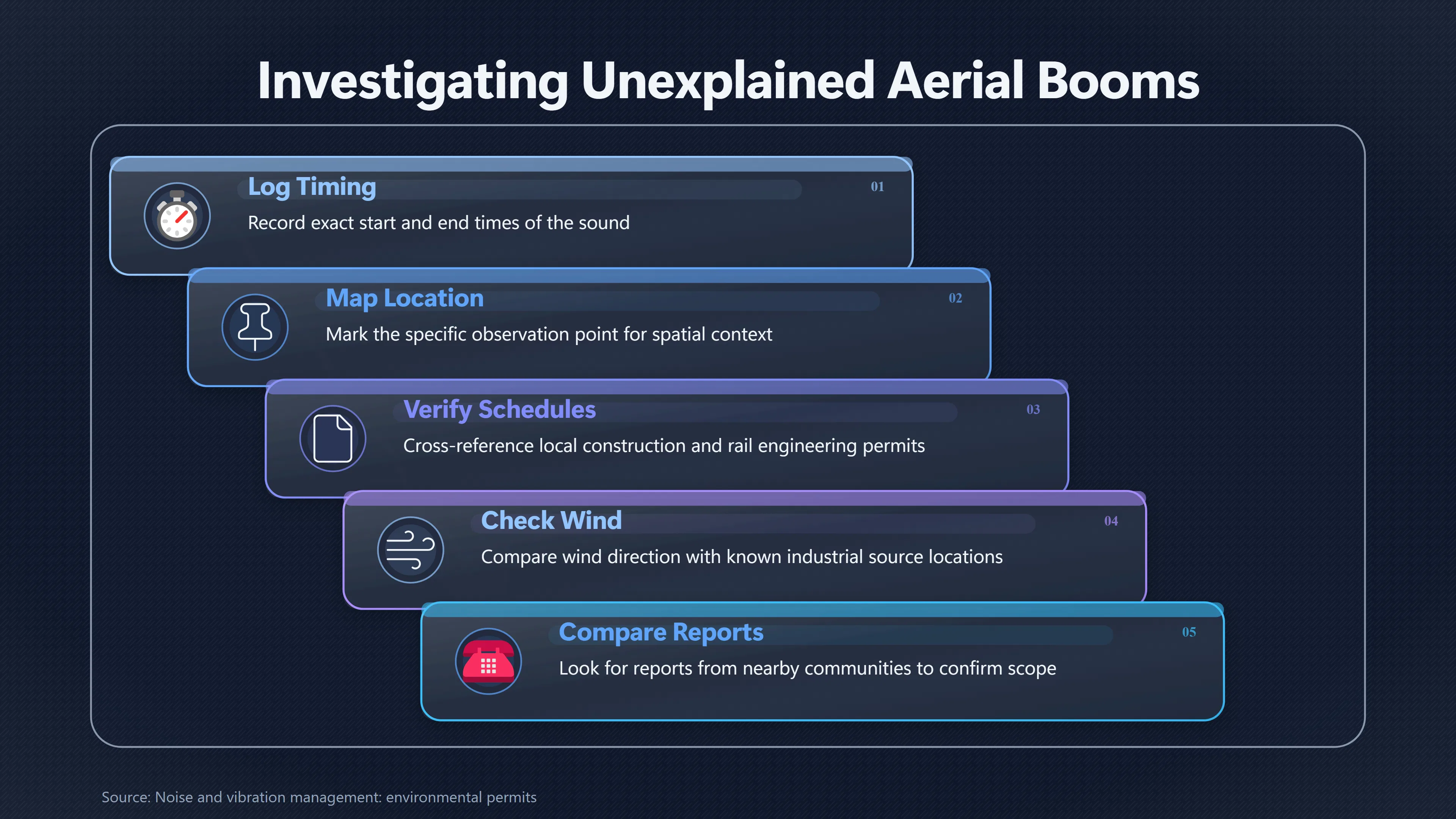
- Record the exact start and end times as accurately as possible.
- Mark the observation location.
- Check whether construction, rail engineering, blasting or public events were scheduled during that period.
- Compare wind direction with the location of possible sources.
- Look for reports from nearby communities rather than only immediate neighbours.
Independent reports from several locations often help distinguish a widespread environmental sound from one confined to a single building or neighbourhood.
Common Pitfalls
Several mistakes frequently lead people to overestimate the mystery of an unusual sound:
- Assuming “overhead” means airborne rather than simply difficult to locate.
- Ignoring sources beyond the visible horizon.
- Forgetting that sound arrival can be delayed or redirected by atmospheric conditions.
- Checking only commercial aircraft while overlooking rail engineering, industrial operations or quarry blasting.
- Assuming a lack of visible lights or structures rules out an ordinary source.
In many investigations, the decisive clue is not the sound itself but its timing. A hum that appears only during overnight rail maintenance, or a boom that consistently matches quarry blasting schedules, provides a much stronger explanation than impressions about where the sound seemed to originate.
Amazon book picks
Further Reading
Books and field guides related to Which Ground Activities Can Sound Like UFOs?. Use these as the next step if you want deeper reading beyond the article.
The Sound Book: The Science of the Sonic Wonders of the World
A professor of acoustic engineering provides a tour of the world's most amazing sound phenomena, including creaking glaciers, whispering...
Master Handbook of Acoustics
Practical Instruction on the Art and Science of Acoustic Design and Architecture Build your own acoustic environments such as recording s...
Environmental Noise Pollution: Noise Mapping, Public Health,...
Environmental Noise Pollution, Second Edition, addresses the key debates surrounding environmental noise pollution, its modelling and mit...
Why You Hear What You Hear: An Experiential Approach to Sound...
First published 2012.
eBay marketplace picks
Marketplace Samples
Live-tested eBay searches with available results related to this page.
Selected fromrailroad model oneBay.co.uk.



Endnotes
1.
Source: GOV.UK
Title: Noise and vibration management: environmental permits
Link:https://www.gov.uk/government/publications/noise-and-vibration-management-environmental-permits
Source snippet
23, 2021...
2.
Source: GOV.UK
Title: Noise and vibration management: environmental permits
Link:https://www.gov.uk/government/publications/noise-and-vibration-management-environmental-permits/noise-and-vibration-management-environmental-permits
3.
Source: GOV.UK
Title: www.gov.uk Rail air quality policy statement
Link:https://www.gov.uk/government/publications/rail-air-quality-policy-statement/rail-air-quality-policy-statement
Source snippet
Purpose and scope of statement 2. Introduction 3. Outcome 1: Reduce emissions across the passenger netw...
4.
Source: hse.gov.uk
Title: YOUR DUTIES AS AN EVENT ORGANISER Find comprehensive information on your dut
Link:https://www.hse.gov.uk/event-safety/noise.htm
Source snippet
Noise - HSEJanuary 9, 2026 — NOISE WHAT YOU WILL FIND ON THIS PAGE Information to help those organising events control or reduce exposure...
Published: January 9, 2026
5.
Source: GOV.UK
Title: www.gov.uk Noise and vibration risk assessment: using the noise advisory tool
Link:https://www.gov.uk/government/publications/noise-and-vibration-risk-assessment-using-the-noise-advisory-tool
6.
Source: GOV.UK
Title: www.gov.uk NTS N: rolling stock – noise
Link:https://www.gov.uk/government/publications/ntsn-rolling-stock-noise
7.
Source: hse.gov.uk
Title: Sound Advice: Control of noise at work in music and entertainment
Link:https://www.hse.gov.uk/noise/goodpractice/sound-advice.htm
8.
Source: GOV.UK
Title: method implementation document mid for bs 4142
Link:https://www.gov.uk/government/publications/method-implementation-document-mid-for-bs-4142/method-implementation-document-mid-for-bs-4142
9.
Source: GOV.UK
Title: www.gov.uk Monitoring the environmental effects of HS2
Link:https://www.gov.uk/government/publications/monitoring-the-environmental-effects-of-hs2
10.
Source: GOV.UK
Title: www.gov.uk Noise management
Link:https://www.gov.uk/government/collections/noise-management
11.
Source: daera-ni.gov.uk
Link:https://www.daera-ni.gov.uk/publications/noise-technical-guidance-competent-authorities-roads-railways-and-airports
12.
Source: GOV.UK
Title: www.gov.uk Noise nuisances: how councils deal with complaints
Link:https://www.gov.uk/guidance/noise-nuisances-how-councils-deal-with-complaints
13.
Source: GOV.UK
Title: www.gov.uk Noise
Link:https://www.gov.uk/guidance/noise–2
14.
Source: hse.gov.uk
Title: Control of noise in quarries
Link:https://www.hse.gov.uk/pubns/books/hsg109.htm
15.
Source: GOV.UK
Title: www.gov.uk Noise from roads, trains or planes: Railway noise
Link:https://www.gov.uk/noise-pollution-road-train-plane/railway-noise
16.
Source: dover.gov.uk
Link:https://www.dover.gov.uk/Environment/Environmental-Protection/Noise/Noise-from-Events.aspx
17.
Source: railroads.dot.gov
Title: Railroad Administration Guidance on Assessing Noise and Vibration Impacts | FRA
Link:https://railroads.dot.gov/environment/noise-vibration/guidance-assessing-noise-and-vibration-impacts
18.
Source: railroads.dot.gov
Title: Railroad Administration Horn Noise FAQ | FRA
Link:https://railroads.dot.gov/environment/noise-vibration/horn-noise-faq
19.
Source: law.cornell.edu
Title: Legal Information Institute30 CFR § 816.64
Link:https://www.law.cornell.edu/cfr/text/30/816.64
Source snippet
Use of explosives: Blasting schedule. | Electronic Code of Federal Regulations (e-CFR) | US Law | LII / Legal Information InstituteNovemb...
20.
Source: law.cornell.edu
Title: edu30 CFR § 817.64
Link:https://www.law.cornell.edu/cfr/text/30/817.64
21.
Source: law.cornell.edu
Title: edu30 CFR § 715.19
Link:https://www.law.cornell.edu/cfr/text/30/715.19
22.
Source: osmre.gov
Link:https://www.osmre.gov/programs/regulating-active-coal-mines/blasting
Additional References
23.
Source: ecfr.io
Title: 30 CFR 817.64 | Use of explosives: General performance standards
Link:https://ecfr.io/Title-30/Section-817.64
Source snippet
15, 2026 — § 817.64 USE OF EXPLOSIVES: GENERAL PERFORMANCE STANDARDS. 30 CFR 817.64 Citation 30 CFR 817.64 Corpus Daily eCF...
Published: July 15, 2026
24.
Source: usgs.gov
Link:https://www.usgs.gov/faqs/does-latest-earthquakes-map-show-non-earthquake-seismic-events?items_per_page=6&page=1
25.
Source: usgs.gov
Link:https://www.usgs.gov/programs/earthquake-hazards/sonic-booms
26.
Source: customsmobile.com
Title: 30 CFR 816.64
Link:https://www.customsmobile.com/regulations/30/816.64
Source snippet
Use of explosives: Blasting schedule.July 22, 2026 — Regulations last checked for updates: Jul 24, 2026 Title 30 - Mineral Resources last...
Published: July 22, 2026
27.
Source: youtube.com
Title: Blasting Area Awarenes | Stay Safe Around Blasting Operations
Link:https://www.youtube.com/watch?v=ignhEOiZ6LA
Source snippet
Installation of Steel Casing with Vibro-Hammer...
28.
Source: nzta.govt.nz
Link:https://www.nzta.govt.nz/partners/maintenance-and-operations/highways-information-portal/technical-disciplines/environment-and-sustainability-in-our-operations/environmental-technical-areas/noise-and-vibration/frequently-asked-questions?_searchAnalytics=eyJpbmRleE5hbWUiOiJuenRhMi1wcm9kLW1haW4tc2l0ZSIsInF1ZXJ5U3RyaW5nIjoiaGlnaCByaXNrIHJlYWQgcm9hZHMgZ3VpZGUiLCJkb2N1bWVudElkIjoic2lsdmVyc3RyaXBlX2Ntc19tb2RlbF9zaXRldHJlZV8xNzg0NCIsInJlcXVlc3RJZCI6IkNDd3dPbU5tVFVhQlVGcVZmMDh4QncifQ%3D%3D
29.
Source: youtube.com
Title: Mystery of The [Taos Hum]({{ ‘taos-hum/’ | relative_url }})
Link:https://www.youtube.com/watch?v=eyIuD3yD3No
Source snippet
Blasting Area Awarenes | Stay Safe Around Blasting Operations...
30.
Source: youtube.com
Title: Why Bristol Is Plagued By A Mysterious Noise
Link:https://www.youtube.com/watch?v=s_tHAS1YzbE
Source snippet
What is a sonic boom?...
31.
Source: environment.ec.europa.eu
Title: eu Environmental Noise Directive
Link:https://environment.ec.europa.eu/topics/noise/environmental-noise-directive_en
32.
Source: youtube.com
Title: Installation of Steel Casing with Vibro-Hammer
Link:https://www.youtube.com/watch?v=Ta7XtkJVW1A