Within Sound Reports
Could a Familiar Source Explain That UFO Noise?
Aircraft, drones, weather and industrial machinery can mimic reported UFO sounds, so investigators compare acoustics with location and context.
On this page
- Common aircraft and mechanical lookalikes
- Environmental effects that alter perceived sound
- Evidence needed to rule out ordinary sources
Page outline Jump by section
Introduction
Many reported UFO sounds can be matched to ordinary sources once investigators examine the event in context. A humming noise may come from a distant aircraft, a buzzing sound from a drone, or a low-frequency rumble from industrial machinery carried unusually far by atmospheric conditions. For this reason, experienced investigators rarely treat sound descriptions on their own as persuasive evidence. Instead, they compare the reported noise with aircraft movements, weather records, terrain, local infrastructure and other observations before deciding whether an event remains unexplained. This approach does not assume that every report has a mundane explanation, but it recognises that human hearing is easily influenced by distance, environment and expectation, making careful elimination of familiar sources an essential first step.[PubMed Central (PMC)]pmc.ncbi.nlm.nih.govPub Med Central (PMC)Real-time identification of aircraft sound eventsPubMed Central (PMC)Real-time identification of aircraft sound events - PMCSeptember 10, 2020…
Could a Familiar Source Explain That UFO Noise?
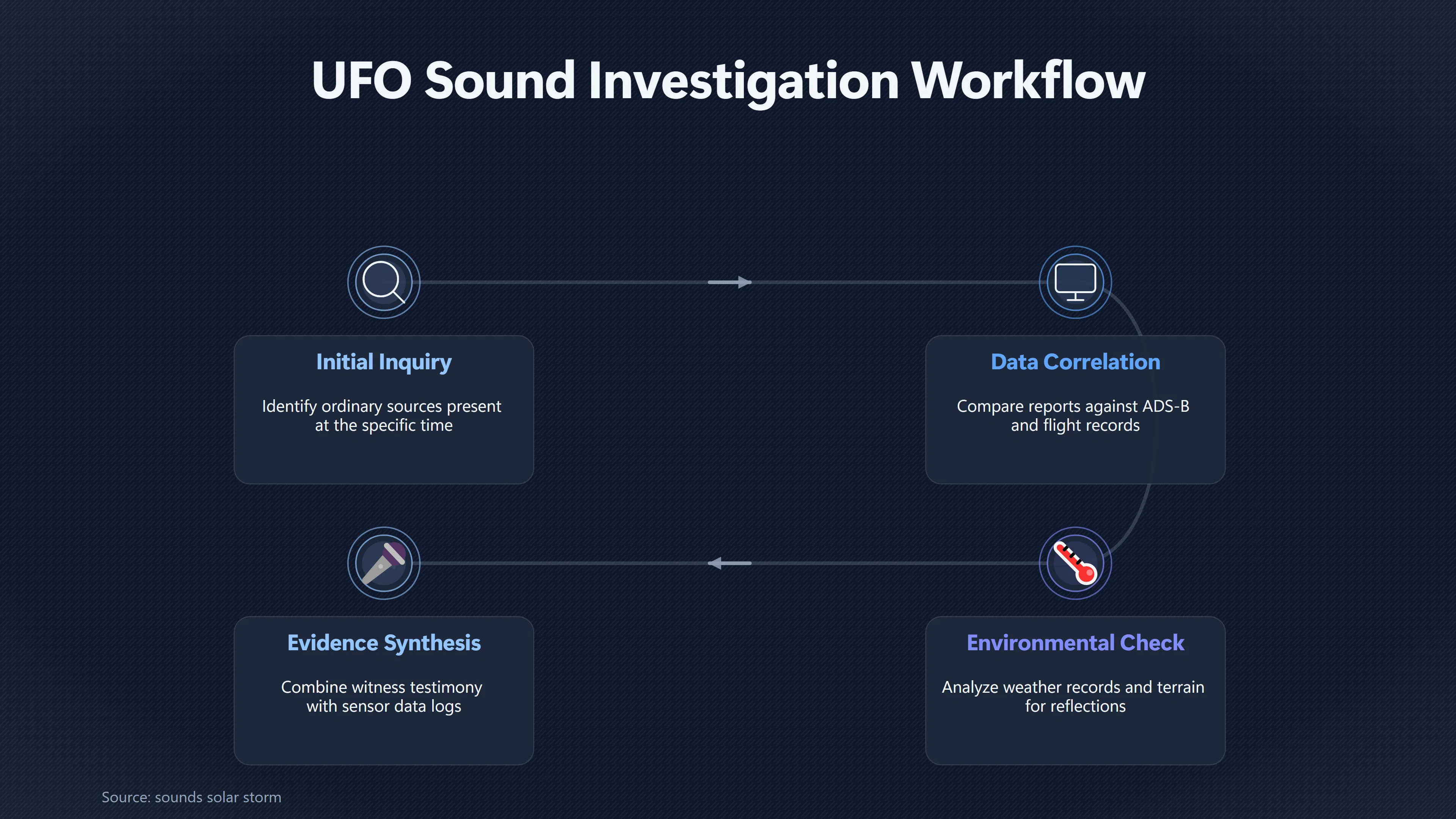
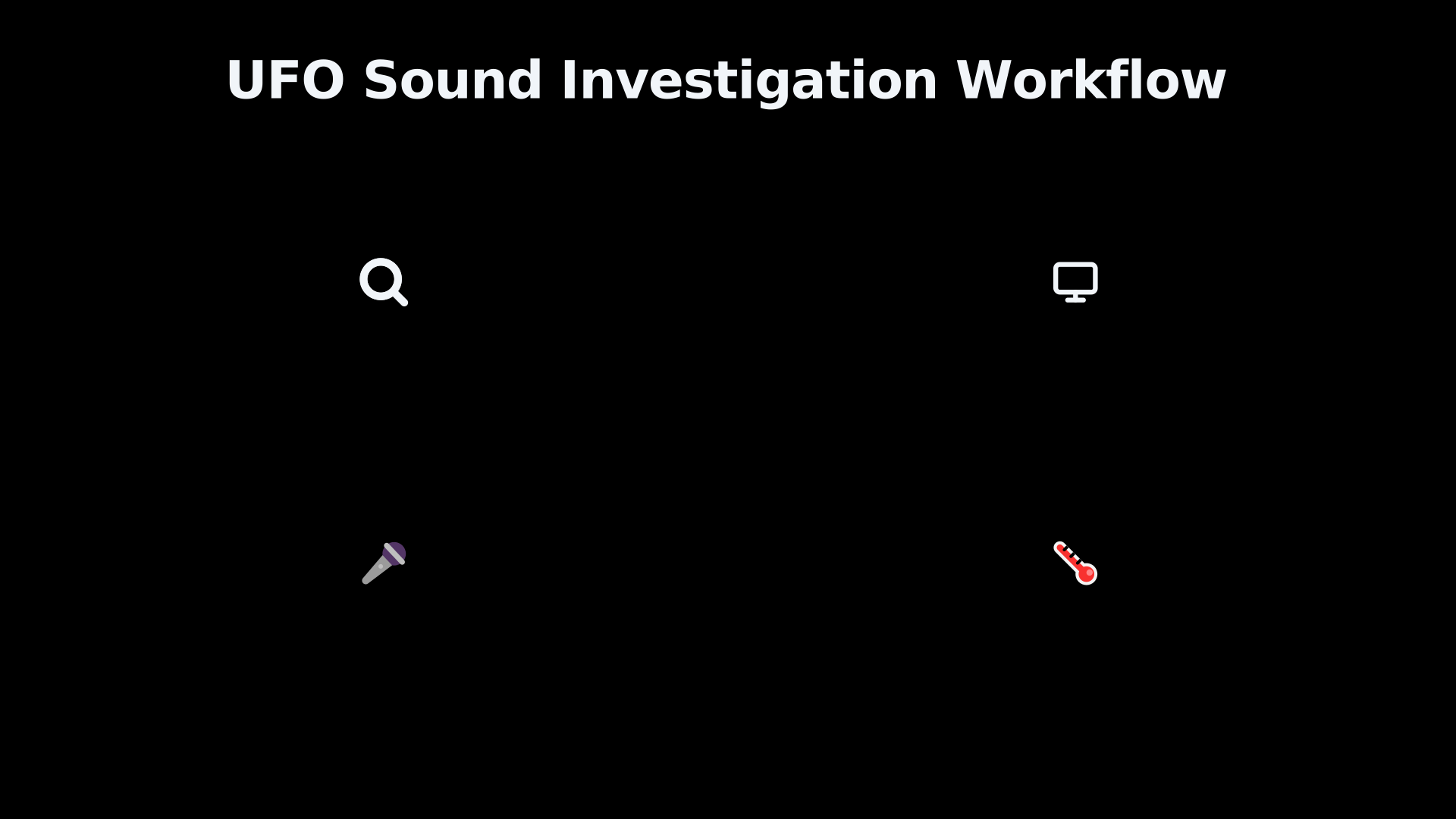
The first question investigators ask is not “What made the sound?” but “What ordinary sources were present at that place and time?”
Unlike visual sightings, sounds can travel around obstacles, reflect from buildings or hills, and arrive from a different direction than their source. A witness may therefore hear an aircraft without seeing it, or hear machinery that appears much closer than it really is. This makes location, timing and environmental conditions as important as the sound itself.[NOAA Institutional Repository]repository.library.noaa.govNOAA Institutional RepositoryTheory and application of a Radio-Acoustic Sounding System…
A typical investigation compares the reported characteristics against known sound sources rather than relying on subjective descriptions such as “electrical”, “metallic” or “otherworldly”.
Common Aircraft and Mechanical Lookalikes
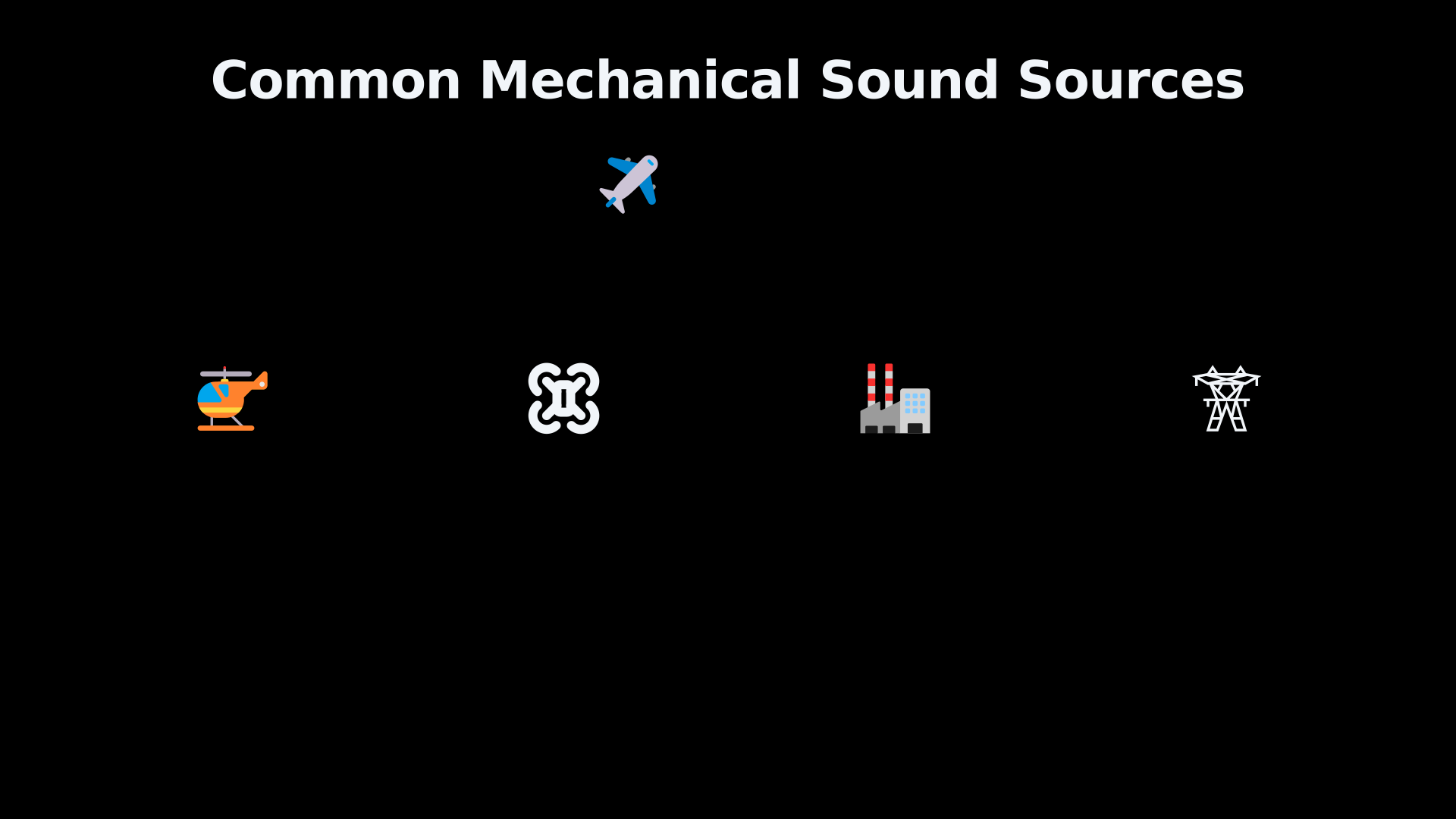
Aircraft are among the most common explanations considered because their sounds change dramatically with altitude, engine power and atmospheric conditions.
Investigators typically check:
- Commercial aircraft operating along scheduled air routes. High-altitude jets may appear visually distant while engine noise reaches observers several seconds later.
- Helicopters, whose blade-slap can resemble rhythmic beating, humming or pulsing noises.
- Military aircraft, which may follow irregular routes or produce unfamiliar engine sounds.
- Small propeller aircraft, especially during climbing turns or low-altitude operations.
- Drones, whose electric motors often produce high-pitched buzzing or whining similar to many witness descriptions.
Today, investigators frequently compare reports with ADS-B (Automatic Dependent Surveillance–Broadcast) flight-tracking data, airport activity and air traffic records. Modern acoustic research also combines aircraft position data with recorded sound to identify whether particular aircraft produced measured noise, demonstrating how synchronising flight information with acoustics can distinguish aircraft from unrelated environmental sounds.[PubMed Central (PMC)]pmc.ncbi.nlm.nih.govPub Med Central (PMC)Real-time identification of aircraft sound eventsPubMed Central (PMC)Real-time identification of aircraft sound events - PMCSeptember 10, 2020…
However, flight-tracking tools are not perfect. Not every aircraft broadcasts publicly available ADS-B data, some military flights are intentionally absent from public tracking services, and coverage varies by region. Consequently, the absence of a tracked aircraft is not considered proof that no aircraft were present.[Federal Aviation Administration]faa.govFederal Aviation Administration ADS-B Privacy | Federal Aviation AdministrationFederal Aviation AdministrationADS-B Privacy | Federal Aviation AdministrationMarch 22, 2025…
Beyond aviation, investigators also examine nearby:
- electrical substations and transformers,
- wind turbines,
- factories and processing plants,
- railways,
- heavy road traffic,
- construction equipment,
- agricultural machinery.
Many produce continuous low-frequency sounds that witnesses later describe as mysterious humming or vibration.
How Weather Changes What People Hear
Environmental conditions can make ordinary sounds seem extraordinary.
Temperature inversions—layers of warm air above cooler air—can bend sound waves back towards the ground, allowing aircraft or industrial noise to travel much farther than normal. Humidity, wind direction and atmospheric stability also influence how loudly and clearly distant sounds are perceived. These well-established acoustic effects are one reason investigators obtain weather observations alongside witness testimony.[NOAA Institutional Repository]repository.library.noaa.govNOAA Institutional RepositoryTheory and application of a Radio-Acoustic Sounding System…
Terrain also matters.
Valleys can channel sound over long distances, while cliffs, forests and urban buildings reflect or scatter it. A witness may therefore perceive a sound as stationary when the source is moving, or believe it originated overhead when reflections altered its apparent direction.
Because of these effects, investigators avoid assuming that perceived direction accurately identifies the sound source.
Why Witness Descriptions Alone Are Not Enough
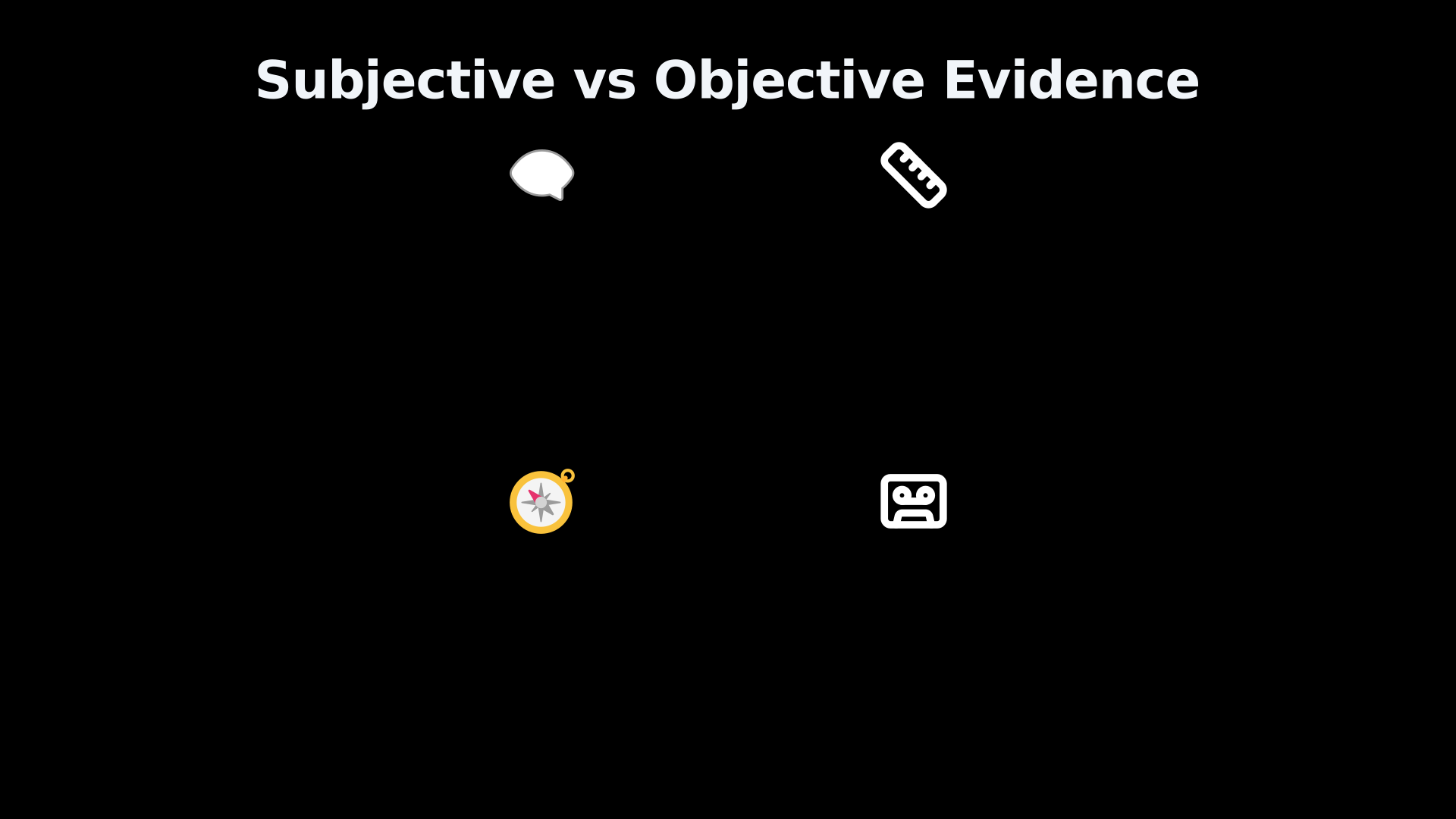
Most reports describe sounds through comparison rather than measurement:
- “like a transformer”;
- “like bees”;
- “like a jet”;
- “like electricity”;
- “like an enormous fan.”
These comparisons are understandable but subjective. Two witnesses hearing the same sound may choose completely different analogies depending on personal experience.
Investigators therefore focus on measurable features where possible:
- approximate duration,
- whether the pitch changed,
- whether loudness increased or faded,
- whether the sound appeared to move,
- whether multiple witnesses independently described similar characteristics,
- whether recordings exist.
Objective information generally carries greater evidential value than descriptive labels.
What Evidence Helps Rule Out Ordinary Sources?
The strongest investigations combine several independent lines of evidence instead of relying on memory alone.
Useful information includes:
- Accurate time and location, allowing comparison with aircraft movements and weather records.
- Multiple independent witnesses, particularly if they were separated geographically.
- Audio or video recordings, which permit spectral or timing analysis.
- Meteorological observations, including wind, cloud cover and temperature profiles.
- Information about nearby infrastructure, such as airports, industrial sites or railway lines.
- Visual observations, showing whether a visible object’s movement matches the reported sound.
Modern proposals for scientific UAP research go further by recommending integrated sensor networks that combine optical cameras, microphones, environmental sensors, radar and radio receivers. Using several independent instruments makes it easier to recognise ordinary aircraft, environmental noise or recording artefacts before classifying an event as anomalous.
When Does a Sound Remain Unexplained?
After familiar explanations are examined, some reports may still lack an obvious source. That does not necessarily imply an extraordinary cause.
An unexplained sound usually means only that available evidence is insufficient to identify it confidently. Missing timing information, incomplete flight records, lack of recordings or uncertain witness estimates often prevent a definitive conclusion.
Investigators therefore distinguish between unidentified and unexplainable. A sound can remain unidentified because the evidence is incomplete, not because known physical explanations have been ruled out.
This cautious distinction reflects the broader approach used in serious investigations of reported UFO noises: eliminate the ordinary explanations that can be tested, recognise the limits of the available evidence, and avoid drawing conclusions that extend beyond what the observations can support.
Amazon book picks
Further Reading
Books and field guides related to Could a Familiar Source Explain That UFO Noise?. Use these as the next step if you want deeper reading beyond the article.
The UFO Handbook: A Guide to Investigating, Evaluating, and R...
An explanation of the usual reasons for confusing IFOs (identified flying objects) with UFOs and a survey of the tools used to investigat...
UFOs Explained
Analyzing several UFO cases, the author exposes the myth of extraterrestrial visitors to earth.
The Demon-Haunted World: Science as a Candle in the Dark
NEW YORK TIMES BESTSELLER • From the renowned astronomer and author of Cosmos comes a “powerful [and] stirring defense of informed ration...
Bad Astronomy: Misconceptions and Misuses Revealed, from Astr...
A clever, thought-provoking guide that attacks common astronomical misconceptions What is Bad Astronomy? Anything that accidentally or in...
eBay marketplace picks
Marketplace Samples
Live-tested eBay searches with available results related to this page.
Selected fromUFO poster oneBay.co.uk.


Current eBay listing
I Want To Believe UFO Poster Giclée Fine Art Heavyweight Print


Current eBay listing
VINTAGE UFO FLYING SAUCERS COMIC ADVERTISING A2 POSTER PRINT
Endnotes
1.
Source: repository.library.noaa.gov
Link:https://repository.library.noaa.gov/view/noaa/32558
Source snippet
NOAA Institutional RepositoryTheory and application of a Radio-Acoustic Sounding System...
2.
Source: oceanservice.noaa.gov
Link:https://oceanservice.noaa.gov/facts/sound.html?platform=hootsuite
3.
Source: ncei.noaa.gov
Title: sounds solar storm
Link:https://www.ncei.noaa.gov/news/sounds-solar-storm
4.
Source: psl.noaa.gov
Link:https://psl.noaa.gov/seminars/Abstracts/ostashev2007.html
5.
Source: prod-01-alb-www-noaa.woc.noaa.gov
Title: sound of thunder
Link:https://prod-01-alb-www-noaa.woc.noaa.gov/jetstream/lightning/sound-of-thunder
6.
Source: repository.library.noaa.gov
Link:https://repository.library.noaa.gov/view/noaa/32580
7.
Source: pmel.noaa.gov
Link:https://www.pmel.noaa.gov/acoustics/sounds/upsweep.html
8.
Source: prod-01-alb-www-noaa.woc.noaa.gov
Title: anomalous propagation
Link:https://prod-01-alb-www-noaa.woc.noaa.gov/jetstream/anomalous-propagation
9.
Source: marine.weather.gov
Link:https://marine.weather.gov/glossary.php?word=inversion
10.
Source: forecast.weather.gov
Link:https://forecast.weather.gov/glossary.php?word=sounding
11.
Source: weather.gov
Title: NW S Jet Stream
Link:https://www.weather.gov/source/zhu/ZHU_Training_Page/lightning_stuff/lightning2/thunder.html
12.
Source: pmc.ncbi.nlm.nih.gov
Title: Pub Med Central (PMC)Real-time identification of aircraft sound events
Link:https://pmc.ncbi.nlm.nih.gov/articles/PMC7481859/
Source snippet
PubMed Central (PMC)Real-time identification of aircraft sound events - PMCSeptember 10, 2020...
Published: September 10, 2020
13.
Source: faa.gov
Title: Federal Aviation Administration Chapter 4. Air Traffic Control
Link:https://www.faa.gov/air_traffic/publications/atpubs/aim_html/chap4_section_5.html
14.
Source: faa.gov
Title: Federal Aviation Administration ADS-B Privacy | Federal Aviation Administration
Link:https://www.faa.gov/air_traffic/technology/equipadsb/privacy
Source snippet
Federal Aviation AdministrationADS-B Privacy | Federal Aviation AdministrationMarch 22, 2025...
Published: March 22, 2025
15.
Source: faa.gov
Link:https://www.faa.gov/newsroom/statements/general-statements
Source snippet
FAA General Statements | Federal Aviation AdministrationJuly 9, 2026 — This summer will see more planes in the skies, frequent bad weathe...
Published: July 9, 2026
16.
Source: faa.gov
Link:https://www.faa.gov/noise/inquiries
Source snippet
Noise Complaints & Inquiries | Federal Aviation AdministrationFebruary 20, 2026 — NOISE COMPLAINTS & INQUIRIES The FAA's mission is to en...
Published: February 20, 2026
17.
Source: faa.gov
Link:https://www.faa.gov/airports/new_entrants/uas_detection_mitigation_response
18.
Source: faa.gov
Title: AD S-B Traffic Advisory System (ATAS) | Federal Aviation Administration
Link:https://www.faa.gov/air_traffic/technology/adsb/pilot/atas
19.
Source: faa.gov
Title: Getting to Know Your ADS-B System | Federal Aviation Administration
Link:https://www.faa.gov/air_traffic/technology/equipadsb/installation/know_adsb_system
20.
Source: faa.gov
Title: AD S-B In Pilot Applications | Federal Aviation Administration
Link:https://www.faa.gov/air_traffic/technology/adsb/pilot
21.
Source: faa.gov
Link:https://www.faa.gov/air_traffic/publications/atpubs/AIM/aim0405.html
22.
Source: faa.gov
Link:https://www.faa.gov/air_traffic/publications/atpubs/atc_html/chap5_section_3.html
23.
Source: adsbperformance.faa.gov
Link:https://adsbperformance.faa.gov/PAPRRequest.aspx
24.
Source: faa.gov
Link:https://www.faa.gov/air_traffic/publications/atpubs/aip_html/part2_enr_section_1.1.html
25.
Source: faa.gov
Link:https://www.faa.gov/air_traffic/publications/atpubs/aim_html/chap7_section_7.html
Additional References
26.
Source: thefederalregister.org
Link:https://thefederalregister.org/documents/2026-09236/agency-information-collection-activities-request-for-comments-clearance-of-renewed-approval-of-information-collection-fa
Source snippet
se Complaint and Inquiry System (Noise Portal) | 91 FR 25751May 11, 2026 — FOR FURTHER INFORMATION CONTACT: Nitin Rao by email at: TACT...
Published: May 11, 2026
27.
Source: youtube.com
Link:https://www.youtube.com/watch?v=4ow5NVmUvfI
Source snippet
Acoustic Scene Analysis, Complex Modulations, and a New Form of Filtering – Les Atlas (UW) - 2008...
28.
Source: ntsb.gov
Link:https://www.ntsb.gov/news/press-releases/Pages/NR20260226.aspx
Source snippet
Letter: ALERT Act Falls Short of Fully Implementing NTSB Recommendations in Midair CollisionFebruary 26, 2026 — LETTER: ALERT ACT FALLS S...
Published: February 26, 2026
29.
Source: files.gao.gov
Link:https://files.gao.gov/reports/GAO-26-107648/index.html
Source snippet
gao.govGAO-26-107648, TRANSFORMING AVIATION: FAA Planning Efforts Should Address How [Drones]({{ 'drones/' | relative_url }}) Will Communicate with and Avoid Other Aircraf...
30.
Source: youtube.com
Title: What is a Sonic Boom and Why Do They Happen?
Link:https://www.youtube.com/watch?v=7AIw_HSd1a8
Source snippet
Infrasonic, Sonic & Ultrasonic Frequencies | Class 9 Physics | Propagation of Sound Waves...
31.
Source: ntsb.gov
Link:https://www.ntsb.gov/news/Pages/cvr_fdr.aspx
32.
Source: gao.gov
Link:https://www.gao.gov/products/gao-26-107648
33.
Source: youtube.com
Link:https://www.youtube.com/watch?v=fcQbhulInps
Source snippet
The Science of Silencing Sonic Booms...
34.
Source: flightradar24.com
Link:https://www.flightradar24.com/how-it-works
35.
Source: sciencedirect.com
Link:https://www.sciencedirect.com/science/article/pii/S1270963823004340