Within Record It
Was the Sound in the Sky or Ground?
Clouds, wind, storms, vibration and nearby shaking can reveal whether a sky sound came from atmospheric or geological activity.
On this page
- Checking clouds, wind and storm activity
- Noting vibration and possible seismic clues
- Distinguishing thunder from isolated booms
Page outline Jump by section
Introduction
When an unexplained boom seems to come from the sky, the surrounding weather and any signs of ground movement are often more informative than the sound itself. A loud report that appears airborne may have travelled unusually far because of atmospheric conditions, while a boom that seems to come from overhead may actually originate from a shallow earthquake, frost-related ground cracking or another source near the surface. Careful notes about clouds, wind, storms and vibration can therefore help distinguish between competing explanations. Rather than proving what caused the sound, these observations narrow the possibilities and make later analysis far more reliable.
Was the Sound in the Sky or Ground?
A single loud boom can be surprisingly difficult for the human ear to locate. Low-frequency sound bends around obstacles, reflects from cloud layers and terrain, and can be refracted by changes in air temperature. The result is that a sound generated many kilometres away may seem to come directly overhead, while a nearby ground source may be perceived as airborne.
This is why weather observations belong alongside audio recordings. Conditions that affect how sound travels can make ordinary events seem mysterious without requiring an unusual source. USGS guidance on mysterious booms likewise notes that many reports are eventually linked to human activity, sonic booms or shallow natural processes, even though some events remain unexplained.[USGS]usgs.govEarthquake Booms, Seneca Guns, and Other Sounds | U.S. Geological SurveyEarthquake Booms, Seneca Guns, and Other Sounds | U.S. Geological Survey…
Checking Clouds, Wind and Storm Activity
Weather changes both how sounds are produced and how they propagate.
Cloud cover and nearby storms
The first question is whether thunderstorms were present, even if no lightning was visible overhead. Thunder from distant storms can travel tens of kilometres under favourable conditions. A single cloud-to-ground lightning strike may produce a sharp crack close by or a deep rolling boom when heard from farther away.
If rain shafts or storm clouds were visible on one horizon, record their direction. A boom arriving from that same direction is more consistent with thunder than with an isolated unexplained event. NOAA explains that thunder consists of many overlapping shock waves from the lightning channel, creating the familiar rumbling or booming character.[NOAA]prod-01-alb-www-noaa.woc.noaa.govThe Sound of Thunder | National Oceanic and Atmospheric AdministrationThe Sound of Thunder | National Oceanic and Atmospheric Administration…
Wind direction and strength
Wind affects both loudness and apparent direction.
Note whether:
- The air was calm or gusty.
- Wind was blowing towards or away from your location.
- The sound became louder or quieter as the wind changed.
Strong winds can scatter and weaken sound, whereas calm conditions often allow low-frequency noise to travel farther with less distortion. If several witnesses are spread across an area, comparing wind conditions can help explain why one location heard a sharp boom while another heard only a faint rumble.
Temperature inversions
One of the most important atmospheric clues is a temperature inversion, where warmer air sits above cooler surface air. Instead of allowing sound to spread upwards, an inversion bends sound waves back towards the ground.
Under these conditions:
- distant thunder may sound unexpectedly loud;[prod-01-alb-www-noaa.woc.noaa.gov]prod-01-alb-www-noaa.woc.noaa.govThe Sound of Thunder | National Oceanic and Atmospheric AdministrationThe Sound of Thunder | National Oceanic and Atmospheric Administration…
- sonic booms may be heard much farther than usual;
- industrial or transport noise may appear to originate from the sky.
NOAA notes that inversions can significantly amplify thunder heard at ground level, while USGS also identifies atmospheric refraction as a reason sonic booms sometimes carry much farther than expected.[NOAA]prod-01-alb-www-noaa.woc.noaa.govThe Sound of Thunder | National Oceanic and Atmospheric AdministrationThe Sound of Thunder | National Oceanic and Atmospheric Administration…
Noting Vibration and Possible Seismic Clues
A useful question is whether you merely heard the boom or also felt it.
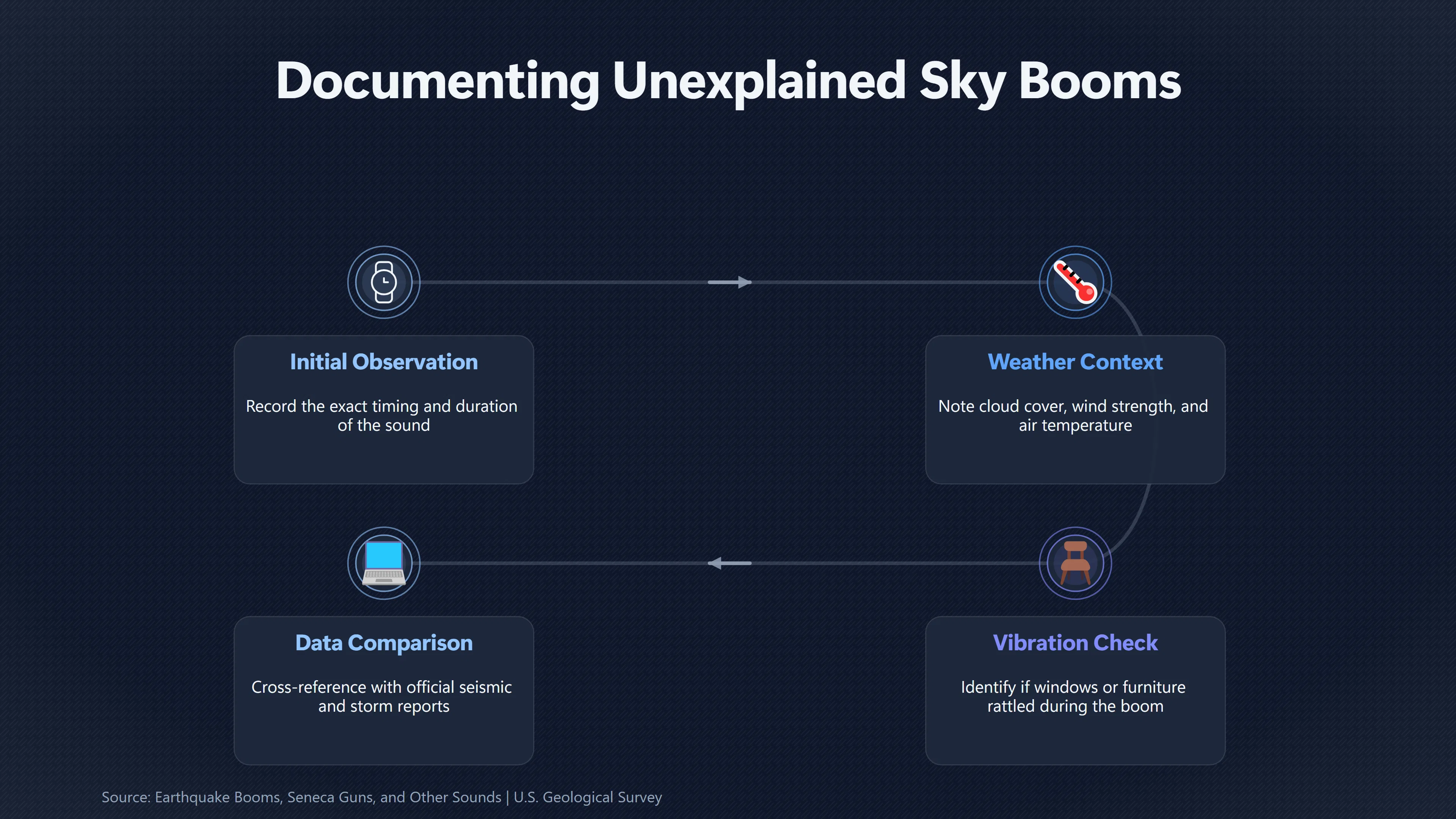
If windows rattled, shelves vibrated or the floor shook briefly, record exactly what happened. The order also matters:
- Did the vibration and sound occur together?
- Did you hear the boom first?
- Was there a brief jolt before the sound?
These details may indicate whether the source was atmospheric or within the ground.
USGS notes that very shallow earthquakes can produce audible booms because high-frequency vibrations reach the surface. In some cases, people hear a boom without recognising that a small earthquake occurred, especially if the shaking is weak or highly localised.[USGS]usgs.govEarthquake Booms, Seneca Guns, and Other Sounds | U.S. Geological SurveyEarthquake Booms, Seneca Guns, and Other Sounds | U.S. Geological Survey…

Shallow earthquakes
Small earthquakes close to the surface are more likely to produce audible sounds than deeper events.
Witnesses commonly describe:
- a cannon-like report;
- a deep rumble;
- a heavy thump;
- brief window rattling.
The boom may last only a second while the vibration is subtle enough to be mistaken for a passing lorry or nearby explosion. Because many shallow earthquakes are small, they may only be noticed by people close to the source.[USGS]usgs.govEarthquake Booms, Seneca Guns, and Other Sounds | U.S. Geological SurveyEarthquake Booms, Seneca Guns, and Other Sounds | U.S. Geological Survey…
Frost quakes and cold-weather cracking
During severe cold weather, frozen soil and shallow groundwater can crack suddenly as ice expands. These so-called frost quakes or cryoseisms may produce loud explosive sounds with little or no sustained shaking.
If the boom occurred during an intense freeze, note:
- recent temperature changes;
- frozen ground;
- absence of storms;
- whether neighbours reported similar sounds.
USGS identifies frost quakes as one explanation for wintertime booming sounds reported in some regions.[USGS]usgs.govEarthquake Booms, Seneca Guns, and Other Sounds | U.S. Geological SurveyEarthquake Booms, Seneca Guns, and Other Sounds | U.S. Geological Survey…
Distinguishing Thunder from Isolated Booms
[Thunder]psl.noaa.govSource details in endnotes. usually leaves several clues beyond the sound itself.
Typical characteristics include:
- repeated rumbles rather than a single report;
- visible storm clouds;
- lightning flashes, even if distant;
- a gradual decrease in loudness as the storm moves away.
By contrast, many mysterious boom reports involve:
- one or two isolated detonations;
- clear skies;
- no obvious lightning;
- no continuing weather activity.
However, clear skies alone do not rule out weather as a factor. Sound from storms beyond the visible horizon can still arrive under favourable atmospheric conditions, especially during temperature inversions.[NOAA]prod-01-alb-www-noaa.woc.noaa.govThe Sound of Thunder | National Oceanic and Atmospheric AdministrationThe Sound of Thunder | National Oceanic and Atmospheric Administration…
Practical Clues to Record Immediately
When documenting an unexplained sky sound, weather and ground observations are as valuable as the recording itself. Useful details include:
- Cloud type and percentage of sky covered.
- Wind direction and estimated strength.
- Rain, hail or lightning anywhere visible.
- Air temperature or recent rapid temperature changes.
- Whether the ground, floor or furniture vibrated.
- Whether windows, doors or loose objects rattled.
- Whether nearby animals reacted before or after the sound.
- Any official reports of thunderstorms or minor earthquakes later that day.
Separating direct observations from assumptions is especially important. Writing “windows rattled for about one second” is far more useful than writing “it must have been a UFO.”
Why These Clues Matter
Many reports of mysterious aerial booms remain unresolved because too little contextual information was recorded. Weather conditions can dramatically alter how ordinary sounds are heard, while shallow geological activity can generate noises that resemble explosions or aircraft. Recording clouds, wind, storm activity and any evidence of vibration provides investigators with independent evidence that can support—or eliminate—common explanations before considering rarer possibilities. Even when no definitive cause is found, these observations make the event substantially more useful for later comparison with meteorological records, seismic data and reports from other witnesses.
Amazon book picks
Further Reading
Books and field guides related to Was the Sound in the Sky or Ground?. Use these as the next step if you want deeper reading beyond the article.
The Weather Book
The best, most readable and visually stimulating guide to our nation's weather--featuring the full-color graphics of the most popular sec...
Meteorology Today
METEOROLOGY TODAY has for many years been one of the most widely used and authoritative texts for the introductory meteorology course. Ea...
Earthquakes
The ultimate introduction to seismology, written by distinguished scholar and Professor Bruce Bolt, of the University of California, Berk...
Atmospheric Science
Atmospheric Science, Second Edition, is the long-awaited update of the classic atmospheric science text, which helped define the field ne...
eBay marketplace picks
Marketplace Samples
Live-tested eBay searches with available results related to this page.
Selected fromUFO poster oneBay.co.uk.


Current eBay listing
VINTAGE UFO FLYING SAUCERS COMIC ADVERTISING A2 POSTER PRINT

Current eBay listing
I Want To Believe UFO Poster Giclée Fine Art Heavyweight Print

Endnotes
1.
Source: usgs.gov
Title: Earthquake Booms, Seneca Guns, and Other Sounds | U.S. Geological Survey
Link:https://www.usgs.gov/programs/earthquake-hazards/earthquake-booms-seneca-guns-and-other-sounds
Source snippet
Earthquake Booms, Seneca Guns, and Other Sounds | U.S. Geological Survey...
2.
Source: usgs.gov
Title: What is that mysterious booming sound? | U.S. Geological Survey
Link:https://www.usgs.gov/publications/what-mysterious-booming-sound
Source snippet
What is that mysterious booming sound? | U.S. Geological Survey...
3.
Source: prod-01-alb-www-noaa.woc.noaa.gov
Title: The Sound of Thunder | National Oceanic and Atmospheric Administration
Link:https://prod-01-alb-www-noaa.woc.noaa.gov/jetstream/lightning/sound-of-thunder
Source snippet
The Sound of Thunder | National Oceanic and Atmospheric Administration...
4.
Source: usgs.gov
Title: Sonic Booms | U.S. Geological Survey
Link:https://www.usgs.gov/programs/earthquake-hazards/sonic-booms
Source snippet
Sonic Booms | U.S. Geological Survey...
5.
Source: usgs.gov
Link:https://www.usgs.gov/faqs/what-are-those-booms-i-sometimes-hear-or-during-earthquake
Source snippet
What are those booms I sometimes hear before or during an earthquake? | U.S. Geological Survey...
6.
Source: nesdis.noaa.gov
Title: what causes lightning and thunder
Link:https://www.nesdis.noaa.gov/about/k-12-education/severe-weather/what-causes-lightning-and-thunder
7.
Source: usgs.gov
Link:https://www.usgs.gov/faqs/how-does-usgs-tell-difference-between-earthquake-and-a-sonic-boom
8.
Source: pubs.usgs.gov
Link:https://pubs.usgs.gov/publication/70048204
9.
Source: usgs.gov
Title: Earthquake Hazards
Link:https://www.usgs.gov/programs/earthquake-hazards/science/faqs?page=5
10.
Source: prod-01-alb-www-noaa.woc.noaa.gov
Title: learning lesson determining distance to thunderstorm
Link:https://prod-01-alb-www-noaa.woc.noaa.gov/jetstream/lightning/sound-of-thunder/learning-lesson-determining-distance-to-thunderstorm
11.
Source: nssl.noaa.gov
Link:https://www.nssl.noaa.gov/education/svrwx101/lightning/
12.
Source: repository.library.noaa.gov
Link:https://repository.library.noaa.gov/view/noaa/32526
13.
Source: psl.noaa.gov
Link:https://psl.noaa.gov/outreach/education/science/convection/Thunder.html
14.
Source: nssl.noaa.gov
Link:https://www.nssl.noaa.gov/education/svrwx101/thunderstorms/
15.
Source: weather.gov
Title: NW S Jet Stream
Link:https://www.weather.gov/source/zhu/ZHU_Training_Page/lightning_stuff/lightning2/thunder.html
16.
Source: bgs.ac.uk
Link:https://www.bgs.ac.uk/discovering-geology/earth-hazards/earthquakes/
Source snippet
British Geological Survey...
17.
Source: data.gov.uk
Title: U K earthquake seismogram data
Link:https://www.data.gov.uk/dataset/65323c92-969f-43b8-9cfe-7836c411db49/uk-earthquake-seismogram-data1
Source snippet
UK earthquake seismogram data - National Data LibraryJuly 23, 2026 — UK EARTHQUAKE SEISMOGRAM DATA Published by: British Geological Surve...
Published: July 23, 2026
18.
Source: ckan.publishing.service.gov.uk
Title: publishing.service.gov.uk U K earthquake seismogram data
Link:https://ckan.publishing.service.gov.uk/dataset/uk-earthquake-seismogram-data1
Additional References
19.
Source: theweathernetwork.com
Title: What are these mysterious booms heard around the world?
Link:https://www.theweathernetwork.com/en/news/science/earth-science/what-are-these-mysterious-booms-heard-around-the-world-skyquakes
Source snippet
The Weather NetworkMay 8, 2026 — WHAT ARE THESE MYSTERIOUS BOOMS HEARD AROUND THE WORLD? Dennis MersereauDigital Journalist, Weather Spec...
Published: May 8, 2026
20.
Source: sciencefocus.com
Title: Mystery ‘skyquakes’ are ripping through the world
Link:https://www.sciencefocus.com/planet-earth/mystery-skyquakes-are-ripping-through-the-world-and-nobody-knows-why
Source snippet
And nobody knows why | BBC Science Focus MagazineApril 12, 2026 — MYSTERY ‘SKYQUAKES’ ARE RIPPING THROUGH THE WORLD. AND NOBODY KNOWS WHY...
Published: April 12, 2026
21.
Source: youtube.com
Link:https://www.youtube.com/watch?v=P6_a314KiZo
Source snippet
Frozen Ground Explodes: US Frost Quakes Explained | WION Podcast...
22.
Source: youtube.com
Title: So Apparently Skyquakes Are A Thing | Answers With Joe
Link:https://www.youtube.com/watch?v=YWXESGggpLY
Source snippet
What Are the Mystery Booms, Hums and "Trumpets" in the Sky? | Make This Make Sense...
23.
Source: youtube.com
Title: Frozen Ground Explodes: US Frost Quakes Explained | WION Podcast
Link:https://www.youtube.com/watch?v=gc_30ZCwrP0
Source snippet
What Causes Mysterious Sky Booms Still Puzzles Locals...
24.
Source: doi.org
Link:https://doi.org/10.2514%2F1.J059209
25.
Source: mysterybooms.com
Link:https://www.mysterybooms.com/
26.
Source: mysterybooms.com
Link:https://www.mysterybooms.com/resources-online/
27.
Source: af.mil
Link:https://www.af.mil/About-Us/Fact-Sheets/Display/article/104540/sonic-boom/
28.
Source: livescience.com
Link:https://www.livescience.com/agu-seneca-guns-cause.html