Within Sound Travel
How Terrain Makes Ground Noise Seem Airborne
Hills, ridges and valleys can block direct noise while reflecting or channelling it from a direction that appears to be in the sky.
On this page
- How ridges block direct sound paths
- Why valleys channel engines and industrial noise
- Using local geography to test a reported sky sound
Page outline Jump by section
Introduction
Reports of mysterious “UFO noises” often describe a hum, roar or droning sound that appears to come from the sky even though no aircraft or visible object can be seen. While atmospheric conditions such as temperature inversions can bend sound over long distances, local terrain frequently completes the illusion. Hills, ridges and valleys reshape the paths that sound follows, blocking direct routes while reflecting, diffracting or channelling noise from entirely different directions. The result is that an ordinary quarry, motorway, industrial plant or distant aircraft may seem to hover overhead or emerge from an empty stretch of sky rather than from its true location. Understanding these terrain effects helps explain why sincere witnesses can misjudge both the direction and apparent height of unfamiliar sounds without requiring an unusual airborne source.[Annual Reviews]annualreviews.orgAnnual Reviews SOUND PROPAGATION CLOSE TO THE GROUND | Annual ReviewsAnnual ReviewsSOUND PROPAGATION CLOSE TO THE GROUND | Annual ReviewsJanuary 1, 2002…
How ridges block direct sound paths
A ridge does more than reduce the loudness of a sound source hidden behind it. It also changes which parts of the sound field reach a listener.
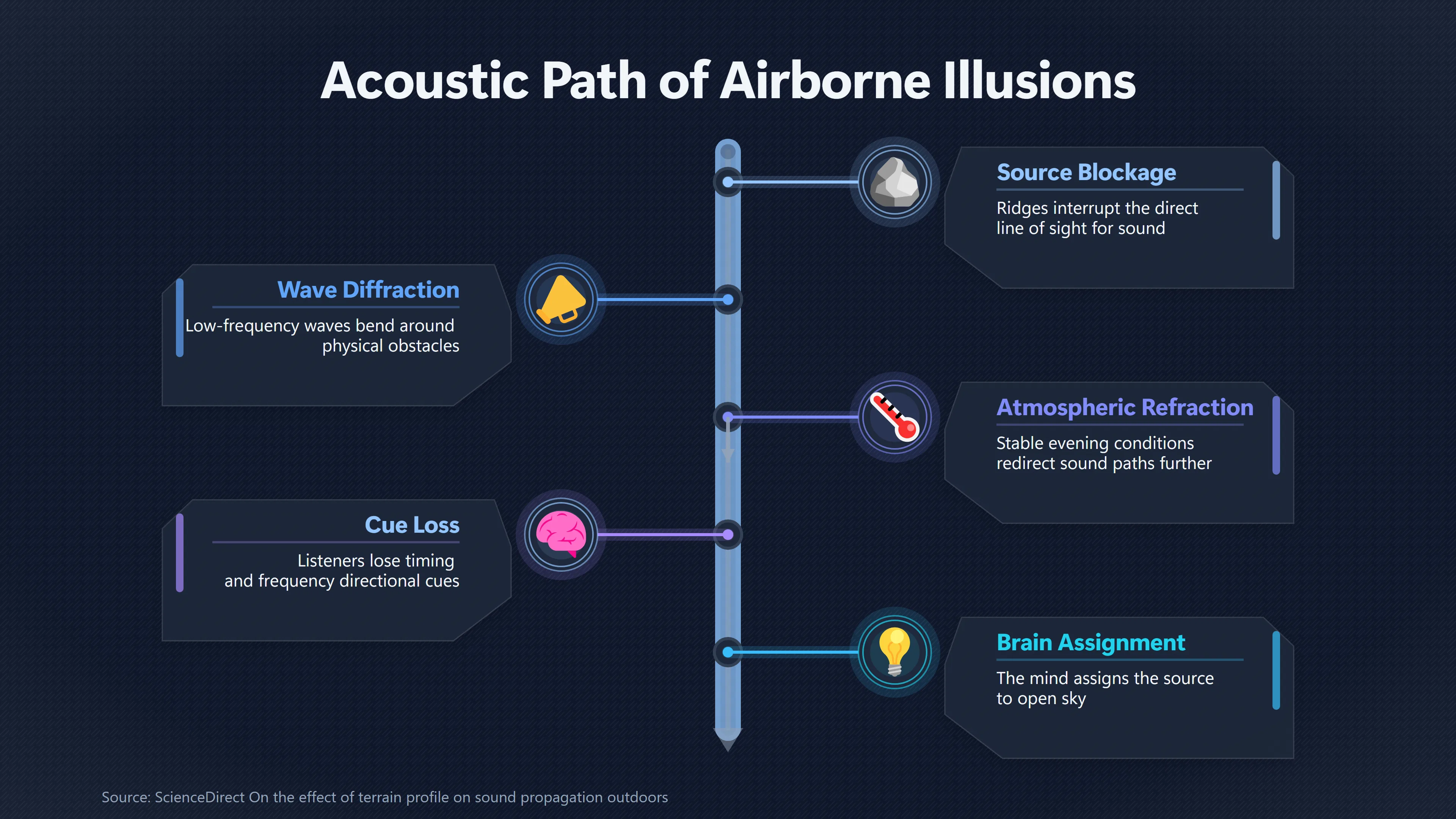
If a hill or ridge blocks the direct line of sight between a source and an observer, the strongest sound waves are interrupted. However, lower-frequency sound, such as the deep rumble of heavy machinery, aircraft engines or large diesel vehicles, bends around the obstacle through a process called diffraction. Higher frequencies are blocked more effectively, leaving a muffled sound that is harder for the human ear to locate accurately.[ScienceDirect]sciencedirect.comScienceDirect On the effect of terrain profile on sound propagation outdoorsOn the effect of terrain profile on sound propagation outdoors - ScienceDirectJanuary 8, 1985…
This matters because people determine the direction of a sound using small differences in timing and frequency between their ears. When the direct sound is removed and only diffracted or reflected sound remains, those directional cues become much less reliable. Instead of identifying a source hidden beyond a ridge, listeners may perceive the remaining sound as coming from above, from a nearby hillside or from open sky.
Terrain also creates acoustic shadow zones. These are areas immediately behind hills where direct sound is greatly weakened. As wind and atmospheric conditions change, sound may fade in and out as it enters or leaves these shadowed regions. Someone walking only a few hundred metres may experience dramatic changes in loudness and apparent direction without the source moving at all.[Annual Reviews]annualreviews.orgAnnual Reviews SOUND PROPAGATION CLOSE TO THE GROUND | Annual ReviewsAnnual ReviewsSOUND PROPAGATION CLOSE TO THE GROUND | Annual ReviewsJanuary 1, 2002…
Why valleys channel engines and industrial noise
Valleys can behave like broad natural corridors that guide sound over surprisingly long distances.
Rather than spreading evenly in all directions, sound travelling along a valley often encounters repeated reflections from opposing slopes. Although natural terrain is not as reflective as concrete walls, the combination of multiple reflections, reduced sideways spreading and favourable atmospheric conditions can preserve low-frequency sound far beyond what would be expected over flat ground.[NASA Technical Reports Server]ntrs.nasa.govNASA Technical Reports ServerSound propagation over uneven ground and irregular topography - NASA Technical Reports Server (NTRS)…
Common sources that become unusually prominent include:
- heavy lorries travelling through distant valleys;
- quarry blasting and stone crushing;
- rail traffic following river valleys;
- industrial plants located beyond intervening hills;
- low-flying aircraft using valley routes.
Low-frequency components travel particularly well because they are less easily scattered by vegetation and small terrain features than higher frequencies. A distant engine may therefore be heard as a deep, directionless rumble while the higher-frequency sounds that would normally reveal its location have been absorbed or blocked.[Annual Reviews]annualreviews.orgAnnual Reviews SOUND PROPAGATION CLOSE TO THE GROUND | Annual ReviewsAnnual ReviewsSOUND PROPAGATION CLOSE TO THE GROUND | Annual ReviewsJanuary 1, 2002…
In mountainous regions, this effect sometimes leads observers to believe that an unseen aircraft is circling overhead when the actual source is travelling many kilometres away along a valley outside the observer’s line of sight.
Why terrain can make ground noise seem airborne
The illusion of an airborne source usually develops from several terrain effects acting together rather than from a single acoustic phenomenon.
A typical sequence looks like this:
- A ridge blocks the direct path between the listener and the true source.
- Low-frequency sound bends around the ridge or reflects from valley slopes.
- Atmospheric refraction, especially during stable evening conditions, further redirects the sound.
- The listener receives delayed or redirected sound but lacks the normal directional cues.
- The brain assigns the source to the most plausible open direction, often the sky above or a nearby hillside.
This combination explains why witnesses sometimes report a hovering hum despite finding no visible aircraft or machinery nearby. The sound is real, but its propagation path has been reshaped by both the atmosphere and the landscape.[annualreviews.org]annualreviews.orgAnnual Reviews SOUND PROPAGATION CLOSE TO THE GROUND | Annual ReviewsAnnual ReviewsSOUND PROPAGATION CLOSE TO THE GROUND | Annual ReviewsJanuary 1, 2002…
Practical examples of terrain-driven misidentification
Several familiar situations demonstrate how easily topography can mislead listeners.
A quarry hidden behind a ridge may be inaudible at one location yet clearly audible several kilometres away where a valley opens towards the listener. Because only the low-frequency components arrive, the sound resembles a distant aircraft or an unidentified aerial hum rather than industrial machinery.
Similarly, motorway traffic can appear to originate from elevated ground instead of the road itself when intervening hills block direct sound but allow refracted or diffracted energy to reach neighbouring valleys. Residents in hilly regions often notice that traffic noise changes dramatically between calm evenings and windy afternoons, even though vehicle volumes remain similar.[ScienceDirect]sciencedirect.comScienceDirect A Simple Model of Outdoor Noise PropagationA Simple Model of Outdoor Noise Propagation - ScienceDirect…
Aircraft can produce similar confusion. A jet flying beyond a mountain ridge may remain hidden from view while its engine noise follows a path around terrain features and into a valley. Conversely, an aircraft directly overhead may sound unexpectedly quiet if terrain and atmospheric conditions redirect most of its acoustic energy elsewhere.[NASA Technical Reports Server]ntrs.nasa.govNASA Technical Reports ServerSound propagation over uneven ground and irregular topography - NASA Technical Reports Server (NTRS)…
Using local geography to test a reported sky sound
When investigating reports of unexplained sky noises, local terrain should be examined before assuming the source was actually airborne.
Useful checks include:
- Study elevation maps. Identify ridges, escarpments and valleys between the observation point and nearby roads, railways, airports, quarries or industrial sites.
- Look for hidden infrastructure. A motorway or quarry concealed behind high ground may still project sound into neighbouring valleys.
- Compare multiple listening locations. If moving a short distance causes the sound to weaken, strengthen or shift direction dramatically, terrain effects are a likely contributor.
- Note the weather. Calm evenings, light winds and stable atmospheric conditions often enhance long-range propagation through valleys.
- Check frequency characteristics. Sounds dominated by low-frequency rumbling are more likely to survive terrain blockage than sharper, high-frequency noises.
Because topography changes sound paths in complex ways, two observers separated by only a small distance may honestly report different directions or even disagree about whether the sound came from the ground or the sky. This variability is consistent with established outdoor acoustics rather than evidence for an unknown aerial phenomenon.[sciencedirect.com]sciencedirect.comScienceDirect On the effect of terrain profile on sound propagation outdoorsOn the effect of terrain profile on sound propagation outdoors - ScienceDirectJanuary 8, 1985…
Amazon book picks
Further Reading
Books and field guides related to How Terrain Makes Ground Noise Seem Airborne. Use these as the next step if you want deeper reading beyond the article.
Predicting Outdoor Sound
Predicting Outdoor Sound provides a scholarly yet practical examination of the phenomena that affect outdoor sound close to the ground an...
Engineering Noise Control: Theory and Practice
The practice of engineering noise control demands a solid understanding of the fundamentals of acoustics, the practical application of cu...
Fundamentals of Acoustics
Dargestellt werden die physikalischen und mathematischen Konzepte zur Beschreibung der Erzeugung, Weiterleitung und Wahrnehmung von Schal...
eBay marketplace picks
Marketplace Samples
Live-tested eBay searches with available results related to this page.
Selected fromUFO art print oneBay.co.uk.




Endnotes
1.
Source: ntrs.nasa.gov
Link:https://ntrs.nasa.gov/citations/19880017527
Source snippet
NASA Technical Reports ServerSound propagation over uneven ground and irregular topography - NASA Technical Reports Server (NTRS)...
2.
Source: sciencedirect.com
Title: ScienceDirect On the effect of terrain profile on sound propagation outdoors
Link:https://www.sciencedirect.com/science/article/pii/0022460X85904006
Source snippet
On the effect of terrain profile on sound propagation outdoors - ScienceDirectJanuary 8, 1985...
Published: January 8, 1985
3.
Source: ntrs.nasa.gov
Link:https://ntrs.nasa.gov/citations/19870018049
Source snippet
NASA Technical Reports ServerSound propagation over uneven ground and irregular topography - NASA Technical Reports Server (NTRS)...
4.
Source: sciencedirect.com
Title: ScienceDirect A Simple Model of Outdoor Noise Propagation
Link:https://www.sciencedirect.com/science/article/pii/S0003682X97000716
Source snippet
A Simple Model of Outdoor Noise Propagation - ScienceDirect...
5.
Source: nps.gov
Title: In the Field
Link:https://www.nps.gov/subjects/sound/field.htm
Source snippet
Natural Sounds (U.S. National Park Service)...
6.
Source: GOV.UK
Title: www.gov.uk Military Aviation Noise Contours
Link:https://www.gov.uk/government/publications/military-aviation-noise-contours/military-aviation-noise-contours
Source snippet
Aviation Noise Contours - GOV.UKMay 15, 2026 — MILITARY AVIATION NOISE CONTOURS Updated 15 May 2026 [Button: Print this page] Image © Cro...
Published: May 15, 2026
7.
Source: nps.gov
Link:https://www.nps.gov/mora/learn/nature/soundscapes.htm
Source snippet
National Park Service)January 14, 2026 — SOUNDSCAPES > “Only when one comes to listen, only when one is aware and still, can things be se...
Published: January 14, 2026
8.
Source: nps.gov
Title: Types of Data
Link:https://www.nps.gov/subjects/sound/data.htm
Source snippet
National Park Service)July 16, 2025 — TYPES OF DATA Several types of data are needed to accurately quantify the acoustic environment of a...
Published: July 16, 2025
9.
Source: nps.gov
Title: Natural Sounds (U.S. National Park Service)
Link:https://www.nps.gov/subjects/sound
10.
Source: nps.gov
Link:https://www.nps.gov/subjects/sound/noise.htm
11.
Source: home.nps.gov
Link:https://home.nps.gov/subjects/sound/mapfaq.htm
12.
Source: nps.gov
Title: What We Do
Link:https://www.nps.gov/orgs/1050/whatwedo.htm
13.
Source: home.nps.gov
Title: rm47 part 5 impact
Link:https://home.nps.gov/subjects/sound/rm47-part-5-impact.htm
14.
Source: sciencedirect.com
Title: Acoustic wave three-dimensional ground reflection and bouncing
Link:https://www.sciencedirect.com/science/article/pii/S0003682X21002036
15.
Source: sciencedirect.com
Title: Noise barriers in a refracting atmosphere
Link:https://www.sciencedirect.com/science/article/pii/0003682X9500047D
16.
Source: ntrs.nasa.gov
Link:https://ntrs.nasa.gov/citations/19940019741
17.
Source: ntrs.nasa.gov
Link:https://ntrs.nasa.gov/citations/19880005381
18.
Source: ntrs.nasa.gov
Link:https://ntrs.nasa.gov/citations/19870018047
19.
Source: ntrs.nasa.gov
Link:https://ntrs.nasa.gov/citations/19880052487
20.
Source: ntrs.nasa.gov
Link:https://ntrs.nasa.gov/citations/19870002142
21.
Source: ntrs.nasa.gov
Link:https://ntrs.nasa.gov/citations/19860022776
22.
Source: nps.gov
Title: Mapping Sound
Link:https://www.nps.gov/subjects/sound/soundmap.htm?source=techstories.org
23.
Source: sciencedirect.com
Title: U S National Parks and management of park soundscapes: A review
Link:https://www.sciencedirect.com/science/article/abs/pii/S0003682X07000904
24.
Source: annualreviews.org
Title: Annual Reviews SOUND PROPAGATION CLOSE TO THE GROUND | Annual Reviews
Link:https://www.annualreviews.org/content/journals/10.1146/annurev.fluid.34.081701.143541
Source snippet
Annual ReviewsSOUND PROPAGATION CLOSE TO THE GROUND | Annual ReviewsJanuary 1, 2002...
Published: January 1, 2002
25.
Source: annualreviews.org
Title: SOUN D PROPAGATION CLOSE TO THE GROUND | Annual Reviews
Link:https://www.annualreviews.org/doi/pdf/10.1146/annurev.fluid.34.081701.143541
Additional References
26.
Source: youtube.com
Title: Understanding “Acoustic Shadow”: A Deep Dive into Sound Phenomena
Link:https://www.youtube.com/watch?v=swfCXG77U38
Source snippet
Refraction of Sound: How Sound Waves Bend Through Different Media...
27.
Source: usgs.gov
Link:https://www.usgs.gov/publications/exact-solution-effects-topography-free-rayleigh-waves
28.
Source: youtube.com
Title: Refraction of Sound: How Sound Waves Bend Through Different Media
Link:https://www.youtube.com/watch?v=4_B_pTxlQvE
Source snippet
What Does Acoustic Interference Look Like?...
29.
Source: nationalacademies.org
Link:https://www.nationalacademies.org/publications/26897?page=301
30.
Source: jcaa.caa-aca.ca
Link:https://jcaa.caa-aca.ca/index.php/jcaa/article/view/878
31.
Source: jcaa.caa-aca.ca
Title: ca Review of sound propagation in the atmosphere | Canadian Acoustics
Link:https://jcaa.caa-aca.ca/index.php/jcaa/article/view/477
32.
Source: youtube.com
Title: Acoustic Diffraction
Link:https://www.youtube.com/watch?v=-DFHGh7tjcc
Source snippet
Cosmic Background Radiation Ambient Noise (12 Hours)...
33.
Source: saemobilus.sae.org
Title: air6501 method modeling line sight blockage [aircraft noise]({{ ‘aircraft-noise/’ | relative_url }})
Link:https://saemobilus.sae.org/standards/air6501-method-modeling-line-sight-blockage-aircraft-noise
34.
Source: oro.open.ac.uk
Link:https://oro.open.ac.uk/106735/
35.
Source: jcaa.caa-aca.ca
Title: ca Sound Propogation Outdoors | Canadian Acoustics
Link:https://jcaa.caa-aca.ca/index.php/jcaa/article/view/386