Within Sound Travel
Why Low Hums Seem to Fill the Sky
Long-wavelength humming and rumbling are hard to locate, especially when wind and refraction distort the timing cues used by both ears.
On this page
- Why low frequencies provide weak directional cues
- How refraction disrupts binaural localisation
- Practical checks for locating a persistent outdoor hum
Page outline Jump by section
Introduction
Reports of unexplained “UFO noises” often describe a deep hum or distant rumble that seems to come from everywhere at once. Unlike sharp sounds, which are usually easy to point towards, low-frequency outdoor noise can be remarkably difficult for the human auditory system to locate. When long-wavelength sound combines with atmospheric refraction, wind gradients and reflections from the landscape, listeners may sincerely perceive a source as hovering overhead, surrounding them or remaining fixed despite movement. This does not mean the sound has no physical origin. Instead, it reflects well-understood limits of human sound localisation under challenging outdoor conditions.[PubMed]pubmed.ncbi.nlm.nih.govPub Med[Sound localization cues of binaural hearingPubMed[Sound localization cues of binaural hearing] - PubMed…
Within the broader context of atmospheric conditions that distort sky sounds, low-frequency humming deserves separate attention because the mechanism differs from simple sound bending. The atmosphere may alter where sound energy arrives, but the listener’s hearing also struggles to assign an accurate direction when the sound itself contains few reliable localisation cues.
Why low frequencies provide weak directional cues
Human hearing estimates a sound’s direction by comparing what reaches each ear. At higher frequencies, the head casts an acoustic shadow, making the sound noticeably louder in one ear than the other. The folds of the outer ear also alter high-frequency sound differently depending on whether it comes from above, below, in front or behind.
Low-frequency sounds behave differently. Their wavelengths are much larger than the width of the human head, so they bend around it instead of producing a strong acoustic shadow. As a result, the loudness difference between the ears becomes very small. The brain must rely mainly on tiny differences in arrival time—known as interaural time differences—which become increasingly ambiguous for distant, slowly varying hums.[nih.gov]ncbi.nlm.nih.govNCBIBasics of Sound, the Ear, and HearingHearing Loss - NCBI Bookshelf…
This creates several characteristic effects:
- a hum may seem centred overhead even when originating near the horizon;
- listeners may disagree about its direction despite standing close together;
- turning the head often provides little improvement;
- the sound can appear stationary even while the true source is moving.[sciencedirect.com]sciencedirect.comSound source localizationAugust 1, 2018 — EUROPEAN ANNALS OF OTORHINOLARYNGOLOGY, HEAD AND NECK DISEASES Volume 135, Issue 4, August 2018, Pages 259…
Researchers have long described these ambiguities as part of the “cone of confusion”: different physical source locations can produce almost identical timing differences between the ears. Normally, head movement and higher-frequency content resolve this ambiguity. A nearly pure outdoor hum provides far fewer clues.[PubMed]pubmed.ncbi.nlm.nih.govPub Med[Sound localization cues of binaural hearingPubMed[Sound localization cues of binaural hearing] - PubMed…
How atmospheric refraction disrupts binaural localisation
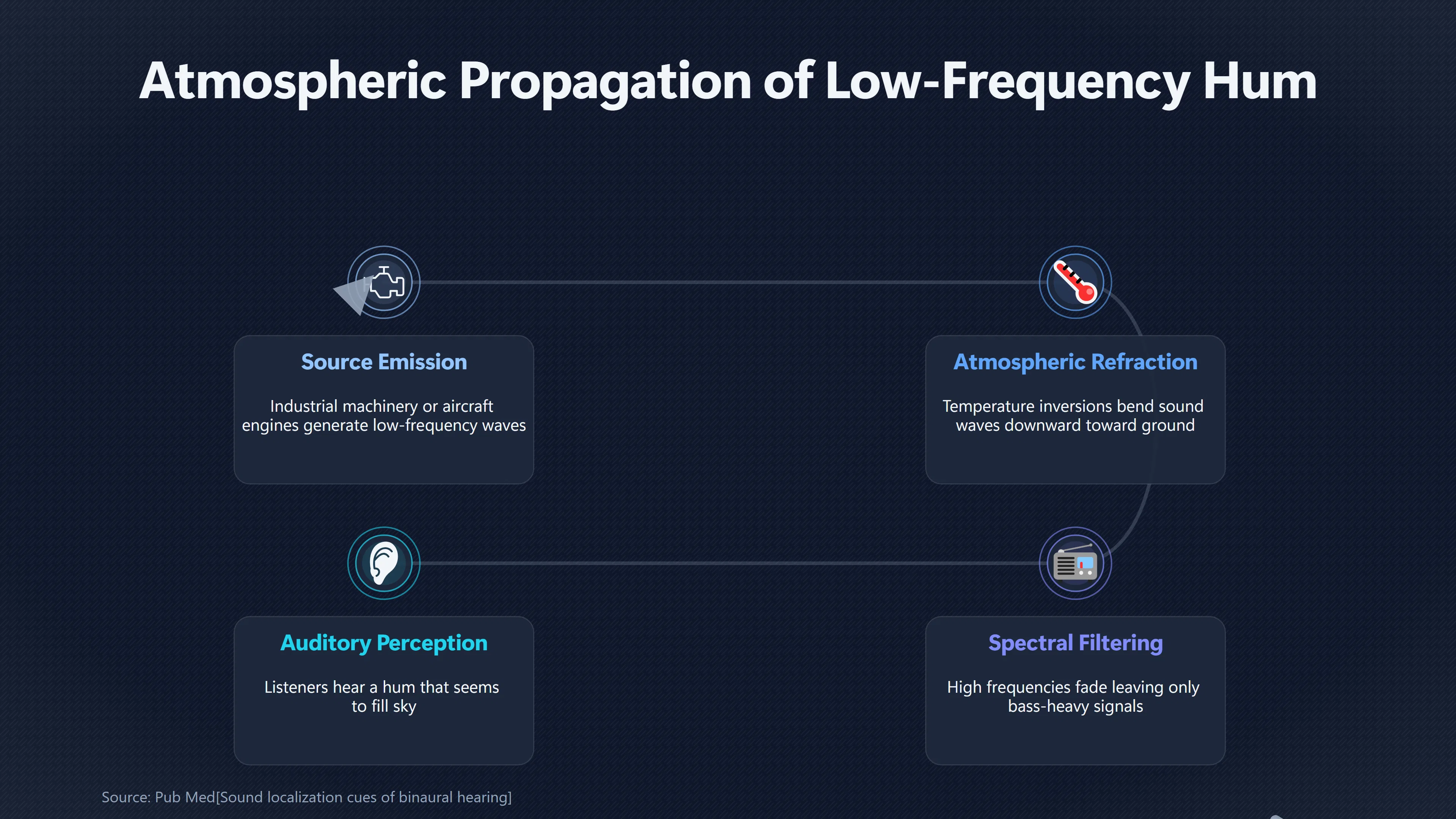
Atmospheric refraction does not merely carry sound farther. It also changes the path by which sound reaches the listener.
Temperature inversions and wind-speed gradients can bend sound downward over long distances, allowing machinery, aircraft engines or heavy traffic to remain audible far beyond their expected range. By the time these waves arrive, they may have followed curved paths through multiple layers of air rather than travelling directly from the source. Their timing, phase relationships and mixture of frequencies therefore differ from what the auditory system expects for a nearby source.[NCBI]ncbi.nlm.nih.govNCBIBasics of Sound, the Ear, and HearingHearing Loss - NCBI Bookshelf…
Low-frequency energy is particularly resistant to atmospheric absorption, allowing it to survive these long propagation paths better than higher-frequency components. As the higher frequencies fade, the listener is left with a smoother, bass-heavy signal containing fewer directional landmarks. The result is often described as a hum that seems to “fill the sky” rather than coming from a single point.[PubMed Central (PMC)]pmc.ncbi.nlm.nih.govPub Med Central (PMC)Auditory localization: a comprehensive practical reviewPubMed Central (PMC)Auditory localization: a comprehensive practical review - PMCJuly 10, 2024…
Importantly, refraction does not create new sounds or make them intrinsically directionless. Instead, it reduces the reliability of the cues that humans normally use to identify direction.
Why distant hums can seem overhead or everywhere
Several mechanisms can combine simultaneously.
First, a distant industrial fan, compressor, motorway or aircraft engine may be refracted back towards the ground by an inversion layer.
Second, because low frequencies spread efficiently around obstacles and terrain, reflections from buildings, hills or woodland may arrive alongside the direct wave. These overlapping arrivals reduce the contrast between the ears even further.
Third, the remaining signal often contains little high-frequency detail. Without those spectral cues from the outer ear, the brain has difficulty distinguishing whether the source is above, behind or far away.[PubMed Central (PMC)]pmc.ncbi.nlm.nih.govPub Med Central (PMC)Auditory localization: a comprehensive practical reviewPubMed Central (PMC)Auditory localization: a comprehensive practical review - PMCJuly 10, 2024…
These factors explain why eyewitnesses sometimes describe a deep humming sound as:
- directly overhead despite an empty sky;
- surrounding an entire neighbourhood;
- impossible to point towards;
- apparently unchanged while walking several hundred metres.
Such descriptions are genuine perceptual experiences, but they do not reliably indicate the physical position of the source.
Practical checks for locating a persistent outdoor hum
A persistent low-frequency hum can still be investigated systematically, even though localisation is difficult.
Move a significant distance. Walking tens rather than just a few metres may reveal changes hidden by local reflections. If the apparent direction never changes, the sound may be arriving through multiple propagation paths rather than directly.
Compare different elevations. Listening from an upstairs window, an open field or a sheltered valley can alter the balance between direct and refracted sound. Marked changes suggest atmospheric or terrain effects.
Listen at different times. Temperature inversions commonly strengthen after sunset and weaken after sunrise. A hum that becomes much clearer on calm nights than during windy afternoons is consistent with atmospheric propagation changes rather than a new source appearing. Atmospheric conditions can substantially alter long-distance audibility from one period to the next.[NCBI]ncbi.nlm.nih.govNCBIBasics of Sound, the Ear, and HearingHearing Loss - NCBI Bookshelf…
Look for broadband clues. If only a narrow bass tone remains while higher-pitched components disappear, distance and atmospheric filtering may be responsible. A nearby machine usually produces a broader spectrum of audible frequencies.
Compare with independent information. Flight-tracking services, industrial operating schedules or traffic patterns may identify ordinary sources active at the relevant time. This should be treated as corroborating evidence rather than proof, because several distant sources can overlap acoustically.

What this means for reports of unexplained sky hums
Low-frequency humming illustrates an important limitation of human perception rather than evidence for an unusual aerial object. The combination of long wavelengths, weak directional cues and atmospheric refraction can produce a compelling illusion of a sound that is overhead, omnipresent or impossible to trace.
For investigations of alleged UFO noises, this means witness confidence about hearing a hum should not automatically be interpreted as confidence about where it originated. Deep outdoor sounds are among the least reliable for directional judgement, particularly under calm nighttime conditions that favour long-range propagation. Recognising this distinction helps explain why sincere observers may report mysterious sky-filling hums even when the ultimate source is an ordinary aircraft, distant industrial installation or other conventional low-frequency emitter.[nih.gov]pubmed.ncbi.nlm.nih.govPub Med[Sound localization cues of binaural hearingPubMed[Sound localization cues of binaural hearing] - PubMed…
Amazon book picks
Further Reading
Books and field guides related to Why Low Hums Seem to Fill the Sky. Use these as the next step if you want deeper reading beyond the article.
An Introduction to the Psychology of Hearing
Now available in a Fourth Edition, Introduction to the Psychology of Hearing is the leading textbook in the field of auditory perception-...

Spatial Hearing: The Psychophysics of Human Sound Localization
The field of spatial hearing has exploded in the decade or so since Jens Blauert's classic work on acoustics was first published in Engli...
Auditory Perception: An Analysis and Synthesis
This revised and updated third edition describes the nature of sound, how sound is analyzed by the auditory system, and the rules and pri...
Why You Hear What You Hear: An Experiential Approach to Sound...
First published 2012.
eBay marketplace picks
Marketplace Samples
Live-tested eBay searches with available results related to this page.
Selected fromUFO poster oneBay.co.uk.

Current eBay listing
VINTAGE UFO FLYING SAUCERS COMIC ADVERTISING A2 POSTER PRINT



Current eBay listing
I Want To Believe UFO Poster Giclée Fine Art Heavyweight Print
Endnotes
1.
Source: pubmed.ncbi.nlm.nih.gov
Title: Pub Med[Sound localization cues of binaural hearing]
Link:https://pubmed.ncbi.nlm.nih.gov/12717598/
Source snippet
PubMed[Sound localization cues of binaural hearing] - PubMed...
2.
Source: ncbi.nlm.nih.gov
Title: NCBIBasics of Sound, the Ear, and Hearing
Link:https://www.ncbi.nlm.nih.gov/books/NBK207834/?report=reader
Source snippet
Hearing Loss - NCBI Bookshelf...
3.
Source: pubmed.ncbi.nlm.nih.gov
Link:https://pubmed.ncbi.nlm.nih.gov/1564201/
Source snippet
The dominant role of low-frequency interaural time differences in sound localization - PubMed...
4.
Source: pubmed.ncbi.nlm.nih.gov
Title: Pub Med Sound localization by human listeners
Link:https://pubmed.ncbi.nlm.nih.gov/2018391/
Source snippet
Sound localization by human listeners - PubMed...
5.
Source: pmc.ncbi.nlm.nih.gov
Title: Pub Med Central (PMC)Auditory localization: a comprehensive practical review
Link:https://pmc.ncbi.nlm.nih.gov/articles/PMC11267622/
Source snippet
PubMed Central (PMC)Auditory localization: a comprehensive practical review - PMCJuly 10, 2024...
Published: July 10, 2024
6.
Source: sciencedirect.com
Title: Sound source localization
Link:https://www.sciencedirect.com/science/article/pii/S187972961830067X
Source snippet
August 1, 2018 — EUROPEAN ANNALS OF OTORHINOLARYNGOLOGY, HEAD AND NECK DISEASES Volume 135, Issue 4, August 2018, Pages 259...
Published: August 1, 2018
7.
Source: pmc.ncbi.nlm.nih.gov
Link:https://pmc.ncbi.nlm.nih.gov/articles/PMC4271773/
8.
Source: pmc.ncbi.nlm.nih.gov
Link:https://pmc.ncbi.nlm.nih.gov/articles/PMC3858499/
9.
Source: pmc.ncbi.nlm.nih.gov
Link:https://pmc.ncbi.nlm.nih.gov/articles/PMC34350/
10.
Source: pmc.ncbi.nlm.nih.gov
Link:https://pmc.ncbi.nlm.nih.gov/articles/PMC4172152/
11.
Source: pmc.ncbi.nlm.nih.gov
Link:https://pmc.ncbi.nlm.nih.gov/articles/PMC27804/
12.
Source: pubmed.ncbi.nlm.nih.gov
Link:https://pubmed.ncbi.nlm.nih.gov/9600989/
13.
Source: pubmed.ncbi.nlm.nih.gov
Link:https://pubmed.ncbi.nlm.nih.gov/30599662/
Additional References
14.
Source: students.aip.org
Title: physics puzzler sound reasons the answers
Link:https://students.aip.org/observer/physics-puzzler-sound-reasons-the-answers
Source snippet
Puzzler: Sound Reasons: The AnswersFebruary 1, 2016 — PHYSICS PUZZLER: SOUND REASONS: THE ANSWERS FEB 01, 2016 Shouting at the Wind Donal...
Published: February 1, 2016
15.
Source: link.springer.com
Title: If the sound propagates under w
Link:https://link.springer.com/chapter/10.1007/978-3-030-97540
Source snippet
springer.comSource-Path-Receiver Model for Airborne Sounds | Springer Nature LinkOctober 4, 2022 — 5.2.7 SPEED OF SOUND IN STILL AIR The...
Published: October 4, 2022
16.
Source: youtube.com
Title: Where is Sound Coming From? | How Humans Use Sound LOCALIZATION
Link:https://www.youtube.com/watch?v=dnDrAG8FZok
Source snippet
Surround Sound With Headphones?? | HRTF & Binaural Audio Explained...
17.
Source: youtube.com
Title: Interaural Time Difference and Interaural Level Difference
Link:https://www.youtube.com/watch?v=7-tJoSS5fmg
Source snippet
Where is Sound Coming From? | How Humans Use Sound LOCALIZATION...
18.
Source: link.springer.com
Link:https://link.springer.com/chapter/10.1007/978-3-030-44787
Source snippet
springer.comReflection, Transmission, and Refraction | Springer Nature LinkNovember 3, 2020 — 11.4 CONSTANT SOUND SPEED GRADIENTS To this...
Published: November 3, 2020
19.
Source: youtube.com
Title: The Mysterious Hum
Link:https://www.youtube.com/watch?v=xYPtgsV3Icc
Source snippet
Interaural Time Difference and Interaural Level Difference...
20.
Source: sciencedirect.com
Link:https://www.sciencedirect.com/science/article/abs/pii/S0378595509001580
21.
Source: sciencedirect.com
Link:https://www.sciencedirect.com/science/article/pii/S0022460X78800339
22.
Source: resource.isvr.soton.ac.uk
Link:https://resource.isvr.soton.ac.uk/FDAG/VAP/html/localisation.html
23.
Source: sciencedirect.com
Title: The localisation of spectrally restricted sounds by human listeners
Link:https://www.sciencedirect.com/science/article/abs/pii/S0378595598002056