Within Perception
Why Confident UFO Sound Memories Can Still Be Wrong
A witness can become highly certain about a UFO noise even when timing, source or descriptive details have shifted in memory.
On this page
- How confidence grows through repeated recall
- Why confidence and accuracy can diverge
- What investigators should ask beyond certainty
Page outline Jump by section
Introduction
A witness who is absolutely certain that a UFO emitted a humming, buzzing or mechanical sound may be giving a sincere account, but confidence alone does not establish that every remembered detail is accurate. Decades of psychological research show that confidence and memory accuracy are related in complex ways. Under some carefully controlled conditions, an immediate, uncontaminated memory can be both highly confident and highly accurate. However, confidence can also increase after repeated retelling, discussion, media exposure or suggestive questioning even when specific details have drifted from the original experience. This distinction is especially important when evaluating reports of unusual sounds associated with unidentified aerial phenomena (UAP), where the sound source, timing and acoustic characteristics are often difficult to verify.[Association for Psychological Science]psychologicalscience.orgAssociation for Psychological ScienceThe Relationship Between Eyewitness Confidence and Identification Accuracy: A New Synthesis - Psycho…
How confidence grows through repeated recall
Memory is not a fixed recording that is replayed unchanged. Each act of remembering involves reconstruction, and the recalled version can become the basis for later memories. As a result, people often become more fluent and more certain when describing an event repeatedly, even if some details have gradually changed.[Wiley Online Library]onlinelibrary.wiley.comWiley Online LibraryRepeated recall, retention interval and the accuracy–confidence relation in eyewitness memory - Odinot - 2006 - Appli…
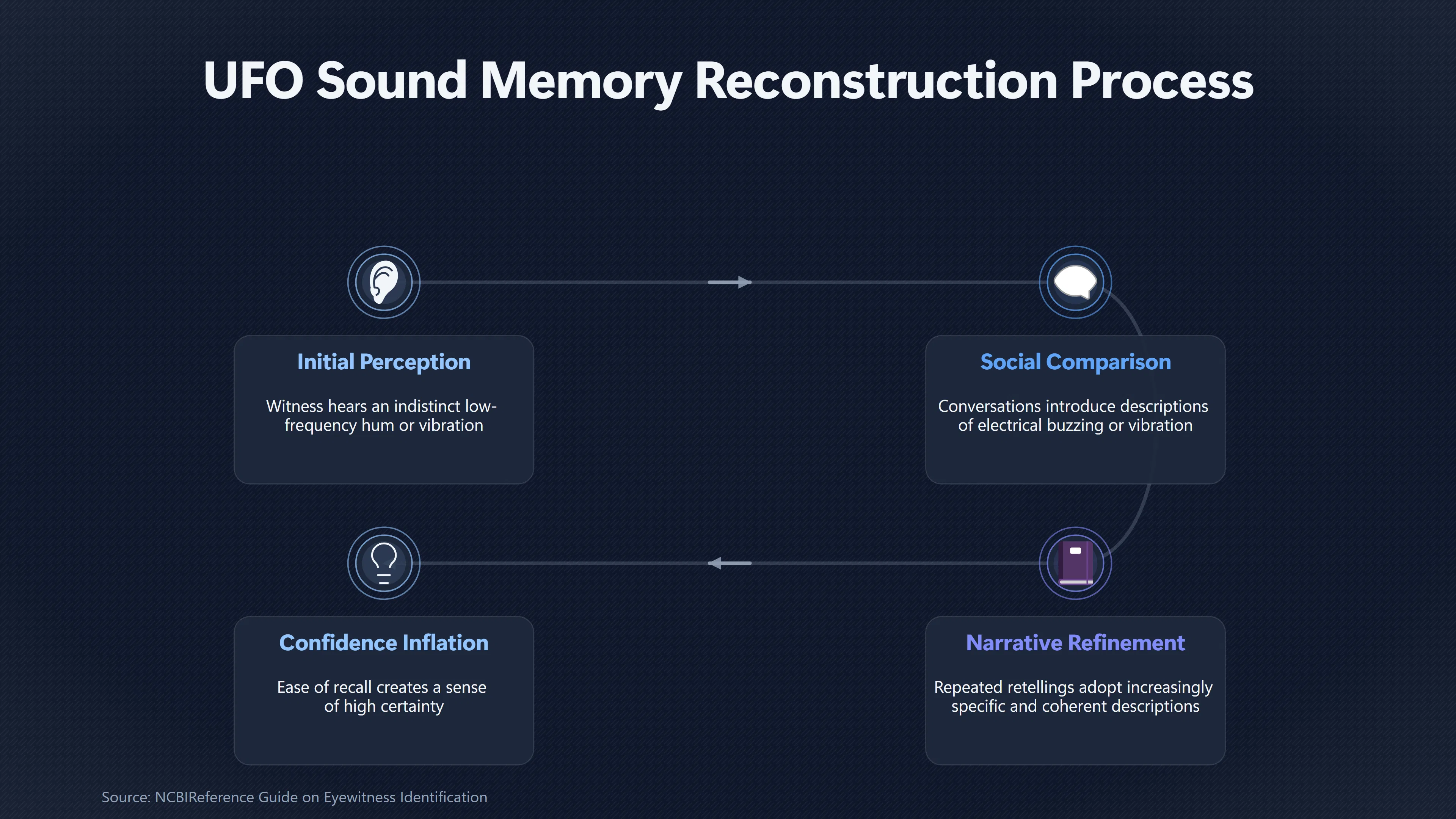
For reports of alleged UFO sounds, this process may unfold over weeks or years:
- A witness initially recalls hearing an indistinct low-frequency hum.
- Later conversations encourage comparison with other UFO reports mentioning electrical buzzing or vibration.
- Subsequent retellings adopt increasingly specific descriptions.
- The story becomes easier to recall, and that ease is experienced as confidence rather than as evidence that the memory has remained unchanged.
Research on eyewitness memory has found that repetition itself can increase confidence in misinformation. Repeated exposure to the same claim makes it feel more familiar and believable, even when the claim originated after the original event rather than during it.[ScienceDirect]sciencedirect.comRepetition, not number of sources, increases both susceptibility to misinformation and confidence in the accuracy of eyewitn…
This does not imply deliberate exaggeration. Instead, confidence often reflects how coherent and well-rehearsed a memory has become rather than whether every remembered sound matches what was originally heard.
Why confidence and accuracy can diverge
The relationship between confidence and accuracy is more nuanced than the simple assumption that “confident means correct” or “confident means unreliable.” Psychological research shows both positions are too simplistic.[Association for Psychological Science]psychologicalscience.orgAssociation for Psychological ScienceThe Relationship Between Eyewitness Confidence and Identification Accuracy: A New Synthesis - Psycho…
Several mechanisms can produce a gap between certainty and sound accuracy.
Source confusion
People may accurately remember hearing a sound while becoming less certain where that sound originated. A distant aircraft engine, industrial machinery, insects or wind-induced vibration may later become mentally linked with the unusual object that was being observed.
The memory of the sound itself may remain genuine, while the remembered source gradually shifts through repeated reconstruction. This phenomenon, often discussed as source monitoring or source confusion, is well established in memory research and becomes more likely when events are unexpected or ambiguous.[NCBI]ncbi.nlm.nih.govNCBIReference Guide on Eyewitness IdentificationReference Manual on Scientific Evidence - NCBI Bookshelf…
Confidence inflation after feedback
Confidence can increase when witnesses receive explicit or implicit confirmation from others.
Examples include:
- investigators appearing to endorse a description;
- friends reporting similar experiences;
- reading published UFO accounts that resemble one’s own;
- online discussions reinforcing a particular interpretation.
Eyewitness research shows that confirming feedback can substantially inflate confidence without improving underlying memory accuracy. This is one reason forensic psychologists recommend recording a witness’s initial confidence before outside influences accumulate.[American Psychological Association]apa.orgAmerican Psychological Association Eyewitness accuracy in police lineupsAmerican Psychological AssociationEyewitness accuracy in police lineupsApril 1, 2014…
Narrative coherence
Humans naturally prefer a coherent story over disconnected observations.
Instead of remembering:
“I saw an unusual light, and separately I heard an unfamiliar noise.”
people often come to remember:
“The object made a loud electrical hum.”
The second version is easier to understand, easier to tell and therefore easier to remember confidently, even if the original evidence linking the sound to the object was uncertain.[NCBI]ncbi.nlm.nih.govNCBIReference Guide on Eyewitness IdentificationReference Manual on Scientific Evidence - NCBI Bookshelf…
Evidence from eyewitness research
Most scientific evidence on confidence and memory comes from eyewitness studies rather than UFO investigations specifically. Although identifying a suspect differs from recalling an unexplained aerial event, the underlying cognitive processes are highly relevant.
Early research consistently found that confidence alone was a poor predictor of whether individual memories were accurate. In some experiments, the statistical relationship between confidence and correctness was surprisingly weak, demonstrating that people could express high certainty about incorrect recollections.[PubMed]pubmed.ncbi.nlm.nih.govEyewitness accuracy and confidence: within- versus between-subjects correlations - PubMed…
More recent work has refined that conclusion rather than overturning it. Studies indicate that an immediate confidence judgement made under carefully controlled conditions—before feedback, repeated interviews or contamination—can provide useful information about accuracy. Once memories have been repeatedly discussed or influenced by later information, however, confidence becomes much less informative because it may have been inflated independently of memory accuracy.[Association for Psychological Science]psychologicalscience.orgAssociation for Psychological ScienceThe Relationship Between Eyewitness Confidence and Identification Accuracy: A New Synthesis - Psycho…
For historical UFO cases, witnesses are frequently interviewed days, months or even decades after the reported event. By then, opportunities for memory reconstruction are far greater than in the controlled conditions where confidence has stronger evidential value.
What investigators should ask beyond certainty
Because confidence and accuracy are not identical, investigators examining reported UFO sounds should treat certainty as one piece of evidence rather than as proof.
More informative questions include:
- When was the sound first noticed? Determining whether the sound preceded, coincided with or followed the visual observation helps separate perception from later reconstruction.
- How was the sound described immediately after the event? Contemporary notes or recordings are generally more informative than memories recalled years later.
- Could the witness identify the sound’s direction? Humans often struggle to localise low-frequency or distant sounds accurately.
- Has the description changed over time? Comparing early and later accounts can reveal whether details became more elaborate through repeated recall.
- Were there possible conventional sound sources? Nearby aircraft, traffic, industrial equipment, wildlife or weather conditions should be considered before attributing a sound to the observed object.
These questions do not assume the witness is mistaken. Instead, they recognise that sincerity and memory precision are separate issues.

Confidence is evidence of belief, not proof of acoustic reality
A highly confident witness should not be dismissed simply because memory can change. Confidence provides valuable evidence that the person genuinely believes their account and may indicate that the experience was emotionally significant. What it cannot do, by itself, is verify that every remembered acoustic detail—including the timing, source, loudness or character of an alleged UFO noise—accurately reflects the original event.
For reports of unexplained aerial sounds, the strongest assessments combine witness testimony with contemporaneous notes, multiple independent observations, environmental conditions, audio recordings and other corroborating evidence whenever available. Confidence contributes to that assessment, but it cannot substitute for independent verification of what was actually heard.[psychologicalscience.org]psychologicalscience.orgAssociation for Psychological ScienceThe Relationship Between Eyewitness Confidence and Identification Accuracy: A New Synthesis - Psycho…
Amazon book picks
Further Reading
Books and field guides related to Why Confident UFO Sound Memories Can Still Be Wrong. Use these as the next step if you want deeper reading beyond the article.
The Seven Sins of Memory
Rating: 3.5/5 from 5 Google Books ratings
A New York Times Notable Book: A psychologist's "gripping and thought-provoking" look at how and why our brains sometimes fail us (Steven...
The Memory Illusion
THE INTERNATIONAL BESTSELLER 'Truly fascinating.' Steve Wright, BBC Radio 2 - Have you ever forgotten the name of someone you’ve met doze...
Remember: The Science of Memory and the Art of Forgetting
NEW YORK TIMES BESTSELLER • A fascinating exploration of the intricacies of how we remember, why we forget, and what we can do to protect...
eBay marketplace picks
Marketplace Samples
Live-tested eBay searches with available results related to this page.
Selected fromUFO poster oneBay.co.uk.

Current eBay listing
VINTAGE UFO FLYING SAUCERS COMIC ADVERTISING A2 POSTER PRINT


Current eBay listing
I Want To Believe UFO Poster Giclée Fine Art Heavyweight Print

Endnotes
1.
Source: ncbi.nlm.nih.gov
Title: NCBIReference Guide on Eyewitness Identification
Link:https://www.ncbi.nlm.nih.gov/books/NBK621592/
Source snippet
Reference Manual on Scientific Evidence - NCBI Bookshelf...
2.
Source: onlinelibrary.wiley.com
Link:https://onlinelibrary.wiley.com/doi/abs/10.1002/acp.1263
Source snippet
Wiley Online LibraryRepeated recall, retention interval and the accuracy–confidence relation in eyewitness memory - Odinot - 2006 - Appli...
3.
Source: sciencedirect.com
Link:https://www.sciencedirect.com/science/article/pii/S000169181100223X
Source snippet
Repetition, not number of sources, increases both susceptibility to misinformation and confidence in the accuracy of eyewitn...
4.
Source: sciencedirect.com
Link:https://www.sciencedirect.com/science/article/pii/S0005791623000228
Source snippet
December 1, 2023 — JOURNAL OF BEHAVIOR THERAPY AND EXPERIMENTAL PSYCHIATRY Volume 81, December 2023, 101855 MEMORY CONFIDENC...
Published: December 1, 2023
5.
Source: onlinelibrary.wiley.com
Link:https://onlinelibrary.wiley.com/doi/abs/10.1002/acp.1443
6.
Source: psychologicalscience.org
Link:https://www.psychologicalscience.org/journals/pspi/1529100616686966/
Source snippet
Association for Psychological ScienceThe Relationship Between Eyewitness Confidence and Identification Accuracy: A New Synthesis - Psycho...
7.
Source: pubmed.ncbi.nlm.nih.gov
Link:https://pubmed.ncbi.nlm.nih.gov/22257711/
8.
Source: apa.org
Title: American Psychological Association Eyewitness accuracy in police lineups
Link:https://www.apa.org/topics/forensics-law-public-safety/eyewitness-accuracy-police-lineups
Source snippet
American Psychological AssociationEyewitness accuracy in police lineupsApril 1, 2014...
Published: April 1, 2014
9.
Source: pubmed.ncbi.nlm.nih.gov
Link:https://pubmed.ncbi.nlm.nih.gov/2708267/
Source snippet
Eyewitness accuracy and confidence: within- versus between-subjects correlations - PubMed...
10.
Source: pmc.ncbi.nlm.nih.gov
Link:https://pmc.ncbi.nlm.nih.gov/articles/PMC6450142/
11.
Source: psychologicalscience.org
Link:https://www.psychologicalscience.org/publications/journals/eyewitness-identification.html
12.
Source: pubmed.ncbi.nlm.nih.gov
Link:https://pubmed.ncbi.nlm.nih.gov/26348334/
13.
Source: pmc.ncbi.nlm.nih.gov
Link:https://pmc.ncbi.nlm.nih.gov/articles/PMC3269835/
14.
Source: pubmed.ncbi.nlm.nih.gov
Link:https://pubmed.ncbi.nlm.nih.gov/10932793/
Additional References
15.
Source: journals.sagepub.com
Link:https://journals.sagepub.com/doi/abs/10.1111/1467-8721.00189
Source snippet
Sage JournalsThe Confidence of Eyewitnesses in Their Identifications From Lineups - Gary L. Wells, Elizabeth A. Olson, Steve D. Charman...
16.
Source: wrap.warwick.ac.uk
Link:https://wrap.warwick.ac.uk/id/eprint/160579/
Source snippet
and Wade, Kimberley A. (2022) Long retention intervals impair the confidence-accuracy re...
17.
Source: youtube.com
Title: Why incompetent people think they’re amazing
Link:https://www.youtube.com/watch?v=pOLmD_WVY-E
Source snippet
Eyewitness confidence accuracy memory loftus Using Confidence Judgements Provided During Versus After Memory Retrieval to Predict Eyewitness...
18.
Source: ojp.gov
Link:https://ojp.gov/ncjrs/virtual-library/abstracts/influence-confidence-inflation-and-explanations-changes-confidence
19.
Source: youtube.com
Title: How We Make Memories: Crash Course Psychology #13
Link:https://www.youtube.com/watch?v=bSycdIx-C48
Source snippet
Are all of your memories real? - Daniel L. Schacter...
20.
Source: researchers.westernsydney.edu.au
Link:https://researchers.westernsydney.edu.au/en/publications/repetition-not-number-of-sources-increases-both-susceptibility-to/
21.
Source: researchgate.net
Title: (PDF) The Confidence of Eyewitnesses in Their Identifications From Lineups
Link:https://www.researchgate.net/publication/235355593_The_Confidence_of_Eyewitnesses_in_Their_Identifications_From_Lineups
22.
Source: youtube.com
Title: The Science of Thinking
Link:https://www.youtube.com/watch?v=UBVV8pch1dM
Source snippet
Why incompetent people think they're amazing - David Dunning...
23.
Source: youtube.com
Title: Are all of your memories real?
Link:https://www.youtube.com/watch?v=D-2p86FvqF4
Source snippet
Elizabeth F. Loftus - False Memories...
24.
Source: youtube.com
Title: Elizabeth F. Loftus
Link:https://www.youtube.com/watch?v=CSo_esEgIjc
Source snippet
The Science of Thinking...