Within Sound Reports
Why Do Nearby UFO Reports So Often Mention Silence?
Reported silence can seem extraordinary, but distance errors, wind, terrain and nighttime scale confusion can all reduce audible sound.
On this page
- How often witnesses report silence
- Ordinary reasons sound may not reach an observer
- Why silence is not proof of unusual propulsion
Page outline Jump by section
Introduction
One of the most frequently repeated claims in UFO reports is that an object appeared surprisingly close, moved rapidly, or hovered overhead without producing any obvious sound. In UFO literature, silence is often presented as one of the phenomenon’s most striking characteristics. However, silence alone is not unusual enough to demonstrate that an object used unconventional propulsion. Acoustics, human perception, and errors in judging distance all provide well-understood reasons why an apparently nearby object may seem silent.

Investigators therefore treat reported silence as an observation that deserves explanation rather than as evidence in itself. It becomes meaningful only when considered alongside independently verified information about an object’s distance, speed, environment and the reliability of the witness’s estimates.
How Often Do Witnesses Report Silence?
Historical collections of UFO reports consistently show that witnesses frequently describe seeing no accompanying engine or propulsion noise. The British UFO Research Association (BUFORA), for example, notes that a large majority of reported UFOs are described as silent, making silence one of the most commonly reported acoustic characteristics in the field.
That consistency is interesting because it appears across many decades and many different types of reported objects. Yet the reports vary enormously in other respects. Some witnesses describe slow-moving lights, others fast-moving objects, and others stationary shapes. The only common factor is often the absence of an obvious sound rather than the presence of any distinctive one.
The important limitation is that these accounts almost always rely on subjective estimates of distance and size. Without independent measurements, investigators cannot determine whether an object was genuinely nearby or only appeared so.
Why Apparently Nearby Objects May Produce Little or No Audible Sound
Several ordinary mechanisms can make an object seem much quieter than expected.
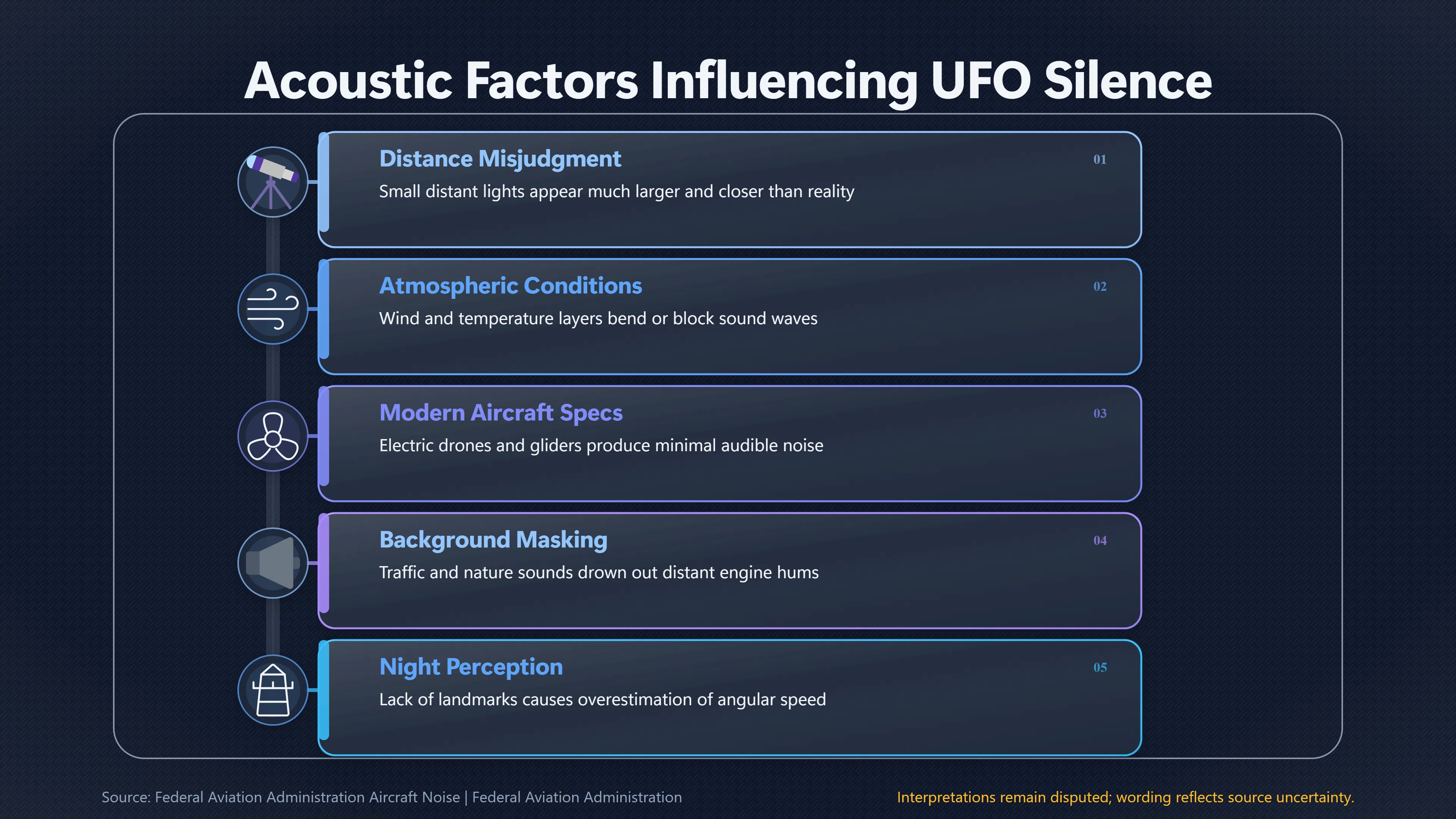
Distance Is Commonly Misjudged
Human observers are poor at estimating the distance of isolated lights against a dark sky. Without familiar visual references, a small distant light can appear to be a much larger nearby object.
If the object is actually several kilometres away rather than a few hundred metres away, its sound may have weakened below the listener’s hearing threshold before reaching the observer. This is especially relevant at night, when depth cues are reduced and apparent size becomes a poor guide to actual range.
Wind and Atmospheric Conditions
Sound does not travel uniformly in every direction. Wind can carry sound away from an observer, while temperature layers in the atmosphere can bend sound upward or downward. Terrain, trees and buildings also absorb or block sound.
These effects explain why aircraft that are plainly visible sometimes seem unexpectedly quiet, while others sound much louder than their appearance would suggest. Aviation noise specialists have long recognised that weather, flight path and atmospheric conditions strongly influence what people hear on the ground.[Federal Aviation Administration]faa.govFederal Aviation Administration Aircraft Noise | Federal Aviation AdministrationFederal Aviation AdministrationAircraft Noise | Federal Aviation AdministrationJanuary 31, 2025…
Modern Aircraft Can Be Quieter Than People Expect
Many people’s expectations are shaped by older jet aircraft or helicopters. Modern aircraft, electric drones and gliders may produce considerably less noise under some conditions than observers anticipate.
An aircraft travelling towards an observer at altitude may also appear visually prominent before its sound arrives, while one moving away can become difficult to hear much sooner than expected. Aircraft noise is therefore not determined solely by engine power but also by direction, altitude, atmospheric conditions and the listener’s location.[Federal Aviation Administration]faa.govFederal Aviation Administration Aircraft Noise | Federal Aviation AdministrationFederal Aviation AdministrationAircraft Noise | Federal Aviation AdministrationJanuary 31, 2025…
Background Noise Masks Weak Sounds
Witnesses often recall a dramatic visual event but overlook the existing acoustic environment. Wind through trees, road traffic, rivers, insects, surf or urban noise can mask quieter sounds.
Conversely, rural settings that feel “very quiet” are rarely acoustically silent. Low-level environmental sounds can make distant engines harder to distinguish than intuition suggests.
Night-Time Perception Can Exaggerate the Mystery
Many UFO reports occur after dark, when estimating speed, altitude and distance becomes substantially more difficult.
Several perceptual effects contribute:
- Bright lights against a dark background often appear closer than they are.
- Without landmarks, observers can overestimate angular speed and underestimate distance.
- A slow-moving distant object may appear to be a fast-moving nearby one.
- Brief observations leave little opportunity to compare visual and auditory cues.
If the observer unconsciously places the object much closer than it actually is, silence naturally seems far more surprising.
Why Silence Does Not Demonstrate Unusual Propulsion
It is tempting to argue that a genuinely nearby fast-moving object should necessarily produce loud engine noise. That conclusion depends on assumptions that are rarely established in eyewitness reports.
For silence to become strong evidence of something unusual, investigators would need reliable confirmation of several facts simultaneously:
- the object’s true distance;
- its actual speed;
- whether it possessed any conventional propulsion system;
- whether atmospheric conditions favoured sound transmission;
- whether competing environmental noise masked quieter sounds.
Eyewitness reports seldom provide enough objective information to establish all of these factors independently. Consequently, silence by itself cannot distinguish between an ordinary but misidentified object and an unidentified one.
This does not mean every report is explained. Rather, it means that the reported absence of sound is not diagnostically unique. The same observation can arise through several ordinary physical and perceptual mechanisms.

What Investigators Can Learn From Silent Reports
Although silence is not proof of unconventional technology, it still has value as part of a complete witness account.
Investigators compare reported silence with other observations, including estimated range, weather conditions, radar information, known aircraft movements and the testimony of multiple independent witnesses. When several observers at different locations report the same event, differences in what each person heard can sometimes reveal more about local acoustic conditions than about the object itself.
For that reason, silence is best treated as one observational detail rather than a defining characteristic. It remains one of the most frequently reported features of UFO sightings, but its evidential weight depends on whether the surrounding circumstances support the claim that the object was genuinely close enough that audible sound would reasonably have been expected.
Amazon book picks
Further Reading
Books and field guides related to Why Do Nearby UFO Reports So Often Mention Silence?. Use these as the next step if you want deeper reading beyond the article.
The UFO Handbook: A Guide to Investigating, Evaluating, and R...
An explanation of the usual reasons for confusing IFOs (identified flying objects) with UFOs and a survey of the tools used to investigat...
The UFO Experience: A Scientific Inquiry
Cited by the New York Review of Books as "the best brief for visitation," this classic study presents an analysis of UFO reports and conc...
UFOs Explained
Analyzing several UFO cases, the author exposes the myth of extraterrestrial visitors to earth.
Why You Hear What You Hear: An Experiential Approach to Sound...
First published 2012.
eBay marketplace picks
Marketplace Samples
Live-tested eBay searches with available results related to this page.
Selected fromUFO poster oneBay.co.uk.

Current eBay listing
I Want To Believe UFO Poster Giclée Fine Art Heavyweight Print



Current eBay listing
VINTAGE UFO FLYING SAUCERS COMIC ADVERTISING A2 POSTER PRINT
Endnotes
1.
Source: faa.gov
Title: Federal Aviation Administration Aircraft Noise | Federal Aviation Administration
Link:https://www.faa.gov/noise/aircraft_noise
Source snippet
Federal Aviation AdministrationAircraft Noise | Federal Aviation AdministrationJanuary 31, 2025...
Published: January 31, 2025
2.
Source: faa.gov
Link:https://www.faa.gov/regulations_policies/policy_guidance/noise/basics
3.
Source: faa.gov
Title: Noise | Federal Aviation Administration
Link:https://www.faa.gov/noise
Source snippet
While there are many benefits to air travel, aviation noise can be a concern for communities. The FAA is limited b...
4.
Source: faa.gov
Title: Fundamentals of Noise and Sound | Federal Aviation Administration
Link:https://www.faa.gov/noise/aviation_noise/fundamentals_of_noise
Source snippet
July 22, 2022 — FUNDAMENTALS OF NOISE AND SOUND * Using the Day-Night Average Sound Level * Comparative Noise Levels * Annoyance Due to N...
Published: July 22, 2022
5.
Source: faa.gov
Title: airports every day. Noise from aircraft, however, may
Link:https://www.faa.gov/noise/aviation_noise
Source snippet
Aviation Noise | Federal Aviation AdministrationJuly 22, 2022 — AVIATION NOISE FAA FACT SHEETS Aviation enables Americans to move safely...
Published: July 22, 2022
6.
Source: faa.gov
Title: Aviation Noise | Federal Aviation Administration
Link:https://www.faa.gov/regulations_policies/policy_guidance/noise
7.
Source: faa.gov
Title: Community Response to Noise | Federal Aviation Administration
Link:https://www.faa.gov/regulations_policies/policy_guidance/noise/community
8.
Source: acoustics.org
Title: 4th ASA/ASJ Joint Meeting Lay Language Papers
Link:https://acoustics.org/pressroom/httpdocs/152nd/wax.html
9.
Source: bufora.org.uk
Link:https://www.bufora.org.uk/about
10.
Source: energy.gov
Link:https://www.energy.gov/cmei/systems/windexchange/sound
Additional References
11.
Source: sciencedirect.com
Link:https://www.sciencedirect.com/science/article/pii/S0003682X25006590
Source snippet
March 1, 2026 — APPLIED ACOUSTICS Date: 1 March 2026 Article: 111187 Volume: Volume 245 PART OF SPECIAL ISSUE AIRCRAFT NOISE...
Published: March 1, 2026
12.
Source: youtube.com
Link:https://www.youtube.com/watch?v=WVcu3UREK7Y
Source snippet
The UFO Phenomenon | Full Documentary 2021 | 7NEWS Spotlight This video is relevant because it directly explores witness descriptions of...
13.
Source: youtube.com
Link:https://www.youtube.com/watch?v=1WwGGuQljl4
Source snippet
Alien Revelations in Our Solar System Marathon | Unidentified: Inside America's UFO Investigation...
14.
Source: ufouap.net
Title: Drone, Balloon or Satellite?
Link:https://www.ufouap.net/en/explainers/drones-[balloons
Source snippet
UFO Guide | Global UFO ArchiveJuly 16, 2026 — Evidence / Updated 2026-07-16 / 10 min read DRONES, BALLOONS, SATELLITES, AND UFO REPORTS...
Published: July 16, 2026
15.
Source: youtube.com
Title: Why the US government won’t explain what’s in our skies | Reality Check
Link:https://www.youtube.com/watch?v=HXOfCmMOvzQ
Source snippet
Revealing The Cover Up Of The [Unexplained]({{ 'unexplained/' | relative_url }}) 'Phoenix Lights' | UFO Conspiracies...
16.
Source: youtube.com
Link:https://www.youtube.com/watch?v=sm6AL5lA4Zc
Source snippet
Why the US government won't explain what's in our skies | Reality Check...
17.
Source: pubs.usgs.gov
Link:https://pubs.usgs.gov/publication/sir20245087/full
Source snippet
OPTIONS FOR ESTIMATING SOUND PROPAGATION We outline two options for estimating sound propagation in sections “3.2.1. Option 1—Estimate So...
18.
Source: sciencedirect.com
Link:https://www.sciencedirect.com/science/article/pii/S0003682X22004807
19.
Source: bufora.org.uk
Link:https://www.bufora.org.uk/investigations
20.
Source: sciencedirect.com
Link:https://www.sciencedirect.com/science/article/pii/S0022460X78800339