Within Drones
When the Drone Explanation Stops Fitting
A nearby silent object or one making sustained high-speed right-angle turns would be difficult to reconcile with known multirotor drones.
On this page
- Why nearby drones should usually be audible
- Motion claims beyond multirotor capability
- How distance errors can imitate impossible performance
Page outline Jump by section
Introduction
Most buzzing lights in the night sky can be explained by ordinary drones once distance, lighting and acoustics are taken into account. However, the drone explanation becomes increasingly difficult to sustain when reports combine two particular features: an object that appears genuinely close yet remains completely silent, or an object that performs manoeuvres well beyond the physical limits of known multirotor aircraft. Neither feature automatically proves that an unidentified object is extraordinary, because human observers can misjudge distance, speed and direction. Even so, these are among the strongest reasons investigators hesitate before attributing a sighting to a conventional drone. The key question is not whether a witness reported silence or extreme motion, but whether those observations remain consistent after considering known limitations of perception and the performance envelope of real aircraft.[Sage Journals]journals.sagepub.comSage JournalsAcoustic signature measurement of small multi-rotor unmanned aircraft systems - N Kloet, S Watkins, R Clothier, 2017February…
Why Nearby Drones Should Usually Be Audible
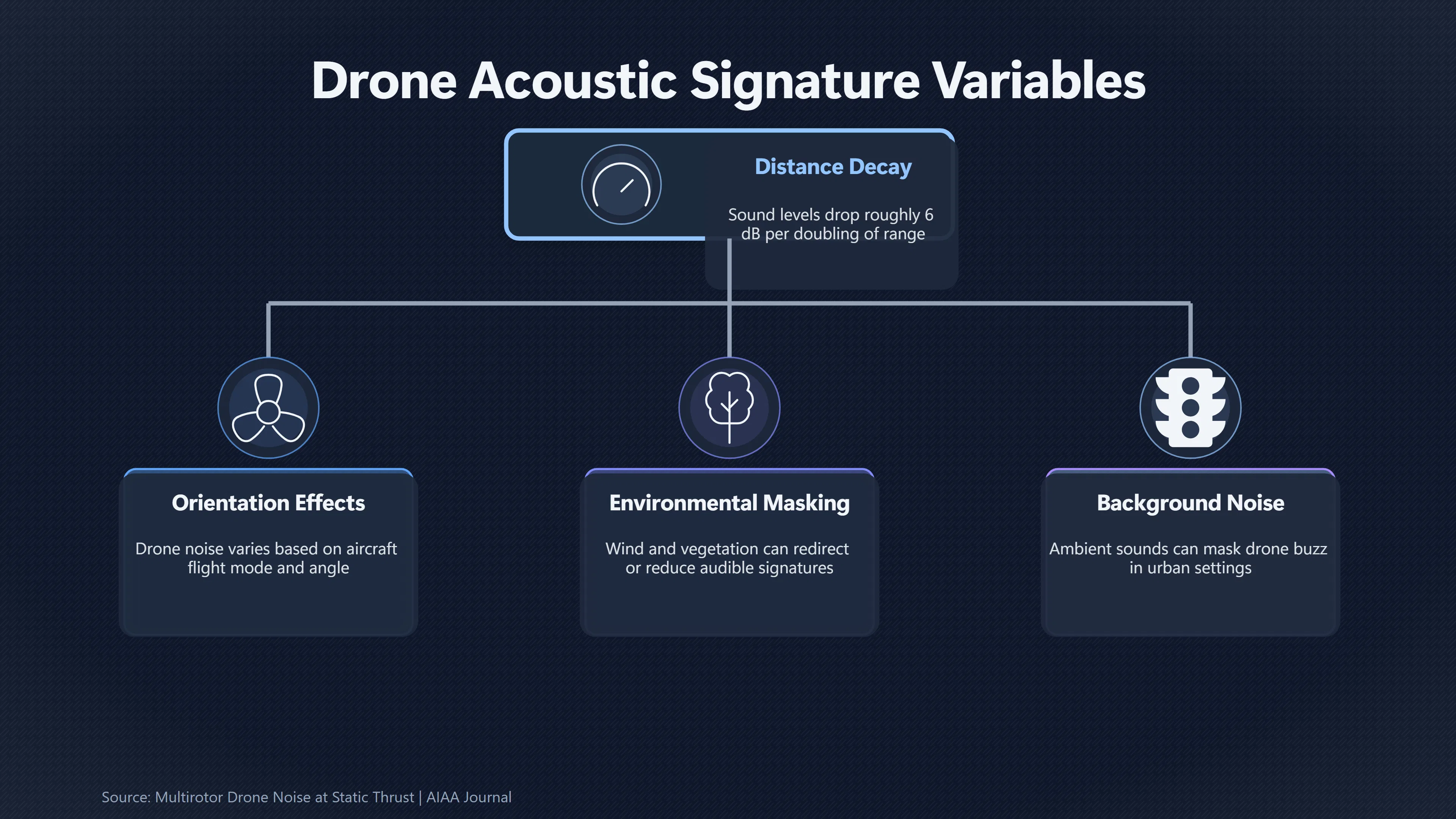
Small electric drones are quieter than helicopters, but they are not silent. Their characteristic sound comes from rapidly rotating propellers, producing a tonal, pulsing buzz that changes as motor speed varies. Acoustic measurements consistently show that sound level falls rapidly with distance—roughly 6 dB for each doubling of range under ideal conditions—but a drone that is genuinely nearby should normally still be detectable unless environmental factors interfere.[Sage Journals]journals.sagepub.comSage JournalsAcoustic signature measurement of small multi-rotor unmanned aircraft systems - N Kloet, S Watkins, R Clothier, 2017February…
Silence therefore becomes noteworthy when several conditions are met simultaneously:
- The object is estimated to be within tens of metres rather than hundreds.
- Background noise is low enough that ordinary environmental sounds are easily heard.
- The witness has an unobstructed line of sight.
- Wind direction or shielding cannot reasonably explain why sound failed to reach the observer.
Even then, caution is required. Modern research shows that drone noise is highly directional and depends on the aircraft’s orientation, flight mode and the observer’s position. A drone viewed from certain angles may sound noticeably quieter than one flying the same path from another direction. Wind, vegetation, buildings and terrain can further reduce or redirect the sound reaching a listener.[DOI.org]doi.orgMay 20, 2026…
This means that “I heard nothing” is not, by itself, decisive evidence against a drone. Instead, it becomes significant only when supported by reliable estimates that place the object close enough that its absence of sound would genuinely be unexpected.
Motion Claims Beyond Multirotor Capability
Consumer and professional multirotor drones are remarkably agile. They can hover precisely, climb rapidly, accelerate briskly and reverse direction much faster than conventional aircraft. These capabilities explain why inexperienced observers sometimes describe drone flight as unusual.
There are, however, reported behaviours that exceed what current multirotor designs can plausibly achieve. Examples commonly cited in UFO reports include:
- Instantaneous acceleration from stationary to extreme speed without visible transition.
- Sharp right-angle turns at high speed without slowing.
- Abrupt stops that appear to involve no braking distance.
- Sustained hypersonic-looking motion within the atmosphere.
- Rapid oscillations or repeated high-speed directional changes that would impose enormous inertial loads.
Such descriptions do not fit the known flight mechanics of battery-powered quadcopters or similar multirotor systems. Real drones must obey aerodynamic limits, thrust limits, battery constraints and structural loads. High-speed turns require banking, reduced speed or increased turning radius; they cannot simply ignore inertia. Even specialised racing drones, while exceptionally manoeuvrable, remain constrained by these physical requirements.
That does not automatically invalidate witness testimony. Instead, it shifts attention towards whether the reported motion reflects the object’s actual movement or the observer’s interpretation of what they saw.
How Distance Errors Can Imitate Impossible Performance
One of the largest sources of error in aerial observations is uncertainty about distance.
A light with no familiar background reference can appear much closer or farther away than it really is. Because perceived speed depends directly on estimated distance, even modest range errors can dramatically alter apparent performance.
For example:
- A distant aircraft crossing the sky can appear to “shoot away” if the observer assumes it is nearby.
- A small change in viewing angle may look like a sharp right-angle turn when the object is actually following a smooth curved path.
- Two separate lights switching attention between one another may be remembered as a single object making impossible jumps.
- Brief losses of visual contact behind cloud, trees or glare can create the impression of sudden acceleration or disappearance.
Psychologists studying visual perception have long recognised that humans estimate angular motion far more reliably than true speed or distance. Without accurate range information, even experienced observers can greatly overestimate acceleration and manoeuvrability.[Federal Aviation Administration]faa.govOpen source on faa.gov.
This is particularly important at night, when the object itself may be visible only as a bright point of light with few surrounding visual references.
When Silence and Extreme Motion Together Deserve Closer Attention
A report becomes more difficult to reconcile with an ordinary drone when multiple independent observations point in the same direction.
For example, investigators would pay closer attention if:
- Several observers at different locations independently reported the object as silent despite apparent close proximity.
- Video, radar or other sensor data supported unusually rapid manoeuvres rather than relying on visual impressions alone.
- Environmental conditions made acoustic masking unlikely.
- The reported motion remained inconsistent with known drone performance after careful reconstruction of distance, perspective and timing.
By contrast, a single witness estimating both extraordinary speed and complete silence from an unknown distance provides much weaker evidence. Human memory, perception and estimation errors can produce exactly this combination without requiring any unconventional aircraft.

A Balanced Interpretation
Silence and extreme manoeuvring are among the strongest observational challenges to a routine drone explanation, but neither feature is conclusive in isolation. Drone acoustics vary with direction, altitude and weather, while apparent speed and acceleration depend heavily on uncertain distance estimates. Research into drone noise confirms that real multirotors normally produce detectable acoustic signatures at close range, although those signatures are not equally audible from every direction or under every environmental condition.[sagepub.com]journals.sagepub.comSage JournalsAcoustic signature measurement of small multi-rotor unmanned aircraft systems - N Kloet, S Watkins, R Clothier, 2017February…
The most persuasive cases are therefore those in which careful investigation cannot reconcile multiple lines of evidence with known drone behaviour. Reports based solely on subjective impressions of silence or seemingly impossible motion remain intriguing, but they require corroboration before they can confidently be said to fall outside the capabilities of ordinary multirotor aircraft.
Amazon book picks
Further Reading
Books and field guides related to When the Drone Explanation Stops Fitting. Use these as the next step if you want deeper reading beyond the article.
Escaping the Rabbit Hole
Revised and updated for the first time in 2023—Now includes strategies for debunking conspiracies regarding the coronavirus pandemic, ele...
The UFO Experience
Cited by the New York Review of Books as “the best brief for visitation,” this classic study presents an analysis of UFO reports and conc...
The Demon-Haunted World
Rating: 4.5/5 from 43 Google Books ratings
NEW YORK TIMES BESTSELLER • From the renowned astronomer and author of Cosmos comes a “powerful [and] stirring defense of informed ration...
The Complete Book of Drones
Grâce à ce guide très illustré, vous allez acquérir toutes les compétences et les connaissances pour faire voler votre drone à la perfect...
eBay marketplace picks
Marketplace Samples
Live-tested eBay searches with available results related to this page.
Selected fromUFO art print oneBay.co.uk.



Endnotes
1.
Source: doi.org
Link:https://doi.org/10.2514/6.2026-3462
Source snippet
May 20, 2026...
Published: May 20, 2026
2.
Source: doi.org
Link:https://doi.org/10.1121/10.0024522
3.
Source: doi.org
Title: Multirotor Drone Noise at Static Thrust | AIAA Journal
Link:https://doi.org/10.2514/1.J056827
4.
Source: journals.sagepub.com
Link:https://journals.sagepub.com/doi/abs/10.1177/1756829316681868
Source snippet
Sage JournalsAcoustic signature measurement of small multi-rotor unmanned aircraft systems - N Kloet, S Watkins, R Clothier, 2017February...
5.
Source: faa.gov
Link:https://www.faa.gov/data_research/research/med_humanfacs/oamtechreports/1960s/1968/196810
6.
Source: faa.gov
Title: There’s More to VLOS Than Meets the Eye | Federal Aviation Administration
Link:https://www.faa.gov/blog/clearedfortakeoff/theres-more-vlos-meets-eye
Source snippet
Drones and helicopters regularly operate in the same environments. They perform many of the same operations, of...
7.
Source: hf.tc.faa.gov
Title: 2016 01 uas operational assessment visual compliance
Link:https://hf.tc.faa.gov/publications/2016-01-uas-operational-assessment-visual-compliance/
8.
Source: faa.gov
Title: Chapter 8. Medical Facts for Pilots
Link:https://www.faa.gov/air_traffic/publications/atpubs/aim/aim0801.html
9.
Source: faa.gov
Title: Perceived Pitch Versus Actual Pitch
Link:https://www.faa.gov/data_research/research/med_humanfacs/aeromedical/aircraftaccident/charlotte
10.
Source: faa.gov
Title: Office of Aerospace Medicine Technical Reports | Federal Aviation Administration
Link:https://www.faa.gov/data_research/research/med_humanfacs/oamtechreports/1970s/1971/7131
11.
Source: faa.gov
Link:https://www.faa.gov/data_research/research/med_humanfacs/oamtechreports/1960s/1969/196915
12.
Source: faa.gov
Link:https://www.faa.gov/Air_traffic/publications/atpubs/aim_html/chap7_section_4.html
Additional References
13.
Source: nature.com
Link:https://www.nature.com/articles/s44384-024-00001-6
Source snippet
Human perception and response to sound from unmanned aircraft systems within ambient acoustic environments | npj Acoustics...
14.
Source: pubmed.ncbi.nlm.nih.gov
Link:https://pubmed.ncbi.nlm.nih.gov/38310607/
Source snippet
Perception of noise from unmanned aircraft systems: Efficacy of metrics for indoor and outdoor listener positions - PubMed...
15.
Source: sciencedirect.com
Link:https://www.sciencedirect.com/science/article/pii/S1270963823004340
Source snippet
On-field noise measurements and acoustic characterisation of multi-rotor small unmanned aerial systems - ScienceDirect...
16.
Source: research.tudelft.nl
Link:https://research.tudelft.nl/en/publications/sound-quality-directivity-characterization-of-a-hovering-drone-us/
Source snippet
Yupa Villanueva *, R. Merino Martinez *, A.M. Morin *, M. Snellen * Operations & Environ...
17.
Source: sciencedirect.com
Title: ScienceDirect Quad-copter noise measurements under realistic flight conditions
Link:https://www.sciencedirect.com/science/article/pii/S1270963822002164
Source snippet
Quad-copter noise measurements under realistic flight conditions - ScienceDirect...
18.
Source: youtube.com
Title: Drones, Airplanes, Or UAPs? How To Tell The Difference | Business Insider
Link:https://www.youtube.com/watch?v=lnIxGL_fP9E
Source snippet
UAP Flight Characteristics: The Five Observables | Kevin Knuth...
19.
Source: youtube.com
Title: How UAP Achieve “Impossible” Speeds & Acceleration | Kevin Knuth
Link:https://www.youtube.com/watch?v=KZgUfNKBfZ0
Source snippet
Drones, Airplanes, Or UAPs? How To Tell The Difference | Business Insider...
20.
Source: youtube.com
Title: UAP Flight Characteristics: The Five Observables | Kevin Knuth
Link:https://www.youtube.com/watch?v=-FSaV3HleUY
Source snippet
Quantum Physicists Analyze Pentagon US Navy UFO Video Footage...
21.
Source: data.nasa.gov
Link:https://data.nasa.gov/dataset/evaluating-the-impact-of-unrestricted-operation-of-unmanned-aircraft-systems-in-the-nation
22.
Source: researchgate.net
Link:https://www.researchgate.net/publication/313545566_Acoustic_signature_measurement_of_small_multi-rotor_unmanned_aircraft_systems