Within Myths
Did That Strange Sound Really Come From the UFO?
Timing, darkness, echoes and poor low-frequency localization can make an unrelated sound seem to come from an unfamiliar light.
On this page
- How simultaneous events become mentally linked
- Why low sounds and echoes confuse direction
- Ways investigators test whether light and sound matched
Page outline Jump by section
Introduction
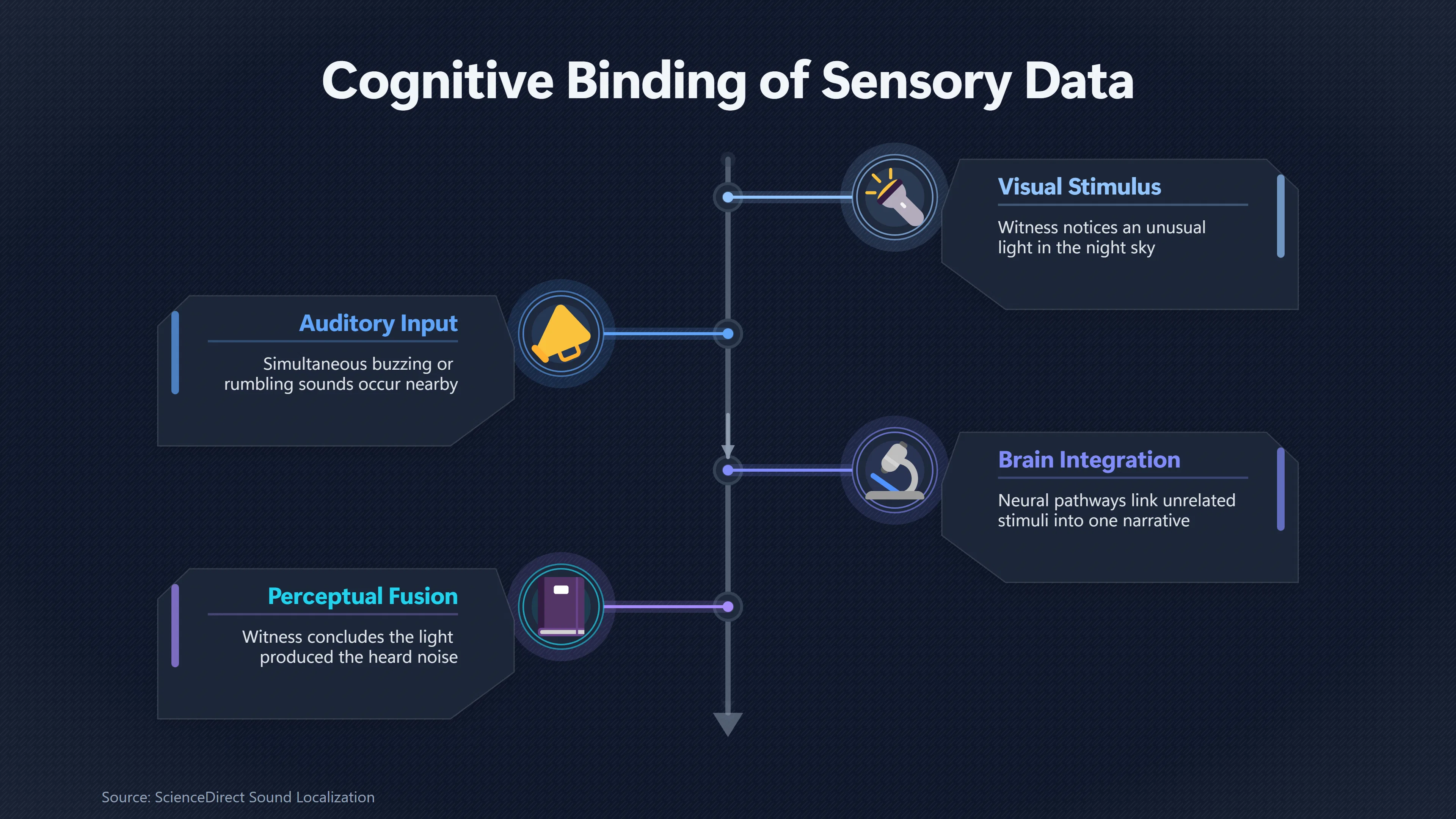
When witnesses report both an unusual light and an unusual sound, it is natural to assume they came from the same source. However, research on human perception shows that events occurring at roughly the same time are often mentally linked even when they are physically unrelated. This does not mean witnesses are being dishonest. Rather, the brain automatically combines visual and auditory information to create a coherent account of what happened. In UFO reports, this tendency can make a distant aircraft, electrical hum, animal call or industrial noise seem to belong to an unfamiliar light overhead. Understanding this mechanism helps explain why sound reports vary so widely and why investigators treat sound–light associations as a hypothesis to test rather than as evidence that the light itself produced the noise.[PubMed Central (PMC)]pmc.ncbi.nlm.nih.govPubMed Central (PMC)Broad generalisation of the ventriloquism aftereffect across sound frequencies - PMCMarch 7, 2026…
How simultaneous events become mentally linked
Humans are exceptionally good at detecting patterns, especially when unexpected events occur together. If an unfamiliar light appears in the sky at the same moment a person notices a buzzing or rumbling sound, the brain tends to assume they share a common cause unless there is evidence to the contrary.
Psychologists studying multisensory perception have shown that vision often influences where people believe a sound originated. This is known as visual capture, or the ventriloquism effect. The classic example is a ventriloquist’s puppet: although the sound comes from the performer, observers perceive it as coming from the moving puppet. The same principle applies more generally whenever visual information is judged to be more reliable than auditory location cues.[PubMed Central (PMC)]pmc.ncbi.nlm.nih.govPub Med Central (PMC)An f MRI Study of the Ventriloquism EffectPubMed Central (PMC)An fMRI Study of the Ventriloquism Effect - PMC…
This mechanism is particularly relevant during unexpected night-time observations because:
- the visual object may be unusual or emotionally salient;
- the sound source may be hidden by darkness;
- there is little surrounding information to judge distance or direction accurately; and
- attention becomes focused on the unusual light, encouraging the brain to bind nearby sensory events into a single experience.[PubMed Central (PMC)]pmc.ncbi.nlm.nih.govPub Med Central (PMC)An f MRI Study of the Ventriloquism EffectPubMed Central (PMC)An fMRI Study of the Ventriloquism Effect - PMC…
Importantly, this is a normal feature of perception rather than a flaw unique to UFO witnesses.
Why low sounds and echoes confuse direction
Even without an unusual light, humans are not equally good at locating every type of sound.
Low-frequency sounds present a particular challenge because the brain relies heavily on tiny timing differences between the ears to estimate direction. Those cues become less precise when sounds are distant, diffuse or mixed with environmental reflections. Narrowband sounds are also harder to localise than broadband sounds that contain a wider range of frequencies.[nature.com]nature.comMarch 7, 2026…
Night-time environments introduce further complications:
- Echoes and reverberation: Buildings, hills, forests and clouds can reflect sound, making it appear to come from somewhere other than its original source.
- Temperature inversions: Certain atmospheric conditions can bend sound over long distances, allowing traffic, trains or industrial machinery to be heard unexpectedly far from their source.
- Missing visual references: Without landmarks, estimating whether a sound is nearby or kilometres away becomes much more difficult.
These factors mean a witness may sincerely perceive a distant rumble as coming from a bright object overhead when the sound and light are unrelated.
Why the timing can seem convincing
A common reason witnesses become confident that a sound belonged to a UFO is that the sound appears to change as the light moves or disappears.
Several ordinary situations can create this impression:
- a vehicle emerges from behind terrain just as an aircraft or bright planet is noticed;
- wind carries intermittent sounds that seem to strengthen or fade with the observer’s attention;
- a witness notices a background hum only after becoming alert to the unusual light;
- separate events begin or end close together by coincidence.
Because people naturally construct coherent narratives, the sequence “I saw the light, then heard the sound” can easily become “the light made the sound”, even when no direct physical connection exists.
This tendency is strongest when neither the sound nor the light can be independently identified.
How investigators test whether the sound really matched the light
Experienced investigators generally avoid assuming that simultaneous observations had the same source. Instead, they examine whether the physical evidence supports the witness’s interpretation.
Typical questions include:
- Was the sound consistent with the light’s apparent distance? A nearby loud hum is difficult to reconcile with an object estimated to be many kilometres away.
- Did the timing make physical sense? If the object appeared distant, investigators compare the expected travel time of sound with the witness’s account.
- Could another sound source explain the report? Aircraft, helicopters, drones, road traffic, electrical infrastructure, wildlife and industrial activity are all considered.
- Do independent witnesses agree? If observers at different locations describe different sounds while seeing the same light, this suggests separate sound sources.
- Is there instrumental evidence? Audio recordings, radar data, aircraft tracking and weather information can help determine whether the reported sound plausibly originated from the observed object.
Modern recommendations for studying unidentified aerial phenomena emphasise collecting synchronised measurements from cameras, microphones and other sensors precisely because human perception alone cannot reliably establish that a particular sound belonged to a particular light.[ScienceDirect]sciencedirect.comScienceDirect Sound LocalizationSound Localization - an overview | ScienceDirect Topics…
What this means for interpreting UFO sound reports
The existence of a reported hum, buzz or roar does not automatically strengthen the case that an unidentified light represented an unusual craft. Instead, it introduces another observation that must be independently evaluated.
The available evidence from perception research suggests that witnesses can honestly and accurately report both seeing a strange light and hearing an unusual sound while still being mistaken about the connection between them. Darkness, poor sound localisation, echoes and the brain’s natural tendency to integrate simultaneous sensory information all make such false linking entirely plausible. Recognising this distinction helps explain why sound descriptions in UFO reports are so varied and why investigators look for independent confirmation before concluding that a reported noise truly originated from the observed object.[nature.com]nature.comMarch 7, 2026…
Amazon book picks
Further Reading
Books and field guides related to Did That Strange Sound Really Come From the UFO?. Use these as the next step if you want deeper reading beyond the article.
The Demon-Haunted World
Rating: 4.5/5 from 43 Google Books ratings
NEW YORK TIMES BESTSELLER • From the renowned astronomer and author of Cosmos comes a “powerful [and] stirring defense of informed ration...
Spatial Hearing
The field of spatial hearing has exploded in the decade or so since Jens Blauert's classic work on acoustics was first published in Engli...
The Invisible Gorilla
NEW YORK TIMES BESTSELLER • Our minds don’t work the way we think they do. Two renowned psychologists explain how and why our intuitions...
eBay marketplace picks
Marketplace Samples
Live-tested eBay searches with available results related to this page.
Selected fromUFO poster oneBay.co.uk.

Current eBay listing
VINTAGE UFO FLYING SAUCERS COMIC ADVERTISING A2 POSTER PRINT

Current eBay listing
I Want To Believe UFO Poster Giclée Fine Art Heavyweight Print


Endnotes
1.
Source: nature.com
Link:https://www.nature.com/articles/s41598-026-40873-0
Source snippet
March 7, 2026...
Published: March 7, 2026
2.
Source: sciencedirect.com
Title: ScienceDirect Sound Localization
Link:https://www.sciencedirect.com/topics/social-sciences/sound-localization
Source snippet
Sound Localization - an overview | ScienceDirect Topics...
3.
Source: nature.com
Link:https://www.nature.com/articles/s41562-021-01244-z
Source snippet
January 27, 2022 — * Article *...
Published: January 27, 2022
4.
Source: sciencedirect.com
Title: The aftereffects of ventriloquism: Are they sound-frequency specific?
Link:https://www.sciencedirect.com/science/article/abs/pii/S000169180300043X
5.
Source: sciencedirect.com
Title: The aftereffects of ventriloquism: Generalization across sound-frequencies
Link:https://www.sciencedirect.com/science/article/abs/pii/S0001691804001039
6.
Source: sciencedirect.com
Title: Utilizing the ventriloquism-effect to investigate audio-visual binding
Link:https://www.sciencedirect.com/science/article/pii/S0028393206000832
7.
Source: nature.com
Title: nn0799 656
Link:https://www.nature.com/articles/nn0799_656
8.
Source: pmc.ncbi.nlm.nih.gov
Link:https://pmc.ncbi.nlm.nih.gov/articles/PMC13087236/
Source snippet
PubMed Central (PMC)Broad generalisation of the ventriloquism aftereffect across sound frequencies - PMCMarch 7, 2026...
Published: March 7, 2026
9.
Source: pmc.ncbi.nlm.nih.gov
Title: Pub Med Central (PMC)An f MRI Study of the Ventriloquism Effect
Link:https://pmc.ncbi.nlm.nih.gov/articles/PMC4816779/
Source snippet
PubMed Central (PMC)An fMRI Study of the Ventriloquism Effect - PMC...
10.
Source: pubmed.ncbi.nlm.nih.gov
Link:https://pubmed.ncbi.nlm.nih.gov/41794839/
Source snippet
generalisation of the ventriloquism aftereffect across sound frequencies - PubMedMarch 7, 2026 — ABSTRACT Humans localise sounds in the h...
Published: March 7, 2026
11.
Source: pmc.ncbi.nlm.nih.gov
Link:https://pmc.ncbi.nlm.nih.gov/articles/PMC4672909/
12.
Source: pmc.ncbi.nlm.nih.gov
Link:https://pmc.ncbi.nlm.nih.gov/articles/PMC4310855/
13.
Source: pmc.ncbi.nlm.nih.gov
Link:https://pmc.ncbi.nlm.nih.gov/articles/PMC3055288/
14.
Source: pmc.ncbi.nlm.nih.gov
Link:https://pmc.ncbi.nlm.nih.gov/articles/PMC2835501/
15.
Source: pubmed.ncbi.nlm.nih.gov
Link:https://pubmed.ncbi.nlm.nih.gov/3693704/
Additional References
16.
Source: researchgate.net
Link:https://www.researchgate.net/publication/401678953_Broad_generalisation_of_the_ventriloquism_aftereffect_across_sound_frequencies
Source snippet
March 1, 2026 — Article PDF Available BROAD GENERALISATION OF THE VENTRILOQUISM AFTEREFFECT ACROSS SOUND FREQUENCIES Scientific Reports *...
Published: March 1, 2026
17.
Source: sciety.org
Link:https://sciety.org/articles/activity/10.64898/2026.05.12.724474
Source snippet
Francesca Rocchi 2. Nina C. Haukes 3. A. John van Opstal 4. Marc M. van Wanrooij Read the full article...
18.
Source: youtube.com
Title: Visual Illusions: Catching the Brain Creating Reality | World Science Festival
Link:https://www.youtube.com/watch?v=MD-O4Gpx74s
Source snippet
These videos directly explain the cognitive and perceptual mechanisms—such as visual capture, the ventriloquist effect, and multisensory...
19.
Source: youtube.com
Title: The Human Body: How the Senses and the Brain Create Total Perception
Link:https://www.youtube.com/watch?v=YYKOMg5XDsk
Source snippet
The Brain with David Eagleman 1. What Is Reality...
20.
Source: youtube.com
Title: The Brain with David Eagleman 1. What Is Reality
Link:https://www.youtube.com/watch?v=aUwgmNOfjss
Source snippet
Visual Illusions: Catching the Brain Creating Reality | World Science Festival...
21.
Source: frontiersin.org
Link:https://www.frontiersin.org/journals/integrative-neuroscience/articles/10.3389/fnint.2019.00051/full
22.
Source: elifesciences.org
Title: Sound localization: These are not the neurons you are looking for | e Life
Link:https://elifesciences.org/articles/39244
23.
Source: research.tilburguniversity.edu
Title: the aftereffects of ventriloquism are they sound frequency specif
Link:https://research.tilburguniversity.edu/en/publications/the-aftereffects-of-ventriloquism-are-they-sound-frequency-specif/
24.
Source: youtube.com
Title: Hearing lips and seeing voices: The science of the Mc Gurk Effect
Link:https://www.youtube.com/watch?v=eKuFaIHrH00
Source snippet
Perceptual Fusion...
25.
Source: youtube.com
Title: Perceptual Fusion
Link:https://www.youtube.com/watch?v=GmgtacdPFSg
Source snippet
The Human Body: How the Senses and the Brain Create Total Perception...