Within Low Frequency
Why Mysterious Hums Feel Bigger After Dark
Quieter surroundings, altered sound propagation and fewer visual references can make ordinary low-frequency noise seem unusually broad at night.
On this page
- How falling background noise reveals faint bass
- How night air can carry distant sound
- Why darkness removes useful location clues
Page outline Jump by section
Introduction
Reports of mysterious low-frequency “UFO noises” often become more common after dark, but night itself does not create unexplained hums. Instead, several ordinary effects combine to make distant bass-rich sounds seem louder, broader and much harder to locate. Traffic and daytime activity decline, leaving faint low-frequency sounds exposed. Under suitable weather conditions, the atmosphere can also carry some sounds farther than during the day. At the same time, darkness removes many visual cues that the brain normally uses to confirm where a sound originates. The result is that an otherwise ordinary industrial fan, ship engine, ventilation system or distant transport source may appear to surround the listener or hover overhead rather than coming from a specific point.[nih.gov]pmc.ncbi.nlm.nih.govPubMed Central (PMC)An Overview of the Major Phenomena of the Localization of Sound Sources by Normal-Hearing, Hearing-Impaired, and Aide…
How quieter nights reveal sounds that daytime hides
One of the biggest changes after sunset is not that low-frequency sounds become dramatically stronger, but that competing sounds become weaker.
During the day, nearby traffic, aircraft, conversation, construction and wind-generated noise mask faint background hums. When those higher-level sounds diminish at night, the same distant low-frequency source can suddenly become noticeable even if it has not increased in volume.
This change in contrast is especially important for bass frequencies. Deep tones are often produced continuously by machinery such as industrial compressors, large ventilation systems, electrical infrastructure, marine engines and transport networks. During busy daylight hours they blend into the overall environmental soundscape. At night they can emerge as a distinct, persistent hum simply because there is less masking noise.
This explains why people frequently report hearing a mysterious hum only after dark, even when measurements show that the underlying source has been operating continuously throughout the day.
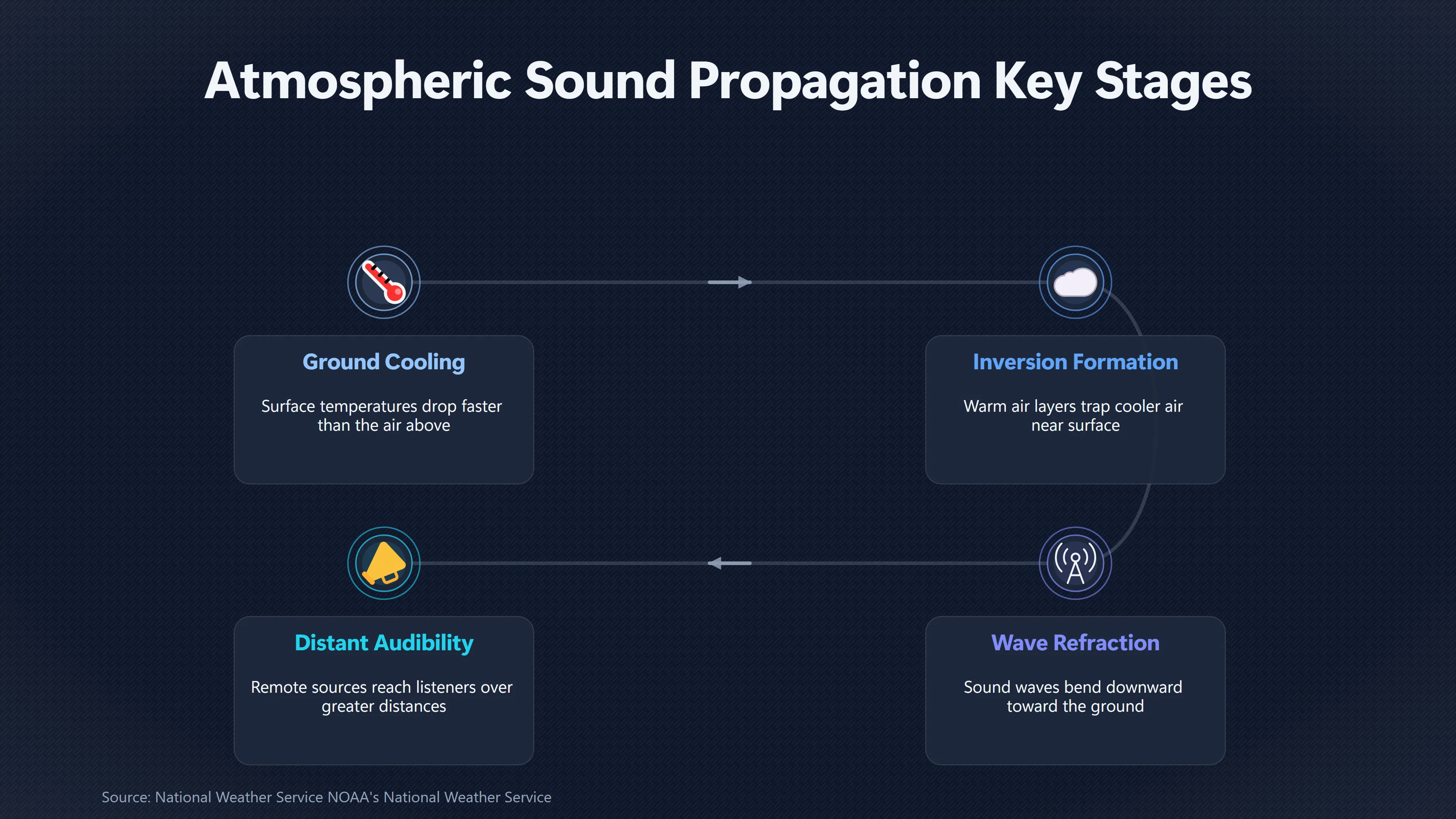
How night air can carry distant sound
Night-time weather sometimes alters how sound travels, although the effect depends on local conditions and should not be assumed every evening.
Temperature inversions can bend sound downward
After sunset, the ground often cools faster than the air above it, creating a nocturnal temperature inversion. Instead of warm air near the surface and cooler air higher up, the pattern briefly reverses. Meteorologists recognise this as a common overnight atmospheric condition.[National Weather Service]forecast.weather.govNational Weather Service NOAA's National Weather ServiceNational Weather ServiceNOAA's National Weather Service - Glossary…
Because the speed of sound varies with air temperature, these layers can refract, or bend, sound waves. Under favourable conditions, sound that would normally disperse upward can instead remain closer to the ground, allowing distant sources to be heard over greater distances.
The effect is well known in environmental acoustics and helps explain why trains, ships, industrial facilities or major roads may sound unexpectedly prominent on some calm nights but not on others.
Low frequencies survive long journeys better
Even without an inversion, low-frequency sound generally loses less energy to atmospheric absorption than higher frequencies over long distances. As the sharper, higher-pitched components fade, what remains is often a deep rumble with relatively poor directional information.
This selective survival means a listener may hear only the bass portion of a distant machine. Without the higher-frequency details that normally help identify location, the sound can seem detached from its true source and appear to fill the surrounding environment rather than arriving from one direction.[PubMed Central (PMC)]pmc.ncbi.nlm.nih.govPub Med Central (PMC)Auditory localization: a comprehensive practical reviewPubMed Central (PMC)Auditory localization: a comprehensive practical review - PMC…
Why darkness removes useful location clues
Humans rarely rely on hearing alone to determine where a sound comes from. Vision constantly reinforces auditory perception.
When a lorry passes, an aircraft crosses the sky or factory machinery is visible in the distance, the brain combines what it sees with what it hears to produce a stable interpretation. Research on auditory localisation shows that visual information significantly influences perceived sound position, often improving localisation accuracy.[PubMed Central (PMC)]pmc.ncbi.nlm.nih.govPubMed Central (PMC)An Overview of the Major Phenomena of the Localization of Sound Sources by Normal-Hearing, Hearing-Impaired, and Aide…
At night many of those confirming cues disappear. Buildings, roads and moving vehicles become difficult to see, particularly when the sound source is kilometres away or hidden behind terrain.
Without visual confirmation, listeners are more likely to experience:
- uncertainty about whether the sound is in front, behind or overhead;
- difficulty estimating distance;
- the impression that the sound surrounds them rather than coming from one location; and[youtube.com]youtube.comWhere is Sound Coming From? | How Humans Use Sound LOCALIZATIONEngineering Acoustics: Outdoor Sound Propagation…
- repeated changes in perceived direction as they listen.
These effects are particularly noticeable for continuous low-frequency hums because they already contain fewer localisation cues than broadband sounds.
Why low hums seem to come from “everywhere”
A persistent bass tone gives the auditory system relatively little information compared with a short, broadband sound such as a hand clap or a bird call.
Low-frequency sounds produce only small differences in loudness between the ears because their long wavelengths wrap around the head rather than being blocked by it. The brain therefore relies heavily on subtle timing differences and on additional cues such as reflections, head movements and visual information. When some of those cues are missing or degraded, localisation becomes much less reliable.[PubMed Central (PMC)]pmc.ncbi.nlm.nih.govPub Med Central (PMC)Auditory localization: a comprehensive practical reviewPubMed Central (PMC)Auditory localization: a comprehensive practical review - PMC…
At night, the combination of reduced background noise, occasional favourable atmospheric propagation and missing visual references can therefore produce a powerful illusion that a distant hum is spread across the entire landscape.
This helps explain why witnesses sometimes describe a mysterious sound as “coming from the sky”, “everywhere at once” or “impossible to point at”, even though the source may remain firmly on the ground.
Why night-time reports do not necessarily indicate an unusual source
Many reports associated with alleged UFO noises begin with an honest observation: the sound was clearer, stranger or more intrusive after dark.
However, that timing alone does not distinguish an ordinary source from an extraordinary one. Environmental acoustics provides several well-understood mechanisms that make familiar sounds seem unfamiliar at night, especially when they are rich in low frequencies and originate at considerable distance.
For investigators, the important question is therefore not simply whether the sound occurred after sunset, but whether it remains consistent with known acoustic behaviour. In many cases, quieter surroundings, occasional atmospheric refraction and the loss of visual orientation together provide a sufficient explanation for why an otherwise ordinary hum feels unusually widespread and difficult to identify.[nih.gov]pmc.ncbi.nlm.nih.govPubMed Central (PMC)An Overview of the Major Phenomena of the Localization of Sound Sources by Normal-Hearing, Hearing-Impaired, and Aide…
Amazon book picks
Further Reading
Books and field guides related to Why Mysterious Hums Feel Bigger After Dark. Use these as the next step if you want deeper reading beyond the article.
The Sound Book
A professor of acoustic engineering provides a tour of the world's most amazing sound phenomena, including creaking glaciers, whispering...
The Universal Sense
A surprising, entertaining book about how what we hear with our ears affects what's between them.
The Great Animal Orchestra
Bernie Krause is the world's leading expert in natural sound. Beginning by recording the sound of wheat growing in a Kansas field, he has...
Why You Hear What You Hear
Why You Hear What You Hear is the first book on the physics of sound for the nonspecialist to empower readers with a hands-on, ears-open...
eBay marketplace picks
Marketplace Samples
Live-tested eBay searches with available results related to this page.
Selected fromUFO poster oneBay.co.uk.


Current eBay listing
I Want To Believe UFO Poster Giclée Fine Art Heavyweight Print

Current eBay listing
VINTAGE UFO FLYING SAUCERS COMIC ADVERTISING A2 POSTER PRINT

Endnotes
1.
Source: forecast.weather.gov
Title: National Weather Service NOAA’s National Weather Service
Link:https://forecast.weather.gov/glossary.php?word=r
Source snippet
National Weather ServiceNOAA's National Weather Service - Glossary...
2.
Source: forecast.weather.gov
Title: National Weather Service NOAA’s National Weather Service
Link:https://forecast.weather.gov/glossary.php?word=nocturnal
Source snippet
National Weather ServiceNOAA's National Weather Service - Glossary...
3.
Source: acoustics.org
Title: 4th ASA/ASJ Joint Meeting Lay Language Papers
Link:https://acoustics.org/pressroom/httpdocs/152nd/wax.html
4.
Source: forecast.weather.gov
Link:https://forecast.weather.gov/glossary.php?word=INVERSION
5.
Source: forecast.weather.gov
Link:https://forecast.weather.gov/glossary.php?letter=n
6.
Source: forecast.weather.gov
Link:https://forecast.weather.gov/glossary.php?word=n
7.
Source: weather.gov
Link:https://www.weather.gov/ggw/GlossaryN
8.
Source: forecast.weather.gov
Link:https://forecast.weather.gov/glossary.php?word=T
9.
Source: weather.gov
Link:https://www.weather.gov/source/zhu/ZHU_Training_Page/winds/nighttime_influences/Nighttime_Influences.htm
10.
Source: youtube.com
Title: Refraction of Sound: How Sound Waves Bend Through Different Media
Link:https://www.youtube.com/watch?v=4_B_pTxlQvE
Source snippet
Temperature Inversions...
11.
Source: youtube.com
Title: Temperature Inversions
Link:https://www.youtube.com/watch?v=Dk9VHHFUbqo
Source snippet
What Are Inversions?...
12.
Source: pmc.ncbi.nlm.nih.gov
Link:https://pmc.ncbi.nlm.nih.gov/articles/PMC4271773/
Source snippet
PubMed Central (PMC)An Overview of the Major Phenomena of the Localization of Sound Sources by Normal-Hearing, Hearing-Impaired, and Aide...
13.
Source: pmc.ncbi.nlm.nih.gov
Title: Pub Med Central (PMC)Auditory localization: a comprehensive practical review
Link:https://pmc.ncbi.nlm.nih.gov/articles/PMC11267622/
Source snippet
PubMed Central (PMC)Auditory localization: a comprehensive practical review - PMC...
14.
Source: pubmed.ncbi.nlm.nih.gov
Link:https://pubmed.ncbi.nlm.nih.gov/9745742/
Source snippet
Auditory-visual spatial integration: a new psychophysical approach using laser pointing to acoustic targets - PubMed...
15.
Source: pubmed.ncbi.nlm.nih.gov
Link:https://pubmed.ncbi.nlm.nih.gov/6535983/
16.
Source: pubmed.ncbi.nlm.nih.gov
Link:https://pubmed.ncbi.nlm.nih.gov/6535984/
17.
Source: pubmed.ncbi.nlm.nih.gov
Link:https://pubmed.ncbi.nlm.nih.gov/3973685/
18.
Source: pubmed.ncbi.nlm.nih.gov
Link:https://pubmed.ncbi.nlm.nih.gov/7675624/
19.
Source: pubmed.ncbi.nlm.nih.gov
Link:https://pubmed.ncbi.nlm.nih.gov/16454267/
20.
Source: pubmed.ncbi.nlm.nih.gov
Link:https://pubmed.ncbi.nlm.nih.gov/8642114/
Additional References
21.
Source: research.tue.nl
Link:https://research.tue.nl/en/publications/47ffeac1-6738-415f-b059-e4bac3776b17/
Source snippet
of low frequency outdoor-to-indoor noise attenuation factors based on night-time noise exposure - Research portal Eindhoven University of...
22.
Source: sciencedirect.com
Link:https://www.sciencedirect.com/science/article/abs/pii/S0378595598002056
Source snippet
The localisation of spectrally restricted sounds by human listeners - ScienceDirect...
23.
Source: agupubs.onlinelibrary.wiley.com
Link:https://agupubs.onlinelibrary.wiley.com/doi/full/10.1002/2014JD022821
Source snippet
infrasound generated by wind farms and its propagation in low‐altitude tropospheric waveguides - Marcillo - 2015 - Journal of Geophysical...
24.
Source: nature.com
Link:https://www.nature.com/articles/s41370-023-00599-x
Source snippet
Long-term measurement study of urban environmental low frequency noise | Journal of Exposure Science & Environmental EpidemiologySeptembe...
25.
Source: youtube.com
Title: Where is Sound Coming From? | How Humans Use Sound LOCALIZATION
Link:https://www.youtube.com/watch?v=dnDrAG8FZok
Source snippet
Engineering Acoustics: Outdoor Sound Propagation...
26.
Source: sciencedirect.com
Link:https://www.sciencedirect.com/science/article/abs/pii/S0003682X04001598
27.
Source: tracesurveys.com
Link:https://www.tracesurveys.com/knowledge-base-archive/
28.
Source: sciencedirect.com
Link:https://www.sciencedirect.com/science/article/abs/pii/S0003682X13002132
29.
Source: impact.ornl.gov
Title: on infrasound generated by wind farms and its propagation in low
Link:https://impact.ornl.gov/en/publications/on-infrasound-generated-by-wind-farms-and-its-propagation-in-low-/
30.
Source: sciencedirect.com
Title: The effect of eye position and background noise on vertical sound localization
Link:https://www.sciencedirect.com/science/article/abs/pii/S0378595502003878