Within Perception
Why Separate Sights and Sounds Feel Like One Event
The brain can merge a strange light and nearby noise into one event even when they came from separate sources.
On this page
- How the brain binds sights and sounds
- Why darkness and poor distance cues increase errors
- How to separate observation from inferred source
Page outline Jump by section
Introduction
When people report a mysterious light and an unusual sound during the same UFO sighting, it is natural to assume they came from the same source. However, research on multisensory perception shows that this conclusion does not necessarily follow from the observations themselves. The human brain is designed to combine information from different senses into a single, coherent event whenever the timing and circumstances seem compatible. This process is usually highly effective, but in situations with poor visibility, uncertain distances or unfamiliar sounds, it can lead people to connect events that were actually independent.[ScienceDirect]sciencedirect.comAudiovisual temporal integration: Cognitive processing, neural mechanisms, developmental trajectory and potential interventi…
Within UFO reports, this means a witness may accurately remember both seeing an unusual light and hearing an unusual noise while being mistaken only about the causal link between them. Understanding this distinction helps explain why sincere eyewitnesses can disagree about whether an unidentified object produced a sound without implying dishonesty or faulty observation.
How the brain binds sights and sounds
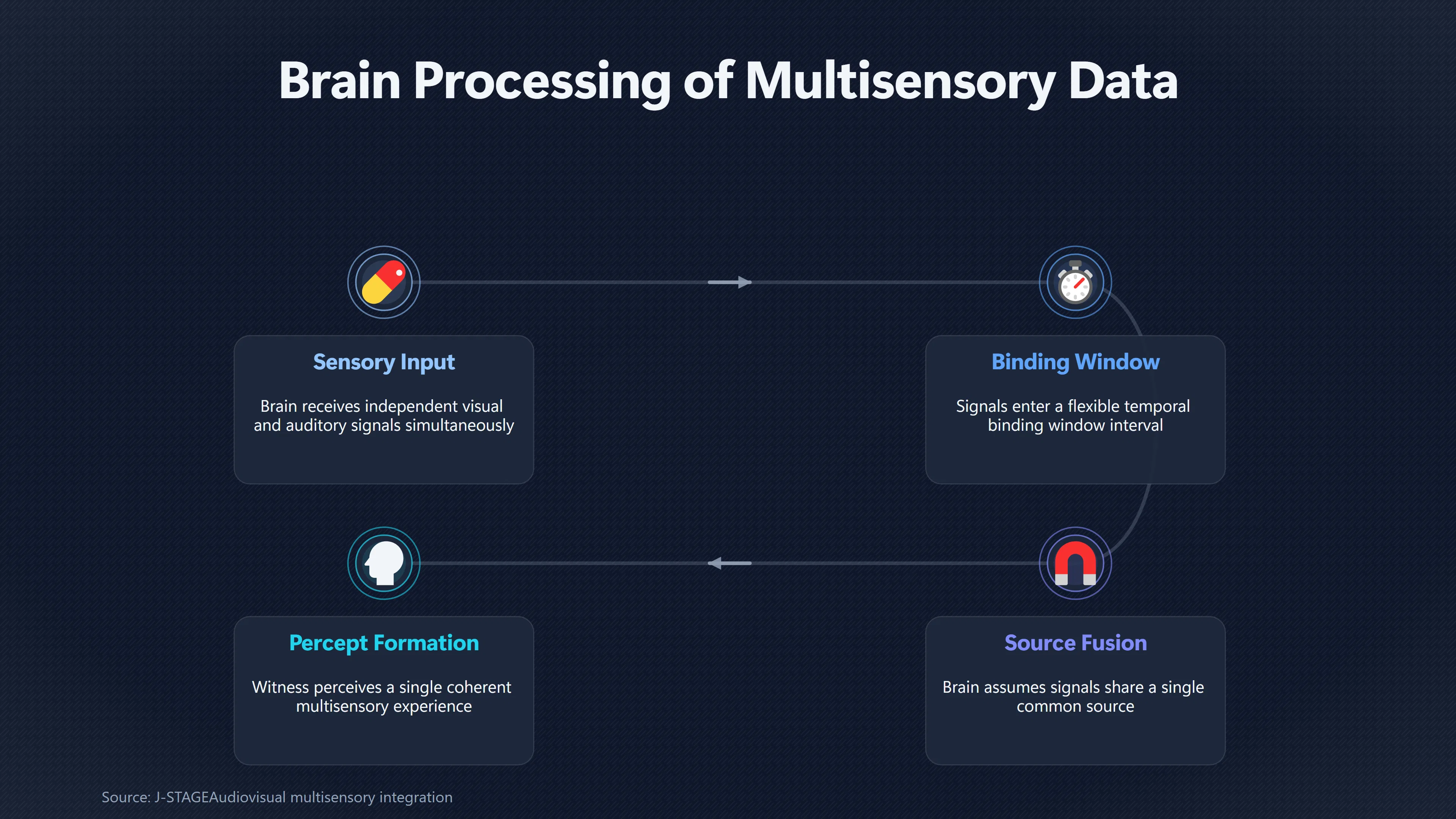
The brain constantly solves what psychologists call the binding problem: deciding which sensory signals belong together as parts of the same event. Rather than processing vision and hearing independently, it combines them whenever they occur close together in time and appear likely to share a common cause. This integration reduces uncertainty and normally produces an accurate understanding of everyday events such as watching a person speak or seeing a vehicle pass while hearing its engine.[sciencedirect.com]sciencedirect.comAudiovisual temporal integration: Cognitive processing, neural mechanisms, developmental trajectory and potential interventi…
Researchers describe one important factor as the temporal binding window—a brief interval during which sounds and sights are likely to be treated as belonging to one occurrence even if they are not perfectly simultaneous. The width of this window is flexible rather than fixed. It changes with attention, expectations, stimulus quality and environmental conditions, making the brain more willing to fuse uncertain sensory information into one percept.[sciencedirect.com]sciencedirect.comAudiovisual temporal integration: Cognitive processing, neural mechanisms, developmental trajectory and potential interventi…
This tendency is generally adaptive. In ordinary life, a sound heard immediately after a visible event usually does come from that event. The same mechanism, however, can encourage mistaken associations when several unrelated stimuli happen within a short period.
Why darkness and poor distance cues increase errors
Night-time observations create exactly the conditions in which sensory binding becomes more uncertain.
Visual information is reduced because landmarks disappear into darkness, making it harder to estimate:
- how far away a light is;
- how large it might be;
- whether it is moving or stationary; and
- whether multiple lights belong to one object or several.
At the same time, hearing provides only limited information about distance and direction. Humans are generally much less accurate at locating sounds than visible objects, particularly for low-frequency noises or sounds that have reflected from terrain, buildings or cloud layers. Echoes, wind and atmospheric conditions can all alter where a sound appears to originate.
When both senses are uncertain, the brain often favours the simplest explanation: that the unusual light and unusual sound belong to the same object. This “common source” assumption is an efficient shortcut in most circumstances, but under ambiguous viewing conditions it increases the chance of combining unrelated events into a single experience.[go.jp]jstage.jst.go.jpJ-STAGEAudiovisual multisensory integrationJ-STAGEAudiovisual multisensory integration
Laboratory demonstrations of sensory binding
Scientists have demonstrated these mechanisms using controlled perceptual illusions rather than UFO-related experiments.
One of the best-known examples is the ventriloquist effect. Even when listeners know intellectually where a loudspeaker is located, they often perceive the sound as coming from the visible moving mouth of a puppet or actor. The visual signal effectively “captures” the perceived location of the sound because the brain assumes both originated from one source.[PubMed Central (PMC)]pmc.ncbi.nlm.nih.govPubMed Central (PMC)The Ventriloquist Illusion as a Tool to Study Multisensory Processing: An Update - PMC…
Another example is the sound-induced flash illusion. Under carefully controlled conditions, a single flash accompanied by multiple beeps can lead observers to report seeing multiple flashes. Here, auditory information changes visual perception itself rather than simply influencing interpretation. Neuroimaging and brain-stimulation studies indicate that multisensory integration and attention jointly contribute to these effects.[PubMed]pubmed.ncbi.nlm.nih.govParietal disruption alters audiovisual binding in the sound-induced flash illusion - PubMed…
These experiments do not imply that UFO witnesses experience laboratory illusions directly. Instead, they demonstrate that combining sight and sound is an active interpretive process rather than a perfect recording of external reality.
Why UFO observations are especially vulnerable
Several features common to UFO reports encourage the brain to bind separate sensory events together.
Unexpected timing. Witnesses are rarely prepared to observe an unusual aerial event. Because attention is rapidly redirected, there is little opportunity to establish whether a sound began before, during or after the visual observation.
Sparse environmental information. A bright light against a dark sky provides few reliable reference points for judging altitude or distance.
Multiple possible sound sources. Aircraft, road traffic, industrial equipment, insects, wind, wildlife or electrical infrastructure may all generate unfamiliar sounds that overlap in time with an unrelated visual event.
Limited observation time. Many sightings last only seconds. When information is incomplete, the perceptual system tends to favour one coherent explanation over several unrelated ones.[sciencedirect.com]sciencedirect.comAudiovisual temporal integration: Cognitive processing, neural mechanisms, developmental trajectory and potential interventi…
These conditions increase the probability of an honest but mistaken causal inference: “the object made that sound.”
Separating observation from inferred source
A useful way to evaluate witness testimony is to distinguish between observations and interpretations.
Observations are direct sensory experiences, such as:
- “I saw a bright white light moving north.”
- “I heard a low humming sound.”
- “The sound became louder after several seconds.”
Interpretations add a causal conclusion, for example:
- “The humming came from the object.”
- “The light produced the vibration.”
- “The object accelerated silently and then generated the buzz.”
The observations may be entirely accurate even if the inferred relationship is not. Investigators in aviation, accident reconstruction and eyewitness psychology often encourage witnesses to report what they directly perceived before discussing explanations, because later reasoning can become difficult to separate from the original memory.
Applied to UFO sound reports, this distinction allows researchers to preserve valuable witness observations while recognising that causal links between sights and sounds require independent supporting evidence rather than assumption alone.
What this mechanism does—and does not—explain
Sensory binding offers a well-supported explanation for why unrelated lights and sounds may feel like parts of one event. It explains a cognitive mechanism, not the identity of any observed object.
The mechanism does not imply that every reported UFO sound came from an unrelated source. Some aerial phenomena—including conventional aircraft, helicopters, drones, meteors and atmospheric events—can genuinely produce both visible and audible effects. Instead, the research shows that simultaneous perception alone is insufficient evidence that one caused the other.
For that reason, reports describing a mysterious light accompanied by an unusual sound are strongest when they distinguish carefully between what was directly seen, what was directly heard and what was inferred afterwards. Doing so reduces the risk that the brain’s normal tendency to create a coherent narrative is mistaken for proof of a physical connection.[sciencedirect.com]sciencedirect.comAudiovisual temporal integration: Cognitive processing, neural mechanisms, developmental trajectory and potential interventi…
Amazon book picks
Further Reading
Books and field guides related to Why Separate Sights and Sounds Feel Like One Event. Use these as the next step if you want deeper reading beyond the article.
The Seven Sins of Memory
Rating: 3.5/5 from 5 Google Books ratings
A New York Times Notable Book: A psychologist's "gripping and thought-provoking" look at how and why our brains sometimes fail us (Steven...
The Tell-Tale Brain
John, aged sixty, suffered a stroke and recovered fully, except in one respect: although he can see perfectly, he can no longer recognise...
The Invisible Gorilla
NEW YORK TIMES BESTSELLER • Our minds don’t work the way we think they do. Two renowned psychologists explain how and why our intuitions...
eBay marketplace picks
Marketplace Samples
Live-tested eBay searches with available results related to this page.
Selected fromUFO poster oneBay.co.uk.

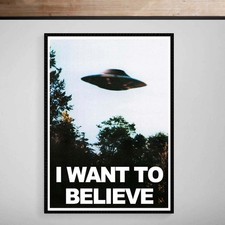
Current eBay listing
I Want To Believe UFO Poster Giclée Fine Art Heavyweight Print

Current eBay listing
VINTAGE UFO FLYING SAUCERS COMIC ADVERTISING A2 POSTER PRINT

Endnotes
1.
Source: sciencedirect.com
Link:https://www.sciencedirect.com/science/article/abs/pii/S0028393220300683
Source snippet
Audiovisual temporal integration: Cognitive processing, neural mechanisms, developmental trajectory and potential interventi...
2.
Source: jstage.jst.go.jp
Title: J-STAGEAudiovisual multisensory integration
Link:https://www.jstage.jst.go.jp/article/ast/28/2/28_2_61/_article
3.
Source: sciencedirect.com
Title: Auditory capture of vision: examining temporal ventriloquism
Link:https://www.sciencedirect.com/science/article/abs/pii/S0926641003000892
4.
Source: sciencedirect.com
Link:https://www.sciencedirect.com/science/article/pii/S0926641005002193
5.
Source: sciencedirect.com
Title: Chapter 14 Ventriloquism: A case of crossmodal perceptual grouping
Link:https://www.sciencedirect.com/science/article/pii/S016641159980034X
6.
Source: sciencedirect.com
Title: Chapter 14 Combining visual and auditory information
Link:https://www.sciencedirect.com/science/article/abs/pii/S0079612306550149
7.
Source: sciencedirect.com
Link:https://www.sciencedirect.com/science/article/pii/S0149763420305637
8.
Source: sciencedirect.com
Title: Visual illusion induced by sound
Link:https://www.sciencedirect.com/science/article/pii/S0926641002000691
9.
Source: youtube.com
Title: Can You Trust Your Ears? (Audio Illusions)
Link:https://www.youtube.com/watch?v=kzo45hWXRWU
Source snippet
Perception - Features & the Binding Problem...
10.
Source: youtube.com
Link:https://www.youtube.com/watch?v=DPp83zi3S6E
Source snippet
Where is Sound Coming From? | How Humans Use Sound LOCALIZATION...
11.
Source: pmc.ncbi.nlm.nih.gov
Link:https://pmc.ncbi.nlm.nih.gov/articles/PMC6751356/
Source snippet
PubMed Central (PMC)The Ventriloquist Illusion as a Tool to Study Multisensory Processing: An Update - PMC...
12.
Source: ir.psych.ac.cn
Link:https://ir.psych.ac.cn/bitstream/311026/31501/1/Audiovisual%20temporal%20integration_%20Cognitive%20processing%2C%20neural%20mechanisms%2C%20developmental%20trajectory%20and%20potential%20interventions.pdf
13.
Source: pubmed.ncbi.nlm.nih.gov
Link:https://pubmed.ncbi.nlm.nih.gov/22658974/
Source snippet
Parietal disruption alters audiovisual binding in the sound-induced flash illusion - PubMed...
14.
Source: pmc.ncbi.nlm.nih.gov
Link:https://pmc.ncbi.nlm.nih.gov/articles/PMC8329114/
15.
Source: pubmed.ncbi.nlm.nih.gov
Link:https://pubmed.ncbi.nlm.nih.gov/31572136/
16.
Source: pubmed.ncbi.nlm.nih.gov
Link:https://pubmed.ncbi.nlm.nih.gov/27003546/
17.
Source: pmc.ncbi.nlm.nih.gov
Link:https://pmc.ncbi.nlm.nih.gov/articles/PMC4744562/
18.
Source: pmc.ncbi.nlm.nih.gov
Link:https://pmc.ncbi.nlm.nih.gov/articles/PMC4070624/
19.
Source: jstage.jst.go.jp
Title: jst.go.jp Audiovisual multisensory integration
Link:https://www.jstage.jst.go.jp/article/ast/28/2/28_2_61/_article/-char/ja/
21.
Source: pubmed.ncbi.nlm.nih.gov
Link:https://pubmed.ncbi.nlm.nih.gov/16530232/
22.
Source: pubmed.ncbi.nlm.nih.gov
Link:https://pubmed.ncbi.nlm.nih.gov/12880914/
23.
Source: pubmed.ncbi.nlm.nih.gov
Link:https://pubmed.ncbi.nlm.nih.gov/26669309/
Additional References
24.
Source: journals.sagepub.com
Title: Sage Journals Multisensory Illusions and the Temporal Binding Window
Link:https://journals.sagepub.com/doi/10.1068/ic903
Source snippet
Sage JournalsMultisensory Illusions and the Temporal Binding Window - Ryan A Stevenson, Raquel K Zemtsov, Mark T Wallace, 2011...
25.
Source: youtube.com
Title: Where is Sound Coming From? | How Humans Use Sound LOCALIZATION
Link:https://www.youtube.com/watch?v=dnDrAG8FZok
Source snippet
Multisensory integration brain sensory binding temporal binding window Dr Philip Sanders: Multisensory Integration as a Measure of Plasti...
26.
Source: bpspsychub.onlinelibrary.wiley.com
Link:https://bpspsychub.onlinelibrary.wiley.com/doi/full/10.1111/bjop.70029
Source snippet
rhythm of sensory input shapes audio‐visual temporal processing - Zamfira - 2026 - British Journal of Psychology - Wiley Online LibrarySe...
27.
Source: link.springer.com
Link:https://link.springer.com/article/10.3758/s13423-024-02478-4
Source snippet
simultaneity windows reflect temporal sensory uncertainty | Psychonomic Bulletin & Review | Springer Nature LinkFebruary 22, 2024 — AUDIO...
Published: February 22, 2024
28.
Source: frontiersin.org
Link:https://www.frontiersin.org/journals/integrative-neuroscience/articles/10.3389/fnint.2019.00051/full
29.
Source: frontiersin.org
Link:https://www.frontiersin.org/journals/psychology/articles/10.3389/fpsyg.2017.00445/full
30.
Source: cambridge.org
Link:https://www.cambridge.org/core/journals/international-journal-of-astrobiology/article/psychological-aspects-in-unidentified-anomalous-phenomena-uap-witnesses/7D23058E10309384DDAA8E15607485CC
31.
Source: hub.hku.hk
Link:https://hub.hku.hk/handle/10722/367696
32.
Source: youtube.com
Title: Mc Gurk effect
Link:https://www.youtube.com/watch?v=2k8fHR9jKVM
Source snippet
Can You Trust Your Ears? (Audio Illusions)...
33.
Source: mdpi.com
Link:https://www.mdpi.com/2076-3425/13/8/1126