Within Drones
Do the Lights and Height Match a Drone?
Red, green and white lights combined with low-altitude hovering can make an unknown object more consistent with lawful or unlawful drone activity.
On this page
- Common drone navigation light colours
- Estimating low altitude flight at night
- How flight rules inform identification without proving it
Page outline Jump by section
Introduction
When a buzzing object with bright lights appears at night, it is tempting to assume that its lighting pattern or apparent height can identify it immediately as either a drone or something more unusual. In practice, neither clue is conclusive on its own. Navigation lights, anti-collision strobes and estimated flight altitude can make a drone explanation more or less plausible, but they cannot positively identify an aircraft. Modern drone regulations also vary by jurisdiction, and many drones can legally carry additional lights that differ from traditional aviation lighting. Understanding how lighting conventions and legal altitude limits work helps place a sighting into context without overstating what the evidence can prove.

Do the Lights Match a Drone?
Many consumer and professional drones are equipped with multiple LEDs for orientation, visibility or regulatory compliance. The colours and flashing patterns often resemble familiar aircraft lighting, but manufacturers are not required to use one universal configuration across every model.
Common features include:
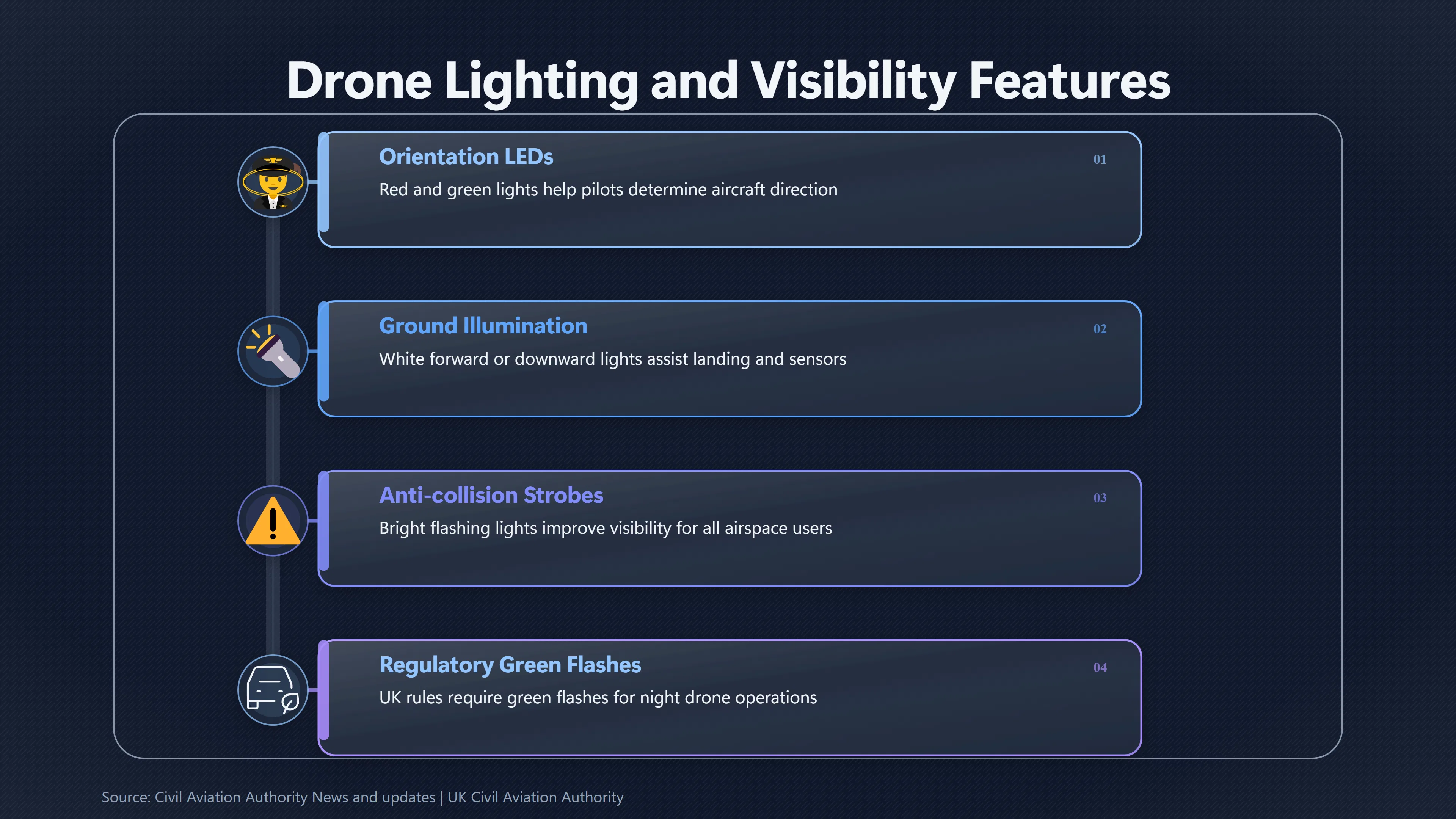
- Red and green orientation lights: Some multirotor drones use red and green LEDs on opposite arms to help the pilot determine the aircraft’s direction.
- White forward or downward-facing lights: These may illuminate the ground for landing, assist onboard sensors or improve visibility rather than serving as certified navigation lights.
- Flashing anti-collision lights: Bright strobes are increasingly common, particularly for night operations, because they improve the aircraft’s visibility to both the operator and other airspace users.
Because many drones are viewed only as small points of light at night, observers often cannot distinguish whether several coloured lights belong to one aircraft or whether one flashing light dominates the view. Atmospheric haze, mist and distance can also blend colours together.
Importantly, the presence of red, green and white lights does not automatically mean an object is a drone. Manned aircraft also use navigation lighting, and aftermarket lighting kits allow drone operators to modify the appearance of many consumer models. Lighting therefore provides supporting evidence rather than definitive identification.[Civil Aviation Authority]caa.co.ukOpen source on caa.co.uk.
Estimating Height After Dark Is Surprisingly Difficult
Witnesses frequently describe a hovering object as being “just above the trees” or “a few hundred feet up”. These estimates are often much less reliable than they seem.
At night, people lose many of the visual references normally used to judge altitude, including terrain detail, shadows and object size. A small drone with bright LEDs may appear much farther away than it really is, while a conventional aircraft approaching head-on may seem almost stationary and deceptively low.
Several factors increase estimation errors:
- Bright lights appear larger than the aircraft carrying them.
- A dark sky removes depth cues.
- Wind-blown sound can make a drone seem closer or farther than its actual position.
- Hovering flight reduces the motion cues people normally use to judge distance.
For this reason, statements such as “it was definitely below 100 metres” or “well above the legal drone limit” should be treated cautiously unless the observation includes reliable reference points such as buildings, towers or known terrain features.

How Legal Height Limits Inform Identification
Many countries impose a maximum routine operating height for small drones in standard recreational or low-risk commercial operations. In the UK Open Category, for example, drones are generally limited to 120 metres (400 feet) above the nearest point of the ground, with some authorised exceptions. The purpose is to reduce conflict with manned aircraft, which usually operate higher but may legally fly lower in specific circumstances such as emergency services, military operations or agricultural work.[Civil Aviation Authority]caa.co.ukOpen source on caa.co.uk.
This rule is useful when evaluating sightings, but only as contextual evidence.
If an observer can confidently demonstrate that an illuminated object remained thousands of feet above the ground, an ordinary consumer drone becomes a less likely explanation. Conversely, an object hovering apparently below rooftop level or treetop height is broadly consistent with typical drone operations.
However, several important qualifications remain:
- Human estimates of altitude are frequently inaccurate at night.
- Professional operators may have authorisations that differ from standard recreational rules.
- Terrain affects legal altitude because the limit is measured from the nearest point of the surface, not always from the observer’s position.
- A drone operating above legal limits is still physically capable of doing so; illegality does not make it impossible.
Therefore, exceeding a regulatory altitude does not automatically eliminate the drone hypothesis, nor does remaining below the limit prove that an object was a drone.
Night-Flying Rules Add Useful Context
Night operations have become increasingly regulated because visibility is reduced for both operators and other airspace users.
Current UK Civil Aviation Authority guidance requires drones flying at night in the Open Category to display a green flashing light throughout the flight to improve visibility and help distinguish unmanned aircraft from manned aircraft while maintaining visual line of sight. The rule is intended to increase safety rather than to create a unique visual signature that members of the public can use for identification.[Civil Aviation Authority]caa.co.ukOpen source on caa.co.uk.
This highlights an important limitation in interpreting sightings. A witness may report seeing a flashing green light and reasonably conclude that the object could be a legally operated drone. Equally, the absence of such a light does not prove the object was something unusual. The aircraft may have been operating unlawfully, the light may have been obscured by viewing angle, or the observer may simply have been too far away to perceive its colour accurately.
Using Lights and Height Together
Within reports of buzzing unidentified objects, lighting and apparent altitude become most useful when considered alongside other observations rather than in isolation.
A combination of features that is broadly consistent with drone activity includes:
- A continuous electric buzzing sound.
- Slow movement or prolonged hovering.
- Bright flashing or coloured LEDs visible at relatively low apparent altitude.
- Flight remaining within a limited local area.
By contrast, if the reported sound, movement, lighting behaviour and apparent height consistently conflict with known drone capabilities, investigators have stronger reasons to examine alternative explanations. Even then, discrepancies should first be checked against common sources of observational error before concluding that the object cannot have been a conventional aircraft.
The key point is that navigation lights and legal altitude rules are valuable contextual tools. They help assess whether a drone explanation is plausible, but they cannot identify an aircraft by themselves or determine whether a reported UFO is genuinely unexplained.
Amazon book picks
Further Reading
Books and field guides related to Do the Lights and Height Match a Drone?. Use these as the next step if you want deeper reading beyond the article.
The Drone Pilot's Handbook
The perfect companion for anyone buying (or thinking of buying) a drone, whether it's just for fun, to race against friends, or to give t...
Remote Pilot Test Prep 2022: Study & Prepare: Pass Your Part...
eBundle: printed book and software download code Operating a drone for non-hobby operations requires a Remote Pilot Certificate. You must...
Make: Drones
Make: Drones will help the widest possible audience understand how drones work by providing several DIY drone projects based on the world...
The Complete Book of Drones
Grâce à ce guide très illustré, vous allez acquérir toutes les compétences et les connaissances pour faire voler votre drone à la perfect...
eBay marketplace picks
Marketplace Samples
Live-tested eBay searches with available results related to this page.
Selected fromUFO art print oneBay.co.uk.

Endnotes
1.
Source: caa.co.uk
Link:https://www.caa.co.uk/drones/open-category/getting-started-with-drones-and-model-aircraft/flying-at-night-in-the-open-category/
2.
Source: caa.co.uk
Link:https://www.caa.co.uk/drones/open-category/drone-code/where-you-can-fly-points-3-to-9/
3.
Source: caa.co.uk
Title: Civil Aviation Authority News and updates | UK Civil Aviation Authority
Link:https://www.caa.co.uk/drones/drone-regulations/news-and-updates/
4.
Source: caa.co.uk
Title: Where you can fly | UK Civil Aviation Authority WHERE YOU CAN FLY
Link:https://www.caa.co.uk/drones/open-category/getting-started-with-drones-and-model-aircraft/where-you-can-fly/
5.
Source: caa.co.uk
Link:https://www.caa.co.uk/drones/open-category/drone-code/getting-what-you-need-to-fly-legally/
6.
Source: caa.co.uk
Link:https://www.caa.co.uk/drones/open-category/drone-code/
7.
Source: caa.co.uk
Link:https://www.caa.co.uk/drones/
9.
Source: caa.co.uk
Link:https://www.caa.co.uk/drones/open-category/drone-code/making-every-flight-safe-points-10-to-20/
Additional References
10.
Source: faa.gov
Link:https://www.faa.gov/newsroom/small-unmanned-aircraft-systems-uas-regulations-part-107
Source snippet
July 6, 2026 — SMALL UNMANNED AIRCRAFT SYSTEMS (UAS) REGULATIONS (PART 107) Monday, July 6, 2026 The Federal Aviation Administration (FAA...
Published: July 6, 2026
11.
Source: faa.gov
Title: The FAA gets a lot of questions when people spot dro
Link:https://www.faa.gov/newsroom/what-know-about-drones
Source snippet
What To Know About Drones | Federal Aviation AdministrationJanuary 14, 2025 — WHAT TO KNOW ABOUT DRONES Tuesday, January 14, 2025 More an...
Published: January 14, 2025
12.
Source: youtube.com
Title: Fly your drone above 400 ft. in the sky with an FAA waiver!
Link:https://www.youtube.com/watch?v=I8T3JRPi3Qo
Source snippet
These videos directly address the FAA regulatory requirements for anti-collision and navigation lights during night drone operations, alt...
13.
Source: easa.europa.eu
Title: eu Easy Access Rules for Air Operations
Link:https://www.easa.europa.eu/en/document-library/easy-access-rules/online-publications/easy-access-rules-air-operations?erules-id=ERULES-1963177438-13257
Source snippet
Access Rules for Air Operations - Revision 24, March 2026 | EASAMarch 27, 2026 — SUBPART D: INSTRUMENTS, DATA AND EQUIPMENT SECTION 1 – A...
Published: March 27, 2026
14.
Source: easa.europa.eu
Title: eu Easy Access Rules for Air Operations
Link:https://www.easa.europa.eu/en/document-library/easy-access-rules/online-publications/easy-access-rules-air-operations?erules-id=ERULES-1963177438-18537
Source snippet
Access Rules for Air Operations - Revision 24, March 2026 | EASAMarch 27, 2026 — (a)The operator should define responsibilities and proce...
Published: March 27, 2026
15.
Source: arxiv.org
Link:https://arxiv.org/abs/2109.12832
16.
Source: faa.gov
Link:https://www.faa.gov/air_traffic/publications/atpubs/aim_html/chap11_section_4.html
17.
Source: faa.gov
Link:https://www.faa.gov/air_traffic/publications/atpubs/aim_html/chap11_section_8.html
18.
Source: faa.gov
Link:https://www.faa.gov/faq/beyond-visual-line-sight-bvlos-operations-are-anti-collision-lights-required
19.
Source: youtube.com
Title: Can you fly a drone at night? You MUST KNOW these 2 THINGS
Link:https://www.youtube.com/watch?v=IkWMjfYclC0
Source snippet
Fly your drone above 400 ft. in the sky with an FAA waiver...