Within Record It
Why Time and Direction Can Solve the Mystery
Exact start times, end times and compass directions make a strange sound easier to compare with aircraft, weather and seismic records.
On this page
- Recording exact start and end times
- Estimating direction with a compass
- Matching observations to outside records
Page outline Jump by section
Introduction
When documenting an unexplained sky sound, the most valuable information may not be the recording itself but the precise record of when the sound occurred and where it appeared to come from. Exact timestamps and estimated compass directions allow investigators to compare a report with independent datasets such as aircraft movements, weather observations, lightning detections, seismic records and satellite observations. Without these details, even a high-quality audio recording is often impossible to test against ordinary explanations. NASA’s independent study of unidentified anomalous phenomena (UAP) similarly concluded that poor-quality metadata, including missing time and sensor context, is one of the greatest obstacles to scientific analysis.[NASA Science]smd-cms.nasa.govScience NASAUNIDENTIFIED ANOMALOUS PHENOMENA…
Why exact times matter more than memory
People frequently remember an unusual sound as happening “around dusk” or “just after midnight”, but such estimates can differ from the true time by several minutes or more. That seemingly small error can make comparisons with external records far less reliable.
Record three separate times whenever possible:
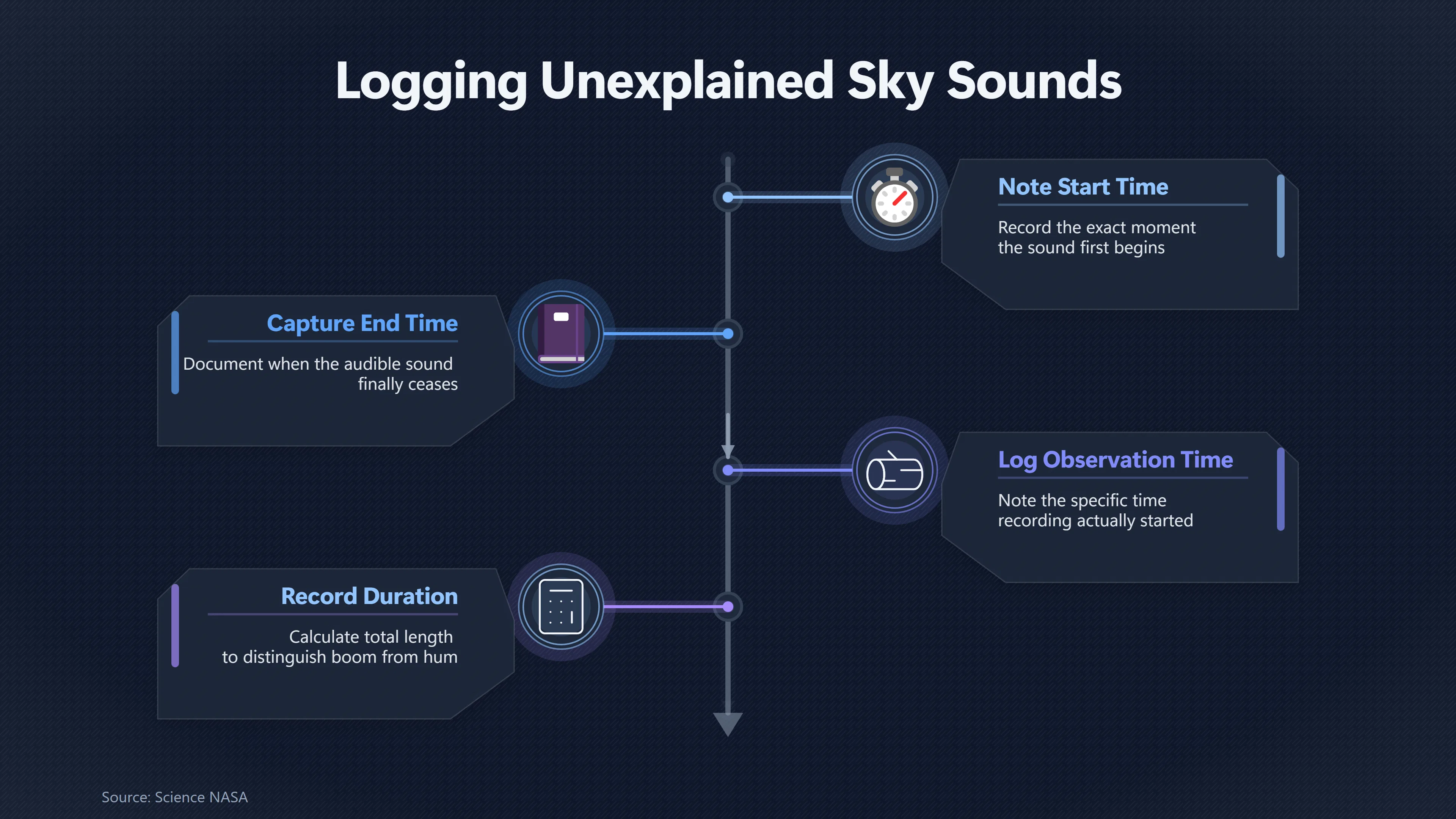
- Start time: when the sound was first noticed.
- End time: when it was last heard.
- Observation time: when the recording began if it started after the sound.
Using the device’s automatically recorded creation time is preferable to relying solely on memory. If you begin recording several seconds after hearing the sound, note that delay in your written log.
Duration is equally important. A single sharp boom lasting less than a second points investigators towards different possibilities than a low-frequency hum that persists for several minutes. Consistent timing also helps determine whether multiple witnesses heard the same event or unrelated sounds.
Estimating direction with a compass
The apparent direction of the sound helps determine which external records deserve investigation first. A simple compass reading is usually sufficient; precision to the nearest few degrees is rarely necessary.
Useful observations include:
- The compass bearing where the sound appeared strongest.
- Whether the sound remained fixed or seemed to travel.
- Whether it rose overhead or faded towards another direction.
- Whether echoes from buildings, hills or valleys may have affected perception.
Because low-frequency sounds can refract through the atmosphere or reflect from terrain, the perceived source is not always the true source. Nevertheless, an approximate direction such as “north-west” or “110° east-south-east” is far more valuable than no directional information at all.
If more than one person is present, each should independently estimate the direction before discussing it. Differences between observers can themselves provide useful clues about echoes, movement or local acoustic effects.
Matching observations to independent records
The main purpose of logging exact time and direction is to compare the report against datasets that were recorded independently of the observer. Independent records are much harder to influence by expectation or memory.
Common comparisons include:
- Aircraft tracking using publicly available flight data to determine whether commercial or military aircraft were nearby at the recorded time.
- Weather observations, including thunderstorms, atmospheric pressure changes and strong wind conditions.
- Lightning detection networks, which can identify distant electrical activity even when no lightning was visible.
- Seismic records, which may reveal small earthquakes associated with reported booms.
- Meteor or fireball reports, where available, if witnesses also observed unusual lights.
Even when no single source provides a complete explanation, combining several independent datasets often narrows the possibilities considerably.
Why start and end times improve verification
Many reports record only a single clock time, but an observation window is considerably more informative.
For example:
- A boom heard between 21:14:08 and 21:14:11 can be compared with lightning or seismic detections occurring within seconds.
- A humming sound lasting from 22:31 until 22:44 can be checked against aircraft tracks crossing the area throughout that period.
- A repeating sound every two minutes may indicate periodic industrial activity rather than an isolated atmospheric event.
Precise timing also allows different recordings from neighbouring locations to be synchronised. If two recordings captured the same event, analysts can compare arrival times and estimate how the sound propagated across the landscape.
Direction logs become stronger with multiple witnesses
Independent directional estimates are often more valuable than multiple identical stories developed after discussion.
If witnesses are separated geographically, each should record:
- Their exact location.
- Their own start and end times.
- Their independent compass bearing.
- Whether the sound appeared stationary or moving.
When plotted on a map, these observations sometimes reveal a consistent pattern that would not be obvious from individual reports alone. Conversely, major disagreements may indicate that echoes, atmospheric refraction or multiple unrelated sounds influenced perception.
What investigators look for
Investigators generally value reports that distinguish clearly between observations and interpretations.
Strong entries include statements such as:
- “Sound began at 20:47:13.”
- “Last audible at 20:48:02.”
- “Appeared strongest from approximately 300° (north-west).”
- “Direction remained unchanged throughout.”
Weaker entries replace measurable information with conclusions, for example “a UFO passed overhead” or “it came from the sky”. Such statements cannot be independently tested.
NASA’s recommendations for future UAP research likewise emphasise collecting high-quality contextual data and metadata rather than relying on anecdotal descriptions alone.[NASA Science]smd-cms.nasa.govScience NASAUNIDENTIFIED ANOMALOUS PHENOMENA…
Time and direction help eliminate ordinary explanations
Most reports of mysterious aerial sounds eventually prove consistent with known natural or human-made causes once accurate timing and location are available. The U.S. Geological Survey notes that reported booms may result from sonic booms, quarry blasting, construction, meteor events or small earthquakes, while some cases remain unresolved because available information is insufficient to identify a cause. Investigators distinguish among these possibilities by comparing witness reports with independent records rather than by relying on the sound description alone.[USGS]usgs.govEarthquake Booms, Seneca Guns, and Other Sounds | U.S. Geological SurveyEarthquake Booms, Seneca Guns, and Other Sounds | U.S. Geological Survey…
For that reason, an unexplained sound accompanied by an exact start time, end time and compass direction is far more useful than a longer recording lacking basic contextual information. Those three pieces of metadata often determine whether a report can be verified, compared with external evidence or confidently attributed to an ordinary source.
Amazon book picks
Further Reading
Books and field guides related to Why Time and Direction Can Solve the Mystery. Use these as the next step if you want deeper reading beyond the article.
Be Expert With Map and Compass
Many of the earliest books, particularly those dating back to the 1900s and before, are now extremely scarce and increasingly expensive....
The Natural Navigator
Before GPS, before the compass, and even before cartography, humankind was navigating. Now this singular guide helps us rediscover what o...
The Location Sound Bible
Written by a seasoned professional, Viers explains how to achieve Hollywood-quality sound that will make productions stand out from the r...
Aviation Weather Handbook
THE ESSENTIAL FULL-COLOR WEATHER HANDBOOK FOR PILOTS! This full-color handbook, released by the Federal Aviation Administration in Decemb...
eBay marketplace picks
Marketplace Samples
Live-tested eBay searches with available results related to this page.
Selected fromUFO poster oneBay.co.uk.

Current eBay listing
I Want To Believe UFO Poster Giclée Fine Art Heavyweight Print


Current eBay listing
VINTAGE UFO FLYING SAUCERS COMIC ADVERTISING A2 POSTER PRINT

Endnotes
1.
Source: smd-cms.nasa.gov
Title: Science NASA
Link:https://smd-cms.nasa.gov/wp-content/uploads/2023/09/uap-independent-study-team-final-report.pdf
Source snippet
UNIDENTIFIED ANOMALOUS PHENOMENA...
2.
Source: science.nasa.gov
Title: Science UAP
Link:https://science.nasa.gov/uap/
Source snippet
NASA ScienceFebruary 23, 2026 — Explore This Section UAP CONTENTS * NASA Unidentified Anomalous Phenomena Independent Study * Final Repor...
Published: February 23, 2026
3.
Source: usgs.gov
Title: Earthquake Booms, Seneca Guns, and Other Sounds | U.S. Geological Survey
Link:https://www.usgs.gov/programs/earthquake-hazards/earthquake-booms-seneca-guns-and-other-sounds
Source snippet
Earthquake Booms, Seneca Guns, and Other Sounds | U.S. Geological Survey...
4.
Source: usgs.gov
Title: Sonic Booms | U.S. Geological Survey
Link:https://www.usgs.gov/programs/earthquake-hazards/sonic-booms
Source snippet
Sonic Booms | U.S. Geological Survey...
5.
Source: usgs.gov
Link:https://www.usgs.gov/faqs/how-does-usgs-tell-difference-between-earthquake-and-a-sonic-boom
Source snippet
How does the USGS tell the difference between an earthquake and a sonic boom? | U.S. Geological Survey...
6.
Source: science.nasa.gov
Title: Trump’s direction for whole-of-government transparency and will alw
Link:https://science.nasa.gov/uap/faqs/
Source snippet
FAQs - NASA ScienceMay 8, 2026 — UAP FAQS NASA UNIDENTIFIED ANOMALOUS PHENOMENA STUDY Frequently Asked Questions < Back to UAP NASA appl...
Published: May 8, 2026
7.
Source: usgs.gov
Title: How do seismologists locate an earthquake?
Link:https://www.usgs.gov/faqs/how-do-seismologists-locate-earthquake
Source snippet
U.S. Geological SurveySeptember 11, 2024 — HOW DO SEISMOLOGISTS LOCATE AN EARTHQUAKE? When an earthquake occurs, one of the first quest...
Published: September 11, 2024
8.
Source: nasa.gov
Title: UPDAT E: NASA Shares UAP Independent Study Report; Names Director
Link:https://www.nasa.gov/news-release/update-nasa-shares-uap-independent-study-report-names-director/
9.
Source: nasa.gov
Title: NAS A to Release, Discuss Unidentified Anomalous Phenomena Report
Link:https://www.nasa.gov/news-release/nasa-to-release-discuss-unidentified-anomalous-phenomena-report/
10.
Source: usgs.gov
Title: The Mystery of the Noon Booms: Part 1 | U.S. Geological Survey
Link:https://www.usgs.gov/observatories/calvo/news/mystery-noon-booms-part-1
11.
Source: science.nasa.gov
Title: identifying ufos and uaps
Link:https://science.nasa.gov/solar-system/skywatching/night-sky-network/identifying-ufos-and-uaps/
12.
Source: usgs.gov
Title: What is that mysterious booming sound? | U.S. Geological Survey
Link:https://www.usgs.gov/publications/what-mysterious-booming-sound
13.
Source: usgs.gov
Link:https://www.usgs.gov/programs/earthquake-hazards/seismographs-keeping-track-earthquakes
14.
Source: weather.metoffice.gov.uk
Title: metoffice.gov.uk How we measure wind
Link:https://weather.metoffice.gov.uk/guides/observations/how-we-measure-wind
Additional References
15.
Source: youtube.com
Title: How to take a compass bearing with Steve Backshall and Ordnance Survey
Link:https://www.youtube.com/watch?v=rZd0RfsC-9I
Source snippet
NASA UAP report press conference metadata time location data NASA UAP (UFO) report released… can’t prove nor disprove aliens ASTRO ALEXANDRA...
16.
Source: rya.org.uk
Title: gps evidence in hearings
Link:https://www.rya.org.uk/network/running-racing/guidance-and-good-practice/racing-responsibilities/gps-evidence-in-hearings/
Source snippet
Racing responsibilitiesDecember 1, 2024 — GPS EVIDENCE IN HEARINGS Guidance on a technical area that is becoming more common CHANGES IN T...
Published: December 1, 2024
17.
Source: youtube.com
Title: NASA UAP Independent Study Report — Press Conference (
Link:https://www.youtube.com/watch?v=uDbo7fq7Rq0
Source snippet
UAP Independent Study Event Post-Meeting Media Teleconference (May 31, 2023)...
Published: September 14, 2023
18.
Source: youtube.com
Title: UAP Independent Study Event Post-Meeting Media Teleconference (
Link:https://www.youtube.com/watch?v=C3uXUfgSadU
Source snippet
How to measure bearings & triangulate locations with a Brunton Compass...
Published: May 31, 2023
19.
Source: archives.gov
Link:https://www.archives.gov/records-mgmt/uap-guidance
20.
Source: youtube.com
Title: How to measure bearings & triangulate locations with a Brunton Compass
Link:https://www.youtube.com/watch?v=7PMSimayGpA
Source snippet
Compass 101 - How to Use a Baseplate Compass...
21.
Source: youtube.com
Title: Compass 101
Link:https://www.youtube.com/watch?v=7MQUIYsmQhc
Source snippet
How to take a compass bearing with Steve Backshall and Ordnance Survey...
22.
Source: aviation.govt.nz
Link:https://www.aviation.govt.nz/airspace-and-aerodromes/meteorology/how-to-interpret-aviation-weather-information/
23.
Source: terminalweather.com
Link:https://terminalweather.com/
24.
Source: knowledge.aidr.org.au
Link:https://knowledge.aidr.org.au/resources/ajem-oct-2011-emergency-management-seismology-to-minimise-aircraft-crash-location-search-time/