Within Identify Sources
Why Distant Noise Can Sound Directly Overhead
Low cloud, calm air and temperature inversions can make distant engines sound louder, closer and more directly overhead.
On this page
- How low cloud reflects mechanical noise
- How inversions bend sound toward the ground
- Which weather records matter most
Page outline Jump by section
Introduction
When people report a mysterious humming, roaring or droning noise during a suspected UFO event, the sound itself is often genuine even if its apparent location is misleading. One of the most important reasons is that the atmosphere does not transmit sound in a simple straight line. Low cloud, calm night-time conditions and temperature inversions can make distant aircraft, trains, industrial plants or traffic sound unusually loud and seem to come from directly overhead rather than from the horizon. Understanding these weather effects helps explain why an ordinary mechanical source can appear to have no obvious origin, especially on quiet evenings when visual cues are limited.[Met Office]weather.metoffice.gov.ukMet Office What is a temperature inversion?Met OfficeWhat is a temperature inversion? - Met Office…
How Low Cloud Reflects Mechanical Noise
A low cloud deck can act as a partial acoustic reflector. While clouds are not perfect mirrors for sound, extensive low cloud reduces the amount of sound energy escaping upward. Instead, some of the energy is scattered back towards the ground, where it combines with the direct sound from the source.
For an observer standing beneath an overcast sky, this can produce several effects:
- Aircraft engines may seem louder than on a clear day.
- Engine noise can linger after the aircraft has passed.[faa.gov]faa.govAircraft Noise | Federal Aviation AdministrationJanuary 31, 2025 — AIRCRAFT NOISE Who to contact about noise complaints TOPICS ON THIS PAGE * Aircraft and airport noise programs * High…
- Sounds from different directions may blend together, making the source difficult to pinpoint.
- Noise may appear to descend from the cloud base instead of arriving from a distant horizon.
This effect is particularly noticeable with continuous low-frequency sounds such as turbofan engines, helicopters and large industrial machinery. Human hearing estimates direction partly by comparing tiny timing and loudness differences between the two ears. When reflections arrive from above as well as from the true source direction, those cues become less reliable, increasing the impression that the sound is overhead rather than several kilometres away.[ScienceDirect]sciencedirect.comMeteorological and ground effects on the propagation of aircraft noise close to the Earth's surface - ScienceDirect…
The phenomenon becomes even more convincing when the cloud base is only a few hundred metres above the ground, because reflected sound returns quickly enough to merge with the original noise rather than being recognised as a separate echo.
How Temperature Inversions Bend Sound Towards the Ground
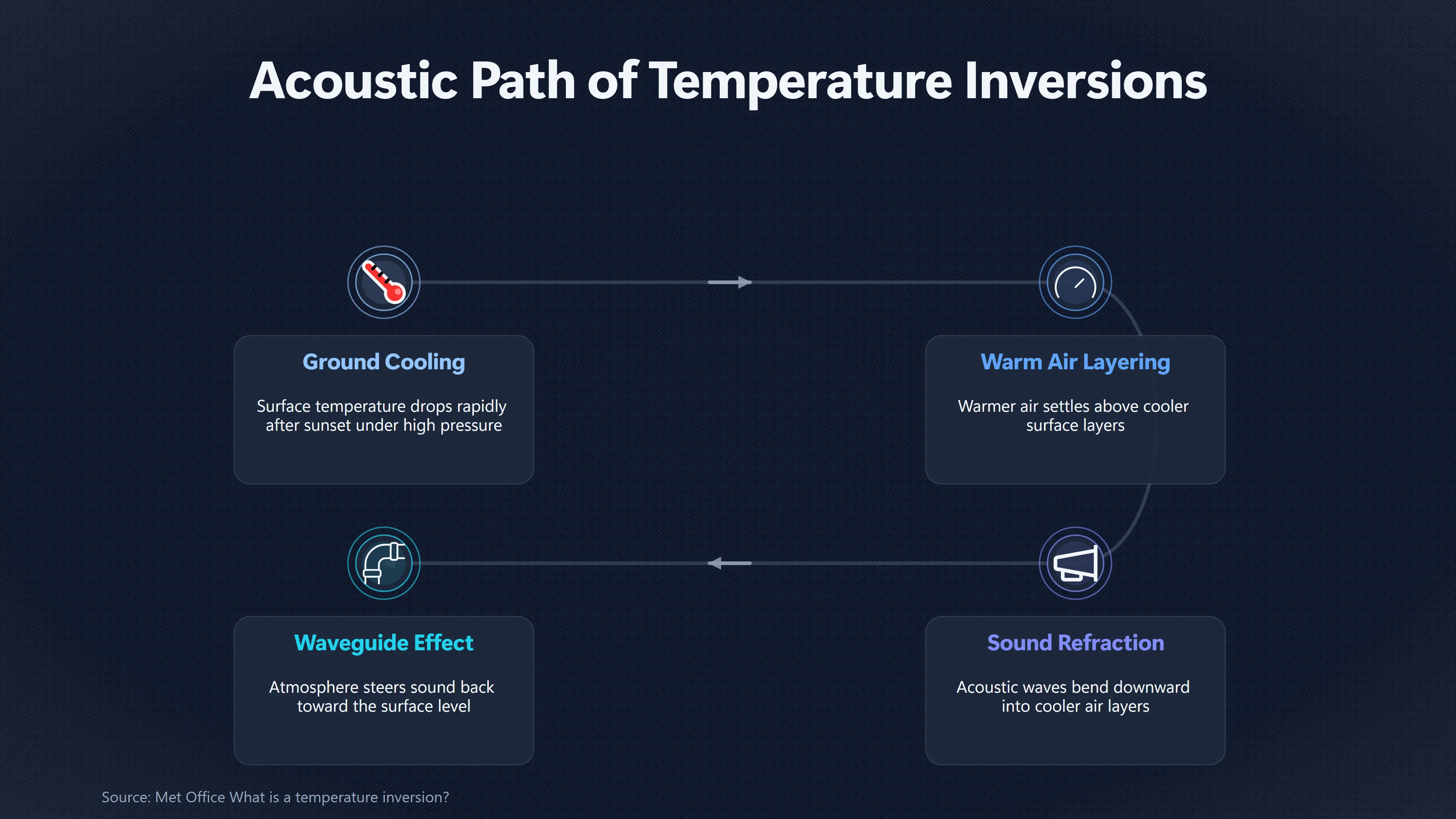
A temperature inversion occurs when air becomes warmer with height instead of cooler. These conditions commonly develop during calm, clear or lightly overcast nights under high pressure, especially after the ground has cooled rapidly following sunset.[Met Office]weather.metoffice.gov.ukMet Office What is a temperature inversion?Met OfficeWhat is a temperature inversion? - Met Office…
From an acoustic perspective, inversions matter because sound travels slightly faster through warmer air than colder air. As sound moves upward into progressively warmer layers, its path bends back towards the cooler air near the ground. Rather than dispersing into the atmosphere, the sound is refracted downwards, allowing it to travel much greater distances than expected.[ScienceDirect]sciencedirect.comMeteorological and ground effects on the propagation of aircraft noise close to the Earth's surface - ScienceDirect…
In practical terms, this means:
- Aircraft cruising many kilometres away may sound surprisingly close.
- Motorways, railways or industrial sites normally hidden by distance become clearly audible.
- Low-frequency engine noise often carries farther than higher-pitched sounds.
- Listeners may perceive the sound as moving overhead even though the source never passed nearby.
The atmosphere effectively becomes a natural waveguide, repeatedly steering sound back towards the surface instead of allowing it to disperse upward.
Importantly, the strongest audible effect often comes from the combination of several mechanisms—including atmospheric refraction, wind structure and interactions with the ground surface—rather than from the inversion acting alone. Long-standing acoustic research has shown that these combined effects explain many reports of unexpectedly strong aircraft noise over large distances.[ScienceDirect]sciencedirect.comMeteorological and ground effects on the propagation of aircraft noise close to the Earth's surface - ScienceDirect…

Why Quiet Night Air Makes Distant Engines Stand Out
Weather affects not only how sound propagates but also how easily it is noticed.
At night:
- Road traffic usually decreases.
- Birds and insects are often quieter.
- Human activity declines.
- Wind speeds frequently weaken near the surface.
With less competing background noise, sounds that would be ignored during the day become obvious. A distant aircraft that would normally blend into daytime ambient noise may become the loudest sound in the environment.
This change in perception is significant during UFO reports. Witnesses frequently describe a low hum or steady roar accompanying an unseen object. In many cases, the weather has simply increased the contrast between a distant mechanical source and an unusually quiet environment rather than creating a new sound.[Met Office]weather.metoffice.gov.ukMet Office What is a temperature inversion?Met OfficeWhat is a temperature inversion? - Met Office…
Why Sound Direction Can Be So Misleading
Humans locate sound best when it arrives directly from a nearby source. Long-distance propagation under unusual weather conditions degrades those directional cues.
Several factors contribute:
- Multiple arrival paths: Direct and reflected sound reach the listener from different angles.
- Low-frequency dominance: Bass sounds are naturally harder to localise than higher frequencies.
- Lack of visual confirmation: At night or beneath cloud, the brain cannot verify the source visually.
- Changing wind and atmospheric layers: Slight changes in atmospheric structure alter the apparent direction over time.
These effects can produce the convincing impression that an invisible object is hovering overhead even when the true source is several kilometres away.

Which Weather Records Matter Most
When investigating an unusual overhead sound, historical weather data are often as useful as flight information.
The most relevant records include:
- Cloud base and cloud cover: Extensive low cloud increases the likelihood of reflected sound.
- Surface wind speed and direction: Calm conditions reduce masking noise, while winds can channel sound towards or away from the observer.
- Temperature profile: Evidence of an overnight inversion strongly supports enhanced long-distance sound propagation.
- Fog or mist: These often accompany stable air masses in which inversions develop, although the fog itself is not the primary reason sound carries farther.[Met Office]weather.metoffice.gov.ukMet Office What is a temperature inversion?Met OfficeWhat is a temperature inversion? - Met Office…
Many national meteorological services archive hourly observations that include cloud cover, wind, temperature and pressure, allowing investigators to reconstruct the acoustic environment at the time of a report.
Interpreting UFO Noise Reports in Context
Weather-related sound relocation does not prove that every unusual overhead noise has an ordinary explanation. It does, however, demonstrate that atmospheric conditions can substantially alter both the loudness and apparent direction of familiar mechanical sounds.
When a UFO report consists mainly of an unexplained humming, roaring or engine-like sound without a clearly observed object, checking cloud cover, wind conditions and evidence of a temperature inversion is a practical first step. If those conditions were present, distant aircraft or industrial activity become considerably more plausible explanations than they would under clear, turbulent daytime skies. Recognising how low cloud and stable night air reshape the acoustic landscape helps avoid mistaking ordinary sources for unexplained overhead phenomena.[metoffice.gov.uk]weather.metoffice.gov.ukMet Office What is a temperature inversion?Met OfficeWhat is a temperature inversion? - Met Office…
Amazon book picks
Further Reading
Books and field guides related to Why Distant Noise Can Sound Directly Overhead. Use these as the next step if you want deeper reading beyond the article.
The Science of Sound
Written for students without a background in mathematics or physics, this textbook provides an introduction to the study of acoustics. It...
Fundamentals of Acoustics
Dargestellt werden die physikalischen und mathematischen Konzepte zur Beschreibung der Erzeugung, Weiterleitung und Wahrnehmung von Schal...
Environmental Noise Pollution
Environmental Noise Pollution, Second Edition, addresses the key debates surrounding environmental noise pollution, its modelling and mit...
Acoustics in Moving Inhomogeneous Media
This is the first book to offer a complete and rigorous study of sound propagation and scattering in moving media that have regular and r...
eBay marketplace picks
Marketplace Samples
Example marketplace items related to this page. Use the search link to explore similar finds on eBay.
Selected fromUFO decal oneBay.co.uk.

Current eBay listing
Alien UFO Glow In The Dark Sticker (Small) - Peel and Stick!

Endnotes
1.
Source: sciencedirect.com
Link:https://www.sciencedirect.com/science/article/pii/S0022460X78800339
Source snippet
Meteorological and ground effects on the propagation of aircraft noise close to the Earth's surface - ScienceDirect...
2.
Source: sciencedirect.com
Link:https://www.sciencedirect.com/science/article/abs/pii/S0022460X78800339
3.
Source: weather.metoffice.gov.uk
Title: Met Office What is a temperature inversion?
Link:https://weather.metoffice.gov.uk/learn-about/weather/types-of-weather/temperature/temperature-inversion
Source snippet
Met OfficeWhat is a temperature inversion? - Met Office...
4.
Source: faa.gov
Title: Aircraft Noise | Federal Aviation Administration
Link:https://www.faa.gov/noise/aircraft_noise
Source snippet
January 31, 2025 — AIRCRAFT NOISE Who to contact about noise complaints TOPICS ON THIS PAGE * Aircraft and airport noise programs * High...
Published: January 31, 2025
5.
Source: metoffice.gov.uk
Title: Deep Dive: High-pressure, dry air and meteor showers
Link:https://www.metoffice.gov.uk/blog/2026/met-office-deep-dive-for-april-22
Source snippet
Met OfficeApril 22, 2026 — Image: meteorcanva DEEP DIVE: HIGH-PRESSURE, DRY AIR AND METEOR SHOWERS Author: Met Office Wed 22 Apr 2026 Hig...
Published: April 22, 2026
6.
Source: metoffice.gov.uk
Title: Aerodrome Weather Warnings
Link:https://www.metoffice.gov.uk/services/transport/aviation/regulated/training-resources-for-aviation/aerodrome-warnings
Source snippet
Met Office...
7.
Source: oceanservice.noaa.gov
Link:https://oceanservice.noaa.gov/facts/sound.html?platform=hootsuite
Source snippet
THE DISTANCE THAT SOUND TRAVELS IN THE OCEAN VARIES GREATLY, DEPENDING PRIMARILY UPON WATER TEMPERATURE AND PRESSURE. Image: short captio...
8.
Source: blog.metservice.com
Link:https://blog.metservice.com/Inversions
9.
Source: metoffice.gov.uk
Title: What is ‘feels like’ temperature?
Link:https://www.metoffice.gov.uk/blog/2012/what-is-feels-like-temperature
10.
Source: metoffice.gov.uk
Title: Low Level Forecasts
Link:https://www.metoffice.gov.uk/services/transport/aviation/regulated/training-resources-for-aviation/low-level-forecasts
11.
Source: weather.metoffice.gov.uk
Title: metoffice.gov.uk What are Lee Waves?
Link:https://weather.metoffice.gov.uk/learn-about/weather/types-of-weather/wind/lee-waves
12.
Source: weather.metoffice.gov.uk
Title: metoffice.gov.uk What is fog?
Link:https://weather.metoffice.gov.uk/learn-about/weather/types-of-weather/fog
13.
Source: metoffice.gov.uk
Title: Satellite sounding of the atmosphere
Link:https://www.metoffice.gov.uk/research/weather/satellite-and-surface-assimilation/satellite-sounding-of-the-atmosphere
14.
Source: weather.metoffice.gov.uk
Title: metoffice.gov.uk Foehn effect
Link:https://weather.metoffice.gov.uk/learn-about/weather/types-of-weather/wind/foehn-effect
15.
Source: weather.metoffice.gov.uk
Title: metoffice.gov.uk Unusual cloud formations
Link:https://weather.metoffice.gov.uk/learn-about/weather/types-of-weather/clouds/unusual-cloud-formations
16.
Source: weather.metoffice.gov.uk
Title: metoffice.gov.uk Clouds
Link:https://weather.metoffice.gov.uk/learn-about/weather/types-of-weather/clouds
Additional References
17.
Source: faa.gov
Title: Fundamentals of Noise and Sound | Federal Aviation Administration
Link:https://www.faa.gov/noise/aviation_noise/fundamentals_of_noise
Source snippet
July 22, 2022 — FUNDAMENTALS OF NOISE AND SOUND * Using the Day-Night Average Sound Level * Comparative Noise Levels * Annoyance Due to N...
Published: July 22, 2022
18.
Source: youtube.com
Title: What is a Temperature Inversion?
Link:https://www.youtube.com/watch?v=jTrZZvnIHl8
Source snippet
This selection of videos directly addresses the physics behind temperature inversions and atmospheric refraction, explaining how low clou...
19.
Source: faa.gov
Link:https://www.faa.gov/noise/aviation_noise/community_response
Source snippet
Community Response to Noise | Federal Aviation AdministrationJuly 22, 2022 — COMMUNITY RESPONSE TO NOISE * Introduction * Using the day-n...
Published: July 22, 2022
20.
Source: youtube.com
Title: Reflection and Refraction of Sound | Edexcel IGCSE Physics Revision
Link:https://www.youtube.com/watch?v=cDxFsEVb16U
Source snippet
What is a Temperature Inversion? - For Student Pilots...
21.
Source: faa.gov
Link:https://www.faa.gov/faq/what-dnl-and-why-does-faa-use-it
22.
Source: youtube.com
Title: ACOUSTICS: Refraction and Temperature Inversion
Link:https://www.youtube.com/watch?v=LkFQg1zhi2o
Source snippet
Reflection and Refraction of Sound | Edexcel IGCSE Physics Revision...
23.
Source: mdpi.com
Link:https://www.mdpi.com/2073-4433/12/11/1424
24.
Source: eprintspublications.npl.co.uk
Link:https://eprintspublications.npl.co.uk/90/
25.
Source: faa.gov
Title: Fundamentals of Noise and Sound | Federal Aviation Administration
Link:https://www.faa.gov/regulations_policies/policy_guidance/noise/basics
26.
Source: nesdis.noaa.gov
Title: new satellite instruments provide step detecting low clouds
Link:https://www.nesdis.noaa.gov/news/new-satellite-instruments-provide-step-detecting-low-clouds