Within Record It
Do Not Let Sharing Ruin Your Best Evidence
Backing up untouched recordings protects metadata and audio quality that social platforms may remove through compression.
On this page
- Saving the original media and metadata
- Creating backups before editing or uploading
- Understanding compression and quality loss
Page outline Jump by section
Introduction
If you record an unexplained sky sound that you think may be significant, the most important file is the one your recording device created—not the version you later upload to a social media platform. Online sharing is useful for finding other witnesses, but many services automatically compress audio and video, alter file formats, reduce resolution, or remove metadata. These changes can make later analysis more difficult and may prevent others from verifying when, where and how the recording was made. For anyone documenting unusual aerial sounds, preserving the untouched original should therefore be treated as a basic evidence-preservation step rather than an afterthought. NASA’s independent study of unidentified anomalous phenomena (UAP) similarly emphasised that complete sensor data and metadata are essential because missing contextual information greatly limits scientific evaluation.[nist.gov]nist.govdigital and multimedia evidenceSeptember 13, 2013…
Save the Original Before You Share Anything
The safest approach is simple: never let your first upload become your only copy.
As soon as practical after making the recording:
- Leave the original file exactly as your device created it.
- Copy it to another location before editing, trimming or uploading.
- Keep the original filename if possible.
- Avoid opening the file in applications that automatically re-encode media on export.
- Store at least two copies on different devices or storage media.
This preserves both the media itself and the information embedded within it. Depending on the device, metadata may include the recording time, file creation details, device model, GPS location (if enabled), recording settings and other technical information that can help reconstruct the circumstances of the event. Apple, for example, notes that original photo and video files may include metadata such as date, time, location and device information, while also providing options to preserve or alter that information during sharing.[Apple Support]support.apple.comSupport Share photos and videos on i PhoneApple SupportShare photos and videos on iPhone - Apple Support (IE)…
Why Social Media Copies Are Usually Poor Evidence
A recording that sounds convincing online may be much less useful for technical review than the original stored on your phone or recorder.
Most major sharing platforms optimise uploaded media for storage and streaming efficiency. Depending on the service, this may involve:
- Lowering audio or video bitrates.
- Changing the codec or container format.
- Reducing image or video resolution.
- Recompressing the file, introducing new artefacts.
- Removing or rewriting metadata.
- Renaming the file.
Research examining major photo-sharing platforms has shown that uploaded images are routinely transformed, with changes extending beyond visible quality to filenames and other digital characteristics. Such processing is valuable for platform efficiency but makes downloaded copies less representative of the original recording.[arXiv]arxiv.orgPractical Analyses of How Common Social Media Platforms and Photo Storage Services Handle Uploaded ImagesFebruary 23, 2023…
For an unexplained sky sound, even subtle changes matter. Compression can soften faint background noises, alter frequency content or introduce artefacts that complicate later spectral analysis. Likewise, stripped metadata may remove information needed to compare independent recordings from different witnesses.
Create Backups Before Any Editing
Many people instinctively trim silence, increase volume or apply noise reduction before sharing. While these edits may make the recording easier to hear casually, they permanently change the evidence unless the original has already been preserved.
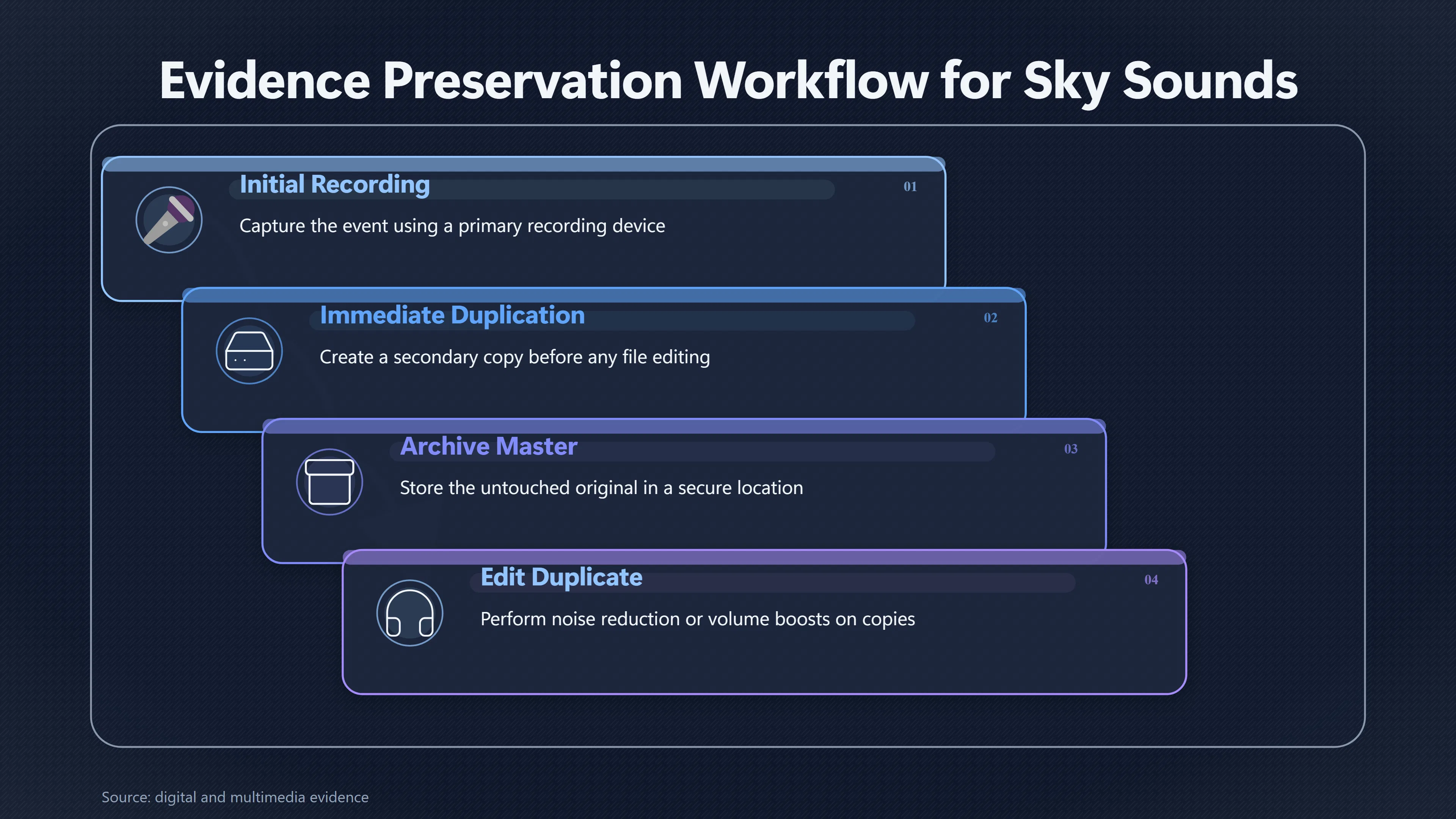
A practical workflow is:
- Record the event.
- Immediately duplicate the file.
- Archive the untouched original.
- Perform any editing only on the duplicate.
- Clearly label edited versions.
Using descriptive filenames such as:
Original_2026-07-31_2148.wavEdited_NoiseBoost_v1.wav
helps prevent accidentally overwriting the source recording.
This approach mirrors established digital evidence practice, where preserving an unmodified original allows later reviewers to distinguish between observed data and subsequent processing. NIST’s work on digital and multimedia evidence likewise emphasises the importance of maintaining original digital material for reliable forensic examination.[nist.gov]nist.govdigital and multimedia evidenceSeptember 13, 2013…
Preserve Metadata Whenever Possible
Metadata is often invisible to the user but can be highly valuable during later review.
Depending on the recording device, useful metadata may include:
- Date and time of recording.
- Device model.
- Recording format and sample rate.
- GPS coordinates (if enabled).
- Orientation and other sensor information.
- Original filename and creation timestamp.
If you intentionally remove location information before publishing publicly for privacy reasons, retain a private copy containing the complete metadata. That way, you can still provide the original file to researchers or investigators if needed without exposing personal information online.
Some platforms and sharing methods preserve more original information than others. Apple, for instance, allows users in certain sharing workflows to send the original media with edit history and metadata instead of a converted version, although this depends on the chosen sharing option.[Apple Support]support.apple.comSupport Share photos and videos on i PhoneApple SupportShare photos and videos on iPhone - Apple Support (IE)…

Share Copies, Not the Master File
Think of the original recording as a master archive.
For public discussion, create a separate sharing copy. This allows you to:
- Reduce file size for easier uploading.
- Blur personal information if necessary.
- Trim irrelevant sections without affecting the archive.
- Add captions or annotations.
- Normalise playback volume for listeners.
If someone later requests the original for detailed analysis, you still have the untouched source available.
This distinction is especially important if multiple investigators independently examine the recording. Everyone can compare their analyses against the same unaltered file instead of different edited versions.
A Small Habit That Can Preserve Your Best Evidence
Most recordings of unusual sky sounds ultimately have ordinary explanations, ranging from aircraft and weather to industrial activity. Regardless of the outcome, preserving the original recording ensures that any investigation begins with the highest-quality evidence available.
Uploading to social media should therefore be viewed as the final step in documentation rather than the first. By keeping an untouched master copy, making secure backups before editing, and understanding that online platforms frequently recompress media and alter metadata, you maximise the chances that your recording can be assessed fairly and accurately if questions arise later.[arxiv.org]arxiv.orgPractical Analyses of How Common Social Media Platforms and Photo Storage Services Handle Uploaded ImagesFebruary 23, 2023…
Amazon book picks
Further Reading
Books and field guides related to Do Not Let Sharing Ruin Your Best Evidence. Use these as the next step if you want deeper reading beyond the article.
Digital Evidence and Computer Crime
Though an increasing number of criminals are using computers and computer networks, few investigators are well versed in the issues relat...
File System Forensic Analysis
The Definitive Guide to File System Analysis: Key Concepts and Hands-on Techniques Most digital evidence is stored within the computer's...
The Location Sound Bible
Written by a seasoned professional, Viers explains how to achieve Hollywood-quality sound that will make productions stand out from the r...
Audio Postproduction for Film and Video
New to this edition: * Learn how many Hollywood techniques--previously impractical on video--can help solve problems on smaller productio...
eBay marketplace picks
Marketplace Samples
Live-tested eBay searches with available results related to this page.
Selected fromUFO poster oneBay.co.uk.



Current eBay listing
VINTAGE UFO FLYING SAUCERS COMIC ADVERTISING A2 POSTER PRINT

Current eBay listing
I Want To Believe UFO Poster Giclée Fine Art Heavyweight Print
Endnotes
1.
Source: nist.gov
Title: digital and multimedia evidence
Link:https://www.nist.gov/forensic-science/digital-and-multimedia-evidence
Source snippet
September 13, 2013...
Published: September 13, 2013
2.
Source: support.apple.com
Title: Support Share photos and videos on i Phone
Link:https://support.apple.com/en-ie/guide/iphone/iphf28f17237/ios
Source snippet
Apple SupportShare photos and videos on iPhone - Apple Support (IE)...
3.
Source: developer.apple.com
Title: Developermedia Metadata | Apple Developer Documentation
Link:https://developer.apple.com/documentation/uikit/uiimagepickercontroller/infokey/mediametadata
Source snippet
Apple DevelopermediaMetadata | Apple Developer Documentation...
4.
Source: arxiv.org
Link:https://arxiv.org/abs/2302.12133
Source snippet
Practical Analyses of How Common Social Media Platforms and Photo Storage Services Handle Uploaded ImagesFebruary 23, 2023...
Published: February 23, 2023
5.
Source: arxiv.org
Title: arXiv Reducing Storage in Large-Scale Photo Sharing Services using Recompression
Link:https://arxiv.org/abs/1912.11145
6.
Source: nist.gov
Title: Digital Video Exchange Standards | NIST
Link:https://www.nist.gov/programs-projects/digital-video-exchange-standards
7.
Source: developer.apple.com
Title: Developerlive Photo Movie Metadata | Apple Developer Documentation
Link:https://developer.apple.com/documentation/avfoundation/avcapturephotosettings/livephotomoviemetadata
Source snippet
Apple DeveloperlivePhotoMovieMetadata | Apple Developer Documentation...
8.
Source: spdf.gsfc.nasa.gov
Title: filenaming recommendations
Link:https://spdf.gsfc.nasa.gov/guidelines/filenaming_recommendations.html
Source snippet
RecommendationsJuly 22, 2026 — RECOMMENDED FILE AND DATA COLLECTION NAMING PRACTICES SUMMARY Use data file and directory names that expre...
Published: July 22, 2026
9.
Source: nasa.gov
Link:https://www.nasa.gov/nasa-brand-center/images-and-media/
Source snippet
Guidelines for using NASA Images and Media GuidelinesJune 23, 2026 — NASA Brand and Collaborations The NASA Insignia, Logotype, identifie...
Published: June 23, 2026
10.
Source: nasa.gov
Title: NAS A Digital and Social Media Policy
Link:https://www.nasa.gov/reference/nasa-digital-and-social-media-policy/
Source snippet
NASA Digital and Social Media Policy - NASAJune 8, 2026 — CONTENTS * Social Media Commenting Policy * Privacy on NASA Social Media Channe...
Published: June 8, 2026
11.
Source: nasa.gov
Title: NAS A Policy on the Release of Information to News and Information Media
Link:https://www.nasa.gov/reference/nasa-policy-on-the-release-of-information-to-news-and-information-media/
Published: December 31, 2025
12.
Source: nasa.gov
Title: Photography and Public Affairs
Link:https://www.nasa.gov/arc-event-photography-and-public-affairs/
Published: August 14, 2025
13.
Source: nasa.gov
Title: Submit a Photo/Video to NASA
Link:https://www.nasa.gov/forms/submit-a-photo-video-to-nasa/
Published: January 3, 2025
14.
Source: standards.nasa.gov
Link:https://standards.nasa.gov/node/233
Published: November 19, 2024
15.
Source: science.nasa.gov
Title: raw images faq
Link:https://science.nasa.gov/solar-system/multimedia/raw-images-faq/
Published: November 2, 2024
16.
Source: nist.gov
Title: digital and multimedia evidence
Link:https://www.nist.gov/spo/forensic-science-program/forensic-science-research/digital-and-multimedia-evidence
Published: February 1, 2024
17.
Source: nist.gov
Title: digital evidence
Link:https://www.nist.gov/itl/ssd/software-quality-group/computer-forensics-tool-testing-program-cftt/digital-evidence
Published: September 28, 2022
18.
Source: nist.gov
Title: digital evidence preservation considerations evidence handlers
Link:https://www.nist.gov/publications/digital-evidence-preservation-considerations-evidence-handlers
Published: September 8, 2022
19.
Source: nist.gov
Title: user guide nist media forensic challenge mfc datasets
Link:https://www.nist.gov/publications/user-guide-nist-media-forensic-challenge-mfc-datasets
Published: July 6, 2021
20.
Source: discussions.apple.com
Link:https://discussions.apple.com/thread/252567608
Published: March 17, 2021
21.
Source: nist.gov
Link:https://www.nist.gov/publications/media-forensics-challenge-image-provenance-evaluation-and-state-art-analysis-large
Published: October 26, 2020
22.
Source: discussions.apple.com
Link:https://discussions.apple.com/thread/251500285
Published: June 22, 2020
23.
Source: developer-mdn.apple.com
Link:https://developer-mdn.apple.com/library/archive/documentation/NetworkingInternet/Conceptual/StreamingMediaGuide/UsingHTTPLiveStreaming/UsingHTTPLiveStreaming.html
Published: March 1, 2016
24.
Source: nodis3.gsfc.nasa.gov
Link:https://nodis3.gsfc.nasa.gov/displayDir.cfm?Internal_ID=N_PR_1441001E&page_name=Chapter1
Published: January 29, 2015
25.
Source: nodis3.gsfc.nasa.gov
Link:https://nodis3.gsfc.nasa.gov/displayDir.cfm?Internal_ID=N_PR_1441001E&page_name=Chapter5
Published: January 29, 2015
26.
Source: nodis3.gsfc.nasa.gov
Link:https://nodis3.gsfc.nasa.gov/displayDir.cfm?Internal_ID=N_PR_1441001E&page_name=main
Published: January 29, 2015
27.
Source: developer.apple.com
Title: live photos
Link:https://developer.apple.com/design/human-interface-guidelines/live-photos/
28.
Source: developer.apple.com
Link:https://developer.apple.com/documentation/avfoundation/avcapturephotosettings/livephotomoviemetadata?language=objc
29.
Source: developer.apple.com
Link:https://developer.apple.com/documentation/uikit/uiimagepickercontroller/infokey/livephoto
30.
Source: developer.apple.com
Link:https://developer.apple.com/documentation/uikit/uiimagepickercontroller/infokey/livephoto?changes=_1
31.
Source: developer.apple.com
Link:https://developer.apple.com/documentation/uikit/uiimagepickercontroller/infokey/livephoto?changes=_5&language=objc
32.
Source: cfreds.nist.gov
Link:https://cfreds.nist.gov/
33.
Source: lsda.jsc.nasa.gov
Link:https://lsda.jsc.nasa.gov/explore/lsdahome/datasubmit
Additional References
34.
Source: loc.gov
Link:https://www.loc.gov/preservation/digital/formats/fdd/fdd000525.shtml
Published: May 22, 2024
35.
Source: gowin.tools
Title: do social platforms strip metadata
Link:https://gowin.tools/blog/do-social-platforms-strip-metadata/
36.
Source: magnetforensics.com
Title: Getting to the
Source: Understanding metadata removal on social media
Link:https://www.magnetforensics.com/blog/getting-to-the-source-understanding-metadata-removal-on-social-media/
Published: January 2, 2024
37.
Source: curate.nd.edu
Title: Exploring iOS Metadata Manipulation in Digital Forensics
Link:https://curate.nd.edu/articles/journal_contribution/Exploring_iOS_Metadata_Manipulation_in_Digital_Forensics/24824241
Published: October 6, 2022
38.
Source: sciencedirect.com
Title: Forensic analysis of video file formats
Link:https://www.sciencedirect.com/science/article/pii/S1742287614000140
Published: May 1, 2014