Within Sound Travel
Why Visible Aircraft Suddenly Become Quiet
Changing winds can make a visible aircraft fade, return or seem to switch its engine off without any change in the aircraft itself.
On this page
- How wind bends sound upwind and downwind
- Why nearby witnesses may hear different loudness
- How to recognise a moving acoustic shadow
Page outline Jump by section
Introduction
A visible aircraft can sometimes become unexpectedly quiet even though it continues flying normally and remains in clear view. To an observer, the engine noise may seem to fade away, return a few moments later, or even appear as though the engines have briefly shut down. In many cases, this is not a change in the aircraft at all but an example of a wind-driven acoustic shadow—a region where atmospheric conditions bend sound away from listeners on the ground. This phenomenon is a well-established aspect of outdoor acoustics and helps explain some reports of unusual or puzzling “UFO noises” in which a visible aircraft does not appear to match the sounds being heard.[MDPI]mdpi.comSound Propagation Modelling for Manned and Unmanned Aircraft Noise Assessment and Mitigation: A ReviewOctober 28, 2021…
How wind bends sound upwind and downwind
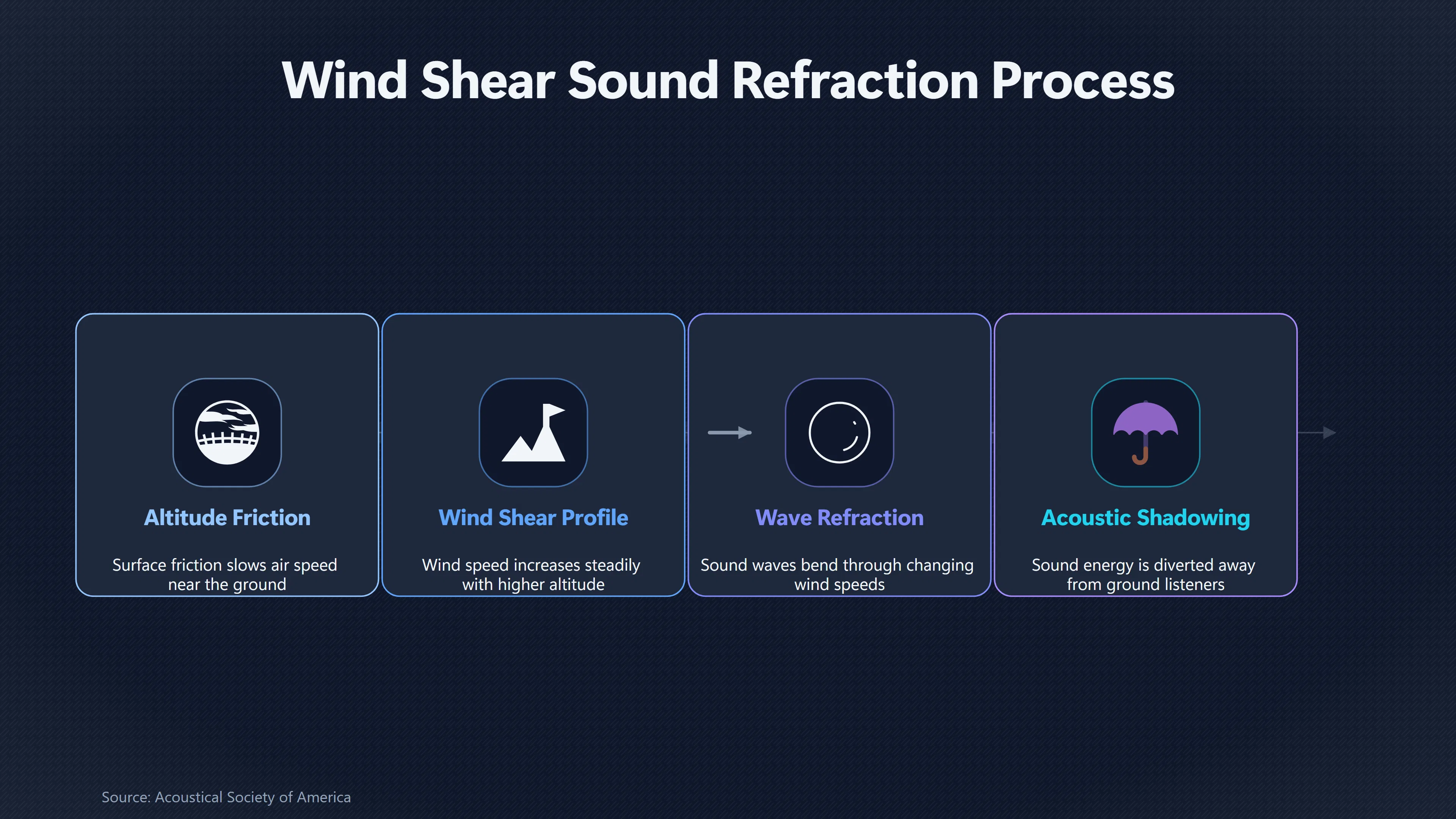
The key factor is not simply the wind at ground level but how wind speed changes with height, a property known as wind shear. In the lower atmosphere, wind usually becomes stronger with altitude because surface friction slows the air close to the ground.
Since sound travels through moving air, this changing wind profile alters the effective speed of sound at different heights. Rather than travelling in straight lines, sound waves gradually bend, or refract, as they move through these changing conditions.
The result is asymmetric sound propagation:
- Downwind, sound rays tend to bend back towards the ground, making aircraft seem louder and audible over greater distances.
- Upwind, the same sound bends upward, away from listeners, creating an acoustic shadow where much less sound reaches the surface.
- The aircraft itself is unaffected; only the path taken by its sound changes.[mdpi.com]mdpi.comSound Propagation Modelling for Manned and Unmanned Aircraft Noise Assessment and Mitigation: A ReviewOctober 28, 2021…
This behaviour explains why people standing on opposite sides of the same flight path can report dramatically different loudness from an aircraft that is equally visible to both.
Why a visible aircraft can suddenly become quiet
An acoustic shadow is not an all-or-nothing effect. Instead, it is usually a region where sound energy reaching the ground is substantially reduced.
As an aircraft moves, or as the atmosphere slowly changes, a listener may pass into or out of this shadow. The experience can include:
- engine noise fading over several seconds;
- apparent silence while the aircraft remains visible;
- sound returning unexpectedly without any visible change in the aircraft;
- the impression that the engine has restarted.
These observations can feel counter-intuitive because people naturally expect seeing and hearing an aircraft to remain closely linked. In reality, light travels essentially unaffected through the atmosphere, while sound is continuously refracted by changing wind and temperature profiles. The aircraft therefore remains visible even as much of its sound is diverted elsewhere.[MDPI]mdpi.comSound Propagation Modelling for Manned and Unmanned Aircraft Noise Assessment and Mitigation: A ReviewOctober 28, 2021…
Modern aircraft-noise prediction models used by researchers increasingly include realistic vertical wind profiles precisely because these atmospheric effects can noticeably change where noise reaches the ground. Simulations have shown that weather-related refraction can alter predicted aircraft noise levels by several decibels and produce distinct refractive shadow zones.[PubMed]pubmed.ncbi.nlm.nih.govToward inclusion of atmospheric effects in the aircraft community noise predictions - PubMed…

Why nearby witnesses may hear different loudness
One of the strongest pieces of evidence for wind-driven acoustic shadows is that nearby observers often disagree about how loud the same aircraft sounded.
The atmosphere is rarely uniform. Wind direction and speed can vary with height and across short horizontal distances. As a result, the boundary between illuminated and shadowed regions is often irregular rather than sharply defined.
Consequently:
- one witness may hear a loud engine rumble;
- another only a few hundred metres away may hear very little;
- a third may hear the sound disappear and then reappear.
This does not require different aircraft, equipment failures or unusual flight manoeuvres. It follows directly from the way refracted sound intersects the ground at different locations. Outdoor acoustics research has modelled these shadow regions for decades, demonstrating that wind and temperature gradients naturally produce areas of strong and weak sound reception.[ScienceDirect]sciencedirect.comThe acoustic shadow produced by wind speed and temperature gradients close to the ground - ScienceDirect…
How to recognise a moving acoustic shadow
Several features distinguish an atmospheric acoustic shadow from an actual change in the aircraft.
A moving acoustic shadow typically shows a combination of the following characteristics:
- The aircraft’s appearance remains steady. There is no visible reduction in speed, altitude or engine exhaust.
- The quiet period is gradual. Sound usually fades over seconds rather than stopping instantly.
- The effect is directional. Observers downwind often continue hearing the aircraft clearly while those upwind report much weaker sound.
- The sound returns naturally. As the aircraft or the refracted sound path changes, engine noise gradually becomes audible again.
- Different aircraft produce different experiences. Aircraft at different altitudes or headings can encounter different wind profiles, leading to varying amounts of refraction.
Because wind fields evolve continuously, the acoustic shadow itself can drift across the landscape. From a stationary observer’s perspective, it can feel as though an invisible quiet zone is moving through the area.
Why this matters when assessing unusual sky sounds
Reports associated with “UFO noises” sometimes describe a visible aircraft that appears impossibly quiet or seems to stop making noise altogether. By itself, this observation is not strong evidence of anything unusual.
Wind-driven acoustic shadows provide a physically understood explanation for several otherwise surprising perceptions:
- a visible aircraft producing little or no audible engine noise;
- engine sound appearing disconnected from the aircraft’s position;
- sudden changes in loudness despite smooth, level flight;
- conflicting witness descriptions from nearby locations.
These effects are especially plausible when atmospheric wind shear is present, because the atmosphere acts less like a transparent medium for sound and more like a shifting acoustic lens. Recognising this mechanism helps separate genuine mysteries from well-established behaviour of sound travelling through a changing atmosphere.[mdpi.com]mdpi.comSound Propagation Modelling for Manned and Unmanned Aircraft Noise Assessment and Mitigation: A ReviewOctober 28, 2021…
Amazon book picks
Further Reading
Books and field guides related to Why Visible Aircraft Suddenly Become Quiet. Use these as the next step if you want deeper reading beyond the article.
Fundamentals of Acoustics
Dargestellt werden die physikalischen und mathematischen Konzepte zur Beschreibung der Erzeugung, Weiterleitung und Wahrnehmung von Schal...
Predicting Outdoor Sound
Predicting Outdoor Sound provides a scholarly yet practical examination of the phenomena that affect outdoor sound close to the ground an...
Engineering Noise Control: Theory and Practice
The practice of engineering noise control demands a solid understanding of the fundamentals of acoustics, the practical application of cu...
Foundations of Engineering Acoustics
Foundations of Engineering Acoustics takes the reader on a journey from a qualitative introduction to the physical nature of sound, expla...
eBay marketplace picks
Marketplace Samples
Live-tested eBay searches with available results related to this page.
Selected fromaviation weather poster oneBay.co.uk.

Endnotes
1.
Source: mdpi.com
Link:https://www.mdpi.com/2073-4433/12/11/1424
Source snippet
Sound Propagation Modelling for Manned and Unmanned Aircraft Noise Assessment and Mitigation: A ReviewOctober 28, 2021...
Published: October 28, 2021
2.
Source: sciencedirect.com
Link:https://www.sciencedirect.com/science/article/pii/0003682X89900637
Source snippet
The acoustic shadow produced by wind speed and temperature gradients close to the ground - ScienceDirect...
3.
Source: sciencedirect.com
Link:https://www.sciencedirect.com/science/article/pii/S0360132318307327
4.
Source: acoustics.org
Title: Acoustical Society of America
Link:https://acoustics.org/pressroom/httpdocs/161st/Ovenden.html
5.
Source: sciencedirect.com
Link:https://www.sciencedirect.com/science/article/pii/S0022460X78800339
6.
Source: sciencedirect.com
Link:https://www.sciencedirect.com/science/article/abs/pii/S0022460X78800339
7.
Source: sciencedirect.com
Link:https://www.sciencedirect.com/science/article/abs/pii/0003682X89900637
8.
Source: sciencedirect.com
Title: Geometrical Acoustic
Link:https://www.sciencedirect.com/topics/earth-and-planetary-sciences/geometrical-acoustic
9.
Source: sciencedirect.com
Link:https://www.sciencedirect.com/science/article/pii/0003682X9190068P
10.
Source: pubmed.ncbi.nlm.nih.gov
Link:https://pubmed.ncbi.nlm.nih.gov/34470331/
Source snippet
Toward inclusion of atmospheric effects in the aircraft community noise predictions - PubMed...
11.
Source: pmc.ncbi.nlm.nih.gov
Link:https://pmc.ncbi.nlm.nih.gov/articles/PMC10066215/
Source snippet
difficulty of upwind shouting is a misconception explained by convective attenuation effect - PMCMarch 31, 2023 — INTRODUCTION In common...
Published: March 31, 2023
12.
Source: trid.trb.org
Link:https://trid.trb.org/View/2296722
Additional References
13.
Source: researchgate.net
Link:https://www.researchgate.net/publication/355923857_Sound_Propagation_Modelling_for_Manned_and_Unmanned_Aircraft_Noise_Assessment_and_Mitigation_A_Review
Source snippet
October 28, 2021 — H: Height above sea-level; dc dH = λ c 0 2 T 0: The gradient of the speed of sound, where T 0 is the sea-level temper...
Published: October 28, 2021
14.
Source: khazna.ku.ac.ae
Link:https://khazna.ku.ac.ae/en/publications/sound-propagation-modelling-for-manned-and-unmanned-aircraft-nois/
Source snippet
propagation modelling for manned and unmanned aircraft noise assessment and mitigation: A review - Khalifa UniversityNovember 1, 2021 — S...
Published: November 1, 2021
15.
Source: research.tudelft.nl
Link:https://research.tudelft.nl/en/publications/toward-inclusion-of-atmospheric-effects-in-the-aircraft-community/
Source snippet
TU Delft Research PortalToward inclusion of atmospheric effects in the aircraft community noise predictions - TU Delft Research Portal...
16.
Source: degruyterbrill.com
Title: Basics of meteorology for outdoor sound propagation and r
Link:https://www.degruyterbrill.com/document/doi/10.1515/noise-2024-0006/html?lang=en
Source snippet
Your documents are now available to view. Article Open Access Image: Cite this Cite this BASICS OF METEOROLOGY FOR OUTDOOR SOUND PROPAGAT...
17.
Source: youtube.com
Title: Noise Pollution L-7: Outdoor Sound Propagation | Environmental Science | UGC NET
Link:https://www.youtube.com/watch?v=PV8dF4ceNyc
Source snippet
Sound refraction wind acoustic shadow Conceptual Physics: Refraction of Sound Marshall Ellenstein...
18.
Source: youtube.com
Title: Aircraft flyover auralization using Atmospheric Ray Tracing
Link:https://www.youtube.com/watch?v=U0haSITYkgk
Source snippet
Lecture 28: Meteorological Conditions and Sound Propagation...
19.
Source: youtube.com
Title: Blue Sky Science: How do temperature and wind affect traffic noise?
Link:https://www.youtube.com/watch?v=RozhxuRidr8
Source snippet
Noise Pollution L-7: Outdoor Sound Propagation | Environmental Science | UGC NET...
20.
Source: faa.gov
Link:https://www.faa.gov/contrails
Source snippet
Federal Aviation AdministrationJuly 21, 2025 — CONTRAILS Embedded Media The Federal Aviation Administration (FAA) has established this we...
Published: July 21, 2025
21.
Source: faa.gov
Link:https://www.faa.gov/air_traffic/publications/atpubs/aim_html/chap10_section_2.html
22.
Source: faa.gov
Link:https://www.faa.gov/Air_traffic/publications/atpubs/aim_html/chap7_section_4.html